Choose one connected region and time to enjoy it for a China road trip. A compact Yunnan route or trains with local road excursions suit a first visit. Compare western Sichuan for mountains, the Silk Road for a longer journey and Tibet through its required organised arrangements.
The day ranges below are planning allowances for a holiday, including arrival and rest time. Your chosen roads, vehicle arrangements and attraction access need to fit the actual dates.
Before a rural road day, use the China payment guide for Alipay and cash backups to prepare a supported wallet, a physical card and small RMB notes. Confirm each hotel or host’s accepted payment method and keep access to bank approvals.
A through journey from Southeast Asia to Central Asia needs more than a sightseeing road loop. The Laos–China–Kyrgyzstan overland framework shows the mainland connection through Kunming and Chengdu, the southern Xinjiang finish and the separate exit-port decisions.
Find your starting point: compare eight route families · choose by season · check driver and vehicle documents · choose a self-drive or private-driver trip.
Start with your available days, not a list of highways
Count arrival, departure, permit visits and collection before assigning sightseeing days. Mountain traffic, hotel changes and the return can consume more time than a short line on the country map suggests.
| Time available | A workable starting choice | What to leave out |
|---|---|---|
| 5–7 days | One small area: Dali–Shaxi–Lijiang, a Guangxi countryside stay, or a short grassland circuit. Use rail or a flight to the gateway. | A cross-province grand tour; a long drive immediately after an overnight flight. |
| 8–12 days | One regional road trip with several two-night bases. Choose northwest Yunnan, southern Yunnan, or a carefully shortened Sichuan route. | Combining rice terraces, rainforest, Meili and Lugu Lake in the same short loop. |
| 14–18 days | A westbound Silk Road journey, a fuller mountain itinerary or a region plus a separate rail-connected city. | A long one-way rental before the exact return branch accepts it. |
| Three weeks or more | A longer connection between regions, with driving and non-driving days designed separately. | Treating every free day as another distant stop. Keep recovery and disruption time. |
Use rail between Beijing, Xi’an, Chengdu and Shanghai when the cities are your main interest. Add a driver or short rental where villages, lakeshores and countryside stops reward it. Road travel need not mean keeping one car for the whole holiday.
Compare eight China road-trip families
Start with the scenery and pace you want, then check the driver, season and vehicle. The eight route families below offer different kinds of holiday; remoteness alone adds no value.
| Route family | Suggested holiday time | Why choose it? | Main decision before booking |
|---|---|---|---|
| Northwest Yunnan: Kunming–Dali–Shaxi–Lijiang | 8–12 days | Old towns, village stays and road sections between well-connected bases. | Whether to add Shangri-La; hotel parking and the final car return. |
| Southern Yunnan: Jianshui–Yuanyang–Pu’er–Jingmai–Jinghong | 10–14 days | Rice terraces, tea landscapes and a progression toward the tropical south. | Mountain-host bookings, weather flexibility and an accepted one-way return. |
| Western Sichuan | 8–14 days for one selected circuit | Mountain towns, valleys and plateau scenery. | Sleeping altitude, road experience and which remote stops to remove. |
| Xi’an–Gansu–Turpan–Urumqi | 14–18 days | A continuous westbound change from historic cities to desert and oasis landscapes. | Long-stage fatigue, rental operating area and the Urumqi return branch. |
| Qinghai–Gansu | 10–14 days | Plateau lakes and the Hexi Corridor in one regional journey. | Altitude and sparse stages; whether a driver or rail combination suits you better. |
| Xinjiang within one chosen subregion | 10–16 days | Grassland, mountain or oasis travel without trying to cover the entire region. | Seasonal road access and the permissions for the exact counties and attractions. |
| Inner Mongolia within one gateway area | 5–8 days | A grassland-and-desert stay with time outdoors. | Which local area, camps and activities operate on your dates; no driving on protected grassland. |
| Sichuan–Tibet / G318 | An individually planned longer expedition | A major organised plateau journey. | Tibet tourism arrangements, driving/vehicle permission, altitude and a compliant receiving operator. |
Yunnan: choose a direction and keep the route compact
Northwest Yunnan for old towns and a first regional road trip
In Yunnan, use a car for Shaxi, village stops and rural rooms beyond the Kunming, Dali and Lijiang gateways. An eight-to-twelve-day starting plan can give Dali and Lijiang two nights each, Shaxi one or two, plus arrival and vehicle collection.
Add Shangri-La when the group wants the highlands and has time to adapt to a higher overnight base. Meili is a further extension, not a quick extra viewpoint from Lijiang. For a shorter holiday, arrive by rail or air and begin the road portion in Dali or Lijiang. Confirm the exact parking entrance: an old-town hotel pin may lead to a pedestrian lane where neither the car nor large cases can go.
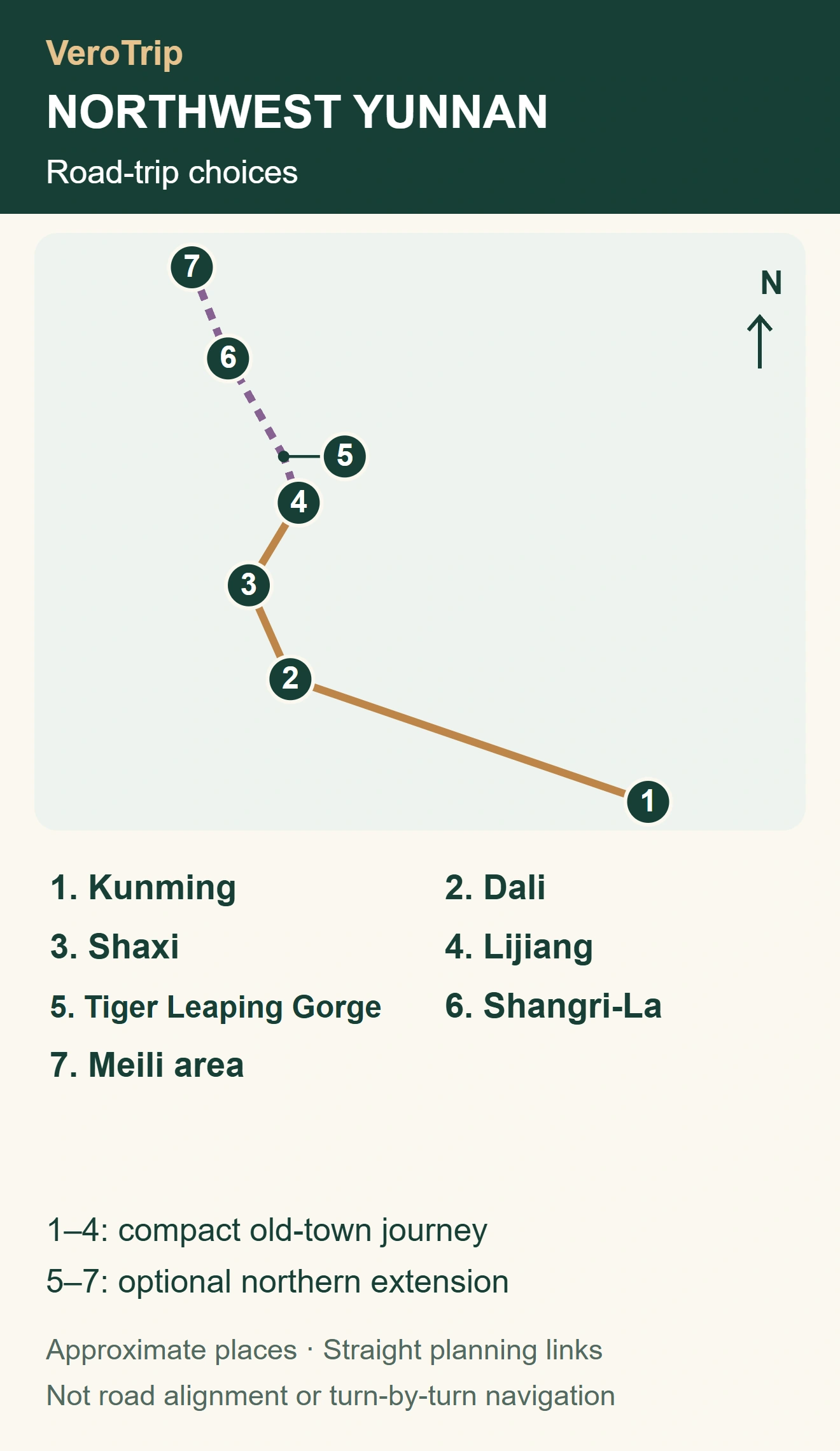
For a regional plan, compare western Yunnan road-trip choices and Dali, Tengchong and Nujiang. The western route is a different direction, not an add-on to every Dali–Lijiang journey. Travellers choosing a driver can compare the 8-day private Yunnan route; its fuller circuit has several transfer days.
Southern Yunnan for terraces, tea and rainforest
Choose a southbound journey if you want Jianshui, Yuanyang and the tea landscapes around Pu’er and Jingmai Mountain. Finish in Jinghong when transport and vehicle-return arrangements make that practical. Jingmai is a western detour within this journey; it is not the same stop as Pu’er city.
Allow time for terrace weather and a booked tea visit. A host’s name on a map does not establish an English-speaking appointment, meals or vehicle access. Ask for the meeting point and the last accessible parking place. If a tea-mountain stay is unavailable, use a confirmed town base and shorten the excursion instead of arriving late without a room.
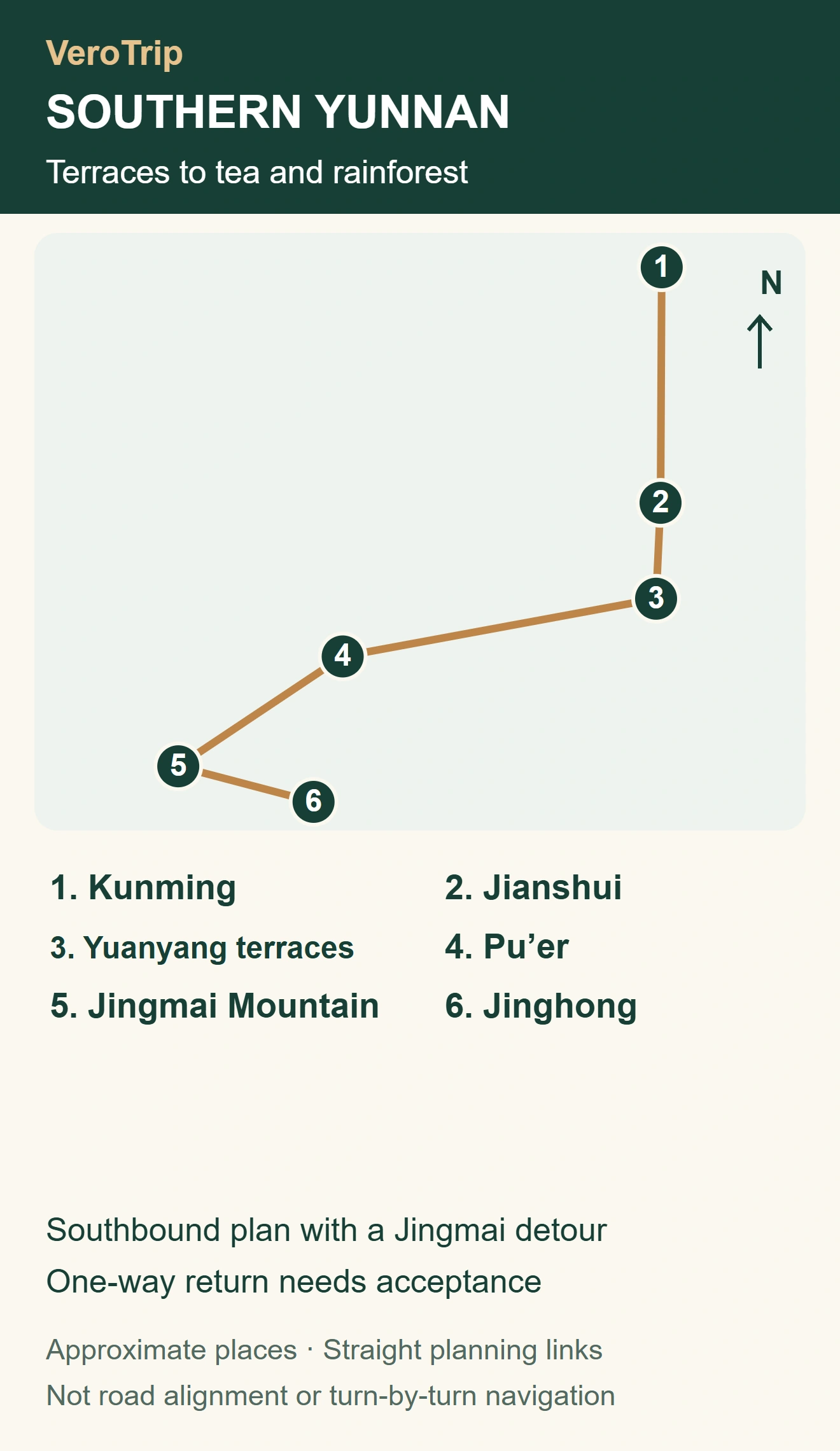
Do not send an unaccepted rental car back to Kunming after every southern stop. Price and compare a supported one-way journey, a round trip with more days, and rail between the main gateways with local road transport. For an alternative western approach, see Dali to Xishuangbanna via Tengchong. These routes share an ending region but offer different experiences and need different time budgets.
Western Sichuan: design altitude and the return before adding sights
Start by choosing a smaller valley circuit or a farther plateau journey. Kangding, Danba and the Mount Siguniang area do not produce the same holiday as Litang and Yading. Adding all of them can turn a scenic trip into consecutive long road days. A longer road distance is sometimes preferable to a steep, winding shortcut; compare current road conditions, stopping options and the driver’s experience.
Record the overnight altitude as well as the highest pass. The Yading route guide helps separate the road journey from the walking commitment inside the attraction. A shorter trail still takes place at altitude; being fit or travelling in a car does not remove that exposure.
The CDC’s altitude guidance supports gradual ascent and advises against further ascent with altitude-illness symptoms. Discuss individual health needs with a clinician before a high-altitude journey. Keep a lower overnight alternative and a route back to services.
For a different Sichuan–Yunnan connection, the Southern Silk Road from Chengdu to Lijiang uses a city-and-lake travel sequence. It should not be confused with a Tibet expedition or a route through every high pass in Kham.
When does rail make more sense for Jiuzhaigou?
If Jiuzhaigou is your main reason for leaving Chengdu, compare a train to Huanglongjiuzhai Station and a local road transfer with hiring a vehicle for the whole journey. For an arrival day, a full park day and a return day, the train removes the long drive out of Chengdu. You still need the mountain road between the station and the park in both directions. Arrange the return pickup against the departure time on your rail ticket.
A car is more useful if you have several stops along an open route and enough days between overnight bases. If snow closes the station-to-park road, switching from coach to car cannot solve that closure. Ask the operator which side has a reachable hotel before moving on. The Jiuzhaigou rail and overnight guide sets out the alternatives for a late arrival.
The Silk Road: drive the corridor or combine rail with local road days
A westbound route from Xi’an through Baoji, Lanzhou, Zhangye, Jiayuguan and Dunhuang can continue through Hami and Turpan to Urumqi. Choose this for the changing landscape and the journey itself. The 14-day Silk Road self-drive programme gives an existing sequence to discuss, with vehicle availability, support and return terms specified in the quotation.
Keep full visiting time in the major bases rather than making every day a transit day. Mogao Caves reservations, a desert outing and an intercity drive each need their own place in the schedule. A second named driver only helps if that person has an accepted licence or permit and is included in the rental arrangements.
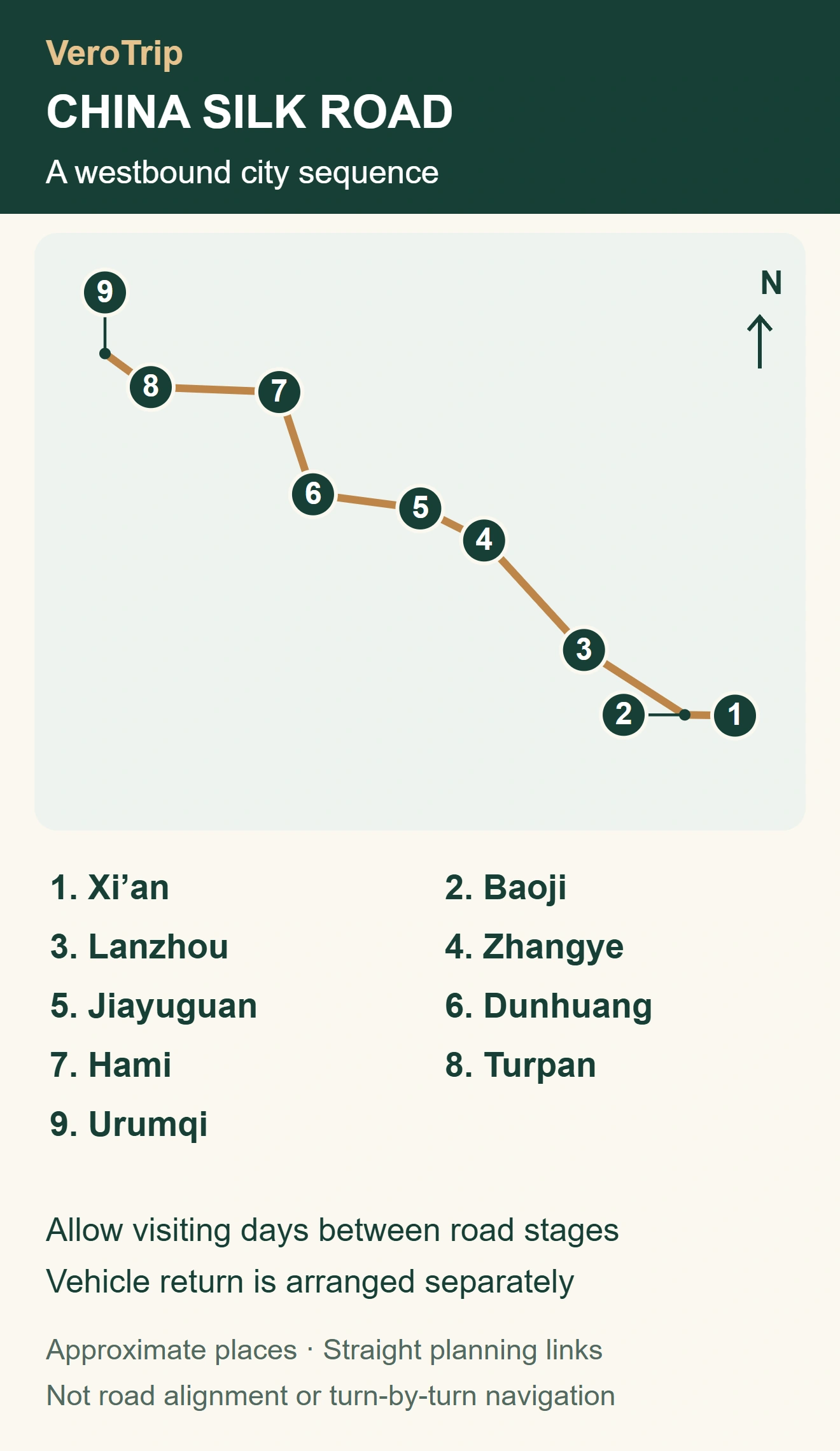
If you mainly want the attractions, compare rail between major cities with local drivers for countryside and desert visits. If you want to keep driving, obtain written acceptance for the entire operating area and the final branch. A supplier’s presence in Urumqi does not mean your vehicle category can be returned there.
Qinghai, Xinjiang, grasslands and Tibet: four different decisions
Qinghai–Gansu: plateau and corridor, with realistic stages
A circuit may link Xining and the Qinghai lake region with Delingha, Golmud and Dunhuang, then return through the Hexi Corridor. That combines altitude with some substantial transfers. Keep a shorter alternative that visits fewer plateau stops or uses rail on the corridor. The Qinghai and Gansu private-driver programme is a starting comparison; ask for the daily driving and overnight bases before selecting optional stops.
Xinjiang: pick one subregion and check the exact route
Northern mountain and grassland travel, the Turpan–Urumqi corridor and a southern oasis/Pamir journey have different access and weather questions. A scenic-highway name is not evidence that it operates for your dates. On 8 October 2026 at 20:00, Duku Highway entered winter closure; the government notice prohibits social vehicles during closure and leaves the next reopening to a later announcement.
For an autumn or winter request, choose a route that does not need the closed Duku crossing. Confirm other roads and attractions individually; a seasonal closure does not mean every Xinjiang journey is unavailable. Border destinations need their own permission checks.
Inner Mongolia: choose one gateway area
A Hohhot-area circuit and a distant Hulunbuir holiday should not be treated as the same short loop. Identify the specific grassland, desert activity and overnight camp before selecting a car. Drive on authorised roads and use designated parking. A desert experience may require the activity operator’s vehicles; a standard rental and its protection terms do not establish off-road permission.
Tibet: organise the trip before committing to a vehicle
The Shannan tourism bureau’s guidance requires foreign tourists to use qualified travel agencies for Tibet entry arrangements. A Chinese driving permit is a separate document and does not authorise independent tourism or a particular G318 journey. Ask the receiving operator to confirm the accepted visitor, vehicle, route, guide and timing arrangements before buying non-refundable services.
Choose the season by what must work
There is no single month that opens every China road trip. Start with your fixed dates, then identify the activity or road that the holiday depends on. A forecast at the starting city does not describe a high pass several days later.
| Date or condition | What to check | A practical adjustment |
|---|---|---|
| Spring or late autumn mountain travel | Snow/ice at passes, daylight and the selected overnight altitude. | Use a shorter valley circuit or a lower overnight base; remove a closed pass. |
| Summer in a rain-affected region | Road warnings, landslide controls, parking access and flexible accommodation. | Keep two-night bases and a nearby town or indoor alternative; do not follow an unofficial bypass. |
| Public holidays or a major local event | Hotel/car availability, parking and attraction reservation slots. | Reserve the essential services first and shorten the daily radius. |
| Winter or a seasonal-road request | The actual closure notice, road-surface conditions and vehicle support. | Choose an open corridor or a regional rail-and-driver plan; do not assume last year’s opening date. |
Foreign documents: keep five permissions separate
Choose the route first enough to identify the paperwork, but confirm the paperwork before paying for a driving-dependent trip. These checks concern different things; completing one does not complete the others.
| Check | What it establishes | Your next step |
|---|---|---|
| Entry and lawful stay | The person’s right to enter and remain for the travel dates. | Check the immigration conditions that apply to the passport and journey. |
| Driving licence or temporary permit | The driver’s accepted vehicle class and document validity. | Read the temporary driving-permit guide and confirm the issuing office. |
| Rental or locally arranged vehicle | The accepted driver, operating area, protection and return branch. | Use the foreign-traveller car-rental guide before committing to the route. |
| Foreign-registered vehicle admission | Separate customs, registration, insurance and route/port arrangements. | Start with bringing a car or campervan into China; a normal rental booking does not cover import. |
| Tibet, border areas and specific attractions | Permission for the actual destination and transport inside it. | Confirm the exact county, traveller and date with the receiving operator or relevant authority. |
For a Chinese rental car, Shanghai’s official permit guidance distinguishes C1/C2 vehicle classes and requires the original foreign licence and Chinese translation to accompany the temporary permit; carry the rental contract too. Office procedures need checking in the city where you will apply.
For a border-area visit, the National Immigration Administration’s 2026 notice puts foreign nationals in the in-person application channel. Bring the required identity documents and ask about the actual destination. Do not copy the mainland-resident mini-program process or treat a border-area pass as permission to enter every restricted location.
Build each road day around people, services and a Plan B
Protect the driver’s rest and the group’s meals before inserting extra sights. A photograph stop is not a full rest day. For children, confirm the correct seat, luggage space and regular places to stop. For older travellers, ask about steps, lifts and the walk from parking to the room. For Muslim travellers, agree the actual meal and prayer arrangements instead of assuming every rural stop has suitable food or a prayer room.
| Before setting off | Save or agree | If it fails |
|---|---|---|
| Route and overnight | Chinese/English place names, parking pin, realistic road stage and hotel check-in contact. | Use the confirmed nearer base; remove a detour rather than chasing the original arrival time. |
| Fuel or charging | A usable service stop, the car’s connector/payment requirements and a reserve option. | Stop before the remote section; ask the supplier before choosing another charging method or road. |
| Weather or access | The official notice and a legal alternative on the same side of a closure. | Wait at a service base or redesign the day; never use an app’s unofficial shortcut around a control. |
| Vehicle or driver problem | Supplier assistance number, protection procedure and transport back to services. | Follow the contract’s evidence/reporting steps and change to local transport where appropriate. |
Download the day’s names and contacts for offline use. Confirm who will handle Chinese-language calls, especially during vehicle handover or a breakdown. A self-drive proposal should name the actual support service; do not infer an escort, guide, replacement car or rescue cover from the words “supported tour.”
Turn the route choice into a trip enquiry
Send Verotrip your dates, arrival/departure cities, available days, number of travellers and drivers, licence-issuing country and vehicle class, preferred travel style, luggage and any mobility, child-seat, meal or prayer needs. State whether you want a Chinese rental car, a driver, or entry with your own vehicle. Include your must-see stops and the part you are willing to shorten.
Use China Self-Drive Tours to compare existing programmes and driving in China as a foreigner for the national driving overview. The proposal should identify the available vehicle, driver or guide where required, support, permissions, protection, included services and price before booking. Contact Verotrip with those details so the region and travel format can be assessed together.
Common road-trip decisions
Can foreigners take a road trip without driving?
Yes. A private driver or rail journey with local road excursions can visit many of the same places. Choose who manages the vehicle separately from which landscape you want to see.
Which route should a first-time driver choose?
Start with a smaller connected area and confirmed collection, return, hotels and service stops. A Dali–Shaxi–Lijiang plan is easier to shorten than a long cross-country trip. The final choice depends on your road experience and the actual conditions.
Can I cross an international border in a Chinese rental car?
Do not assume that a domestic rental allows it. The supplier’s approval, vehicle admission, border procedure and onward-country requirements are separate from normal intercity return. Use a dedicated overland enquiry for a border journey.
How can I keep a route useful if one road closes?
Choose overnight bases that still offer worthwhile visits without the fragile crossing. Agree the permitted shorter route before departure and keep enough flexibility to change transport or remove the distant stop.
Compare a region before fixing the route
The Hulunbuir six-to-eight-day itinerary guide explains Hailar, Ergun, Shiwei and Manzhouli overnight choices. For a highland through journey, the G317 and G318 road-trip comparison separates northern and southern corridor priorities, route changes and altitude planning.
For a heritage-focused inland corridor, the Chengdu–Taiyuan guide via Qinling compares twelve actual calendar days and eleven nights, with rail alternatives and separate time for Hanzhong and Pingyao.
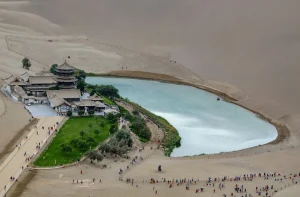
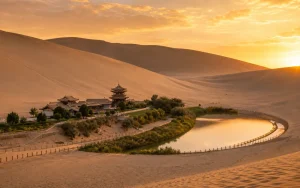
For the western end of a Gansu journey, the Dunhuang planning guide separates local cave and desert days from a wider corridor road trip. Keep the actual Mogao reservation, arrival station, luggage and departure transfer clear before adding more stops.
Frequently asked questions
How should I plan for altitude and know when to stop?
The CDC’s altitude guidance supports gradual ascent and advises against further ascent with altitude-illness symptoms. Discuss individual health needs with a clinician before a high-altitude journey. Keep a lower overnight alternative and a route back to services.
What entry or document arrangements need checking first?
For a border-area visit, the National Immigration Administration’s 2026 notice puts foreign nationals in the in-person application channel. Bring the required identity documents and ask about the actual destination. Do not copy the mainland-resident mini-program process or treat a border-area pass as permission to enter every restricted location.
How should I arrange arrival, transport and the return?
If you mainly want the attractions, compare rail between major cities with local drivers for countryside and desert visits. If you want to keep driving, obtain written acceptance for the entire operating area and the final branch. A supplier’s presence in Urumqi does not mean your vehicle category can be returned there.
How could weather or seasonal conditions change the plan?
Allow time for terrace weather and a booked tea visit. A host’s name on a map does not establish an English-speaking appointment, meals or vehicle access. Ask for the meeting point and the last accessible parking place.