

Updated 12 October 2026.
Bringing a car into China can be possible through an approved temporary-entry arrangement, but your passport permission, the vehicle’s admission, your driving documents and the permitted route are separate decisions. Start with the receiving arrangements for your exact vehicle and border crossing before committing to an overland itinerary. A visa, an overseas insurance policy or another traveller’s successful crossing does not settle all four.
For a campervan, the first useful details are its registered vehicle category, seats, dimensions, weight and ownership—not just the fact that it has a bed. This guide covers temporary visits with your own foreign-registered vehicle to mainland China. Permanent import, commercial freight and special cross-border schemes need different advice.
The header shows an illustrated campervan journey.
Should you bring your own vehicle or arrange transport in China?
Bringing your vehicle makes most sense when China is part of a longer overland journey and you can build the trip around agreed entry, exit and route conditions. It is a less flexible choice when you have a short holiday, an uncertain arrival date or a firm flight home that cannot move.
Compare the whole trip cost with arriving as a passenger and using a local rental or a car with a driver. Include border administration, insurance, any financial guarantee, support arrangements, document preparation and the time needed to take your vehicle out again. A cheap daily driving budget can conceal expensive entry and exit logistics.
If you choose a domestic rental, read the car rental guide for foreign visitors. Rental acceptance and the appropriate Chinese driving document still need arranging; renting locally simply removes the task of temporarily admitting your own foreign vehicle.
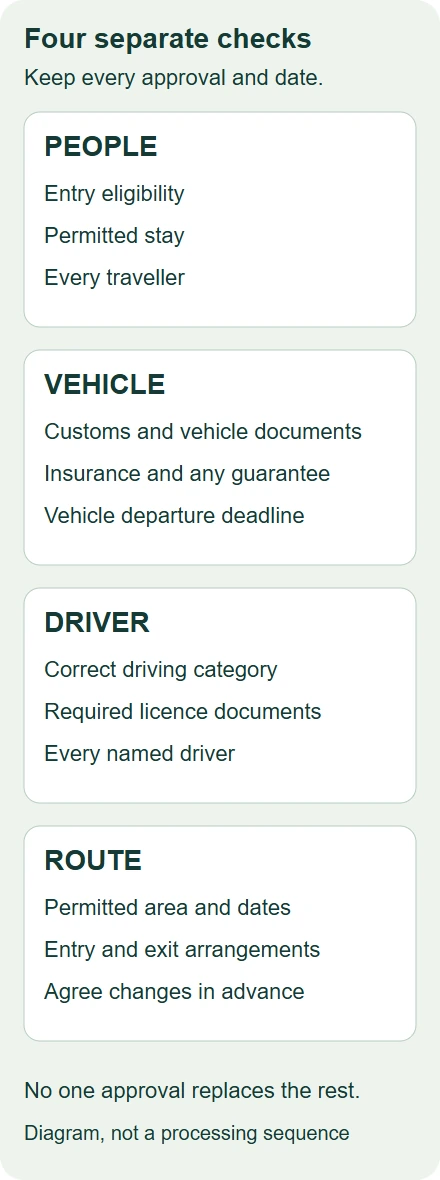
Keep four permissions separate
Build a folder for each of the following. Ask who is responsible for each application and what written document you will receive.
| Layer | What you need to establish | What it does not replace |
|---|---|---|
| People | Every traveller’s entry eligibility, permitted stay and any region-specific permission. | Customs admission of the car or permission to drive it. |
| Vehicle | Customs procedure, temporary vehicle documents, insurance and any guarantee. | The driver’s licence requirements. |
| Driver | A Chinese driving document appropriate to the vehicle, with the required supporting licence documents. | A longer stay for the car or access to every road. |
| Route | The authorised travel area, border points, dates and any applicable local restrictions. | Permission to change the journey at will. |
China’s temporary-entry vehicle and driver rules distinguish approved organised visits, limited border-area travel and other defined situations, with separate treatment where international agreements apply. Do not assume an arrangement for a neighbouring country’s licensed transport vehicle is available to a private tourist campervan.
Check the National Immigration Administration’s current entry guidance against every traveller’s nationality and journey. A Chinese passport holder’s account of driving home is not an entry checklist for a foreign passport holder following the same road.
Choose the border arrangement before fixing the road trip
Send a proposed entry point, exit point and date range to the organisation handling your journey. Ask it to establish whether the selected road crossing can process that particular private vehicle and those travellers on those dates. A passenger crossing being open does not answer the vehicle question.
For a Laos–Yunnan journey, specify the Boten–Mohan road crossing and your vehicle details. A train ticket through the same border area is not evidence of eligibility to drive across it. Check the neighbouring country’s exit and transit requirements separately, including permission to take a financed, leased or company-owned vehicle abroad.
Request a written division of responsibilities: who submits the receiving plan, deals with customs, arranges the vehicle inspection and plates, provides any required guide or escort, and handles the exit. A message saying “we can do the border” leaves too many questions unanswered.
For travel through areas not open to foreigners, additional approval may apply. The NIA’s foreigner travel-permit guidance concerns that particular category of travel; its application timetable should not be presented as a universal lead time for every own-car visit to China.
Prepare a vehicle file before requesting a firm quote
Use the registration certificate as the starting point. A vehicle described casually as a “van” may have a different registered category from the one a traveller or booking agent expects. Tell the receiving team about conversions and trailers at the beginning.
| File | Prepare for the case assessment | Resolve before travel |
|---|---|---|
| Travellers and drivers | Nationalities, intended stay, driver names and licence classes. | Entry eligibility, accepted translations and the correct Chinese driving category. |
| Vehicle identity | Registration country, registered owner, vehicle category, registration date, seats and identifying details. | Whether ownership or use-authorisation documents need further certification. |
| Campervan or trailer | Length, width, total height, registered weight, steering position, conversion details and any trailer information. | Vehicle acceptance, licence category, inspection needs and route suitability. |
| Route and exit | Proposed border points, dates, regions and overnight stops. | The agreed itinerary, required support, amendments process and vehicle departure deadline. |
The Beijing traffic authority’s temporary vehicle-plate checklist lists registration and translation, customs entry evidence, applicable organised-visit documents, inspection evidence and Chinese compulsory traffic-accident liability insurance. It is a useful official document checklist; Beijing’s office arrangements are not instructions for collecting plates at Mohan.
For non-commercial small or micro passenger cars, that checklist limits the inspection-certificate exemption to vehicles registered within six years with fewer than seven seats, alongside the stated document conditions. A campervan should not be assumed eligible because it looks like a passenger van. Exemption from submitting an inspection certificate does not remove presentation of the vehicle for examination.
Keep originals accessible rather than buried under luggage. Have readable scans for preparation, but establish which originals and translation format the receiving office needs. For an initial enquiry, a summary is enough; send sensitive identity documents only through the agreed secure channel when an application actually requires them.
Do not confuse the car’s deadline with the driver’s deadline
A longer driving permit does not extend your vehicle’s temporary stay. Under the standard temporary-entry vehicle rules, the temporary vehicle plate and vehicle driving document are valid for no more than three months and cannot be extended. Customs conditions and the dates on the issued documents also matter.
Driver documents follow a separate rule. A Suzhou police explanation of the current national driving-licence provisions states that a short-stay temporary driving permit is valid for three months; for a stay exceeding three months, its validity can extend up to one year. This is not a one-year admission for your foreign car.
Record the traveller’s permitted stay, driver-document validity, vehicle-document validity, insurance end date and customs departure requirement together. Plan to satisfy every applicable deadline. If one would expire before your planned exit, resolve that before departure rather than relying on a general promise of an extension.
The driver’s vehicle category also matters. The Shanghai police’s bilingual permit guide explains the relationship between the overseas licence and the vehicle to be driven. A temporary permit is not a way to gain an entitlement absent from your original licence. See our temporary driving-permit guide for the driver’s application questions.
Ask for a cost breakdown, not an “all included” total
Separate money paid for a service from money held as security. A low headline package can still require a substantial amount of cash to remain unavailable until the vehicle leaves and the relevant obligations are discharged.
| Cost or commitment | Ask for this in writing | Common misunderstanding |
|---|---|---|
| Customs guarantee | Procedure, assessed amount, accepted form, recipient, receipt and conditions for release. | Treating a traveller’s deposit as a nationwide flat rate. |
| Administration and support | Applications covered, border assistance, guide or escort duties, language and exit handling. | Assuming the same support applies to every port and route. |
| Insurance | Insurer, territory, dates, registered vehicle, covered drivers, limits and exclusions. | Assuming compulsory liability cover pays for damage to your own campervan. |
| Changes and disruption | Cancellation terms, extra waiting costs, route changes, breakdown recovery and alternative exit arrangements. | Assuming a replacement port or extra week is automatically allowed. |
The customs authority’s general guarantee guidance describes guarantees linked to customs obligations and distinguishes deposits from other accepted forms. It is not a private-car price list. Ask the responsible customs office or receiving team which procedure applies to your case; the customs consultation number is 12360.
Do not assume a carnet or overseas insurance certificate replaces the documents accepted for your actual entry. Ask for a written answer about each document. For insurance, check third-party liability, your own vehicle, passengers, recovery and repatriation separately. A policy covering the countries on the approach to China may have different territorial limits inside China.
Campervan decisions that affect the route
Supply the actual travelling height, including fixed roof equipment, and distinguish body width from width with mirrors. Explain any trailer, rear carrier or modification. These details help the receiving team assess the case and help you choose appropriate parking and overnight stops; the sketch below does not establish a legal size limit.
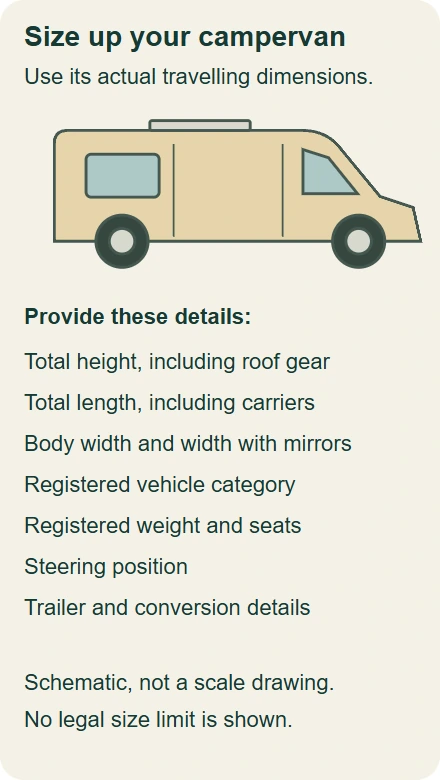
Before booking accommodation, ask about entrance height, turning space, overnight parking permission and whether the vehicle can stay if you sleep in a room. A hotel pin on a map says little about access for a tall or long vehicle. Have a walkable meeting point if a local guide cannot reach the same parking area.
For camping, establish permission to stay overnight, local registration arrangements, water, waste disposal and the site’s electrical connection. Parking permission is not necessarily permission to camp. Do not make an unfamiliar roadside pull-off your default overnight plan.
The NIA states that foreigners staying in accommodation other than hotels must arrange registration within 24 hours. Its non-hotel registration guidance also explains the online service. A campervan traveller should ask the local police or authorised campsite how to register that particular overnight location; the online service is not permission to camp anywhere.
List pets, gas equipment and other potentially regulated items separately for the border enquiry. Vehicle approval should not be taken as approval for everything carried inside it. For families, agree child-restraint arrangements and rest stops. For Muslim travellers, plan meals and a suitable permitted prayer stop before a long administration or transfer day; a camper kitchen alone does not settle ingredient and food-storage needs.
Build the schedule around entry, travel and exit
Keep the first sightseeing day movable. A border arrival, customs processing and completion of vehicle and driver documents are different milestones. Ask the receiving team where you will wait, whether the vehicle may move there, and who can legally drive each stage.
| Stage | Practical action | Fallback to agree |
|---|---|---|
| Before the approach journey | Settle eligibility, route, document originals, financial commitments and exit responsibilities. | Rebookable travel if the proposed crossing cannot accept the case. |
| Before crossing out of the neighbouring country | Reconfirm appointments, road conditions, receiving contact and waiting arrangements. | A legal place to wait before crossing if arrangements change. |
| Entry and document collection | Follow the agreed procedure; compare names, vehicle details, dates and travel area on issued documents. | Accommodation and support for delays, without unauthorised driving. |
| On the road and at exit | Stay within permissions; arrange changes before acting; retain departure and customs close-out evidence. | A documented plan for breakdown, illness or an unavailable exit point. |
Do not turn a published office processing target into a promise for the entire crossing. Arrange interpretation for questions about paperwork and insurance. Before leaving the receiving team, save its telephone number, the insurer’s claims contact and a suitable recovery contact offline.
If you want to leave China temporarily by air while the vehicle remains, or if repairs prevent departure, consult the responsible authorities and receiving team before changing plans. Do not assume that parking the car at a hotel suspends its customs obligations or expiry dates.
When a domestic Yunnan journey is the better choice
If your main aim is to explore Kunming, Dali and Lijiang during a fixed holiday, starting inside China can leave more time for the destinations. Compare a local rental, a car with a driver and trains between the main cities. Choose the transport around the places you want to visit instead of adding a border crossing solely to keep your own vehicle.

The Kunming Stone Forest day-trip guide is one example of planning a destination without making foreign-vehicle admission part of the journey. For a wider route, use our Yunnan self-drive planning guide and compare the China self-drive itinerary options. Those options are not proof that cross-border vehicle services are included.
Questions to settle before you pay
Can I drive with an International Driving Permit alone?
No. Arrange the Chinese driving document appropriate to your case. For temporary driving, carry the required original overseas licence and translation as well. Do not treat an IDP as a replacement for the local procedure.
Are right-hand-drive cars, motorhomes and rented foreign vehicles accepted?
Ask for a decision based on the exact registration, vehicle type, ownership and proposed crossing. Another person’s accepted vehicle does not establish yours. If the vehicle belongs to a rental company, lender or employer, obtain that party’s permission and establish whether the receiving arrangement accepts it before spending on travel.
Can I change the exit border or travel independently after entry?
Only within the conditions that apply to your arrangement. Get the authorised route, guide or escort obligations and amendment procedure in writing. Do not substitute a social-media claim that “nobody checked” for the actual terms.
What should I send VeroTrip first?
Send your nationalities, approximate dates, proposed entry and exit, registration country, vehicle type and dimensions, licence classes, desired regions and any accessibility or dietary needs. Use the VeroTrip trip-planning enquiry to compare route options and specify the questions that a receiving operator must answer. Any vehicle-entry service needs a written scope, named responsible team and case-specific acceptance before you rely on it.
To compare an entry and exit before choosing sightseeing stops, use the China overland route and border planning guide.