

Quick answer: Foreign visitors can drive in mainland China, but a foreign licence or International Driving Permit alone is not a general substitute for a Chinese driving credential. A short-stay visitor normally needs a Temporary Motor Vehicle Driving Permit, a rental branch that confirms it will accept the documents and payment method, and a route with no separate access restrictions. The difficult part is usually not learning how to steer on Chinese roads; it is making the permit, rental counter, deposit, insurance and route work together. This guide explains the complete decision in the order a traveller actually faces it. It covers a locally rented Chinese-plated car. Bringing a foreign-registered vehicle into China, driving in Tibet, and joining a tour where a professional driver operates the vehicle are different products with different rules. Last fact-checked: 31 August 2026. Permit offices, rental-counter policies, local plate restrictions and road access can change. Confirm the final city, branch, vehicle, dates and route before paying non-refundable costs.
Can foreigners drive in China?
Yes, provided the driver has a credential accepted in mainland China and the vehicle is lawfully available for that driver to use. For most short-term foreign visitors, that means obtaining a Temporary Motor Vehicle Driving Permit (Temporary Motor Vehicle Driving Permit) based on a valid overseas licence. Do not plan a China self-drive holiday on any of these assumptions:
- “My home licence is in English, so it must be accepted.”
- “An International Driving Permit works everywhere.”
- “A car-rental reservation proves the counter will release the car.”
- “A permit issued in one city means every rental branch will understand it.”
- “If a road appears on a map, it is open to every foreign traveller.”
The Shanghai government’s temporary-permit guide lists the permit, foreign licence, Chinese translation and rental contract among the documents relevant to driving a rented vehicle. The Chinese government’s guide for foreign residents and visitors separately explains car-leasing document and payment expectations. These official sources are a starting point; the issuing office and rental branch still need trip-specific confirmation.
First decide whether self-driving is worth it
China has fast intercity rail, domestic flights, app-based taxis and private drivers. Renting a car is not automatically the best way to see the country.
| Trip type | Usually best choice | Why |
|---|---|---|
| Beijing, Xi’an, Shanghai and other major-city circuit | High-speed rail plus local transport | Parking, congestion and plate restrictions add work without much route freedom |
| One rural province with villages, mountains or dispersed landscapes | Self-drive or private vehicle | A car can save transfers and make early starts or scenic stops possible |
| First visit of 7–10 days with several big cities | Train or private driver | Permit time and rental friction may outweigh the benefit |
| Experienced road-tripper spending 10–21 days in Yunnan, western Sichuan, the Silk Road or Inner Mongolia | Supported self-drive | Driving is part of the experience and the route rewards flexibility |
| Tibet or a route crossing controlled border areas | Organised overland product | Travel permissions and route controls are separate from the driving permit |
| Traveller uncomfortable reading signs, handling an accident in Chinese or driving in dense mixed traffic | Private driver | Less operational risk and more time for the destination |
If you want the road experience but not the paperwork alone, start with our China Self-Drive & Overland Tours. “Supported self-drive” should mean the provider verifies the permit process, vehicle handover, route, accommodation, seasonal access and emergency contact—not simply sends a list of attractions.

The six checks that make or break a China road trip
1. Do you qualify for the temporary permit?
Check the validity and vehicle class of your overseas driving licence, the length and purpose of your stay, your age, and the issuing city’s document rules. Some cases involving mutual-recognition arrangements may follow a different path; verify the country-specific rule rather than relying on a generic blog. Typical items include:
- Passport and current entry or stay document.
- Valid foreign driving licence.
- Chinese translation produced by an accepted translator or notarial body.
- Passport-style photographs that meet the local specification.
- Health or ability check where required, particularly for older drivers.
- Rental contract or proof of the temporarily imported vehicle when relevant.
Read the detailed China temporary driving permit guide before choosing an arrival airport or booking a same-day rental.
2. Will the exact rental branch release the car?
A national brand policy is not the same as a branch-level promise. The counter may check passport status, the temporary permit, name consistency across documents, a Chinese phone number, the main driver’s age, the card used for pre-authorisation and whether the vehicle may cross provinces or be returned elsewhere. Before paying, obtain a written answer that names:
- Pickup branch and date.
- Passport nationality and entry status.
- Temporary permit type and validity.
- Overseas licence and translation.
- Accepted deposit method and card network.
- Vehicle class and additional-driver rule.
- Cross-province and one-way-return permission.
Our guide to renting a car in China as a foreigner includes a copy-ready confirmation message and pickup checklist.
3. Can you pay the deposit and understand the hold?
Foreign travellers can link eligible international cards to Alipay and WeChat Pay for many everyday purchases; see the official payment service guide. A rental deposit is different. A branch may require a physical credit card, a supported Chinese payment account, or a pre-authorisation method that does not work with every overseas card. Ask about two separate holds:
- Vehicle/security deposit.
- Traffic-violation deposit retained after return while camera records are processed.
Request the amount, release timetable and refund method in writing. Do not treat a successful online booking payment as proof that the pickup deposit will work.
4. Does the insurance match the risk?
China’s compulsory motor-vehicle traffic-accident liability insurance is a legal baseline, not comprehensive protection for a rented car. Rental packages can include different limits, deductibles and exclusions. Ask the supplier to identify, line by line:
- Compulsory third-party cover and liability limit.
- Commercial third-party liability cover.
- Collision or vehicle-damage cover.
- Deductible or excess.
- Tyres, wheels, glass, mirrors, underbody and interior.
- Water damage, wrong fuel, lost key and towing.
- Theft, vandalism and loss-of-use charges.
- Unregistered additional drivers.
- Driving on unpaved or restricted roads.
- Required police, rental and insurer notifications after an accident.
Never describe a package as “full insurance” unless the actual order terms support that phrase.
5. Can the route be driven in real life?
A good China road trip itinerary is a roadbook, not a collection of scenic photographs. Each day should state:
- Start and finish in English and Chinese.
- Real driving distance and estimated wheel time.
- Expressway, national-road, mountain-road and unsealed sections.
- Tolls and payment backup.
- Elevation gain and highest sleeping altitude.
- Seasonal opening and last verification date.
- Last dependable fuel or compatible charging stop.
- Toilets, hospital, repair point and rest areas.
- Hotel parking entrance and foreign-passport registration confirmation.
- Plate, border, scenic-area and reservation restrictions.
- A shorter or lower-risk Plan B.
For an example of a route designed around local support rather than a generic map, see the custom Yunnan self-driving tour. Travellers who prefer a professional driver can compare the 10-day South Yunnan route, where the road sections that public transport handles poorly are already identified.
6. Can you handle a failure in Chinese?
Before leaving the rental lot, save an offline incident card with:
- 122 for traffic police and 120 for medical emergency.
- Rental-company roadside assistance and branch number.
- Insurer claim number and required evidence.
- A Chinese sentence explaining that you need police and rental-company assistance.
- Passport, permit, contract, insurance and vehicle-registration copies.
- Instructions not to move the vehicle unless safety or police direction requires it.
Photograph the vehicle, road position, signs, damage, other vehicle and documents. Do not sign an agreement you cannot understand or privately settle a serious incident without the rental company and insurer.
Getting a temporary driving permit
The process is city-specific. Shanghai publishes an on-site application route and document list; Beijing’s official foreign-driver FAQ identifies vehicle-management and airport service locations and warns that translation must meet local requirements. Build at least one working day of margin into the plan even when an airport service advertises fast issuance. Common failure points include:
- Translation from a provider the office does not accept.
- Passport photo with the wrong dimensions or background.
- Name order that differs between licence, passport and booking.
- Office closed on weekends or public holidays.
- Late flight arrival after the service window.
- Permit vehicle class that does not match the rental.
- Rental branch unable to verify a visa-free or short-stay customer.
Do not copy “15 minutes at the airport” from one city into a national guide. Record the office, terminal or building, floor, hours, telephone, appointment rule, fee, photo rule and last verification date.
Renting and collecting the car
Before arrival
Reserve a cancellable option and send the branch a bilingual confirmation request. Keep screenshots of the written response, booking number and accepted payment method. If this is the first rental with that supplier, ask whether identity verification must be completed a working day in advance.
At pickup
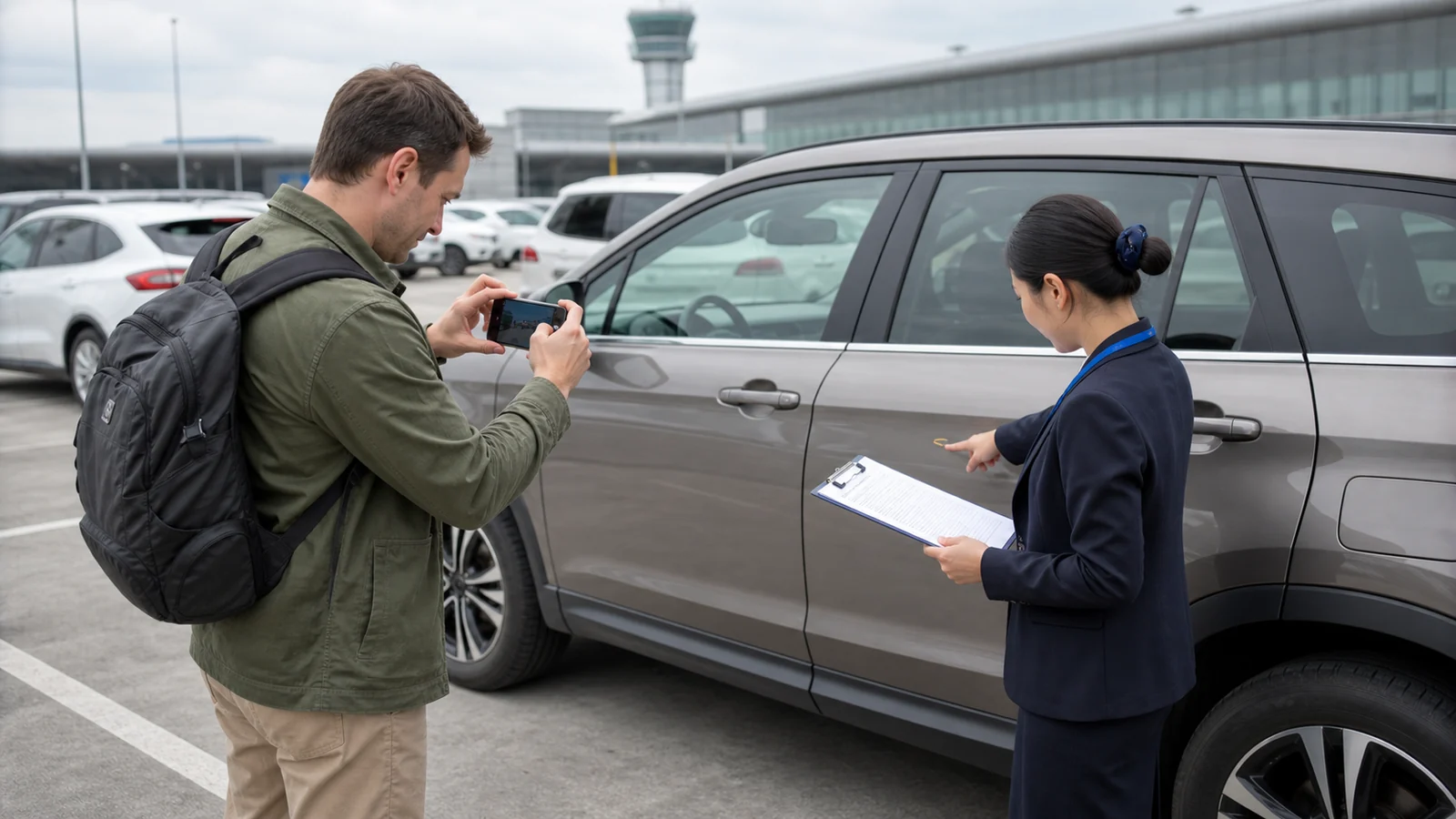
Check every document before accepting the keys. Then record a continuous walk-around video in good light. Capture:
- All panels, bumpers, wheels, windscreen and roof.
- Existing scratches and chips on the damage diagram.
- Fuel level or battery percentage.
- Odometer and warning lights.
- Tyre condition and spare/repair kit.
- Charging cable and connector type for an EV.
- Registration, insurance and inspection documents.
- ETC device and how toll charges will be settled.
- Emergency triangle, reflective vest and basic tools.
Ask how to extend the rental, add a driver, replace the car, report a fault and return outside opening hours.
At return
Photograph the vehicle in the return area, dashboard, fuel/battery level and parking position. Obtain a return receipt that records time, location, condition and immediate charges. Keep it until both the vehicle and traffic-violation deposits are released.
Maps, phone and payments for driving in China
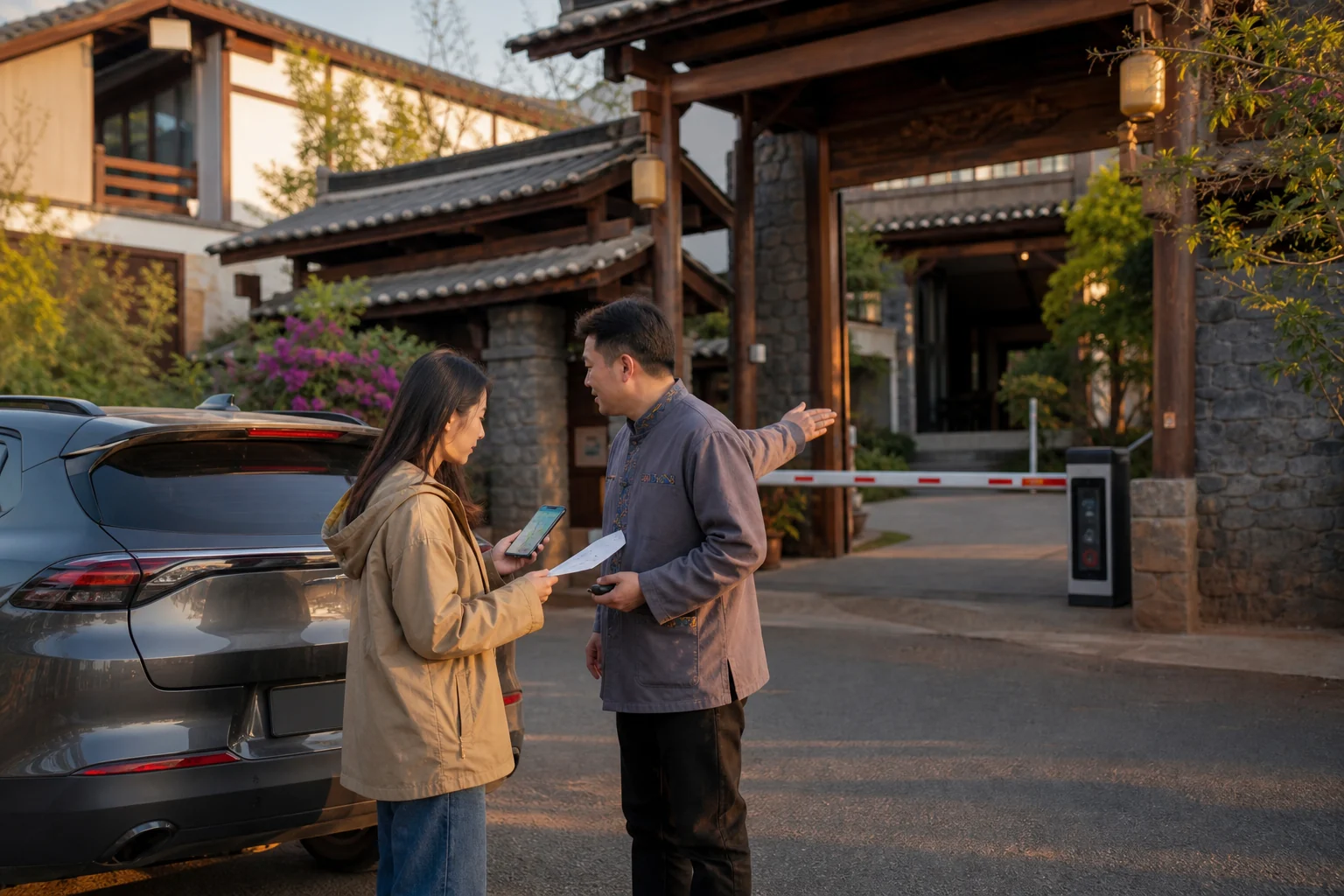
Amap/Gaode (Gaode Map) now offers an English map experience for international users; the Shanghai government announcement makes older “Chinese only” advice obsolete. Chinese road and place names remain valuable because hotel entrances, scenic gates, charging points and rural businesses may not match an English search. Prepare before departure:
- Mobile data and a phone able to receive SMS and place calls.
- Amap with the route and key stops saved.
- Chinese names, addresses and telephone numbers for every overnight stop.
- Alipay and WeChat Pay with an international card where supported.
- A second card and some RMB cash.
- Offline screenshots for the rental branch, hotel, hospital and last fuel/charge point.
- A charger, cable and power bank.
For the wider arrival setup, see our first China trip apps, payments and arrival guide and how to pay in China.
Essential driving rules visitors underestimate
- Traffic keeps to the right.
- Seat belts are required; child-restraint requirements and supplier equipment must be checked for the child’s age and vehicle.
- Red-light right turns are not automatically permitted in every situation; follow signals, signs and lane arrows.
- Speed cameras and lane enforcement are widespread.
- Motorcycles, e-bikes, delivery riders and pedestrians can enter the driver’s path unexpectedly.
- A missed expressway exit should be followed to the next safe exit; never reverse.
- Stop on an expressway only for a genuine emergency and follow warning/evacuation rules.
- Local plate restrictions can affect navigation even when the road itself is open.
See the detailed China driving rules, Amap, tolls and parking guide before the first driving day.
Best China self-drive regions
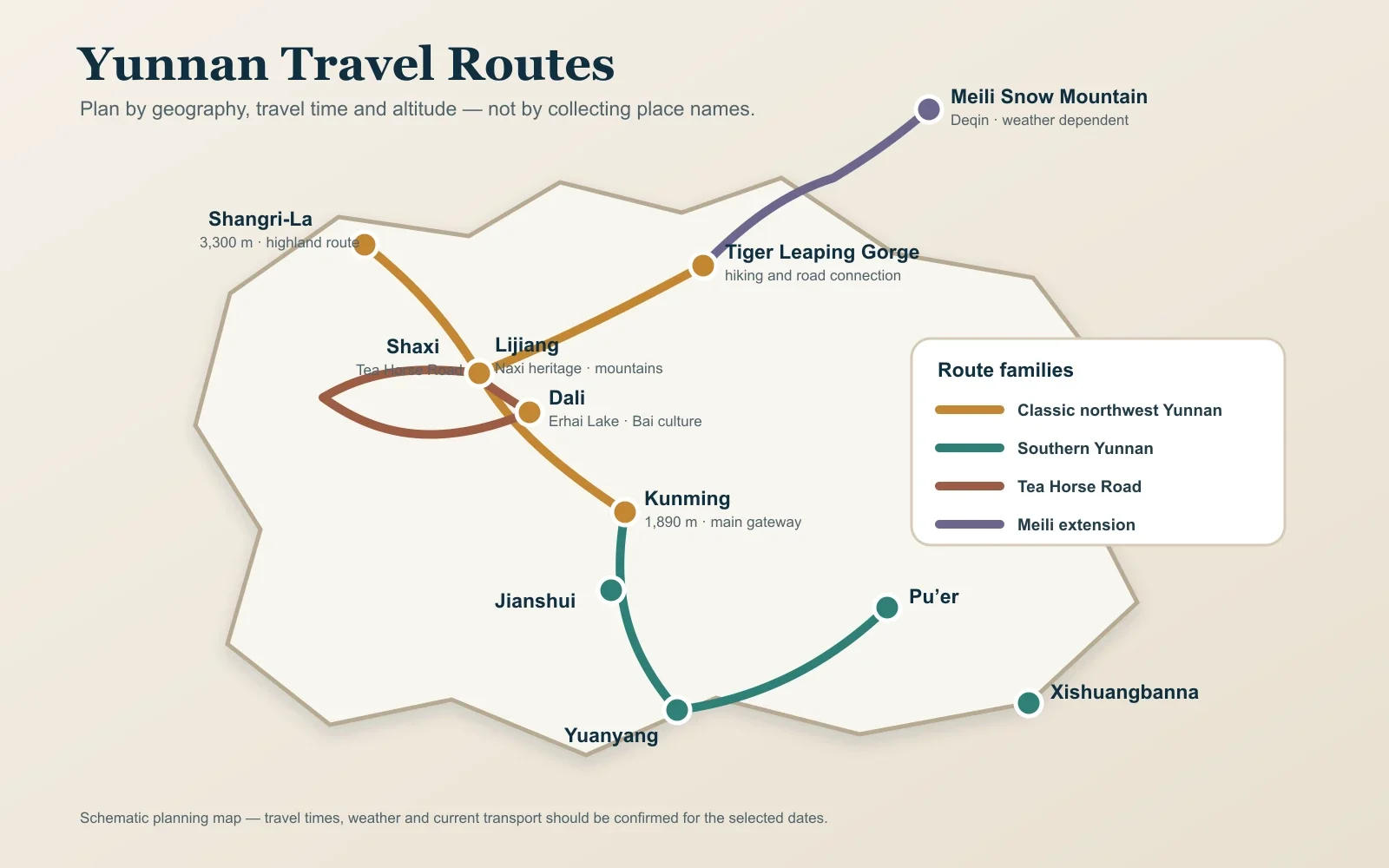
The best route depends on season, altitude, permit complexity and how comfortable the driver is with long road days.
Yunnan
Yunnan works well for a first supported self-drive because it combines established visitor cities with rural sections where a car adds value. A practical route might link Kunming, Dali, Shaxi, Lijiang and selected northwest or southern extensions. Build altitude gradually and avoid inserting every famous place into one week.
Western Sichuan
Western Sichuan offers high mountain roads, Tibetan cultural areas and dramatic seasonal change. Road time, altitude and weather matter more than straight-line distance. Compare the driving pattern in the 8-day Western Sichuan and Lugu Lake overland route.
Silk Road and Gansu
The Silk Road suits travellers who accept longer distances in exchange for desert, passes and historic corridor cities. The 14-day Xi’an-to-Urumqi self-drive tour shows why this is a full overland journey rather than a chain of short day trips.
Xinjiang
Xinjiang road trips need seasonal road checks, long-distance fuel planning, hotel verification and careful handling of border or controlled areas. A professional-driver alternative is the 10-day Duku Highway and Pamir route.
Tibet and the G318 corridor
Do not treat a temporary driving permit as permission for independent travel in Tibet. Foreign visitors’ Tibet travel arrangements and route permissions are separate. Compare the 10-day G318 overland tour and 12-day Sichuan–Tibet Highway private tour as organised products. Read our best road trips in China for route-by-route season, difficulty and support comparisons.
Petrol, hybrid or EV?
Choose the vehicle for the actual roadbook, not for national charging statistics. An EV can work well when the supplier confirms the charging connector, account/payment flow and dependable stations on every leg. It becomes a poor choice when the route depends on a charging app the visitor cannot register for, winter or high-altitude range is uncertain, or the next working charger has no practical backup. A petrol car is usually operationally simpler on remote routes, but fuel stations can still involve identity checks, local procedures and limited opening in sparse areas. A hybrid can reduce range anxiety without requiring every overnight stop to provide charging.
A realistic cost formula
The advertised daily rate is not the trip cost. Calculate: Rental + booking/service fee + insurance upgrade + deductible exposure + deposits + additional driver/child seat + one-way or out-of-hours fee + fuel/electricity + tolls + parking + accommodation + route support + expected incident buffer. Compare that figure against trains plus local taxis and a private-driver quote. Self-driving is worth paying for when the freedom and road experience are central to the trip—not merely because the rental headline looks inexpensive.
When to choose local support
Local support is most useful before the non-refundable decisions. A credible service should be able to:
- Check the permit path for your arrival city and date.
- Obtain written acceptance from the pickup branch.
- Explain the real deposit and insurance terms.
- Build a route roadbook with fuel/charging and Plan B stops.
- Verify hotels will register foreign passports.
- Monitor seasonal closures and local restrictions.
- Provide Chinese-language help during handover, breakdown or accident.
- Track post-return traffic charges and deposit release.
Tell us your passport country, licence country and class, driver age, arrival city, dates, preferred route and comfort with mountain driving. We can first say whether self-driving is sensible, then connect the plan to a suitable supported self-drive or overland route.
Frequently asked questions
Is an International Driving Permit valid in China?
Do not rely on an IDP alone for driving in mainland China. A short-term visitor normally needs a Chinese temporary driving permit or another Chinese credential applicable to the case.
Can I get a temporary Chinese driving licence at the airport?
Some cities publish airport or convenient service locations, but office, terminal, hours, document acceptance and processing time differ. Confirm the exact city and date and keep a working-day buffer.
Can a visa-free traveller rent a car in China?
Visa-free entry does not itself prohibit renting, but the branch must be able to verify the passport/entry status and accept the permit and deposit method. Obtain written confirmation from the exact branch.
Can I drive a friend’s car with a temporary permit?
Do not assume so. Official guidance links the temporary permit to specified temporarily imported or rented vehicles. Confirm the vehicle-use basis with the issuing authority and insurer.
Is self-driving in China safe for a first visit?
It depends on the route and the driver. Dense cities, unfamiliar road behaviour, language and incident handling add risk. A rural supported route may be more suitable than collecting a car in central Beijing or Shanghai.
Can foreigners self-drive in Tibet?
Tibet travel rules and permits are separate from the driving permit. Foreign visitors generally need an organised arrangement for relevant Tibet routes; do not plan independent access based only on a driving credential.
Do I need a Chinese phone number?
Not in every case, but a functioning number and mobile data make rental verification, navigation, hotel calls, parking and roadside assistance far easier. Confirm whether the rental supplier or charging platform requires a mainland number.
What is the biggest mistake foreign road-trippers make?
Treating the temporary permit as the whole solution. The usual failure occurs later: the rental counter does not accept the documents or deposit, the insurance is misunderstood, or the chosen road/hotel cannot be used as expected.