Updated 24 October 2026.
Plan an EV road trip in China around a specific vehicle, usable charging stops and a payment method you have successfully tested. Choose the car before fixing long driving stages, and keep an alternative charging stop within the car’s remaining range. A charging icon on a map is only the start of the decision.
For an overseas visitor, renting a China-registered EV and bringing a foreign-registered EV into China are different projects. The first needs the right driving permission, rental acceptance and a workable charging account. The second adds vehicle entry arrangements and model-specific charging compatibility. Decide which applies before booking hotels or a cross-border route.
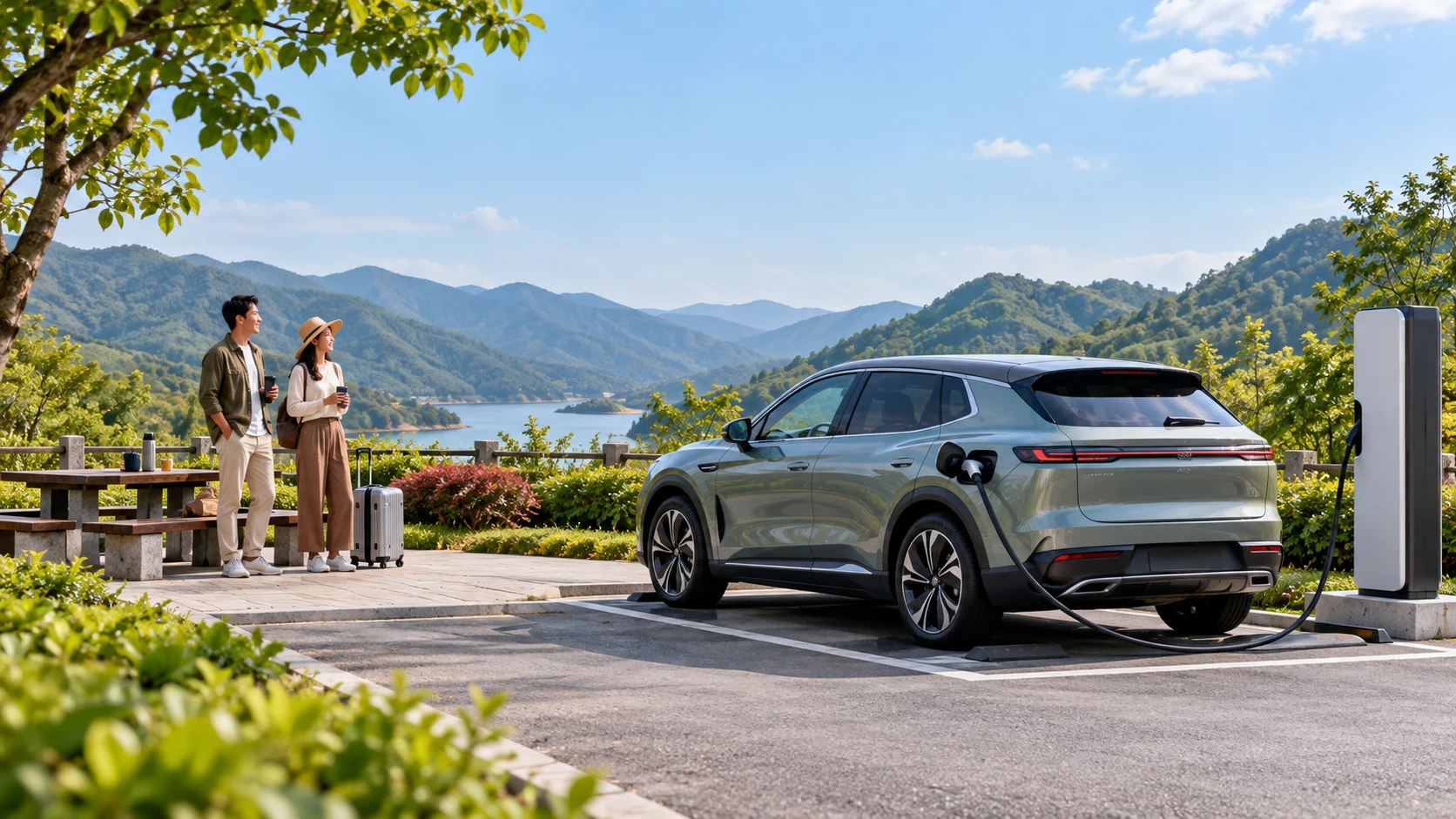
The opening image is an illustration of a generic charging stop, not an identified vehicle model, usable station or actual customer journey.
Choose the vehicle arrangement first
| Your arrangement | Settle first | A separate question |
|---|---|---|
| China-registered rental EV | Driver eligibility, supplied model, insurance and return terms | How you will start and pay for charging |
| Foreign-registered EV | Vehicle entry, road use and home-market specification | Manufacturer-supported charging on the actual route |
| Vehicle with a driver | Actual vehicle, service area and who handles charging | Whether an English-speaking sightseeing guide is included |
Tell the rental provider that you will use a foreign passport and specify your driving documents. Ask for written acceptance of the documents and driver category before paying. Shanghai’s temporary driving permit guidance describes the application documents, licence translation and rental-vehicle categories. Use the issuing authority’s instructions for your pickup city rather than assuming Shanghai’s office arrangements apply elsewhere.
Keep the rental agreement accessible and identify every additional driver. Confirm whether a replacement car could change the charging inlet, usable battery capacity, luggage space or account arrangement. A familiar model name is not enough if the supplied vehicle comes from a different model year or market.
Test charging and payment at handover
Ask for a supervised charging demonstration near the rental pickup. The useful test includes finding the station, accessing the car park, starting a session, seeing energy delivered, stopping normally and receiving the bill. Complete it while help is available rather than learning with a low battery late in the day.
The official payment guide for overseas visitors describes linking international cards to Alipay and WeChat Pay. That general payment option does not establish acceptance by every charging operator, account top-up or rental deposit. Test the actual workflow you intend to use.
| Check | Ask or demonstrate | Keep for the journey |
|---|---|---|
| Account and phone | Can you sign in with your own details and receive required messages? | Your account access and provider support contact |
| Vehicle access | Can you open the port and complete the normal start/stop process? | Exact model and relevant instructions |
| Payment | Who pays: you, a provider account or a rental billing arrangement? | Successful receipt and agreed responsibility |
| Return | What charge level and charging-related fees apply? | Written return terms |
Keep control of your own payment account. If the rental company manages the vehicle account, ask how a session is authorised and what happens outside office hours. The agreement should make responsibility clear; do not rely on being given someone else’s personal credentials.
Check compatibility and station access
Have the supplier identify the exact vehicle’s AC and DC charging requirements. Ask the manufacturer about any proposed adapter before depending on it. A connector that appears to fit does not establish a safe, supported combination, and instructions written for another market may not describe your vehicle.
Tesla’s China guidance illustrates why network access needs checking: its non-Tesla destination charging service identifies a specific GB/T AC interface and lets users filter for participating sites. This is a rule for that service, not a statement that every Tesla site or Chinese charger accepts every EV.
Check the operator’s current site entry for your vehicle and account. Identify the correct car park and travel direction. A charger behind a hotel gate, inside a restricted property or across the opposite carriageway may not be a practical stop.
Build each day around a main stop and a fallback
Start with the actual car and day’s route. Mark a preferred charging stop, an alternative reachable before the battery becomes low, and a place to shorten the sightseeing day if charging takes longer. Keep the overnight base flexible until these decisions work together.
Do not convert advertised range directly into a sightseeing stage. Ask the supplier how to interpret the car’s trip estimate for the planned roads, weather, passengers and luggage. Reassess after a route change rather than using the morning estimate for the rest of the day.
| Decision | Record before departure | If it does not work |
|---|---|---|
| Preferred stop | Operator, exact entrance, charging type and access conditions | Use the reachable fallback before energy becomes a concern |
| Fallback | Separate usable site and approach road | Shorten the day or change the overnight base |
| Hotel | Whether its chargers work for your booking and vehicle | Use a public stop instead of assuming overnight charging |
| Final connection | Charging, return inspection and onward train or flight | Stay near the return location or choose a later connection |
Save the station’s local-language name, location and operator contact. Include entrance information rather than only a map pin. A passenger can help check the next stop while the driver concentrates on the road; make changes while safely parked.
For a first trip, consider a route with room to reduce driving or add a night. This is a planning preference, not a claim that a named corridor has been tested. A route becomes useful only after the selected vehicle, booking terms, stations and fallback have been checked together.
Allow time without promising a fixed charging stop
Use the vehicle and station estimate for that session. Tesla’s supercharging guidance explains that charging power varies with battery condition, temperature, state of charge and vehicle configuration. A station’s peak rating is a capability rather than a promise of the power your rental will receive.
Do not build a tightly timed meal, attraction entry and onward drive around an advertised best-case example. Give the stop a practical purpose, such as lunch or a rest, while keeping flexibility to change the order. Follow the selected vehicle’s instructions for the charge needed before the next leg.
Ask the hotel about the actual charger
A hotel description saying “EV charging” is not enough to plan the following morning. Ask which operator runs the equipment, whether your vehicle can use it, how guests gain access and whether parking and charging are separate charges. Find out whether a charging place can be reserved or is simply subject to availability.
Share a late arrival time before choosing a property requiring staff assistance or gated access. Families should plan where passengers and luggage wait during charging. If the overnight arrangement cannot be established, schedule a public stop before reaching the hotel.
Compare the full cost
Read the live price and conditions before starting. Record energy and service charges, parking or occupancy rules, and the rental company’s billing terms. Keep the completed-session bill so a charging dispute can be separated from a parking or vehicle-return charge.
There is no single route-wide charging price on this page. The vehicle, operator, site and time of use affect the applicable terms. A cheaper advertised rate may be less useful if it requires an unsuitable detour or an account you cannot use.
If a station is busy, closed or will not start
| Problem | Response | Avoid |
|---|---|---|
| Access or equipment unavailable | Check current operator information and use the reachable fallback | Waiting until remaining energy leaves no alternative |
| Account or payment rejected | Contact the operator and rental provider; identify the charger | Assuming a shop payment proves charging-account acceptance |
| Vehicle or charger warning | Follow vehicle instructions and ask for assistance | Forcing a connector or improvising electrical repairs |
| Long delay | Reduce sightseeing or amend the overnight or return plan | Rushing the drive to recover lost time |
Keep the rental assistance details available without relying on the vehicle’s screen alone. Ask who arranges recovery and how costs are authorised. Describe the remaining charge, exact location and warning message; do not continue a longer leg simply because it appeared in the original itinerary.
Bringing your own EV: keep the border plan separate
A foreign-registered car needs its own entry and road-use arrangements. Check these alongside the charging solution, not after booking the passenger itinerary. The car’s home-market specification, manufacturer support and actual route all matter.
Use the Europe-to-China driving planner for the distinction between passenger and vehicle arrangements. For China-based preparation, read driving permission and route planning and the navigation, tolls and parking guide. Those topics remain necessary even when charging is your main concern.
The Chinese temporary-entry vehicle checklist separates registration, customs evidence, inspection conditions and compulsory insurance from the driver’s permission. It describes a Beijing application procedure, not a guaranteed service at your intended land crossing. Have the responsible entry team establish the requirements for your exact vehicle and route.
Common planning questions
Will my overseas phone and card work at every charger?
Do not assume this. Check registration, messages and payment for the selected operator. Complete a real session before committing to a long first stage.
Does a hotel charger make a remote overnight practical?
Only after access, compatibility and availability are established. Keep a public charging alternative that fits the driving plan.
Is an EV itinerary automatically suitable for families?
Choose it around the actual luggage space, child seating, walking, waiting facilities and daily pace. Vehicle type alone does not establish those arrangements.
Plan your China driving journey
Compare China self-drive journeys, then send dates, pickup and return cities, passenger and luggage needs, driving documents and exact vehicle preference through Plan My Trip. If bringing your own EV, include the model year, registration country and charging specification. Request the vehicle terms and a charging plan for the actual route before confirming.
Plan This Visit as Part of Your Journey
This guide introduces a possible visit rather than a confirmed package departure. Share your dates, starting point and the experience you want through Plan My Trip. Vero Trip can check access, travel time, language support and the services to include before quoting.
Explore related travel themes for other ways to shape the journey.