Go to Baima Pass (白马关) in Deyang’s Luojiang District for two connected experiences. Start with the section of the Jinniu Road beside Pang Tong Shrine, where worn stone shows how people once moved through this pass. Then visit the shrine and tomb if the relevant areas are open. Finish with lunch in Luojiang and a planned ride back to your hotel. The strongest visit is a short stretch of road plus time inside the shrine grounds, with a clear point to turn back.
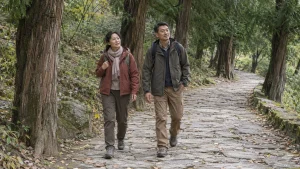
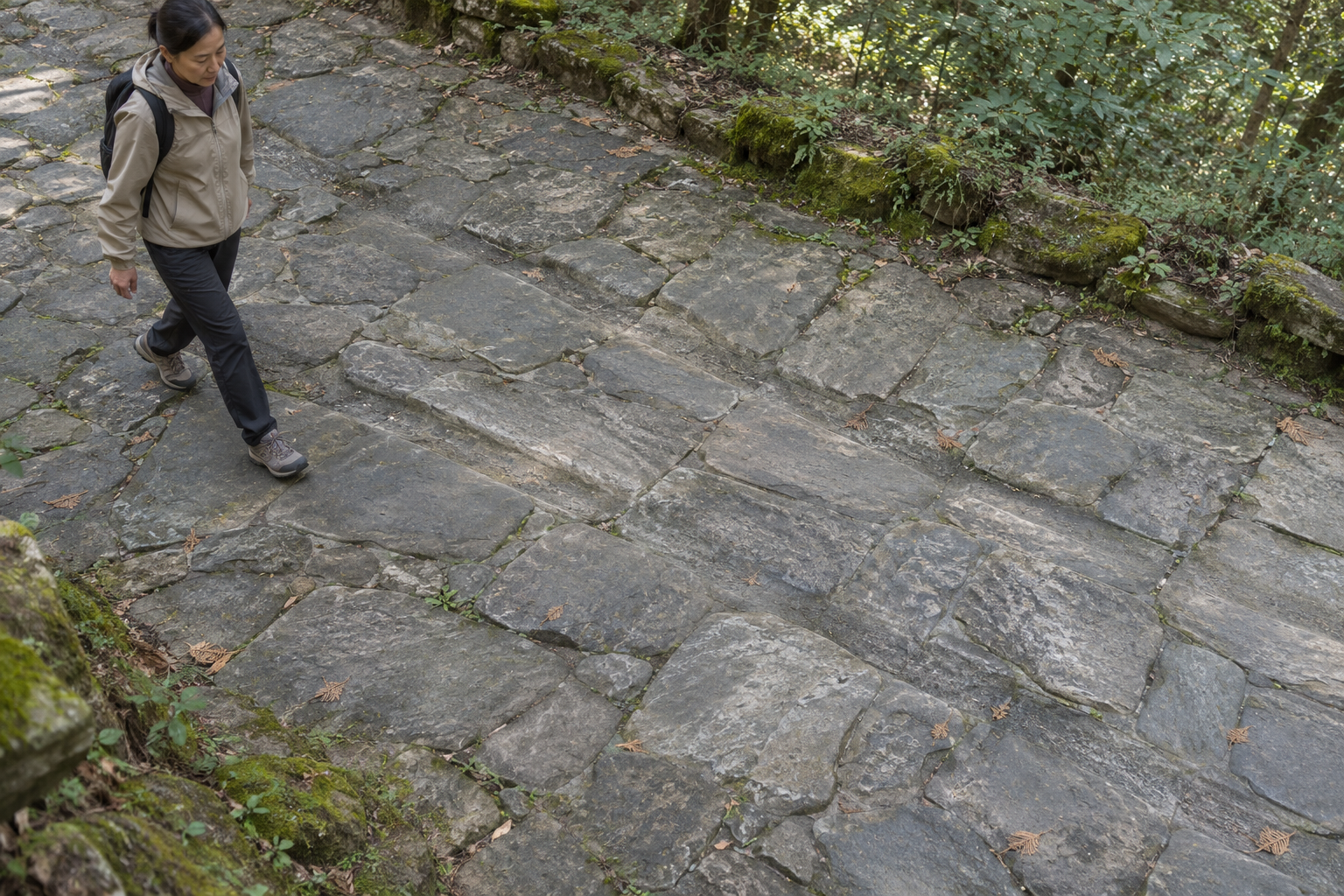
Worn stone paving and shallow grooves along an old road.
Walk the Jinniu Road beside Pang Tong Shrine
The historic Jinniu Road (金牛古道), often translated as the Golden Ox Road, ran through this part of Sichuan. The provincial conservation plan identifies several surviving stretches around Baima Pass. Near Pang Tong Shrine it describes blue-grey stone paving and visible cart wear. Look for the difference between a groove worn into a slab and the joint where two slabs meet. The stone edges beside the path tell another part of the story, showing how the road was supported and kept in place.
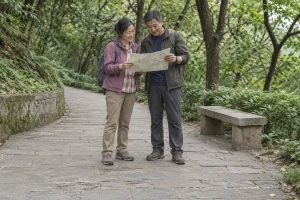
Ask staff which part of the shrine-side stretch you can walk that day. Pick a signed landmark as your turnaround and walk back to the same entrance if permitted. In rain, the polished surfaces and the edges of uneven slabs can be harder to negotiate. Give children time to cross the roughest patches and leave enough space for people coming the other way. An old road on a map can mark an important historic alignment even when individual pieces cannot be followed as one continuous public trail.
| Stop | What to look for | When to shorten the visit |
|---|---|---|
| Shrine-side Jinniu Road | The difference between wear marks and the joints in the blue-grey paving. | Choose the shortest signed turnaround if your feet or balance tire on uneven stones. |
| Shrine courts and halls | Stone columns, carved texts and paired figures if the hall is open. | Use the available court and gate area when the inner route is closed. |
| Tomb grounds | The final part of the memorial sequence where visitor access extends that far. | Stay with the route marked by staff. Allow time to return to your meeting point. |
Travelers choosing between two old-road days can use our Jianmen Pass and Cuiyun Corridor guide for the separate terrain and visitor routes farther north. At Baima Pass the best view may be under your feet. There is little reason to extend the walk beyond the preserved paving if your main interest is the relationship between the historic road and the shrine.
Read the stonework at Pang Tong Shrine
Pang Tong was an adviser to Liu Bei during the events that led to the Three Kingdoms period. His name is also associated with the sobriquet Fengchu, usually translated as Young Phoenix. The provincial conservation account describes the surviving shrine and tomb complex as the result of a Qing-period rebuilding and later repairs. That distinction makes the buildings easier to read. They show how later generations commemorated Pang Tong. The local stories tied to the pass are a separate part of what visitors encounter.
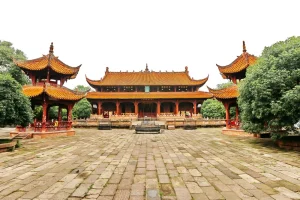
Start with the stone columns and carved couplets. If the Hall of the Two Masters (二师殿) is accessible, look for the paired figures of Pang Tong and Zhuge Liang. A 2026 site report describes the layout from the shrine gate through that hall and Qifeng Hall (栖凤殿) toward the tomb grounds. Follow the route staff have marked for visitors. Some thresholds or halls may be unavailable. If the gate is as far as you can go, examine its stonework from the designated visitor area and spend longer on the adjacent road if its surface is safe. In Mianyang, the Fule Mountain park walk is a different way to explore how Three Kingdoms figures are remembered.
Make time for Luojiang douji and the full return
Ask at lunch for Luojiang douji (罗江豆鸡). The name means bean chicken. The traditional snack is made from soybean skins, folded and pressed before being cut and seasoned. Treat it as a side and order a cooked vegetable dish, rice and another main as needed. Ask about the seasoning or cooking fat if you avoid animal products, and skip the dish if soy is unsuitable for you. Do not depend on a shop beside the shrine being open. Luojiang town is a separate stop to name when you arrange the vehicle.
| Stage | Make time for | Connection to confirm |
|---|---|---|
| Arrival | An entry check and the safest short walking segment. | Save the correct Baima Pass entrance and tell the driver where to wait. |
| Luojiang lunch | A seated break and local douji with your meal. | Choose a town drop-off with an agreed pickup point before walking away. |
| Full return | Travel back before the evening or a fixed departure. | Confirm the ride from lunch to the same hotel, or name the different endpoint in advance. |
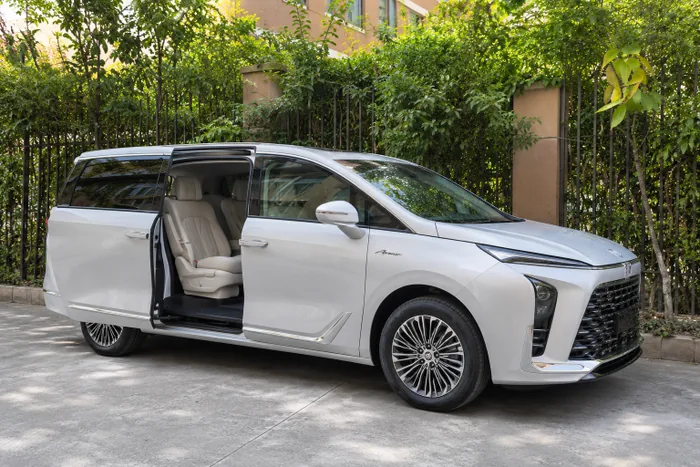
On a day trip from Chengdu, arrange pickup at your hotel or another reachable point, a wait at the agreed Baima Pass entrance, the lunch transfer and the drive all the way back to your hotel. If you travel by rail to the area, check the exact arrival station and book the necessary road legs from there and back. For an onward train or flight, give the return and luggage collection their own time. A ride that ends at a station only works when the route, departure and transfer from the platform match the ticket you actually hold.
Decide where to stay before fixing your route
A central Deyang hotel works well if you want to combine Baima Pass with a separate visit to the Deyang Confucian Temple. Stay in Luojiang town if you want to start closer to the pass and eat dinner near your room. Check the hotel’s actual address and which door the car can reach, especially if traveling with large cases. For an early Chengdu flight, return to the airport side of Chengdu the night before. A room in Luojiang or Deyang is a useful base for the pass, with a longer transfer still ahead when you leave.
| Trip length | Suggested order | Nights |
|---|---|---|
| 3 days / 2 nights | Arrive in Deyang. Visit Baima Pass and have lunch in Luojiang on day two. Return to Deyang and depart on day three. | 2 Deyang nights. |
| 4 days / 3 nights | Arrive in Chengdu. Move to Luojiang on day two, visit Baima Pass on day three and return to Luojiang. Leave road time on day four. | 1 Chengdu night and 2 Luojiang nights. |
| 5 days / 4 nights | Arrive in Chengdu. See Sanxingdui on day two if booked and continue to Deyang. Visit Baima Pass on day three, then return to Chengdu on day four. Depart on day five. | 1 Chengdu night, 2 Deyang nights and 1 Chengdu night. |
Give Sanxingdui Museum in Guanghan its own timed visit if it is a priority. Its ancient Shu galleries explore a much earlier period. Putting the museum and Baima Pass on different days makes it easier to allocate time to both and protects lunch and the full return.
Ask your Verotrip travel consultant for a route that states the actual entrances, current accepted passport details and payment channel, walking pace, vehicle waiting, and final hotel or station drop-off. Price on request. Admission, English-speaking assistance, lunch, rooms and their conditions should be itemized in the written plan. If heavy rain makes the paving unsafe, use only the accessible shrine section if open or move to a separate confirmed indoor stop. Agree what happens to onward transport when the route changes.
Questions about visiting Baima Pass
Is the shrine visit the same as walking the ancient road?
They are separate choices in the same area. You can look for worn paving on the open road section, then check whether the shrine halls and tomb grounds can be visited on your date.
Can travelers with overseas passports visit?
The public route has been used for general visits, and a 2025 cultural programme documented overseas participants walking the road and entering the shrine. Check what the individual visitor window accepts for your passport and whether the museum requires advance booking for your date.
What shoe and walking pace work best?
Choose shoes with good grip and a pace that lets you pause before uneven slabs or thresholds. Try the shortest signed stretch first. If you use a mobility aid, verify the whole path from the drop-off to the area you want to see, including stone joints and steps.
Can I finish in Deyang when I started in Chengdu?
Yes, as an intentionally arranged one-way day. Collect bags before leaving Chengdu, confirm space for them in the vehicle and name the final Deyang hotel on the booking. Leave time to check in before dinner.