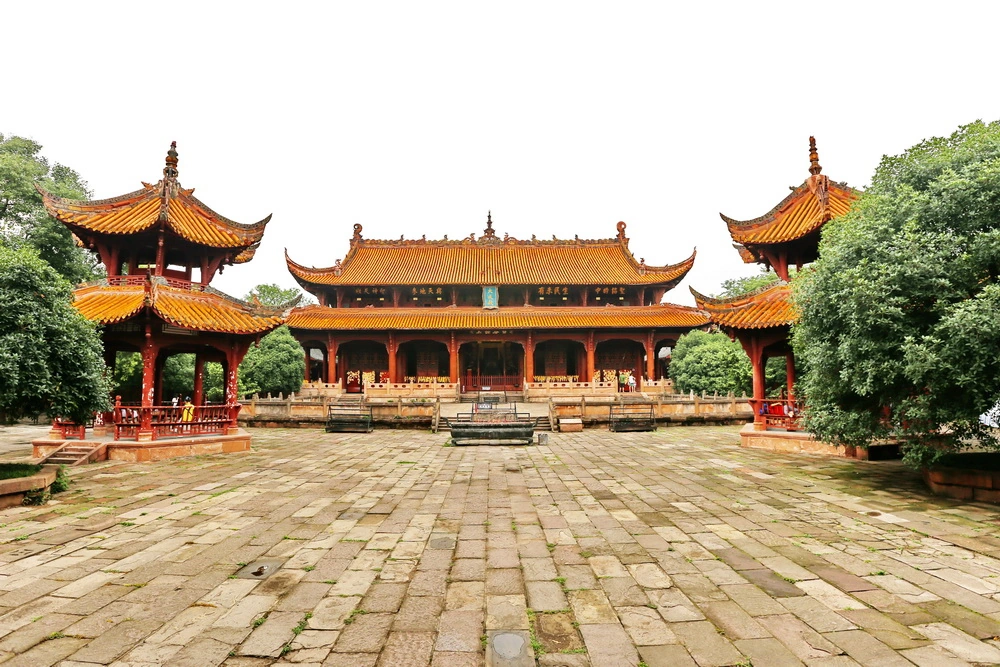
At Deyang Confucian Temple, make the court before Dacheng Hall your main stop. Smaller pavilion roofs lead the eye to the broad yellow-roofed hall, explaining a space designed for ceremony. Follow the gates and bridges, then sit down for lunch near Wenmiao Street.
Save 德阳文庙, 133 Wenmiao Street, Jingyang District. This city-centre walk is for carved stone and timber halls. Sanxingdui’s archaeological collections are in Guanghan and deserve a separate day.
From the screen wall to the music pavilions
Begin at Wanren Gongqiang, the screen wall, comparing glazed dragons with the red background. Step sideways to see how it hides the interior. Follow today’s public entrance rather than assuming the architectural centreline is the visitor route.
At Lingxing Gate’s three stone arches, choose one upright or crosspiece. Look for the museum-identified fish becoming a dragon: one recognisable motif makes the carving easier to remember.
At Pan Pool, look along the semicircle before facing the hall across its three bridges. The form’s school association links education with reverence for Confucius. Children can find the railing lions from a safe position without blocking crossings.
| Where to pause | One detail worth finding | How to see it |
|---|---|---|
| Screen wall and Lingxing Gate | Glazed decoration on a red wall, then three openings carved in stone. | Look from across an open space, then move closer to one carving. |
| Pan Pool | The half-circle and the individual lions along its stone railings. | Look from the side before taking any bridge open to visitors. |
| Courtyard before Dacheng Hall | Four music pavilions with different plans and a much larger hall beyond. | Compare the silhouettes from the courtyard, then turn to look back from the far side if open. |
What to look for at Dacheng Hall
Beyond Halberd/Dacheng Gate, compare the four ritual music pavilions. Move sideways to count the corners: the museum describes hexagonal inner pavilions and outer ones with square lower plans and changing upper tiers.
Look from Dacheng Hall’s raised platform across the court, considering how the pavilions and hall framed a ceremony. Give staff, worshippers and school groups room. Any demonstration or festival music requires its own arrangements.
If the rear court is open and energy remains, compare Qisheng Hall’s green tiles with Dacheng Hall’s yellow. Qisheng honours Confucius’s father. Otherwise turn back after the ceremonial court for lunch.
Keep the institution’s Southern Song origins separate from each building’s age. Relocation and rebuilding shaped the complex, with major present features dating to the Qing. Individual identification panels explain the gate or hall in front of you.
A morning from Chengdu, with lunch and a way home
For a Chengdu return, leave cases by agreement and carry your original passport and a day bag. Count hotel-to-station, train, Deyang street transfer and all return legs separately; arrival at Deyang station is not arrival at the temple.
Agree a legal drop-off and post-lunch collection. Parking is limited and vehicles cannot enter the grounds. Save the Chinese address and contact, choosing a restaurant-side pickup when permitted for anyone who tires standing.
Visit the gates, pool and music court before deciding on the rear hall. Allow for lunch, exit and station transfer before choosing a return train. A Deyang night makes a longer break possible; an evening street walk is separate from closed heritage buildings.
What to eat around Wenmiao Street
Around Wenmiao Street, consider Zhongjiang dried noodles or Lianshan twice-cooked pork, regional dishes from different parts of wider Deyang. Check the menu: noodles suit a quicker solo meal; shared pork, rice and vegetables suit a longer group lunch.
If you avoid meat, ask what goes into the noodle broth and the seasoning as well as the topping. For a severe allergy, bring the ingredient name in Chinese and ask whether the kitchen can prepare the dish separately. Make lunch a seated break, especially if you have been looking up at carvings or standing by the pool for much of the morning. A named restaurant, a particular dish and a meal paid for in advance should each appear in the arrangements if they matter to you.
Where to sleep and how to divide the nights
Keep the Chengdu room for a day excursion, or choose central Deyang for dinner-time streets and a slower morning. Compare luggage access and both station and temple journeys; a pedestrian-street listing can still leave a suitcase walk.
| Trip length | Suggested rhythm | Where to sleep |
|---|---|---|
| 3 days, 2 nights | Arrive in Chengdu on day one. Spend day two in Deyang with a seated lunch and a return to Chengdu. Depart on day three. | Two nights in Chengdu, so the luggage can stay put. |
| 4 days, 3 nights | Start in Chengdu, move to Deyang on day two and take a late lunch. Use day three for the temple if it opens that day, then return to Chengdu. | Chengdu, Deyang, Chengdu. The final transfer is from Chengdu. |
| 5 days, 4 nights | Spend the first two days in Chengdu. Move to Deyang on day three, give the temple and the centre a full day, and arrange an onward connection on day five. | Two nights in Chengdu, then two in Deyang. Allow a fresh transfer if the final departure is from Chengdu. |
If a companion would prefer a museum day in Guanghan, compare the Chengdu Museum and Sanxingdui guide. Verotrip’s Sanxingdui day itinerary travels from Chengdu to the museum in Guanghan, takes a meal break around the reserved session and returns to Chengdu. To visit Deyang’s temple as well, ask for a separate day and specify where you want to sleep afterwards. The Chengdu planning guide helps place the excursion between your arrival and departure.
Access, weather and costs
The operator’s temple notice lists ordinary admission as free and Monday as the normal closure day, with an exception for national public holidays. Check notices for your date before booking transport. The exhibition hall has its own visitor rules. If you intend to enter both, ask about the procedure for your original passport, any booking or group arrangements, available galleries and the last entry to each. Someone who wants only the architectural walk can plan around the courtyards without committing to an exhibition.
| Decision | Why it affects this visit | Practical adjustment |
|---|---|---|
| Short walk or full axis | Bridge slopes, paving, steps and thresholds can interrupt an otherwise compact walk. | Ask about the current level route to the music court. For limited mobility confirm distances, seating and the way back to the vehicle. |
| Rain or strong sun | The pond and the open court are best seen from outside. Wet paving changes the footing. | Shorten the route to one court, allow a longer lunch and leave the rear hall for better conditions. |
| Language and interpretation | A Chinese building name is enough to find a gate. The connections between music, education and ceremony take more explanation. | Save the names on this page. Ask for an English-speaking interpreter in advance if the history matters to your visit. |
Price on request. Identify the starting and final points, walking limits, both rides, waiting, language, train tickets, paid activities, meals and rooms. For a stay, agree bag custody and the last transfer as well.
Questions about visiting Deyang Confucian Temple
Which part is most rewarding on a short visit?
Head for the court before Dacheng Hall. Compare the footprints of the music pavilions and the raised platform in front of the hall. If you can spare another stop, make it the Pan Pool. Together they explain the site’s two strongest themes, education and ritual.
Can I combine the temple with Sanxingdui on the same excursion?
The two stops are in different places. Sanxingdui has a timed museum visit in Guanghan, while the temple is in urban Deyang. For a first visit, give each a separate day. On a shorter trip, choose according to whether you want an object-led archaeological visit or a walk through historic architecture followed by lunch in town.
Will I hear ceremonial music or an English audio guide?
The pavilions can be appreciated on an ordinary visit. For a performance, workshop or an English explanation, obtain the date, language and meeting point before travel. A historic announcement of a Chinese-language audio service gives no timetable for an English session or a live ceremony.
Is Deyang a useful overnight stop for someone travelling with parents?
It can be, particularly when two long transfers in one day would cut short the visit. Choose a hotel with straightforward vehicle access, keep lunch close to the street where you finish, and ask whether everyone can reach the specific courtyard they want to see. Sleeping in Chengdu works well for travellers who prefer to keep one room and can manage both journeys.
Cover photograph of Dacheng Hall by Nekitarc, July 2015. Converted to WebP and cropped for display under CC BY-SA 4.0.