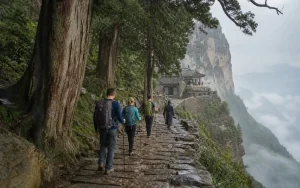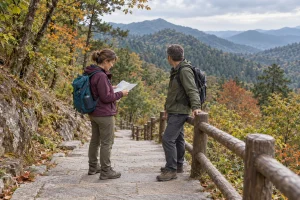
Choose Jianmen Pass for a mountain-and-gate visit, or Cuiyun Corridor for walking beneath the old cypress trees of the Shu Road. Give each its own outing if both matter to you. A substantial Jianmen walk, every optional cliff activity and a long historic-road trek make a very different day from a selective cultural visit.
Both places are in the Jiange area of northern Sichuan, within the wider Guangyuan travel region. They belong in the same historical conversation, but their entrances, walking surfaces and return arrangements need separate planning. For two full visiting days, a four-day stay with three local nights is a useful starting shape. With only one full day, choose the stronger interest.
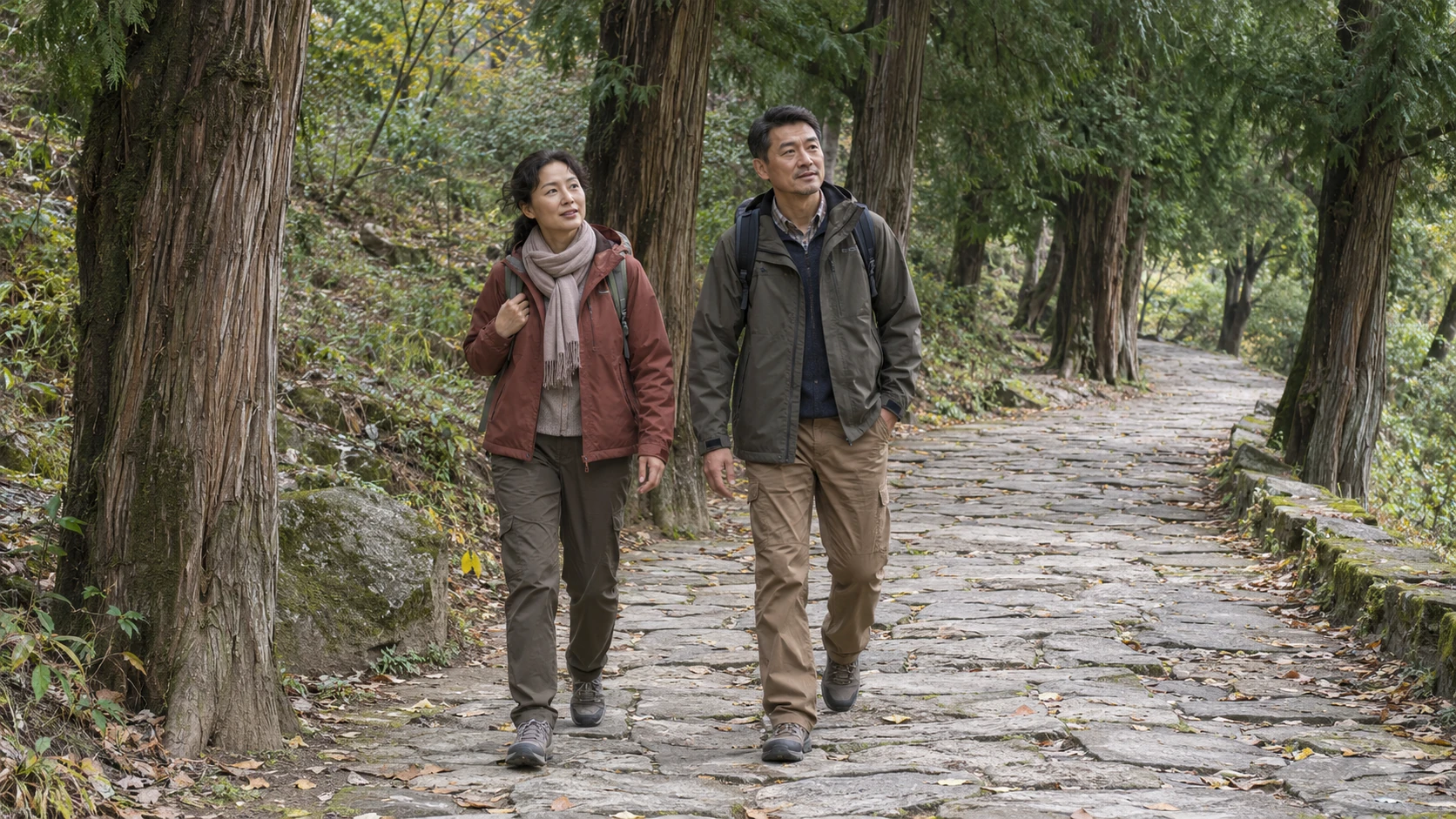
Checked 3 November 2026. AI-generated fictional walking illustration. This is an imagined cypress-lined path, not an exact Cuiyun Corridor tree or trail, current access condition, real client, guide or Vero Trip group.
Choose the walking experience before choosing the ticket
Jianmen Pass, 剑门关, is the mountain setting associated with the difficult historic approach to Sichuan. Cuiyun Corridor, 翠云廊, brings the road itself into focus: old paving, cypress trees and the long relationship between transport and tree protection. The National Forestry and Grassland Administration describes the trees’ historical roles in marking the route, supporting the road environment and providing shade.
That difference is useful for mixed groups. Someone interested in history and trees may enjoy a selective Cuiyun visit without wanting a steep mountain objective. A keen walker may prefer a longer Jianmen day, but should still decide whether the interest is the main visitor landscape or a separately controlled adventure activity.
| Your priority | Planning choice | Settle before travelling |
|---|---|---|
| Historic pass and mountain scenery | A selected, currently open Jianmen visitor route with time around the gate setting. | Entrance and exit, stairs, optional transport and the final pickup. |
| Old trees and road heritage | A manageable section within the operating Cuiyun visitor area. | The actual entrance, walking length, surface and whether the return retraces the route. |
| Sustained trekking over several days | A separately designed ancient-road walking itinerary. | Each authorised segment, daily effort, luggage support and road transfers between walks. |
These choices do not form a compulsory circuit. A broad stone path can still be uneven, wet or tiring over a long distance. A cableway can reduce one ascent without removing every step. Ask for the complete day from the hotel door to the return, rather than judging suitability from one photograph.
Give Jianmen a route that your whole group can finish
At Jianmen, start by choosing the entrance and the main places you want to see. Then ask which open path connects them and where the visit ends. A south-gate approach and a north-gate approach are different transport instructions; “meet at Jianmen” is too vague for someone carrying a phone with limited connectivity.
A cultural visit can concentrate on the pass landscape and the gate setting without making the highest or most exposed activity its purpose. Ask whether the proposed route includes repeated stairs, a substantial descent or a long walk after the last scenic transport. Leave time to look at the landscape and hear its history instead of walking continuously to meet an ambitious finish time.
Bird Path, 鸟道, and Yuan Nao Path, 猿猱道, appear in adventure accounts of Jianmen. They should be treated as distinct, controlled choices with their own current access and booking requirements. The operator’s 2026 holiday notice listed separate real-name reservations for them. That holiday arrangement is evidence that they are not simply an automatic extra included in every ordinary visit; it is not a permanent booking timetable for your dates.
This guide’s lighter visiting outline does not depend on either activity. If a traveller specifically wants one, request the current eligibility, equipment, direction of travel, operating conditions and a suitable alternative before paying. Someone uncomfortable with heights should not discover that a cliff activity is expected only after reaching it.
Agree a shorter version that the party can take together. Transport should support that decision: the driver needs the correct exit and pickup arrangement, while anyone using local services needs the actual return point. A prepaid mountain objective is not a reason to continue when the group’s strength or the conditions no longer suit.
Visit Cuiyun as a protected road landscape
Cuiyun’s interest is more than a backdrop of large trees. The cypress-lined road records how journeys, maintenance and protection developed together. A first-hand Sichuan transport report explains that modern road alignments were changed to protect the trees and that sections of former road became part of the visitor landscape. Modern vehicles and the protected walking setting therefore should not be assumed to use the same alignment.
Choose the operating scenic-area entrance and a specific manageable walk. Ask whether it is an out-and-back visit or a route with a different exit, and where the vehicle can legally collect you. The broad label “Ancient Shu Road” covers a historical network and different modern visitor areas. It does not establish a continuous open pedestrian route between every town.
Leave room for slow observation: the old paving, changing tree forms and the relationship of the road to its surroundings. A seated break and a shorter return may be more rewarding than adding kilometres solely to make the visit sound substantial. For a family, choose one simple theme, such as why trees were planted beside a road, rather than turning every tree into another required stop.
Keep to the permitted visitor surface and respect barriers around trees and conservation work. Do not climb trunks, stand on roots for a photograph or enter a protected side area to avoid other visitors. Old stone can be slippery after rain, and shade does not remove the need for water, layers and a workable return.
A long walk on another ancient-road segment needs separate confirmation. Do not extend from a scenic visit into an unmarked rural track merely because it appears connected on a navigation map. The entrance, exit, legal access and pickup have to be established for that specific segment.
Read dated notices before relying on an ordinary route
Recent notices demonstrate why the day and the individual section matter. The operator’s notice issued on 28 October 2026 specified a filming closure at Cuiyun Corridor on 31 October. It also specified north-gate entry at Jianmen that day and controls until noon on the Xianyun Market–Leiming Bridge–gate tower–south gate section. Guangyuan Daily reproduced that notice.
That was a dated restriction, not evidence of a permanent closure or independently confirmed reopening for every later date. Recheck the current operator notice before choosing the gate, paying for transport or using a saved route. A previous general opening report cannot override a newer closure covering the exact place you intend to walk.
Weather can also affect selected areas. An August 2026 operator update reproduced by Chengdu’s official information service distinguished open visitor areas from several sections still under rain-related controls. Use such reports to understand how specific restrictions work, rather than as today’s all-clear. If the intended walk is unavailable, change the date, choose another confirmed public visit or keep a rest day; a closed path does not require a substitute trek.
Choose a base for the next morning and the last return
A Guangyuan city hotel suits a city arrival, meals and a wider regional stay, but it adds a road approach to the Jianmen and Cuiyun days. A nearer Jiange or Jianmen-area property can reduce repeated approaches when those two visits are the main reason for travelling. Choose the actual address and its role in the programme, not simply a room marketed as “near Jianmen.”
Ask about reception for the passports in your party, heating or cooling, stairs, breakfast and the legal vehicle drop-off. Three nights in the same suitable room make bag handling easier than changing hotels after each walk. Leave large cases at the agreed accommodation or storage point and carry the day’s essentials in a comfortable small bag.
Jianmenguan railway station and a scenic-area gate are separate places. The operator’s 2026 visitor notice describes a road transfer from the station to the gates. Check actual rail services for your date and include the final road leg, hotel check-in and return station approach. An attractive train time alone does not make a complete sightseeing day.
If using taxis or an arranged vehicle, save the Chinese entrance and hotel addresses offline and settle the collection point. A driver and an English-speaking guide are different services. For a self-drive preference, resolve driving entitlement, rental acceptance, insurance and parking in a separate vehicle arrangement; this walking outline does not confirm them.
A four-day stay with two full visiting days
This example uses one local base for three nights and gives Jianmen and Cuiyun separate full days. It is a pacing suggestion, subject to current access and your walking limits, rather than a package with confirmed hotels or admissions. Start it after any Chengdu city stay instead of silently counting the Chengdu nights inside the local three.
| Day | Main purpose | Overnight and return |
|---|---|---|
| 1 | Arrive by the agreed rail or road service, transfer and settle in. Keep a short local outing optional. | Chosen Jiange/Jianmen-area base, night 1. |
| 2 | Selected open Jianmen route, meal and a dependable return; no compulsory cliff activity. | Same base, night 2. |
| 3 | Selected Cuiyun visitor walk with time for the trees, road history and breaks. | Same base, night 3. |
| 4 | Collect luggage and complete the road transfer to the correct onward station or destination. | No fourth local night assumed. |
The two main days can be reversed when confirmed admission, weather and transport make that sensible. Reversing the table does not resolve a closure or create an available ticket. If only one site is essential, shorten the local stay and keep that full day instead of adding another mountain purely to fill the calendar.
With one full day from Guangyuan, choose Jianmen or Cuiyun and include both road transfers. Combining shorter parts of both is possible only when the actual routes and conditions fit; it should not be sold as the same experience as two complete outings. For a major flight afterwards, consider returning to its departure city earlier and keeping an appropriate margin.
Weather, meals and the physical day
Spring and autumn are useful planning starting points for this walking interest, but no month guarantees dry paving or clear mountain views. In colder weather, ask about ice and shorten the exposed visit if needed. In summer, include water, shade and rest; during heavy rain or storms, follow local closures and avoid substituting an unofficial path.
Describe walking limits precisely: comfortable time on your feet, tolerance for steps and descents, fear of heights and the need for regular seated breaks. Children and older relatives may enjoy the road history while needing a shorter programme. Ask about the nearest appropriate toilet and return option before leaving the vehicle, particularly on a longer walk.
Arrange a real meal break. If tofu dishes are part of the local food interest, check ingredients, broth, sauces and cooking methods for your diet. A tofu dish is not automatically vegetarian or halal. Share allergies and prayer or rest needs when fixing the day’s schedule, and carry a suitable snack when the walk extends beyond the next reliable meal stop.
Tickets, passport checks and quotation boundaries
Official information checked for this guide uses real-name booking language and describes domestic identity-card entry. It does not establish the current passport transaction for every entrance or optional activity. Confirm how your passport is booked and checked for the exact date, carry the required original document and keep the reservation details available offline.
Ordinary international visits to Jianmen are documented, and the Ministry of Culture and Tourism discusses Cuiyun among destinations attracting overseas interest. That context is different from guaranteeing a ticket, a particular activity or an English service. Check any concession against its actual eligibility instead of assuming a domestic student or senior discount applies.
Ask the written proposal to separate accommodation, road transfers, guiding, standard admission, scenic transport, optional activities, meals and the final station transfer. A vehicle waiting during a walk, luggage storage and a change of pickup gate can affect the service arrangement. Price on request; inclusions and change terms depend on the dated written proposal.
Compare the existing Shu Road trek carefully
The existing five-day Ancient Shu Road trek is a genuinely related route, but it is substantially more active than the selective visits above. Its daily programme lists a roughly 13-kilometre Cuiyun/ancient-road day and further days with roughly 15-kilometre walks, including additional ancient-road sections and Zhaohua.
Use it as a starting point for a walking discussion, then request current segment access, actual effort and any revisions. Its Bird Path reference is not a live operating notice. The shorter four-day outline here does not inherit that product’s kilometres or imply that its services have already been arranged.
The Guangyuan destination page helps compare a city base. Use the Sichuan walking guide for a broader choice of effort, or the Sichuan regional planner to decide how this extension fits after Chengdu.
Questions before booking
Must we walk Bird Path to enjoy Jianmen?
No. Choose a suitable currently open main visitor route and confirm its steps and return. A separately controlled adventure activity should follow your interests and eligibility, rather than becoming a compulsory part of a cultural day.
Is Cuiyun a flat, effortless alternative?
Do not assume that. Choose a specific length and ask about stone surfaces, gradients, rest points and the return. A gentler emphasis on trees and history can still involve substantial walking.
Can we arrive, visit both and leave on the same day?
That depends on actual transport and short selected visits, with little margin. If both are priorities, keep two full local days. A late arrival and early departure do not provide them.
What should we send Vero Trip?
Send dates, passport nationalities, arrival and departure services, group size and ages, comfortable walking and stair limits, room setup, luggage and food needs. State whether the main interest is Jianmen scenery, old cypress trees or sustained trekking. Request the exact open route, hotel base and return before settling the final programme.
Sources and current-access checks
Sources checked on 3 November 2026 include the national forestry account of Cuiyun’s historic trees, a first-hand report on the protected road landscape, the operator’s dated 2026 holiday visitor notice and the 31 October filming and gate-control notice. Holiday hours, promotions and one-day restrictions are not standing promises for later travel dates.