
Quick answer: Foreign visitors can rent a car in China when they have an accepted Chinese driving credential—usually a temporary driving permit for a short stay—and the exact rental branch accepts their passport, entry status, payment method and route. The biggest risk is assuming that an online reservation or national brand name guarantees pickup. Get written branch confirmation before paying for a non-refundable booking. Last fact-checked: 31 August 2026. Rental terms can change by supplier, city, branch, vehicle and order. The signed rental agreement and insurance schedule control the transaction.
Can a foreigner rent a car in China?
Yes, but the traveller must pass two separate gates:
- Legal driving eligibility: a full Chinese licence or applicable Temporary Motor Vehicle Driving Permit.
- Supplier acceptance: the branch approves the identity, documents, age, payment, deposit, vehicle and travel plan.
A foreign licence, English translation or International Driving Permit alone should not be treated as a general mainland-China driving credential. Complete the China temporary driving permit process first or confirm the specific alternative that applies to your case.
Why “booked” does not always mean “designated”
Large booking platforms can accept a reservation before a branch employee has checked a foreign passport or temporary permit. The website may know that the vehicle exists but not whether the pickup counter will accept:
- Visa-free entry rather than a visa sticker.
- The applicant’s particular temporary permit.
- A translated overseas licence.
- An international credit card for pre-authorisation.
- A driver name that appears in a different order across documents.
- A planned one-way or cross-province rental.
This is why useful rental advice must be branch-specific. Traveller reports are valuable as warning signals, but one successful or failed handover does not prove a national policy.
Documents to prepare
Confirm the exact list with the branch. A foreign tourist’s file commonly includes:
- Passport.
- Current entry/stay evidence.
- Chinese temporary driving permit or full Chinese licence.
- Original overseas driving licence.
- Accepted Chinese translation.
- Booking confirmation.
- Main driver’s physical payment card when required.
- Chinese or reachable phone number.
- Additional-driver documents.
The Chinese government’s guide for foreign residents and visitors explains that foreign travellers renting cars should prepare passport/identity evidence, a valid Chinese driving licence and an accepted credit card. First-time identity checks may require advance processing.
Can visa-free travellers rent a car?
Visa-free entry is not automatically incompatible with renting. The operational question is whether the branch can verify the customer’s entry status and accept the documents within its system. Send the branch a clear question before arrival:
I will enter mainland China visa-free using a [country] passport. I will have a valid Temporary Motor Vehicle Driving Permit, my original [country] driving licence and an accepted Chinese translation. Can your [exact branch] release the booked [vehicle class] to me on [date]? Please also confirm the deposit method and amount.
Keep the written answer. Reconfirm a few days before pickup because staff and internal guidance can change.
How to verify a rental branch
Ask for a response covering every item below. A vague “foreigners can rent” is not enough.
| Question | Required answer |
|---|---|
| Which branch? | Exact branch name and address |
| Which documents? | Permit, passport, licence, translation and entry evidence |
| When is identity checked? | Advance online check or at-counter check |
| Which payment methods? | Card network, physical card, Alipay/WeChat and cardholder rule |
| How much is held? | Vehicle deposit and separate violation deposit |
| Which vehicle? | Confirmed class or substitute policy |
| Where may it go? | Province, border, scenic-road and unsealed-road limitations |
| Where may it return? | Same branch, one-way city and after-hours conditions |
| Who may drive? | Main and additional-driver registration |
| What happens after an incident? | Police, supplier, insurer, towing and replacement steps |
If the branch will not answer in writing, keep a cancellable backup or choose a provider that will.
Deposit and payment: the hidden pickup problem
China’s mobile-payment environment is convenient for many daily purchases. The official guide to payment services for visitors explains how eligible overseas cards can be linked to mobile-payment services. Rental-car pre-authorisation is a separate risk-control transaction. Before booking, confirm:
- Accepted international card networks.
- Whether the physical card must be in the main driver’s name.
- Whether debit cards are rejected.
- Vehicle/security deposit amount.
- Traffic-violation deposit amount.
- When each hold is released.
- Currency conversion and refund method.
- What happens if the foreign card cannot be pre-authorised.
Do not rely on a successful ¥1 verification or booking payment. Ask the branch to confirm the actual pickup pre-authorisation.

What does a China rental car really cost?
Use an all-in formula: Base rental + service/booking fee + insurance upgrade + deductible exposure + deposits + additional driver + child seat + delivery/pickup + one-way return + out-of-hours fee + fuel/electricity + tolls + parking + cleaning/damage risk + route support. The lowest daily rate may be attached to a high deductible, limited mileage, strict return branch or basic vehicle. Compare the final order rather than the search-results headline.
Cost questions to ask
- Is mileage unlimited?
- Is tax included?
- Is the same vehicle class confirmed?
- Is a one-way fee fixed or calculated later?
- Are tolls charged through ETC after return?
- Is a fuel-service fee added if the tank is not full?
- Is the charging cable included with an EV?
- What cleaning, smoking or pet fees can apply?
- Can the supplier charge the card after return, and for what evidence?
Rental insurance without the marketing language
Compulsory motor-vehicle traffic-accident liability insurance is the statutory foundation. It is not a promise that all third-party injury, property, rental-car damage or loss will be paid without limit. Ask for the order-specific insurance schedule and translate these points:
- Third-party liability limit.
- Damage to the rented vehicle.
- Deductible/excess.
- Glass, tyres, wheels, mirrors and underbody.
- Theft and vandalism.
- Water damage, wrong fuel and lost key.
- Towing and roadside rescue.
- Loss of use while the car is repaired.
- Excluded roads or regions.
- Invalidating behaviour such as alcohol, an unregistered driver or late reporting.
The official Regulation on Compulsory Motor Vehicle Traffic Accident Liability Insurance helps define the statutory layer, but commercial rental coverage still depends on the policy and order.
Do overseas credit-card rental benefits cover China?
Do not assume. Ask the card insurer to confirm mainland China, the rented vehicle type, rental length and whether it covers damage to the rental car only or also third-party liability. Many card benefits require the cardholder to decline certain supplier coverage, which may be impractical or unsafe if the local contract is unclear.
Choosing the right vehicle
Automatic or manual
Match the vehicle to the permit class and your actual experience. Do not use a long mountain trip to learn an unfamiliar transmission.
Sedan or SUV
An SUV does not authorise driving on closed, restricted or contract-excluded roads. Choose it for luggage, ground clearance and road conditions, not for a false sense of permission.
Petrol, hybrid or EV
An EV can be excellent on a confirmed corridor when charging connectors, account access, payment and backup stations work for the visitor. Petrol or hybrid is often simpler for high-altitude, winter or remote routes. Make the decision from the roadbook.
Child seats and accessibility
Reserve the exact child-restraint type and check installation at pickup. For older or mobility-limited travellers, confirm door height, luggage loading, daily driving time, toilet stops and hotel access—not just seat count.
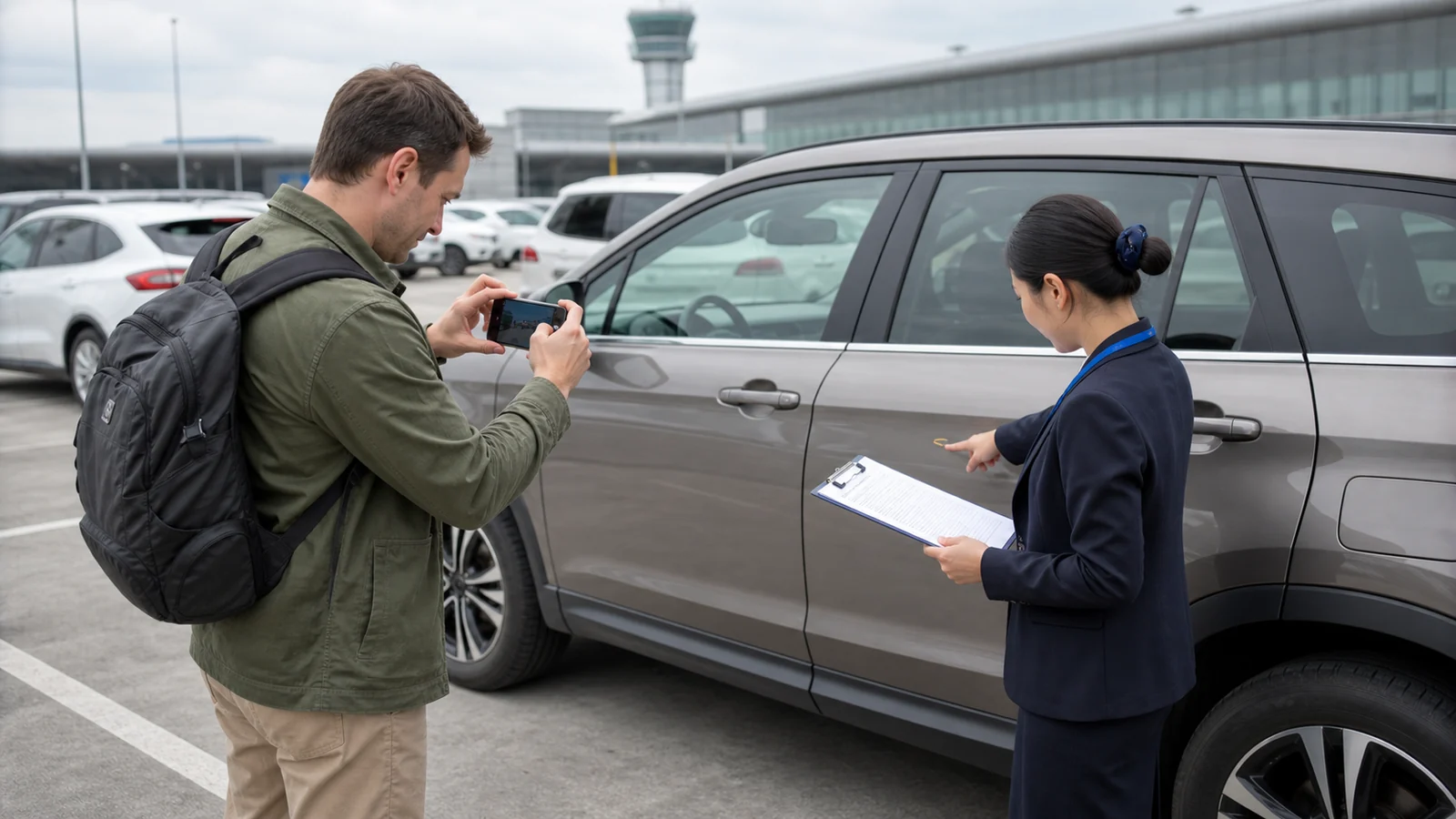
Pickup inspection: create evidence before moving
Film one continuous walk-around with the branch or location visible. Record:
- Every side, bumper, roof and underside visible without risk.
- Windscreen chips and glass.
- All wheels and tyre sidewalls.
- Existing scratches in close-up and wider context.
- Odometer, fuel/battery level and warning lights.
- Interior, seats, mats and luggage area.
- Spare tyre or puncture kit.
- Charging cable and adaptors.
- ETC device.
- Registration, insurance and inspection papers.
- Emergency triangle and reflective equipment.
Compare the video with the damage sheet. Ask an employee to add anything missing before signing.
Questions before leaving the branch
- Which fuel grade should I use?
- How are tolls and ETC settled?
- What is the 24-hour roadside number?
- What must I do before towing?
- Can another registered driver collect or return the car?
- May I cross the listed provinces?
- Which roads or scenic areas are excluded?
- What happens if a warning light appears?
- Where exactly is the return entrance?
- How do I prove an after-hours return?
Save the answers offline in English and Chinese.
Return procedure and post-return charges
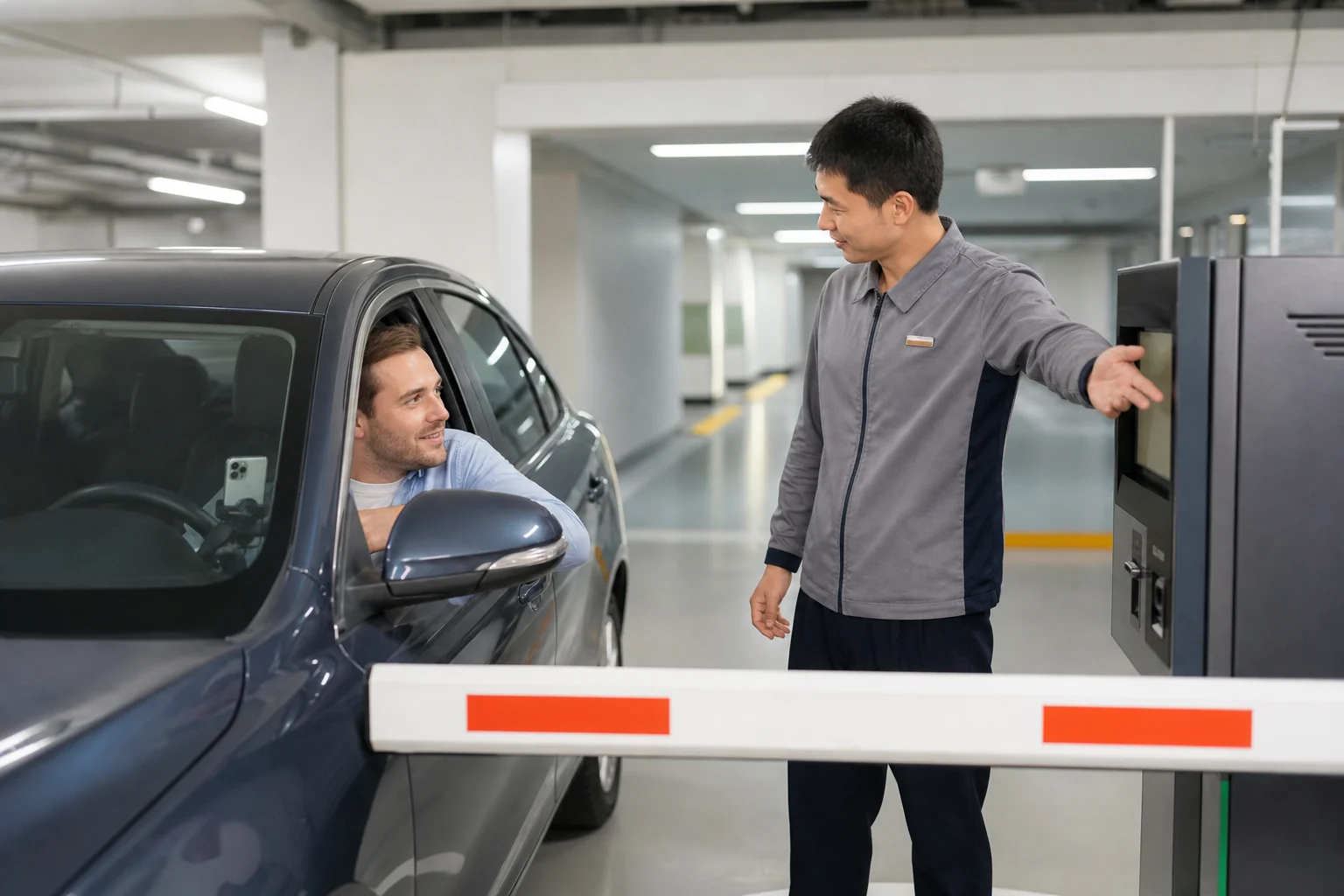
Allow time for a staffed inspection. Photograph:
- Vehicle position in the designated return area.
- All sides and wheels.
- Dashboard, mileage and fuel/battery level.
- Keys and documents handed over.
- Signed return receipt.
The receipt should record return time, location, immediate condition and charges. Ask when the vehicle deposit and traffic-violation deposit will be released. Keep all evidence until both are closed. If a later charge appears, request the dated photograph, ticket, damage report, repair invoice or contract clause supporting it.
Cross-province and one-way rentals
Do not assume nationwide driving simply because the brand operates nationwide. Confirm:
- Provinces permitted by the contract.
- Maximum daily or total mileage.
- One-way branch availability and fee.
- Roadside-replacement coverage outside the pickup province.
- Whether an EV may be returned at a different charge level.
- Restrictions around border counties, islands, ferries or unpaved roads.
For a long overland product, compare a supported itinerary such as the 14-day Silk Road self-drive tour with a standard consumer rental. The support and vehicle plan should match the distance.
When a private driver is a better choice
Choose a private vehicle with driver when:
- The trip is mainly large cities and high-speed rail.
- Permit time would consume a short holiday.
- The route involves Tibet or complicated permissions.
- The traveller is not comfortable handling a Chinese-language accident.
- Only one person can drive a long multi-day route.
- Parking and hotel access are more stressful than the freedom is valuable.
The 10-day G318 Sichuan–Tibet overland tour and 10-day Xinjiang Duku Highway route show how a professional-driver product can preserve the road-trip experience.
Copy-ready branch confirmation message
Hello. I am a [nationality] passport holder entering China [visa-free/on a visa]. I will collect at [exact branch] on [date/time]. I will bring my passport, original [country] driving licence, accepted Chinese translation and a Chinese Temporary Motor Vehicle Driving Permit valid for [class/dates]. Please confirm in writing: (1) the branch will release the booked vehicle, (2) the accepted deposit card/payment method and amount, (3) the traffic-violation deposit and release time, (4) permitted provinces and one-way return, (5) insurance limits/deductible, and (6) additional-driver requirements. Booking number: [number].
Continue planning the drive
If you have not yet confirmed eligibility, start with driving in China as a foreigner and the step-by-step China temporary driving permit guide. Once the branch has accepted the booking, use the China driving rules, Amap, toll and parking guide for collection-day setup, then compare the best road trips in China before locking the vehicle class and one-way plan. For a supported product rather than a consumer rental alone, compare the custom Yunnan self-driving tour and the 10-day Xinjiang Duku Highway and Pamir route.
Frequently asked questions
How much does it cost to rent a car in China?
The answer depends on city, date, vehicle, insurance, mileage and return arrangement. Compare the total order and deductible, not only the daily base rate.
Can I pay with an international credit card?
Some branches accept supported international cards, but card network, physical-card, cardholder and pre-authorisation rules vary. Obtain branch-level confirmation.
Can I use Alipay for the rental deposit?
Possibly, depending on the supplier and account. Everyday Alipay use does not prove that the branch can place a rental deposit or pre-authorisation through that account.
Do I need a Chinese phone number?
Not every rental requires one, but a reachable number helps identity checks, staff calls, roadside assistance and parking/charging services. Ask whether the supplier requires a mainland number.
Can someone else drive the rental car?
Only a driver registered in the contract and accepted by the insurer should drive. That person also needs the appropriate driving credential and documents.
Can I take the rental car to Tibet?
Do not assume so. Tibet travel arrangements, route permits and supplier restrictions are separate. Use an organised product where required.
What should I do if the branch refuses the car?
Do not drive without an accepted contract. Ask for the refusal reason in writing, contact the booking platform, preserve payment evidence and use the pre-planned train/private-transfer alternative.