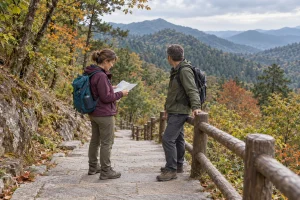
Choose Qingcheng Back Mountain for a forest-and-ravine day of its own. Approach through Tai’an and choose an authorised section that can be comfortably retraced. A shorter walk leaves more freedom than a long circuit dependent on late lifts or a tight train.
The Back Mountain, Qingcheng Houshan / 青城后山, is a separate visit from Qingcheng Front Mountain. This guide concentrates on the Wulong and Feiquan ravine choices, a daytime return and the question of staying near Tai’an. For the waterworks and Taoist Front Mountain, use the Dujiangyan and Qingcheng planning guide. The tickets, road approach and walking objectives should be named separately.
Choose a ravine walk with a dependable way back
Wulong Gou / 五龙沟 and Feiquan Gou / 飞泉沟 are useful names to recognise on the visitor information. They describe different ravine areas, rather than interchangeable labels for a single summit path. The provincial forestry authority’s published detailed plan identifies their stream, waterfall and woodland landscapes. Its proposals for signs, transport and visitor facilities describe planning intentions; they do not establish that every path or improvement is open today.
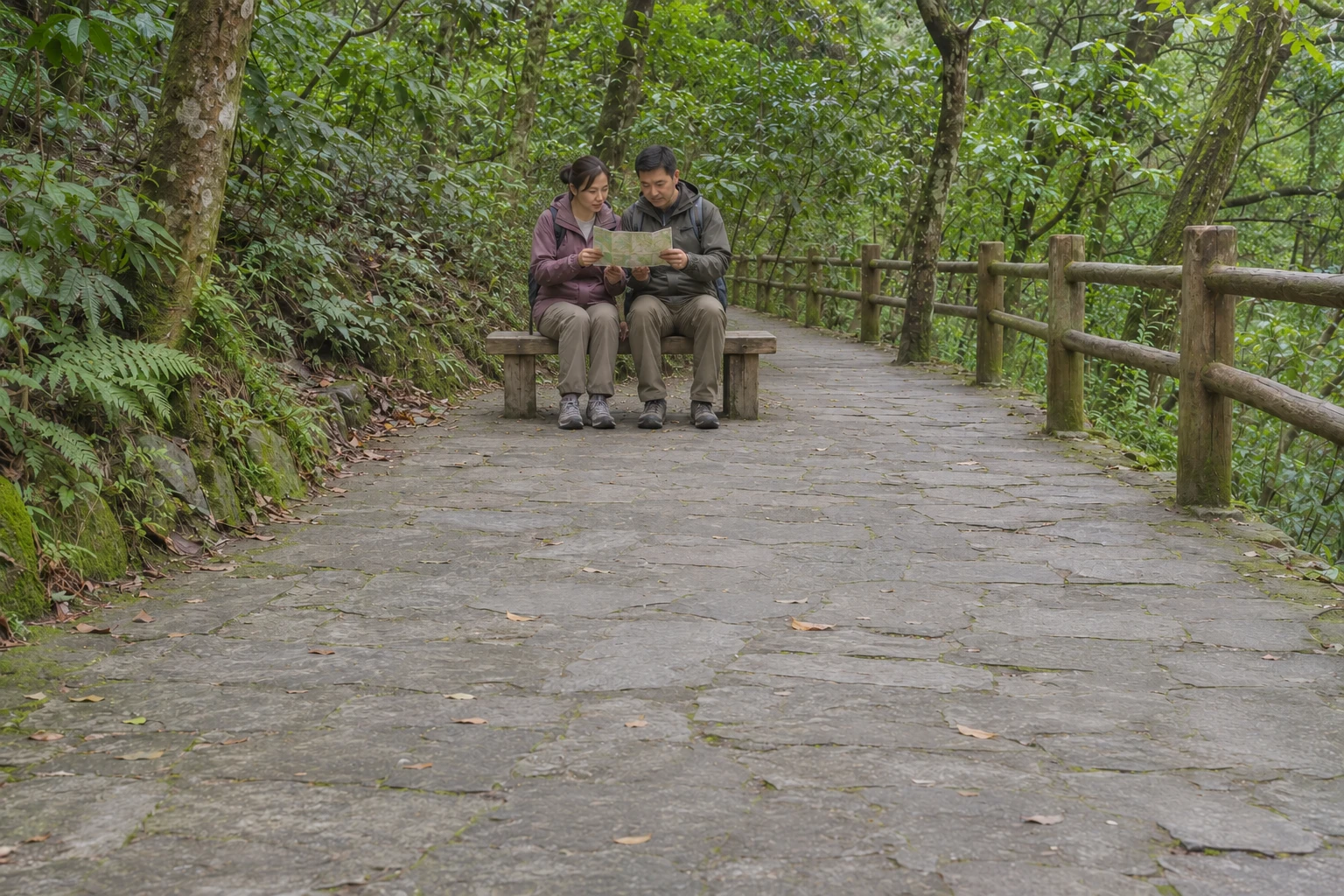
For a first walk, have staff mark an open lower Wulong section, approach and turnaround. Preserve daylight and energy for the same authorised path back. Youyi Village (又一村), higher links and cable stations need not become compulsory endpoints before conditions are known.
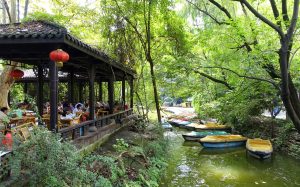
Look at path, trees and stream changing around the valley bends. Pause in a broad permitted area rather than narrow stairs or beyond rails. Water, foliage and visibility vary, so a named waterfall cannot promise one photographic appearance.
| Choice | How to shape the outing | Decision before setting off |
|---|---|---|
| Tai’an and a very limited approach walk | Keep the town, a seated meal and only a confirmed manageable public section as the main visit. | Identify the admission boundary, steps, toilets and exact return meeting point. |
| Lower Wulong ravine return | Choose an open section, enjoy the forest and stream setting, then retrace the permitted path. | Set the turnaround from the slowest walker’s descent and the complete journey home. |
| Feiquan ravine alternative | Select an open section after asking how far it goes and how you return. | Check whether the proposed endpoint introduces a lake crossing, transport dependency or additional steep steps. |
| A longer circuit or higher extension | Arrange a separate, specifically described day for capable walkers. | Confirm the full open connection, every transport component and a workable return if the plan changes. |
Discuss Feiquan as an alternative, not an automatic second ravine. An apparent map connection proves no open higher traverse. If the proposal depends on a lake crossing, establish operation, boarding, fee and return consequences first; the shorter return here needs no boat.
Tai’an is the place to reset the pace
Let Tai’an (泰安) organise arrival, lunch and a change of pace. Give lanes modest time while checking mountain information and transport. It can support a shorter companion plan only where the actual town approach is open and suitable.
Notice how visitor lanes and businesses serve the hillside outing. Check each restaurant or tea shop’s prices, food and seating independently. An open door guarantees no English menu, dietary procedure or free bag storage; keep residents’ passage clear.
A town visit does not include every temple interior, private courtyard or upstairs room. If a particular religious building or activity matters, name it and verify its present admission and conduct rules independently. There is no need to add an unconfirmed ritual, performance or workshop to make a forest day feel complete. For companions who prefer city culture, a separate Chengdu day may be a better shared plan than waiting for hours at a mountain pickup point.
A complete day from Chengdu
Start with the hotel-to-hotel journey. For an arranged road outing, specify the Chengdu hotel entrance, the Back Mountain drop-off that vehicles can actually reach, any final local transfer and the pickup after the walk. Ask whether the vehicle waits and what happens if traffic controls change the meeting place. A transfer to “Qingcheng” is too imprecise: it can leave the wrong mountain approach unresolved.
At arrival, deal with toilets, admission and the exact open endpoint and return before ascending. Carry water, a snack and a layer. Set turnaround from conditions, daylight and the whole onward journey, taking the descent allowance seriously even after an easy first stretch.
A lower morning walk can lead back to a seated Tai’an lunch and short lane pause before returning. If eating first, rest and reduce the afternoon route. An unconfirmed higher stall cannot be the essential dietary plan.
After descending, change a damp layer if needed, collect belongings and reach the agreed pickup. Complete local, road or rail and final Chengdu hotel stages. Keep essential evening bookings or flights apart from this variable mountain return.
Rail needs a real connection to the Back Mountain
Qingchengshan Railway Station / 青城山站 and the Back Mountain entrance are different places. A rail arrival still needs a confirmed local road connection towards the Tai’an approach. Check the exact service, boarding place, last return and any final walk for your travel date. Do not use instructions for the Front Mountain bus or gate as if they delivered you to the Back Mountain.
For an independent trip, work backwards from the return train and the transport reaching its station. Keep time for leaving the path, a rest, collecting bags, the local road journey and station procedures. A short train ride is not the total journey from your hotel. If a usable return connection cannot be established, choose another day or arrange a complete road return before travelling.
Traffic management can affect the road approach during busy periods. Ask the actual transport provider where a car or larger vehicle may stop and whether another shuttle is required. The written route should include that stage in both directions. Do not assume that staying nearby, buying admission or paying for a driver gives priority through a restriction.
Choose a base and count the nights
Keep the Chengdu room for a dedicated day, bags and city dinner. A Tai’an-area night can spread approach and walking over two dates, once actual road access and passport reception are established. A generic Qingcheng hotel name does not identify the mountain side.
| Trip length | Suggested rhythm | Where the nights go |
|---|---|---|
| 3 days / 2 nights | Arrive and settle in; use the middle day for the selected Back Mountain walk; depart after a realistic final transfer. | Chengdu 2 nights. Do not count arrival afternoon as another full mountain day. |
| 4 days / 3 nights | Keep a Chengdu cultural day and a separate Back Mountain day between arrival and departure. | Chengdu 3 nights, with the order adjusted to weather and admission. |
| 5 days / 4 nights | Arrive in Chengdu; transfer to the Tai’an area the next day; walk on the following suitable day and return to Chengdu; retain a city day before departure. | Chengdu 1 night, Tai’an area 1 night, Chengdu 2 nights. One local night, not a multi-night trek. |
In the five-day shape, do not add a full Front Mountain climb to the transfer day by default. Use the time to reach the actual accommodation, eat, confirm the next morning’s access and rest. If the walking day is unsuitable, revise the plan with the hotel and transport provider; sleeping near a ravine does not make a weather closure negotiable.
Leave large cases at the Chengdu hotel only after storage and collection are agreed. For a local night, take a manageable overnight bag and confirm the walk from the vehicle stop to the property, including steps. A hotel may not be reachable by the same vehicle that handles your city transfer. Arrange bag responsibility explicitly; unattended luggage in a car is not an assumed service.
Weather changes the route, not just your jacket
Ravines deserve particular caution during and after heavy rain. A July 2026 police rescue report describes walkers trapped in the Wulong area after a night outing met heavy rain and rising water. The practical lesson for this itinerary is to walk only during permitted daytime hours, obey closures and leave the mountain out of the plan when warnings or conditions make it unsuitable. That dated incident is not a report of today’s conditions.
Check the operator’s latest notice before leaving the hotel and again at admission. A clear sky in central Chengdu does not confirm safe conditions in a mountain ravine. If a section is closed, choose a permitted alternative with staff or abandon the mountain visit. Do not follow a downloaded track around a barrier, use a streambed as a shortcut or enter undeveloped paths to complete a circuit.
For ordinary damp conditions on an open route, choose shoes with reliable grip and clothing that allows comfortable steps and a seated rest. Tell the planner about knee problems, balance difficulties, fear of narrow paths or trouble with long descents. A cableway cannot establish that all approaches, steps and station access are suitable. Wheelchair access must be assessed for the complete proposed outing, rather than inferred from one transport service.
If the group’s needs diverge, agree a shorter shared walk or arrange genuinely separate supported programmes. Do not leave a tired companion at an uncertain junction while others continue to a higher destination. Before travelling, compare the effort and return questions in the Sichuan hiking planning guide. If the mountain day is dropped, choose an available indoor or limited city outing from the Chengdu guide, with its own admission checked.
Transfers, passports and the written scope
International visitors are part of the wider Qingcheng–Dujiangyan travel context. A 2024 China Tourism News report explicitly includes the Back Mountain in its discussion of overseas visitation. This is useful general context, not a test of your passport on today’s Back Mountain booking screen. Confirm the exact admission product, document type, entry arrangement and original document to carry. Do not substitute a Front Mountain booking or assume the same channel works for every passport.
| Item | What the proposal should identify | Keep separate |
|---|---|---|
| Admission and walking | Back Mountain product, passport channel, visit date and currently usable route. | A successful order, a selected open path and any additional charge are different checks. |
| Road or rail travel | Every hotel, station, local approach and final return stage; vehicle waiting and changed pickup terms. | A headline train fare or one-way transfer is not a complete return excursion. |
| Internal transport | Only the named cableway, shuttle or crossing actually required, if available. | Do not infer that all services operate, are included or remove every step. |
| Language, food and rooms | English accompaniment if requested, meal arrangements and the exact hotel nights. | A driver, lunch stop or suggested overnight does not confirm these services are included. |
Price on request. Verotrip can use this outline to discuss a dated proposal; it is not a confirmed departure or an all-inclusive package. Ask for the scope, cancellation and change terms in writing. Lunch and other purchases remain self-paid unless the proposal specifically includes them. Discuss food allergies, halal or vegetarian needs before the route is fixed, rather than assuming every mountain restaurant can meet them.
Questions before choosing the walking day
Can I combine the Back Mountain with Dujiangyan in one day?
For the forest walk described here, keep the Back Mountain as the main excursion. Adding the waterworks reduces the walking, rest and return allowance. If both matter, use separate days or request an explicitly shortened combination after the actual transport and open routes are known.
Do I need to complete a full circuit?
No. A selected lower ravine return is a complete outing. Ask staff to identify a suitable open endpoint and retrace the authorised route. A higher connection should be a deliberate additional decision, not the only way you expect to get home.
Does a cableway make the Back Mountain an easy visit?
It may reduce a particular climb if operating, but approaches, steps, waiting and the remaining descent still matter. Ask about the entire sequence and a suitable alternative if the service is unavailable. Do not plan a late finish around an unconfirmed last descent.
Should I stay near Tai’an or return to Chengdu?
Return to Chengdu if you prefer one city base and a fully arranged day excursion. Choose a local night if a slower approach is valuable, after confirming the property’s real location, passport reception and baggage access. Count that room separately from the Chengdu nights.
Plan a forest day with room for a return
Send Verotrip your travel dates, Chengdu hotel area, party size and recent comfortable walking experience. Describe stair and descent limits, food and language needs, luggage and whether you want one Tai’an-area night. State that the request is for Qingcheng Back Mountain, and whether a shorter Wulong return is your preferred starting point. A travel consultant can then discuss an appropriate route and the full hotel return within the written scope.