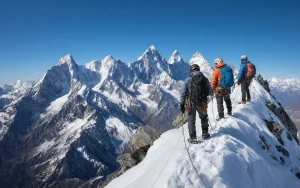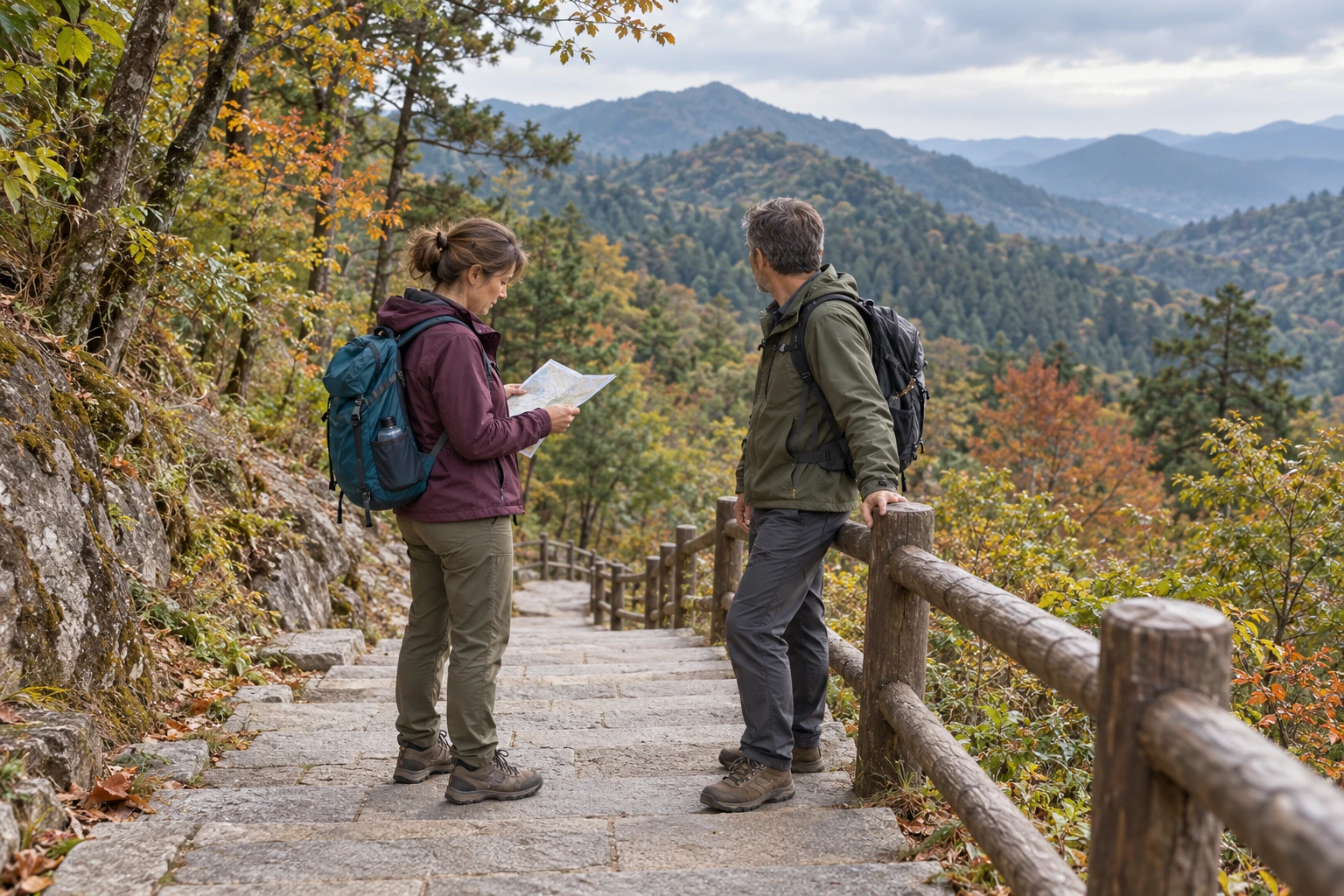
AI image note: fictional hikers in an imagined Sichuan mountain setting, not a precise route or current access condition.
Plan a first hiking trip in Sichuan by choosing the amount of walking, stairs and altitude you want before choosing a famous mountain. A selected daytime forest-and-temple walk on Mount Emei is a different holiday from Yading’s high-altitude visitor paths. A continuous multi-day trek or a summit attempt needs a separate route, permission and support plan.
This guide helps you compare managed visitor walks, the complete day around them and the questions to settle before paying. It develops the Sichuan choices within the wider China hiking route comparison. Use the local guides for detailed Emei and Yading connections; an attractive destination name alone does not establish an open trail or a suitable itinerary.
Updated 2 November 2026. AI illustration disclosure: the lead image depicts fictional hikers and a generic mountain setting; it is not an actual route photograph, current trail condition, customers or guide.
Decide which kind of walking holiday you want
Tell the planner about your recent comfortable walking days, how you feel on long descents and whether everyone wants the same objective. Distance alone is not a useful difficulty label. Repeated steps, slippery surfaces, a heavier bag, waiting in cold weather and sleeping at altitude can change the day substantially.
| Your priority | Choice to develop | What still matters |
|---|---|---|
| Forest, temples and a selected walk | An open lower or middle Mount Emei visitor route, with a clear same-day return. | The actual path, stair load, approach and permitted movement hours. |
| Mountain views with some transport | A transport-assisted Emei or Yading visit, selected around the walking you can manage. | Walking between services, queues, weather and the final return connection. |
| A substantial high-altitude walking day | Consider Yading’s longer route only after an appropriate approach and a separate suitability decision. | Altitude, sustained ascent and descent, access and a firm turnaround. |
| Several continuous trail days or a summit | Request a separate named trekking or mountaineering programme. | Route approval, receiving team, guide qualifications, equipment, accommodation and evacuation arrangements. |
A shorter walk is a complete travel choice. There is no need to finish a high route simply because you bought admission or travelled far. For mixed-ability companions, agree the shorter shared programme first. A longer option works only when each subgroup has its own appropriate guidance, meeting point and dependable return.
Check the current closure before planning a western Sichuan trek
As checked on 1 November 2026, do not plan a Gongga-area summit or undeveloped hike from an old itinerary alone. Kangding’s official notice names Namar, Jinyin, Gongba and Wukuchu peaks, Yamu Snow Mountain, and hazardous undeveloped mountain, forest and gorge areas. It says these areas are closed from 20 November 2025 until a separate reopening notice. The notice expressly prohibits entry for hiking, trekking, camping and related outdoor activities during the closure.
On 31 October 2026, Xinhua reported a fatal fall on Lemordoin Peak in an undeveloped Gongga protected-area zone. The report quotes local departments describing checkpoints and warning signs and says the group entered without approval. It is an incident report, not a reopening order. Treat the municipal closure and any later official reopening notice as the access control. A guide, social-media post, lodge booking or existing product page cannot override that notice.
| Question | What is confirmed | Trip decision |
|---|---|---|
| Can I hike to a named closed peak? | The municipal notice closes listed peaks and hazardous undeveloped areas until separate reopening. | Do not travel to the approach without an official reopening for your precise route and date. |
| Will a host or checkpoint arrange private entry? | The October report describes an unauthorized entry and access control; it gives no visitor exception. | Do not seek an informal bypass or private-transfer entry. |
| What if a page still advertises the trek? | A commercial page does not establish reopening or approved access. | Choose a separately verified open visitor area or postpone; confirm route changes and refunds in writing. |
Choose a managed visitor walk for a managed route
If your priority is mountain scenery rather than a summit, compare developed scenic areas with published visitor routes. Before paying, ask for the responsible operator’s dated notice, exact entrance, named walking segment, turnaround point, road transfer, return vehicle and fallback. Recheck shortly before departure. A route map or booking for the same mountain region does not establish access to an undeveloped trail.
Connect the walking day to the room and return
For a permitted visitor walk, locate the base around its confirmed entrance. Use the prior night to arrive and rest, one day for a route that fits the group’s actual ability, and another night where the descent or road stage warrants it. Carry a day bag and agree where larger cases stay. Confirm the real hotel entrance and last walk from vehicle to room. Price on request. Ask a dated proposal to separate transport, park admission, guide services, accommodation, meals and any extra night. A scenic walk, summit plan and foreign-guest service are separate confirmations.
What Kangding’s 2026 fire-prevention period means for a hike
Kangding City’s 2026 forest-and-grassland fire-prevention periods are 1 January–30 June and 1 October–31 December, so a November visit falls within the second period. The city defines forest and grassland areas as fire-control zones. Its order prohibits outdoor smoking and outdoor fire there, including cooking, heating, campfires and fires for outdoor camping. Visitors must accept checks at designated entrances; ignition sources must be handed to the checkpoint for safekeeping and cannot be carried into a controlled area. Pack ready-to-eat food instead of planning to use a stove or make a fire.
This is a Kangding municipal rule, not a closure of every managed visitor path in Sichuan. A separate Kangding notice closes specifically named peaks and undeveloped mountain, forest and gorge areas to hiking, trekking and camping until a separate reopening notice. Check both the 2026 fire-prevention order and the route-closure notice, then confirm the exact managed path, checkpoint and return service for your date. Do not interpret fire season as permission to enter a closed area or try to bypass an inspection.
| Trip part | Confirm or carry | Keep separate |
|---|---|---|
| Before departure | Check the local notices, open route, entrance inspection and items allowed on that date. | A route shown online is not an access approval. |
| Walking day | Use no-flame food, water and layers; agree the return point and vehicle or managed bus separately. | The fire order does not establish a trail’s opening hours or last bus. |
| Overnight | Choose an indoor base where meals and luggage storage are confirmed. | Do not assume a stove, campfire or camping-cooking plan is permitted in a control zone. |
If the trip depends on camping or cooking outdoors, ask the responsible local authority or site manager whether that exact activity is permitted; if the answer is unclear, choose an indoor night and only a separately confirmed visitor route. For a walk in another Sichuan county, check that locality’s current fire notice and access rules. Kangding’s municipal order does not set conditions for Emei, Yading or the whole province.
Mount Emei: choose a path and a return, rather than “the mountain”
Mount Emei (峨眉山) is near Emeishan in Sichuan. The lower temple area, middle-mountain paths and Golden Summit are different programmes. A forest-and-temple walk need not include the summit, while a summit sightseeing day usually combines several transport and walking stages. Use the Emeishan and Leshan planning guide for the bases, station choice and local connections.
For a selected daytime walk, identify its actual start, finish and open path on the current visitor map. Ask about the steps in both directions and where you can shorten the outing. Do not borrow a long ascent’s overnight sequence for a half-day visit, or assume an attraction vehicle meets every point on a walking path.
The scenic authority’s night-visit prohibition specifies controlled areas and checkpoints between 18:00 and 06:00. It also prohibits walking on the Zero Kilometre–Leidongping road throughout the day. A personal night-climb account is not permission to follow that route; confirm permitted movement when booking a mountain room or sunrise outing.
The May 2026 high-area construction notice describes reduced coach and ropeway capacity, a temporary Leidongping station and the loss of overnight rest space in the old station building. Use the current booking and staff instructions for your visit. Do not make the return depend on an old dispatch time or on sleeping in that building.
A long walking ascent is a separate undertaking. One saved traveller account describes two walking days within four calendar dates, with an overnight when the author tired. The same author’s accommodation note distinguishes simple rooms, shared facilities and bedding warmth. The experience is useful for planning effort and room questions, while its explicitly mentioned 2025 closure and offers do not establish today’s arrangements.
Yading: a shorter route is still a high-altitude visit
Yading (亚丁) is in Daocheng County, western Sichuan. Its Shangri-La Town gateway is different from Shangri-La city in Yunnan. Choose the correct hotel and arrival service before comparing walking routes. An airport arrival, road approach and demanding next-day walk can expose a traveller to altitude before there has been enough adjustment time.
The county’s August 2026 visitor-service account distinguishes short, middle and long routes and places the core visitor area at approximately 3,700–4,700 metres. It describes the high-lake route as a substantial endurance outing. That scale matters more than a fast walker’s social-media completion time.
Compare a selected open walk near Chonggu Temple and Pearl Lake, a cart-assisted Luorong Pasture visit with local walking, and the longer walk beyond Luorong to the high lakes. They have different purposes. Taking the cart for part of the approach does not remove the elevation or the walk between the bus stop and the next service.
The Yading short, middle and high-route guide explains these connections. Use the current signed route and ask which sections operate on your date. A route map or general admission does not establish that a higher seasonal trail is open.
Previously read accounts give useful counterexamples: an active visitor described a quick high-route day with substantial stairs and changing weather; a family chose a more limited transport-assisted visit and still reported discomfort and a child’s motion sickness. Neither establishes a guaranteed comfortable programme for another traveller. Keep the shorter choice available and avoid arranging the return around the fastest account.
Count the whole day, including the descent
Ask for a plan that separates hotel transfer, ticketing, internal transport, walking, meals and the journey back. “Five hours hiking” can leave out much of the day away from the room. An early return is useful when someone is tired, while a late start does not justify walking faster to preserve every stop.
| Stage | Settle before departure | Why it changes the choice |
|---|---|---|
| Hotel to visitor entrance | The exact hotel, pickup and entry booking. | A convenient-looking room can still require a substantial approach. |
| Internal transport | Which bus, cart or ropeway is operating and included. | A private road vehicle does not replace the park’s own transport. |
| Walking section | Named start, optional endpoint, surface, steps and turnaround. | The distance between photographs can be the hardest part of the day. |
| Return | Last usable transport, boarding point and margin for queues. | A route is only workable when you can finish at the correct exit. |
| Evening and next day | Room access, food and whether another hard day is planned. | A tiring descent can affect tomorrow’s walking and transfers. |
Set a turnaround with the guide or park staff using the actual route and operating times. When progress is slower than planned, turn back or shorten the visit while the return remains workable. Do not treat the last vehicle as a target to race toward, and do not leave companions alone without an appropriate agreed arrangement.
Choose rooms for the walking plan
A town hotel, a mountain guesthouse and a camping programme solve different problems. Compare the exact room category, not only a view or a property name. Ask about heating in the room and bathroom, hot water, shared toilets, stairs, bedding and the walking approach with bags.
For Emei, a room higher on the mountain can involve a walking arrival and restricted movement hours. Confirm a legitimate room reservation and its passport registration before committing to the approach. A report that someone found space on arrival is not a room booking for your party.
For Yading, discuss the actual sleeping height as part of the approach. A convenient early start should not be the sole reason to choose a higher overnight. Leave large cases in agreed storage or with a support vehicle and establish when they rejoin you. Keep documents, medicine, warm layers and waterproofs within reach.
Altitude, weather and a practical exit
The CDC’s altitude guidance recommends gradual sleeping ascent and explains that fitness does not protect against altitude illness. Discuss individual suitability and previous problems with a clinician. A short visitor path, a vehicle ride or carrying oxygen does not make high-altitude exposure disappear.
Do not ascend farther while symptoms of altitude illness are present. Worsening symptoms require descent and medical help; confusion, difficulty walking or breathlessness at rest need urgent assistance. A small oxygen can is not a substitute for treatment and a workable descent plan.
Check the actual place and elevation for weather. A dry morning at the hotel does not establish dry stone steps or clear mountain views later. Take footwear with grip, suitable layers, rain protection, water and food appropriate to the confirmed day. Carry what you need rather than relying on every shop, charging point or water source mentioned in an old account.
| What changes? | Adjust the day | Keep clear |
|---|---|---|
| A path or transport service is closed | Select an open shorter programme or change the day. | Another visitor’s successful trip does not cancel the closure. |
| Wet steps, ice or poor visibility | Follow staff instructions and shorten or stop when the route is unsuitable. | Technical equipment alone does not establish a safe route. |
| The group tires sooner than expected | Use the agreed turnaround and protect the return connection. | A prepaid viewpoint is not a reason to push on. |
| A highland traveller feels unwell | Stop further ascent and seek appropriate help; descend when required. | A room or transport booking should not override the health decision. |
Siguniang Mountain: choose the valley before the distance
Siguniang Mountain is not one interchangeable hiking day. Shuangqiao, Changping and Haizi have different transport patterns and walking commitments. The destination also involves high-altitude travel: a shuttle-supported visit reduces the distance walked without turning it into a low-altitude outing. Agree the specific open visitor area, passport admission arrangement and return transport before reserving a mountain stay.
| Valley choice | What changes the walking day | Best question to ask |
|---|---|---|
| Shuangqiao Valley | The official visitor pattern uses scenic buses with stops and optional walking sections. | Which short sections are appropriate for our group, and where do we rejoin transport? |
| Changping Valley | A shuttle brings visitors to the start of walking around Lama Temple; the chosen turnaround determines the effort. | What is our agreed out-and-back endpoint, and what return allowance includes slow walking? |
| Haizi Valley | Walking or horse arrangements involve a different day from a bus-supported scenic visit. | Which exact visitor area is authorised for this proposal, and does the activity require outdoor registration? |
Use the official pages for Shuangqiao, Changping and Haizi to distinguish these formats. A full valley length is not a target every visitor must complete. The official 25 March 2026 entry notice lists different admission windows for Shuangqiao and the other two valleys, and says changes will be separately announced. An admission cutoff does not provide enough time for every possible walk. Use the current notice for your date and a separate turnaround plan.
Give a mountain walking day its own nights
A simple starting structure is three calendar days with two nights at a suitable local base: travel in and settle on day 1, use day 2 for the agreed valley visit, then return on day 3. This is a scheduling comparison, not a claim that two nights are sufficient acclimatisation for everyone. Plan altitude exposure with appropriate advice, your previous experience and the actual overnight elevation. If the arrival day leaves you unwell, the following day’s activity must change rather than become compulsory because it was paid for.
| Part of the stay | Useful arrangement | Avoid making this depend on… |
|---|---|---|
| Arrival afternoon | Check the room access, next morning’s pickup and current visitor arrangements. | A substantial hike squeezed into the end of the transfer. |
| The valley day | Carry suitable layers and food; agree a shorter option and return meeting. | Reaching a distant meadow or lake regardless of conditions. |
| The return day | Leave time for packing, road conditions and the onward connection. | A second full valley visit before a fixed departure. |
For a mixed group, ask whether the transport can support separate walking lengths. The shortest group may still need a guide or a clear bus-and-meeting arrangement; a vehicle cannot pick up at an unofficial point simply because that looks convenient on a map. A local hotel with simple breakfast, luggage storage and a dependable pickup may serve the walking plan better than a room chosen only for a mountain-view photograph.
Keep a scenic visit separate from an outdoor expedition
A normal scenic-area ticket does not establish permission for an overnight camp, summit, traverse or route beyond the managed visitor area. Those activities need their own current authorisation, qualified support and logistics. For international guests, request confirmation of the passport process for the exact activity; an online form mentioning a domestic identity card is not evidence that a foreign passport can use the same process. This guide does not recommend unconfirmed outdoor routes.
If the available days or altitude needs do not suit a Siguniang stay, keep the walking interest within the Emei or Chengdu part of your journey. The Sichuan route comparison helps decide whether the mountain extension is worth the additional nights. Choosing a lower-effort cultural walk with reliable transport can be a better match than treating every snow-mountain photograph as a suitable next-day hike.
Compare a proposal you can understand
The Sichuan hiking collection helps identify the type of programme to discuss. Ask for the full dated details rather than treating the collection’s route labels as your personal walking plan. The Sichuan regional planner helps decide how walking fits between Chengdu and other bases.
| Part of the proposal | Ask for | Decision it helps you make |
|---|---|---|
| Walking and support | Daily walking profile, stairs, endpoints, group size and guide language. | Whether the complete day suits the slowest traveller. |
| Nights and bags | Named room, sleeping height, heating, bathroom and luggage storage. | Whether the night helps recovery and the next morning’s approach. |
| Admission and transport | Booking responsibility, passport process and each included service. | Whether the quoted price covers the journey you are expecting. |
| Food, prayer and changes | Actual meals or packed alternative, practical prayer breaks and disruption terms. | Whether essential needs remain workable when the route changes. |
Specify halal requirements, allergies and cooking alcohol or shared-preparation concerns as relevant. Temple food, vegetarian-looking dishes and a hotel breakfast label are not interchangeable dietary assurances. Agree a suitable packed alternative when needed, and a practical room or rest break for prayer instead of an unconfirmed facility along the path.
Send Vero Trip your walking-trip details: dates, arrival and departure, passport nationalities, ages, recent walking experience, stair and descent limits, previous altitude experience, room expectations and food or prayer needs. State whether the priority is forest, temple culture, mountain views or a longer walking challenge. A useful proposal connects that choice to a reachable room, a permitted route and a dependable return.
Related Journeys to Compare
These existing routes offer starting points for the region or travel interests discussed above. Read the full daily itinerary to see what is included. A visit described in this guide, a specialist session or an international border crossing is added only when confirmed in your own programme.
- A previously listed Gongga hiking itinerary is not a current access notice; do not book it for a route covered by the closure without an official reopening notice for the exact route and date.
- 4-Day Sichuan Mount Siguniang Dafeng Summit Tour with Acclimatization
Ask Vero Trip to plan the visits you want.
Illustration note: fictional hikers and an imagined mountain landscape; not a precise open route, current trail condition, actual customer, guide or tour record. Access checked 2 November 2026; verify local notices for your dates.