Updated 31 October 2026
For a relaxed excursion from Chengdu, give Dujiangyan’s waterworks and Qingcheng Front Mountain separate days. With only one day, choose the irrigation system for engineering and river views, or Qingcheng for Taoist heritage and a mountain walk. A combined day can work with a deliberately shortened mountain visit and coordinated transfers, but it leaves less room for queues, lunch and unhurried sightseeing.
The two places share a World Heritage listing, yet they offer different experiences and use different entrances. This guide helps you choose one, combine selected parts, or spend a night locally. It covers the developed Dujiangyan visitor area and Qingcheng Front Mountain, rather than an independent back-mountain trek or an off-trail circuit.
Which visit fits your available day?
Start with what you want to understand or do. Dujiangyan rewards watching how river channels fit together; Qingcheng rewards time among forest paths and Taoist buildings. Neither is simply a photo stop. Your comfortable amount of walking, transport between the sites and the return to your hotel matter more than collecting both names.
If the party has different interests, make one place the shared main visit. Agree which optional climb or longer section can be dropped before buying a second admission. A person who wants a quiet temple visit should not be committed to the longest walking circuit just because another traveller wants to climb.
| Your priority | A useful choice | The main trade-off |
|---|---|---|
| Water engineering, history and river scenery | Dujiangyan as the main outing, with time to understand the three water-control works. | Keep any hilltop extension optional; the channels are the central story. |
| Taoist architecture and walking under trees | Qingcheng Front Mountain as the main outing. | Choose a selected walk or a longer ascent; transport does not remove every step. |
| A brief introduction to both | Dujiangyan plus a limited Front Mountain visit with arranged transfers. | Less time at each; do not promise a summit, every temple and a fixed evening show. |
| Both places without a tight afternoon deadline | Two sightseeing days, using one local hotel night or two separate Chengdu day trips. | A local night means moving luggage; separate returns mean more repeated travel. |
What makes the Dujiangyan waterworks worth your time?
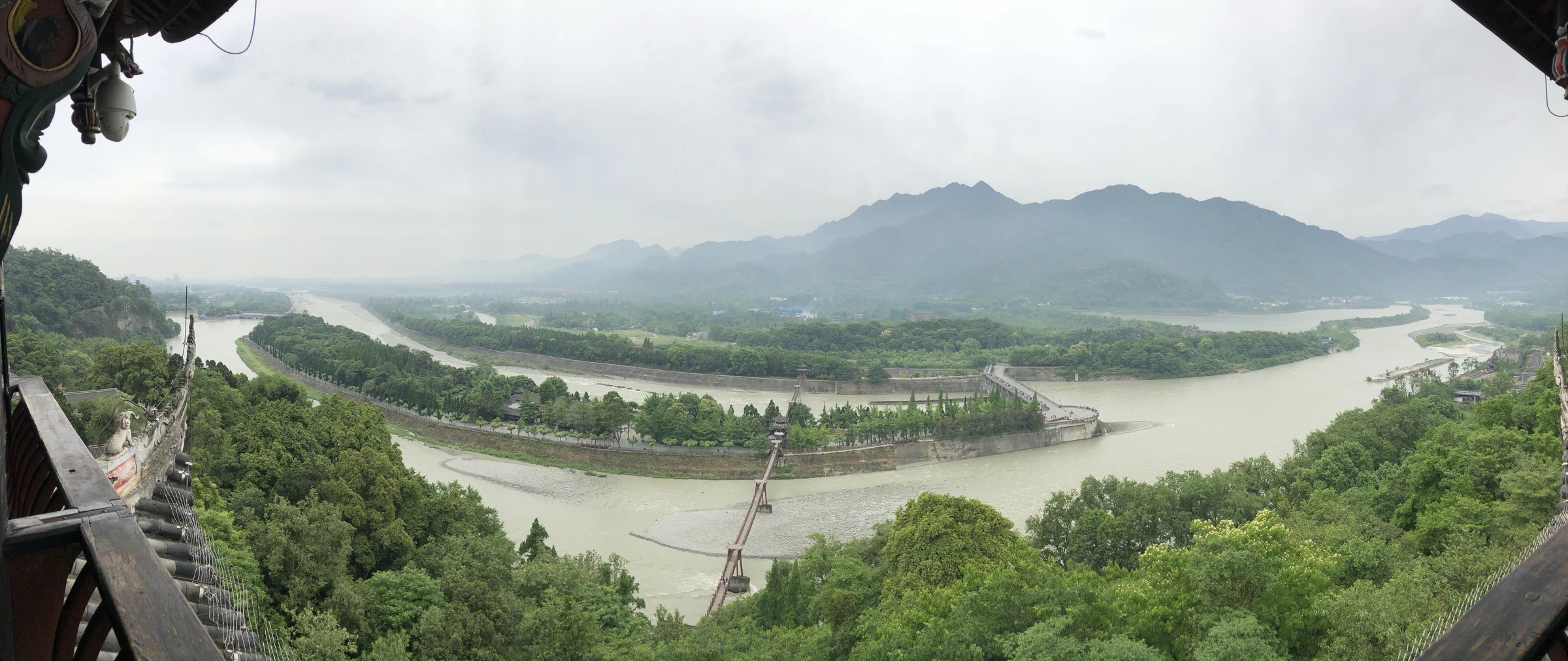
The attraction is a working water-management landscape. UNESCO’s description explains how its longstanding design uses the terrain to divert water, handle sediment and regulate flow. Look for the relationship between the three principal works: Yuzui, Feishayan and Baopingkou. Understanding their different jobs makes the visit more rewarding than photographing a succession of bridges.
At Yuzui, the Fish Mouth dividing structure, look at how the river branches. At Feishayan, consider where excess water and sediment can be released. At Baopingkou, the narrow diversion passage, follow the idea of controlled water entering the irrigation system. Water levels and the appearance of each channel change; the photograph above is not a forecast of the river on your date.
| Feature | The question to ask there | How it shapes the visit |
|---|---|---|
| Yuzui / Fish Mouth | How is the incoming river divided? | Allow a pause to look across the channels instead of rushing straight to the next viewpoint. |
| Feishayan / Flying Sand Weir | Where can excess flow and sediment go? | Connect this stop with the channel arrangement you have just seen. |
| Baopingkou / Bottle-Neck Passage | How does water enter the irrigation network? | Use it to bring the whole system together, rather than treating it as an isolated rock opening. |
For a focused outing, ask at the entrance for an open-path circuit linking those works and the exit you intend to use. The order depends on the gate, current circulation and the walking you select. Do not book a pickup with only “Dujiangyan” as the meeting point: save the exact gate or public-road location, and tell the driver if you change exits.
Extra temple or elevated-view sections can add steps and time. Ask which part can be omitted if someone becomes tired. A shorter waterworks visit with time for explanation can be a better family day than adding every uphill viewpoint. Stay within the visitor paths and barriers; an attractive riverbank is not permission to approach the water.
Choose your Qingcheng Front Mountain walk before buying transport
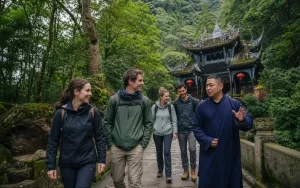
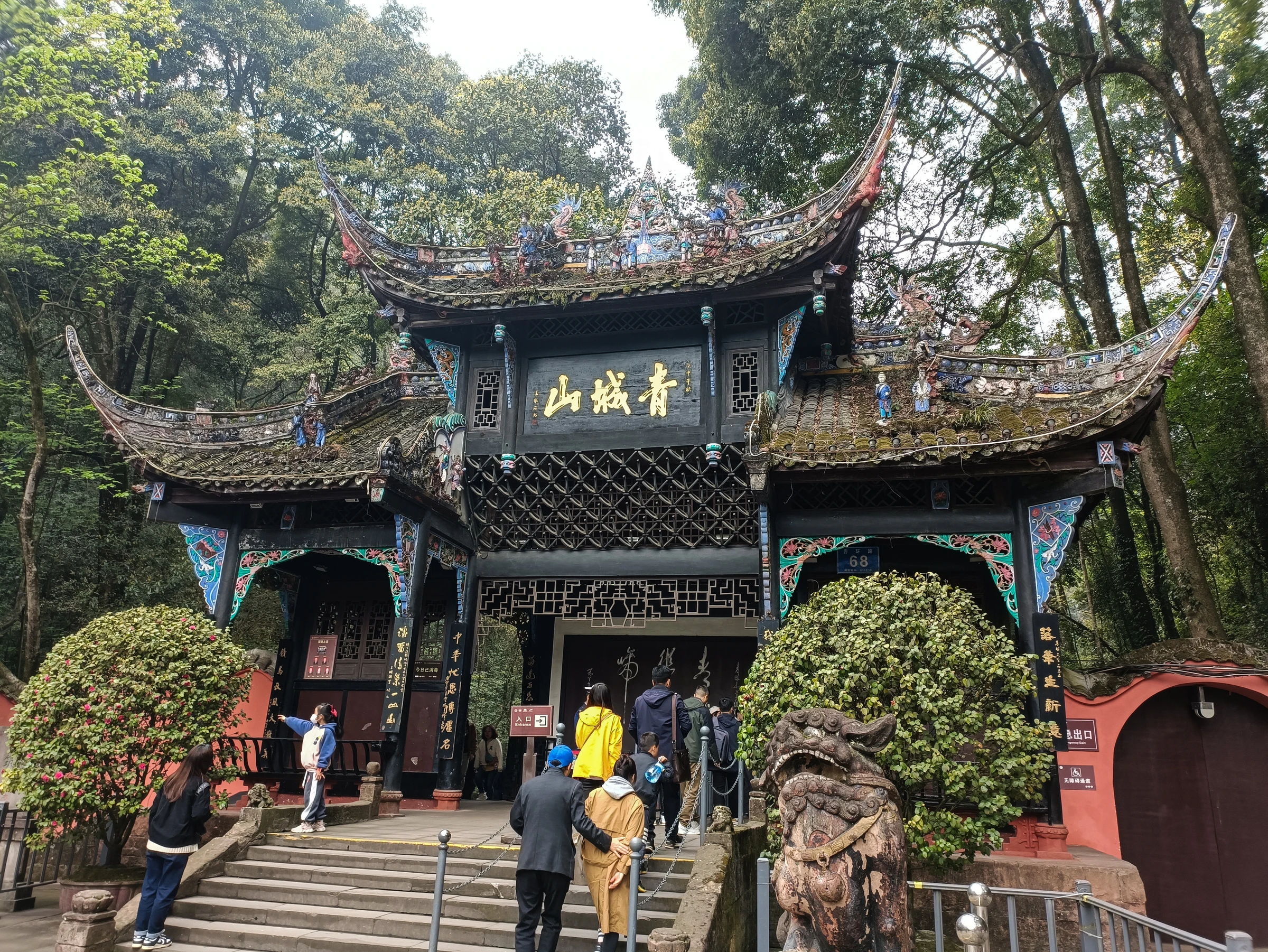
Qingcheng’s appeal is the combination of Taoist heritage, traditional buildings and wooded mountain surroundings. Make time to look at courtyards, roof details and the setting of the temples. You do not need to reach the highest point to give the visit a clear purpose.
For a lower-walking visit, discuss the entrance area, Jianfu Palace and a selected open section with the visitor staff. Have them mark the turning point and explain any admission boundary. This is a limited cultural outing, not a claim that the full scenic area is step-free. For a longer visit, choose an open temple-and-path circuit suited to the party, with a clear descent plan. The cableway, if operating, is one component of that plan; approaches, station access and onward paths still take effort.
Queues can affect both the ascent and the return. In an August 2026 interview with the cableway operator, the operator described terrain-constrained station space and crowd-management measures. That summer report is a useful reason to protect your return allowance, not a prediction of a particular waiting time in November. Ask for the day’s last usable descent arrangements when you arrive.
On a combined day, set the mountain turning point from the time remaining after lunch, the transfer and entrance formalities. If the remaining window is short, keep to the agreed limited section or move Qingcheng to another day. A cableway ticket should not become a reason to rush down wet steps to catch your train.
Three practical ways to organise the trip
One day: choose one main visit
Leave Chengdu with enough time for the station or road transfer and the booked admission. For Dujiangyan, spend the main part of the day following the waterworks story, have lunch without an immediate second-site deadline, and return to Chengdu. For Qingcheng, keep the day for the selected Front Mountain walk, lunch and the descent. These are complete excursions, not incomplete versions of a two-stop package.
If you want a relaxed evening in Chengdu, finish the excursion before adding an independently booked performance or dinner reservation. Onward flights are better kept separate from a mountain day with uncertain queues and road traffic.
One day: a shortened combination
A workable version gives Dujiangyan the main morning, allows a real lunch and transfer, then uses only the agreed part of Qingcheng Front Mountain. Coordinate the afternoon entry and final pickup before departure. This is most suitable when the party accepts that the mountain visit may remain short. A full climbing circuit plus a full waterworks visit is a different, much more demanding request.
If the first visit runs late, remove the second admission or shorten the mountain plan while an appropriate open route remains available. Do not use the published closing time as the time to begin a climb. Agree how unused tickets and changes are handled in the booking terms.
Two days: one local night, with a clear luggage plan
This outline assumes you are already in Chengdu before day one. It uses two sightseeing days and one local hotel night; it does not count your earlier Chengdu hotel or a night after returning to the city.
| Day | Suggested focus | Overnight and return |
|---|---|---|
| Day 1 | Travel from Chengdu, make Dujiangyan the main visit, then leave time for lunch and hotel check-in. | One night in the Dujiangyan urban area, convenient for the agreed next-day pickup. |
| Day 2 | Transfer to Qingcheng Front Mountain, follow the selected walk and leave enough time to descend, collect bags and continue. | Return to Chengdu; any Chengdu hotel afterwards is an additional booking. |
An urban Dujiangyan base suits the first day and makes dinner easier to arrange independently. A Qingcheng-side stay can suit travellers who put the mountain first the next morning, but shifts more of the transfer to day one. Choose the actual hotel location, rather than relying on a name containing “Qingcheng” or “Dujiangyan.” Confirm access from the road and whether luggage storage remains available after checkout.
Carry a small day bag on the mountain. Decide whether larger cases stay with the hotel or travel in a specifically arranged vehicle, who is responsible for them and where they are collected. A rail ticket does not include bag delivery between the two scenic areas. If you return from a different station, build the luggage collection into that route.
Rail or a road transfer from Chengdu?
Rail can work well for an independent visit to one main site. A February 2026 report interviewing railway staff describes the Xipu interchange between Chengdu Metro Line 2 and the Chengguan railway, including services towards Lidui Park and Qingchengshan. Search the exact destination station for your date, then plan the connection from that station to the entrance.
Keep the names distinct: Lidui Park / Liduigongyuan (离堆公园), Dujiangyan (都江堰) and Qingchengshan (青城山) are different stations. Ask which best fits your chosen gate and booked local transfer. Do not assume a ticket to Dujiangyan station delivers you to the scenic-area entrance, or that Qingchengshan station is the mountain gate.
Use China Railway’s 12306 service for date-specific departures, fares and availability. April’s published timetable change added evening services, but those train numbers are not a standing promise for your travel date. The train ride also excludes your hotel-to-station journey, checks, waiting and the final local connection. Save the return booking and station name offline.
A road transfer is useful for linking both sites, managing luggage or returning from a different exit. It still faces traffic and does not bypass admission limits. A driver provides transport; English sightseeing interpretation must be specified separately. If the party needs a shorter walk, request a concrete entrance-and-exit plan rather than the label “easy tour.”
Passports, ticket choice and the cost of the whole day
The official visitor ticket guidance provides a passport or foreign-residence-document option and manual entry for foreign visitors, with document assistance at ticket windows. Carry the original document used for the booking. Confirm the selected place, date and any entry session; a purchase attempt or a screenshot of someone else’s order is not an admission confirmation.
Availability can change during busy periods. An official-source notice dated 5 October 2026 described temporary online sales restrictions and managed entry during holiday crowds. It is an example of date-specific controls, not evidence that online sales remain closed today. Check the live official notice before travelling; a window service is not a guarantee that unsold capacity exists.
Choose the correct product for Dujiangyan or Qingcheng Front Mountain. The official guidance separates admission from several internal transport and interpretation services. Compare the total you actually need, including the trip back to your hotel. An admission concession does not automatically reduce every other charge.
| Cost item | What to identify | Why it matters |
|---|---|---|
| Scenic-area admission | Correct site, visit date, document category and confirmed entry arrangements. | Do not substitute a different scenic-area ticket or assume every concession applies to your passport. |
| Internal transport | The selected cart, cableway, boat or other operating component, with each charge identified. | Buy what supports the chosen walk; an admission ticket is not a transport bundle. |
| Travel between places | Rail and station connections, or the agreed vehicle route and final drop-off. | A low headline fare may cover only one stage of the day. |
| Guiding, meals and accommodation | Requested language, guiding time, meals and any local hotel night. | These depend on the written service list; they are not confirmed by this suggested route. |
Rain, limited mobility and a changed plan
Use the current weather and operator notices to decide the walking, rather than committing to a fixed mountain endpoint months ahead. In light rain, non-slip footwear and a shorter selected path may suit some visitors. During a closure or severe-weather warning, follow the restriction and rearrange the visit; moving to a closed path or riverbank is not an alternative.
Tell the planner about difficulty with stairs, balance, heights or long periods standing in a queue. Ask about the exact path, toilets, resting points and any steps between transport stages. A cableway does not establish wheelchair access for the complete visit. Families with young children can keep Dujiangyan as the sole outing, or choose a limited Qingcheng cultural visit with an agreed turning point.
If a mountain visit becomes unsuitable before you leave Chengdu, keep the day in the city and choose an available indoor or shorter cultural visit from the Chengdu planning guide. Check that venue’s opening and reservation separately. Do not automatically swap to another mountain with the same weather problem.
Questions that change the booking
Can I see both places in one day?
Yes, with limited selected visits and coordinated transfers, if the party is comfortable with the pace. For a longer Qingcheng walk or more time understanding the irrigation system, split them across two days. The difference should appear in the actual walking plan, not only the tour’s description.
Does the shared World Heritage listing mean one ticket?
Do not infer a combined admission from the heritage name. Check the specific products and their usage conditions. Transport within each site and between them is another decision.
Is this the same as Qingcheng Back Mountain?
This plan uses Qingcheng Front Mountain. If you want a different mountain area, name it explicitly and arrange its current access, route, ticket and transfer separately. A Front Mountain booking should not be treated as an interchangeable hiking permit.
Plan a suitable excursion with Vero Trip
The existing five-day Chengdu, Dujiangyan, Qingcheng and Leshan itinerary includes both sites within a wider Chengdu stay. Its combined sightseeing day is a useful starting framework; request a shorter mountain section or an extra day if you want a slower pace. The public itinerary does not itself confirm services for a new departure.
Send your dates, Chengdu hotel area, party size, children’s ages, walking limits, luggage and final destination through Plan My Trip. State whether you prefer the waterworks, temple walking or both. Price on request; the dated written proposal should identify transfers, guiding language, admissions, internal transport, meals, accommodation and change terms. For a larger journey, compare the Sichuan regional planning guide before adding another distant extension.
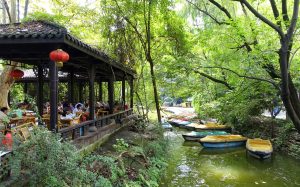
Cover photograph: Dujiangyan Irrigation System, 22 May 2020, by Qiu Xingxiang / 星星. Original photograph, CC BY-SA 4.0; proportionally resized and converted to WebP, shared under the same licence. The older photographs illustrate the places, not current river levels, access or a Vero Trip group.