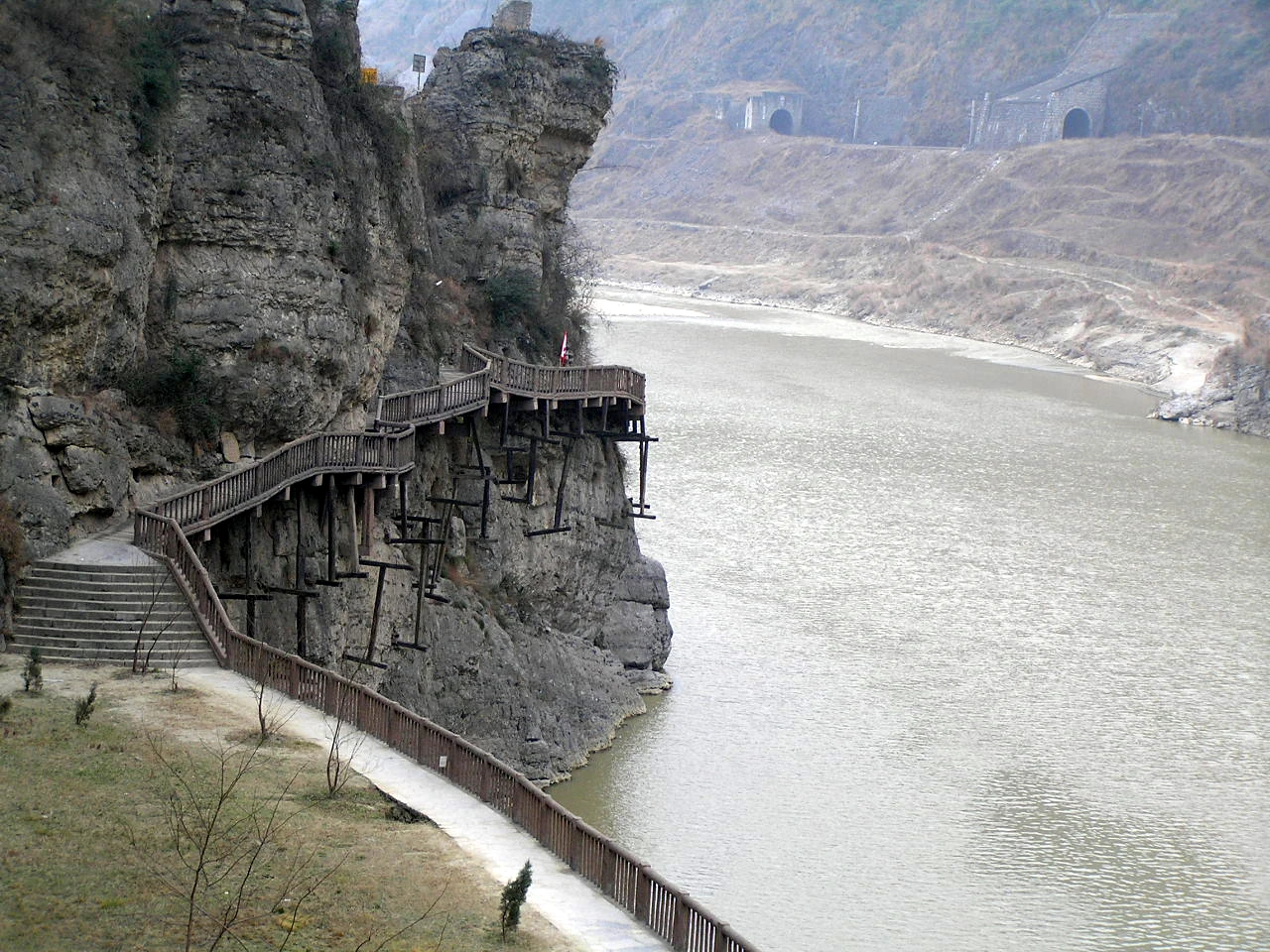
At Mingyue Gorge, look beneath the walking deck towards the cliff sockets. Between the Jialing River and rock in Chaotian, builders had little level ground. The supports explain how a roadway could project out into that narrow space.
Allow a morning for the gorge, followed by a seated lunch and a return to Guangyuan. That gives you time to look closely at the construction and to turn around when you have seen enough. If your interest is the long-distance drive through the Qinling region, the Chengdu to Taiyuan road-trip guide places this stop on a much longer journey. Here the gorge itself is the reason to come.
Reading the road from the cliff
Find an open bend with a side view of the supports. Follow a beam from the cliff towards the river and its brace back into the rock. Stay behind the rail; distance can explain more than a close-up of one hole.
Use one labelled set of sockets to understand the three levels: middle roadway beams, lower bracing and upper shelter timbers. Shadows and natural joints can resemble holes, so avoid counting every dark mark.
Compare cut-rock evidence with the reconstructed walkway. The deck demonstrates the principle at walking scale but cannot date an individual timber. With children, ask what the outer edge would do without a brace, viewed safely from the path.
Choose a short walk or a longer look at transport
Think of six ways through the same gorge: plank and Jinniu roads, river boats and towpath, the Sichuan–Shaanxi motor road and Baoji–Chengdu railway. You can understand their common problem while walking only part of the public route.
| What you want to see | Where to put your attention | When to turn back |
|---|---|---|
| The plank-road engineering | Choose a signed open stretch with a side view of the deck. Compare the cliff sockets, projecting beams and supports below. | Once you can picture the construction, retrace your steps. Allow for returning over the same stairs. |
| The gorge as a transport corridor | From a designated viewpoint, compare the river level with the heights at which builders could lay a road or cut through rock. Use site labels to identify particular lines. | Stop at the last permitted viewpoint. Railway infrastructure, highway bends and old towing routes are subjects to observe from the visitor area. |
| History with less exposure to heights | Ask about the China Plank Road cultural exhibition in Chaotian and the approach to it. See whether its maps and explanations would suit your group. | If the room is closed or its access also requires difficult steps, choose lunch in town and leave the cliff walk for another day. |
If Laohuzui, Tiger’s Mouth, appears on the current map, ask staff for an open viewing position. The March 2025 visit with Hope Justman and overseas guests explains its place in the story, not where visitors may stand now.
If the cultural exhibition is open, start with a map of the gorge, Guangyuan and the Shu Roads. A July 2026 visiting group saw those transport themes. Return to the cliff’s central question: how did people connect usable ground across a narrow river corridor?
A morning from Guangyuan, with lunch on the way back
Save 广元市朝天区明月峡 and the actual entrance, then mark the legal collection point with the driver. Share it, the hotel and contacts across the group’s phones, including a meeting plan for poor reception.
Ask about the open path, return steps and one-way controls. Choose a short same-gate return where permitted; settle another-end pickup before a through-route. Make the decision early for anyone uneasy with drops.
Sit down in Chaotian or central Guangyuan after the walk. For breakfast, Guangyuan steamed cold noodles use rice batter and often soybean sprouts. Ask for chilli separately and check sauces for allergies.
Look for Chaotian walnut cakes at a shop you pass, without relying on a gate snack for lunch. Hanwang Old Street in Zengjia is a separate food destination. Finish with the hotel or baggage-collection point agreed in your transport.
Where to sleep and how to arrange the days
Choose central Guangyuan for rail and city evenings, or Chaotian for a continuing northbound drive. Compare the actual hotel and departure station; the wider city name can cover separate stops.
| Time available | Suggested nights and sequence | What makes it work |
|---|---|---|
| Two days, one night | Arrive in central Guangyuan on day one. Stay one night. Visit the gorge on day two, have lunch, collect bags and transfer to your departure point. | Use this only with a comfortably late departure. An early train leaves too little room for the road journey and a change at the gate. |
| Three days, two nights | Spend both nights in Guangyuan. Give the middle day to Mingyue Gorge and lunch in Chaotian. Return to the same hotel. Leave on day three. | The full day allows slower walking and an exhibition visit if available. The main bags can stay in the room. |
| Four days, three nights | Keep three nights in one Guangyuan hotel. Use day two for Mingyue, day three for Zhaohua or a separate heritage outing, and depart on day four. | One day for construction in the gorge and another for streets and courtyard buildings gives the visits different rhythms. |
If the rail connection matters more than seeing every stop, choose the two-night version. It puts a night’s sleep between the gorge walk and the train. On a longer stay, the Zhaohua Ancient Town guide can help you choose a town gate and a courtyard for the next day. For another cliff setting with a different focus, the Qianfoya guide looks at carved figures. Anyone with knee pain should consider the physical demands of both days before choosing consecutive cliff visits.
How Mingyue fits the Shu Road itineraries
Travellers interested in a multi-day walk should compare the gorge with Jianmen Pass and the Cuiyun Corridor. At Mingyue, you can study how a short stretch of roadway was held above a river. Cuiyun and Jianmen give you more time on the approach to a mountain pass. Someone fascinated by building techniques could spend longer at one view in Mingyue than a companion looking for a full day’s hiking.
Verotrip’s five-day Ancient Shu Road trek starts with arrival in Guangyuan. Its walking days cover Cuiyun, Jianmen Pass and the Hanyang route, then Dachao Yi and Zhaohua, before the return to Guangyuan. Mingyue Gorge would require its own time and arrangements. For example, arrive a day earlier, sleep in Guangyuan and complete the gorge visit before joining the trek. Check where your bag goes and the precise meeting place for day one.
Access, weather and costs
| Decision | What to establish | How it affects your day |
|---|---|---|
| Admission | Ask which entrance, ticket channel and original passport are accepted for your visit date. Check separate arrangements for the exhibition. | Have the Chinese place name and booking details to hand. Allow time for an attended check if one is available. |
| Walking conditions | Ask about wet surfaces, steps, closures and the shortest permitted return. For a wheelchair or walking aid, establish each section from drop-off to pickup. | Wet steps or a closed return section can change the plan even if the attraction is open. Choose a shorter visit or stay in town. |
| Transport and language | Confirm vehicle, waiting time, both ends of the journey and your preferred language for interpretation. | A transfer to the entrance alone leaves the return open. A driver and a person explaining the Shu Roads are different arrangements. |
Carry water, a layer and secure footwear in a small bag that leaves a hand free. Locate any needed seat. Let the guest wanting the shortest route set the turnaround, keeping energy for the same steps back.
Price on request. Share the hotel, walking limits and onward connection. Separate admission, exhibition, waiting and return transport, interpretation, meals and nights, with the cliff time and finish point clear.
Questions about Mingyue Gorge
Are the wooden planks I see ancient originals?
A reconstructed deck helps you understand the passage at walking height. Look for the cut sockets in the rock as evidence of how earlier timberwork was fixed. The age of a particular piece of timber requires evidence specific to that piece.
Can I follow the railway or old road through the gorge?
Stay within the signed public visitor route. Use the river and the corridor across the water to understand why different transport systems converged here. A train passing, a boat ride and access to a road cutting are unnecessary for that visit.
Can overseas visitors visit independently?
Overseas visitors have been documented on the plank road, including a group of foreign friends in March 2025. For an independent trip, verify your passport and the current purchase or collection channel with the site for your date. An organised group’s admission does not establish an individual online booking procedure.
What if the cliff path is closed on my travel day?
Ask whether the cultural exhibition is open independently and whether it can be reached by a suitable public approach. If it cannot, keep lunch and your Guangyuan hotel plan and move the gorge to a different day. There is no reason to try reaching a closed section from the highway or riverbank.
Cover photograph of Mingyue Gorge by landagent, 11 February 2006. Converted to WebP and cropped for display under CC BY-SA 3.0.