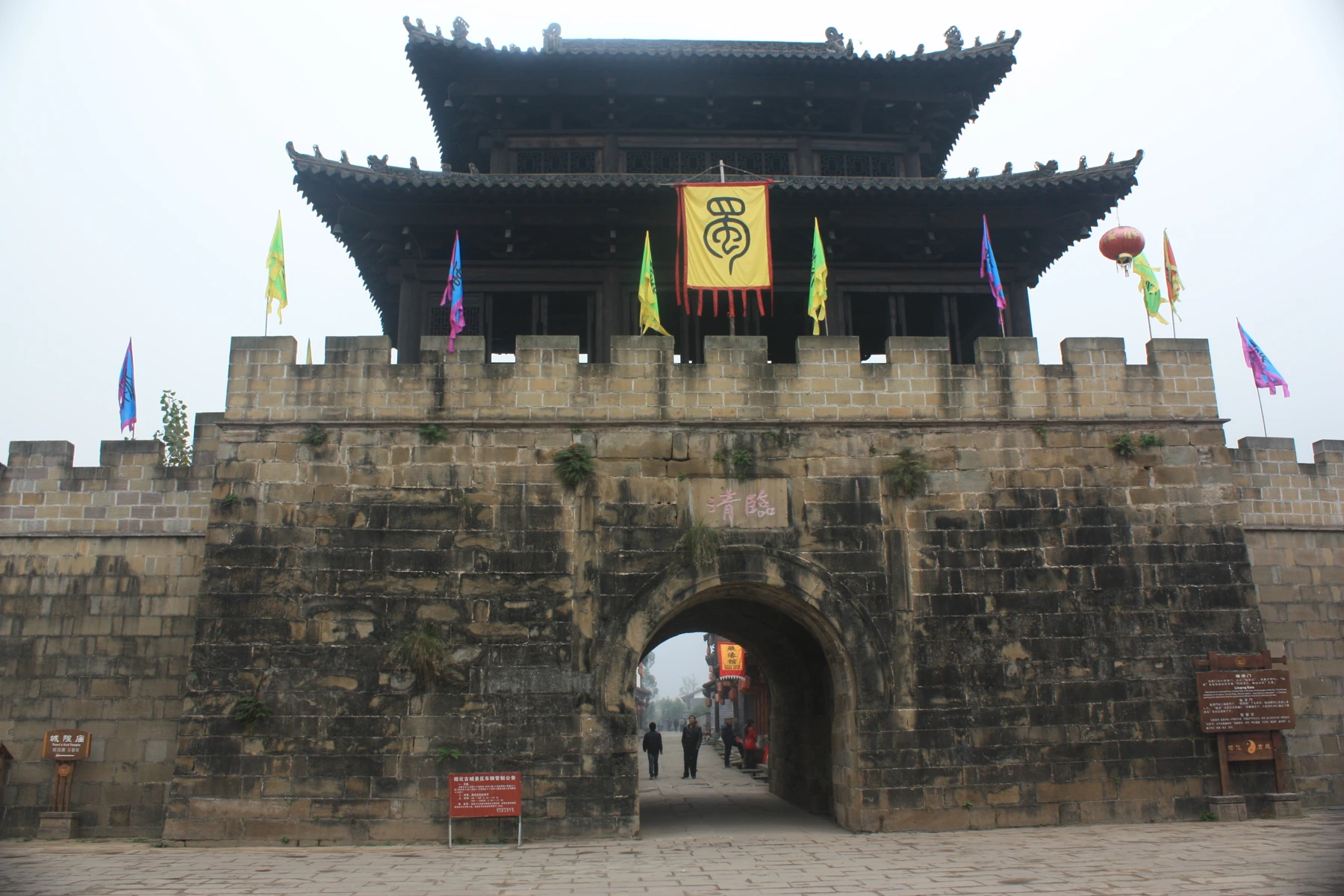
Photograph: Zhaohua ancient city gate, 6 November 2010. Photo by 剑林 (Jianlin), via Wikimedia Commons, CC BY-SA 3.0. Resized and converted to WebP; the derivative is available under the same licence. This historical photograph does not show today’s access, signs, events or facilities. People pictured are not identified as our customers, guides or an operated departure, and no endorsement is implied.
Visit Zhaohua Ancient Town for a focused look at gates, old streets and the institutions of a county town. Choose the county office for government history, the examination compound for education, or the Confucian temple for a different architectural setting. You do not need to turn the visit into a mountain trek or enter every courtyard.
For many overseas travellers, a Guangyuan city base with a separate Zhaohua outing is the practical starting point. Staying in the old town makes sense when an evening and an early walk are part of the purpose. Settle that choice before adding Jianmen Pass, another hotel change or a tightly timed onward train.
First find the ancient town you mean
Save 昭化古城 as the destination, together with the actual visitor entrance and the hotel’s Chinese address. 昭化区 is the wider district name: an accommodation listing or a vehicle destination labelled only Zhaohua need not mean a room or drop-off inside the ancient town.
Think of the visit as a street walk with selected interiors. A Hubei University of Education field account describes the county office, examination compound, Confucian temple and three gates: Linqing to the west, Zhanfeng to the east and Gongji to the north. These names help you recognise places on a visitor map; the account is not a current opening notice.
At arrival, identify which gate or parking area you are using, where the walk will finish and whether the vehicle can collect you there. A town with several entrances invites confusion if everyone remembers only a different gate photograph. Keep the return meeting point saved offline, with a contact method that works for your party.
Choose the county office, examination story or temple
The county office, 昭化县署, provides a way to think about how local administration was organised: who entered a courtyard, where officials worked and how space communicated authority. Look at the relationship between gates, courts and halls rather than treating the visit as a single photograph of a magistrate’s seat.
The examination compound, 昭化考棚, changes the question from government to education. Consider what a candidate’s working space and supervision reveal about the examination system. With children, one simple question about how an examination was conducted can be more engaging than a long list of dates and officials.
The Confucian temple, 昭化文庙, offers a third theme: ceremonial space and architecture. Keep the place distinct from the exam rooms even when visiting them on the same outing. Respect barriers and any active use; a building’s historic name does not establish that every room can be entered or photographed.
| Interest | Main focus | Keep optional |
|---|---|---|
| Local government | County office and its courts and halls. | A second long interpretation immediately afterwards. |
| Education | Examination compound, with the Confucian temple as a separate theme. | Staged exams, costumes and workshops unless confirmed. |
| Three Kingdoms stories | Jiandaoba Junchen Garden or Jinghou Shrine. | Every commemorative site and a mountain excursion. |
These places have histories of repair and restoration. Avoid reading an old-town label as a claim that every visible structure survives unchanged from its earliest foundation. If architectural authenticity is a main interest, ask for interpretation that separates original fabric, later work and modern presentation.
Gates and Three Kingdoms stories without an attraction quota
The same university visit records Jiandaoba Junchen Garden, 剑刀坝君臣园, and Jinghou Shrine, 敬侯祠, among the places used to introduce Three Kingdoms history. Choose that theme if the people and stories interest you. It offers a different emphasis from a day devoted to examinations and administration.
Historical interpretation, later commemoration and a modern presentation are different things. Read the on-site explanations and ask how each place relates to the story being told. Avoid treating every sculpture as an ancient object or every dramatised episode as a documentary account.
Use a gate as an orientation point, then take a manageable street section with time to sit down. A gate exterior and a climb onto a gate tower are separate choices. Before going up, check whether the visitor stairs are open, how steep they are and whether the descent suits everyone. Stay off closed wall sections and private entrances.
The town is also a place where people live and work. Ask before making close portraits or entering a domestic courtyard. A doorway that makes an attractive photograph is not necessarily part of the visitor route. Keep narrow passages clear for residents, deliveries and other visitors.
A shorter introduction or a full heritage day?
For a shorter visit, select one main interior and a street-and-gate walk, with a meal or rest that fits the actual arrival and departure. Decide the priority before buying a multi-site ticket. A brief visit cannot provide the same time for explanations as a day deliberately kept for the town.
For a full local day, give the morning to the stronger interest. For example, start with the county office, follow with the examination story if the party is still interested, then take a seated lunch. Use the afternoon for the Confucian temple or a shorter Three Kingdoms-focused visit rather than adding every remaining name.
This is an interest-based sequence, not a measured walking circuit. Use the current visitor map and opening arrangements to choose the actual order. Leave room to reverse the order, shorten an interior or stop for a drink when crowds, rain or tired legs change the rhythm.
Festival programmes may advertise ceremonies, performances or hands-on experiences. A 19 May 2026 on-site report describes a Tourism Day admission promotion and a rubbing activity. That dated event does not establish free entry or a daily workshop for a November visit. Confirm an experience separately if it is the reason for your trip.
Sleep in Guangyuan or stay in the ancient town?
A Guangyuan city hotel works well when you prefer to keep the same room around a rail arrival and departure. Treat Zhaohua as a separate outing with both directions arranged. A train ticket to Guangyuan does not take you to a courtyard in the ancient town, and a station pickup does not automatically include the next day’s sightseeing.
For two city nights, use day one for arrival and settling in, day two for the chosen Zhaohua visit and day three for the onward journey. The advantage is one full local day without moving the bags twice. If the rail times are generous and your aim is only a short introduction, one night may be enough; compare the real timetable before deciding.
An ancient-town stay earns its place when you actively want the evening setting and a less hurried first walk next morning. Ask about the room’s actual street position, evening noise, stairs, bathroom, heating or cooling and breakfast. A heritage-style photograph does not establish a particular room’s comfort or accessibility.
| Base | Reason to choose it | Settle before booking |
|---|---|---|
| Guangyuan city | Keep one room around rail travel and a separate Zhaohua outing. | Both local transfers, the actual station and final return. |
| Inside or beside the ancient town | Enjoy an evening and morning without an immediate city return. | Exact room pin, legal drop-off, last walk and baggage help. |
| A short road-trip stop | Keep moving when a limited heritage introduction meets the aim. | A realistic visit and meal window before the onward drive. |
Confirm how each traveller’s original passport will be handled for hotel registration and whether the selected room can be booked for your party. Establish the final lawful drop-off and the walk with bags. A car cannot be assumed to reach every historic lane, and a room booking does not automatically include luggage assistance.
Rail, road and the complete return
Use the full station name on the actual booking. Guangyuan and Jianmenguan are different station instructions, and the most convenient one depends on where you will sleep and what you will visit. Compare the rail journey with station access and the local road transfer, rather than choosing a train solely because its running time is shorter.
For a road trip, place Zhaohua within a realistic transfer day. A culture stop is useful only if there is time to park, find the entrance, visit and eat before the next journey. When a late arrival leaves only a quick photograph, either keep the stop modest or add a night instead of promising the full programme.
Self-driving requires the driver’s lawful documentation and the rental company’s acceptance of the actual use. A foreign licence or a route description should not be treated as sufficient permission by itself. If driving eligibility or one-way rental arrangements do not fit, compare a properly arranged vehicle with driver or a rail-and-transfer plan.
Whatever the transport, name the return pickup, waiting arrangement, final address and any charge for changed timing. Leave the required margin for the actual onward train or flight, including collecting luggage and getting through the station or airport. Do not add a last interior visit if the return now depends on the fastest possible road journey.
Walking, rain, food and language
Old street paving, thresholds and courtyard steps mean that a town visit still has physical demands. Wear shoes with grip and state your comfortable walking and standing limits before choosing the route. A wheelchair, stroller or walking aid needs an assessment of the actual entrance and path; this guide does not certify a step-free circuit.
In light rain, shorten the open-air section and spend more time in a suitable chosen interior only if it is open. Covered sections do not make every transfer between sites weatherproof. Heavy rain, slippery stairs or a local restriction can justify a different day, and a closed courtyard is not a reason to enter a private or unmarked area.
Keep lunch as a proper pause. Ask about the portion, ingredients and total before ordering, particularly when a dish is sold by weight or a group meal is being proposed. Tell the planner your dietary needs, but do not infer allergy-safe, vegetarian or halal preparation from a food name or a photograph.
Historical courtyards reward explanation. A driver, remote translation, an on-site guide and a guide accompanying you in English are separate services. If interpretation matters, specify the language, sites and duration before booking. A staged performance or an English sign does not mean the complete visit will be explained in English.
Foreign visitors, tickets and costs
Overseas visits are documented: a 2024 report from the State Administration of Foreign Exchange’s Sichuan branch records foreign students taking part in a visitor-payment experience that included Zhaohua. It supports ordinary international visitor context, not a guarantee that every ticket system, hotel or payment terminal works in the same way today.
Check the current admission arrangements for the interiors you actually want, the original document required and any combined-ticket validity. Carry the passport used for a booking. A dated holiday concession, a domestic student entitlement and an overseas visitor’s ticket are separate questions.
| Item | Specify in the plan | Check separately |
|---|---|---|
| Visits | Chosen interiors, ticket scope and document process. | Tower climbing, workshops, performances and temporary exhibitions. |
| Transport | Station or hotel, visitor entrance, waiting and full return. | Changed gate, extra stop, one-way finish or onward transfer. |
| Stay and meals | Actual room category, nights and named meal arrangements. | Extra nights, luggage assistance, personal purchases and insurance. |
Price on request. The written proposal should state the actual transport, chosen visits, language assistance, meals and accommodation, with exclusions and change terms. No vehicle, guide, entry, hotel, insurance or departure is confirmed simply because this guide describes a useful travel pattern.
How this differs from a Shu Road trek
The existing five-day Ancient Shu Road trek includes Zhaohua after several active walking days. Its daily outline lists roughly 13- and 15-kilometre stages elsewhere, then an evening in Zhaohua and a Guangyuan return. It is a related option for sustained walking, not this selective courtyard visit or two-night city-base pattern.
Ask for the current authorised trail segments and effort before choosing the trek. Its mountain and Bird Path references are not requirements for enjoying the town. Compare the complete Jianmen Pass and Cuiyun Corridor guide when you want a separate walking day; add time for it rather than squeeze it into the same heritage visit.
The Guangyuan destination page helps position the wider stay. For a personal plan, send dates, station or road arrival, party ages, walking needs, room preferences, bags and onward booking through Verotrip’s planning enquiry. Say whether the priority is examinations, local government, Three Kingdoms stories or an evening in the town.
Questions about Zhaohua Ancient Town
Do I need to enter every historic building?
No. Choose the theme you want, then compare the current tickets with that plan. One main interior, a street walk and time to rest can be more satisfying than collecting every admission.
Can I visit from a Guangyuan city hotel?
Yes, that is a useful planning pattern when the complete outward and return transport is arranged. Confirm the real hotel and ancient-town entrance; arrival by train in Guangyuan is a separate stage.
Is an ancient-town night necessary?
Only if its evening and morning are part of your interest. Check the actual room, street noise, final walk and luggage plan. Staying in Guangyuan may be simpler around rail connections.
Is Zhaohua a substitute for a Jianmen mountain walk?
It is a different experience. Zhaohua focuses on streets and selected heritage interiors; Jianmen and a sustained Shu Road trek need their own effort, access and transport planning.
Checked 6 November 2026. Place orientation draws on a university field visit; the foreign-visitor report and Tourism Day account are dated evidence. Current admission, interiors, events, payment, hotels and transfers require checks for your actual dates. No old fare, timetable, holiday waiver or performance is offered as a standing promise.