Visit Black Dragon Pool for Lijiang’s waterside architecture and the story behind the old town’s water supply, with a possible mountain view as a bonus. Give a focused park visit around one and a half to two hours, plus the journey from your accommodation. Choose a small number of buildings and viewpoints rather than waiting indefinitely for the famous reflection.
Save 丽江黑龙潭公园 or 丽江玉泉公园 when checking a map. This is Lijiang’s Black Dragon Pool near the northern side of Dayan Old Town, not the park with the same Chinese name in Kunming. A park walk here is also different from an excursion into Jade Dragon Snow Mountain’s scenic area.
Understand the water before chasing the photograph
Black Dragon Pool belongs to a working landscape, rather than a permanent photographic set. People’s Daily Overseas Edition’s reporting with Lijiang water officials explains the relationship between its springs and the old town’s waterways. It also documents periods when the springs stopped flowing and subsequent recovery. The water you see is part of a changing environmental system.
That context makes the walk more interesting even when a mountain peak is hidden. Look for the relationship between the pond, crossings and the direction of the old-town watercourse. Keep to the visitor paths: a water-source story is a reason to observe carefully, not to enter a channel, disturb a spring or treat the water as a swimming area.
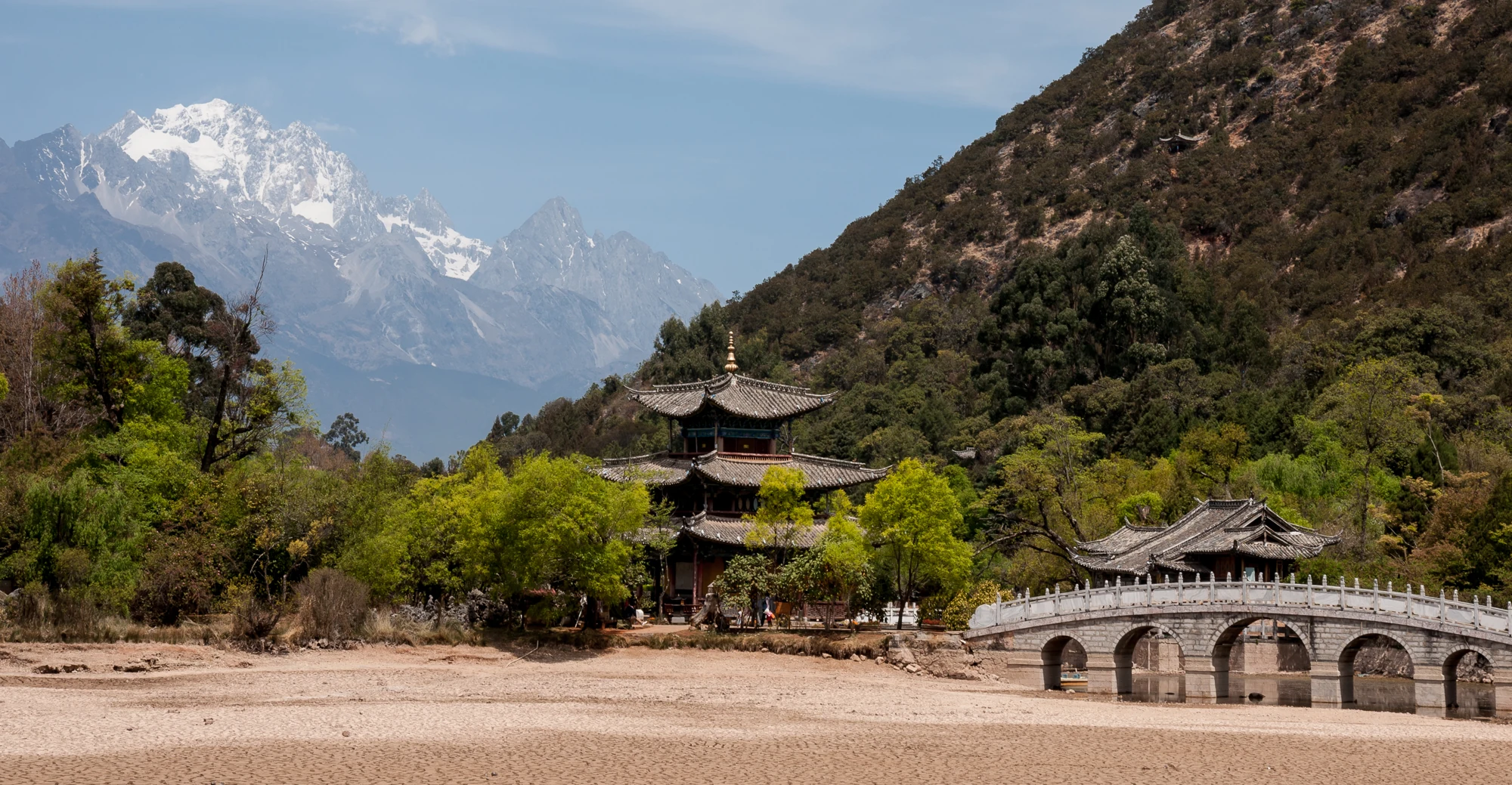
The featured photograph was taken on April 1, 2012, during a dry spring. Its exposed bed is deliberate context for this guide, not a statement about today’s water level. Likewise, a photograph showing a full pool cannot establish conditions for another season. Choose the outing for the park itself as well as any reflection you may see.
Choose buildings with different stories
A Lijiang municipal media centre cultural feature describes a collection of buildings with different origins, including some moved here from other sites. That distinction matters: the park’s present arrangement does not mean every structure was originally built beside this pond.
| Feature to recognize | A useful focus | Keep separate |
|---|---|---|
| Deyue Lou / 得月楼 | The relationship between a waterside pavilion, bridge and wider landscape. | A familiar exterior view does not establish access to an upper floor. |
| Suocui Bridge / 锁翠桥 | A covered bridge associated with the pond’s southern end. | Distinguish it from the uncovered arched bridge in familiar photographs. |
| Wufeng Lou and Jietuolin gateway / 五凤楼、解脱林门楼 | Buildings brought from the Fuguo Temple setting; compare their roof forms. | Original location, later relocation and today’s visitor route are different questions. |
| Longshen Temple and the old stage / 龙神祠、古戏台 | The relationship between cultural buildings, a courtyard and performance space. | A stage is not a guarantee that a performance runs during your visit. |
Choose one building to understand closely. Read its identification board; with children, sketch a roof shape or find a repeated detail. Use the current directory for open sections, keeping a closed interior out of the plan.
Build a short visit or a measured half-day
The time estimates here are suggested pacing choices, not official walking times. Your entrance, path choice, stops and the walk back to your hotel all affect the effort. Check the current map before treating the entire waterside circuit as equally easy.
| Your available time | A sensible emphasis | What to leave flexible |
|---|---|---|
| A short outing | One waterside view and a nearby architectural subject, followed by a return. | Extra paths and waiting for a gap in the clouds. |
| A focused park visit | Roughly 1.5–2 hours of looking, selected walking and a rest. | Interiors, further crossings and any separately arranged explanation. |
| A cultural half-day | The park, a seated meal and a compact section of Dayan. | A second museum, another old town or a performance with its own schedule. |
One useful sequence is entrance checks, a waterside stop, a chosen building, a seated pause and the return. Decide whether to extend the walk at the pause. This keeps a group together without requiring everyone to maintain the same interest in photography or architecture.
Elephant Hill forms part of the setting, but a hill climb is not included in these waterside suggestions. Treat any uphill extension as a separate outing needing current route and access checks. A calm park photograph does not tell you the gradients or steps on every surrounding path.
Give photography a time limit
The familiar scene combines a bridge, traditional architecture and distant Jade Dragon Snow Mountain. Visibility, water level, wind, haze and the light direction all influence what you can photograph. Sunshine above the town does not establish a clear peak, and a visible peak does not establish a mirror-like reflection.
Check the forecast and what you can actually see before choosing a visit window. Morning can be a useful possibility when it fits the opening arrangements and your day, but no particular hour guarantees clear conditions. Do not plan to enter before the posted visitor time merely because a photograph was made in early light.
Set a limit for waiting, then change the subject if the scene does not develop. An architectural detail, bridge curve or wider garden composition can work without a snow-mountain backdrop. Keep tripods, bags and pauses clear of through-walking space, and stay behind barriers instead of stepping onto a bank for a cleaner angle.
A second visit should be a deliberate choice, with its entry conditions and effect on the rest of the day checked first. It is not necessary to sacrifice several useful Lijiang mornings to recreate an image made under different conditions.
Settle entry, identification and costs at the correct venue
Use the current park notice or visitor information for your date to establish opening, last entry, any reservation requirement and the documents accepted. Bring your original passport and any relevant payment or admission receipt. If an online form offers only Chinese identity-card fields, ask for an accepted passport procedure instead of entering an invented number.
Ask specifically about 丽江古城维护费, the old-town maintenance fee, when resolving any verification at the park. Keep its explanation separate from a paid guide, a show or another attraction’s admission. An older blog’s price, expiry period or exemption list should not be combined with another page’s entry instructions to create an assumed current rule.
If you have already paid a relevant charge, show the official receipt and ask whether it applies before paying again. For children, older visitors or concessions, confirm the documentary requirement for your actual passports. Do not assume that a rule described using Chinese identity documents automatically works in the same way on a foreign-passport booking screen.
Budget beyond the gate: transport from your hotel, a meal, any interpretation you request and a separately chosen cultural venue can all affect the day. Ask what each payment covers. A museum or performance nearby may have its own hours, reservation or ticket; physical proximity does not make it part of a park visit.
Connect it to Dayan without overloading the day
Start from your hotel’s actual location and usable entrance, not the assumption that “old-town hotel” means beside the park. Some accommodation involves pedestrian lanes before reaching a vehicle point. Confirm the return meeting place and include the final walk in your transfer allowance; our Lijiang accommodation guide explains why access matters.
A park morning followed by lunch and a selected Dayan walk gives two experiences at a manageable scale. The Lijiang old towns and day-trips guide helps you choose what to add. Keep Shuhe, Baisha or a longer excursion as a separate decision rather than filling every remaining hour.
Mu Palace is another cultural visit with its own route and admission. Combine it only if you want two principal sights and have allowed for the walking and a proper break. It is also a useful alternative focus when your interest is administration and courtyard architecture rather than the park landscape.
Wear shoes with grip and bring a layer for a shaded pause. Wet paving, thresholds and bridge approaches can change the pace; identify a specific accessible route if steps are an issue. Keep children close near the water and give other visitors room around quiet cultural spaces.
Questions before adding it to your stay
Does seeing the snow mountain here replace a mountain day?
No. This is a distant view from a city park, when visibility permits. A mountain scenic-area visit involves separate transport, admission and route choices. Use the Jade Dragon cable-car planning guide for that decision.
Can it be a lighter day after arrival?
It can be planned that way by choosing a short section and protecting time to rest. Do not turn the park, Dayan and an optional climb into one compulsory programme. The city and mountain planning guide explains the wider distinction between those outings.
Can it fit a longer cultural route?
The existing eight-day Dali, Shaxi and Lijiang Tea Horse Road itinerary places Dayan and Black Dragon Pool on its Lijiang cultural day. It is a regional journey, not a standalone park ticket. Any hosted paper or music experience depends on a confirmed programme; guiding, transport, accommodation and other services belong in your written proposal.
Send your dates, hotel area, walking needs and interest in architecture or photography through Plan My Trip. Vero Trip can use those priorities to discuss a park-focused outing or how much space to leave for it within a longer journey.
Featured image: Black Dragon Pool in Lijiang during a dry spring, April 1, 2012; it does not show today’s water level or promise a mountain view. Photo by CEphoto, Uwe Aranas / CC-BY-SA-3.0. Resized and converted to WebP; the adapted image is shared under the same license.