Updated 31 October 2026.
Choose Mu Palace, also called Mufu, for a focused look at Lijiang’s Mu rulers, their architecture and their tradition of learning. Make it the main visit in an old-town half-day, with time to approach on foot, pause in selected courtyards and return comfortably. Choose daytime if you want to examine buildings and interpretation at your own pace; investigate the separately ticketed evening programme if staged storytelling is your priority.
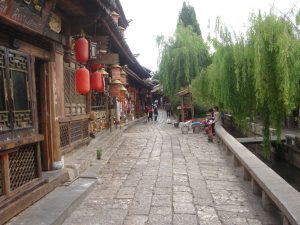
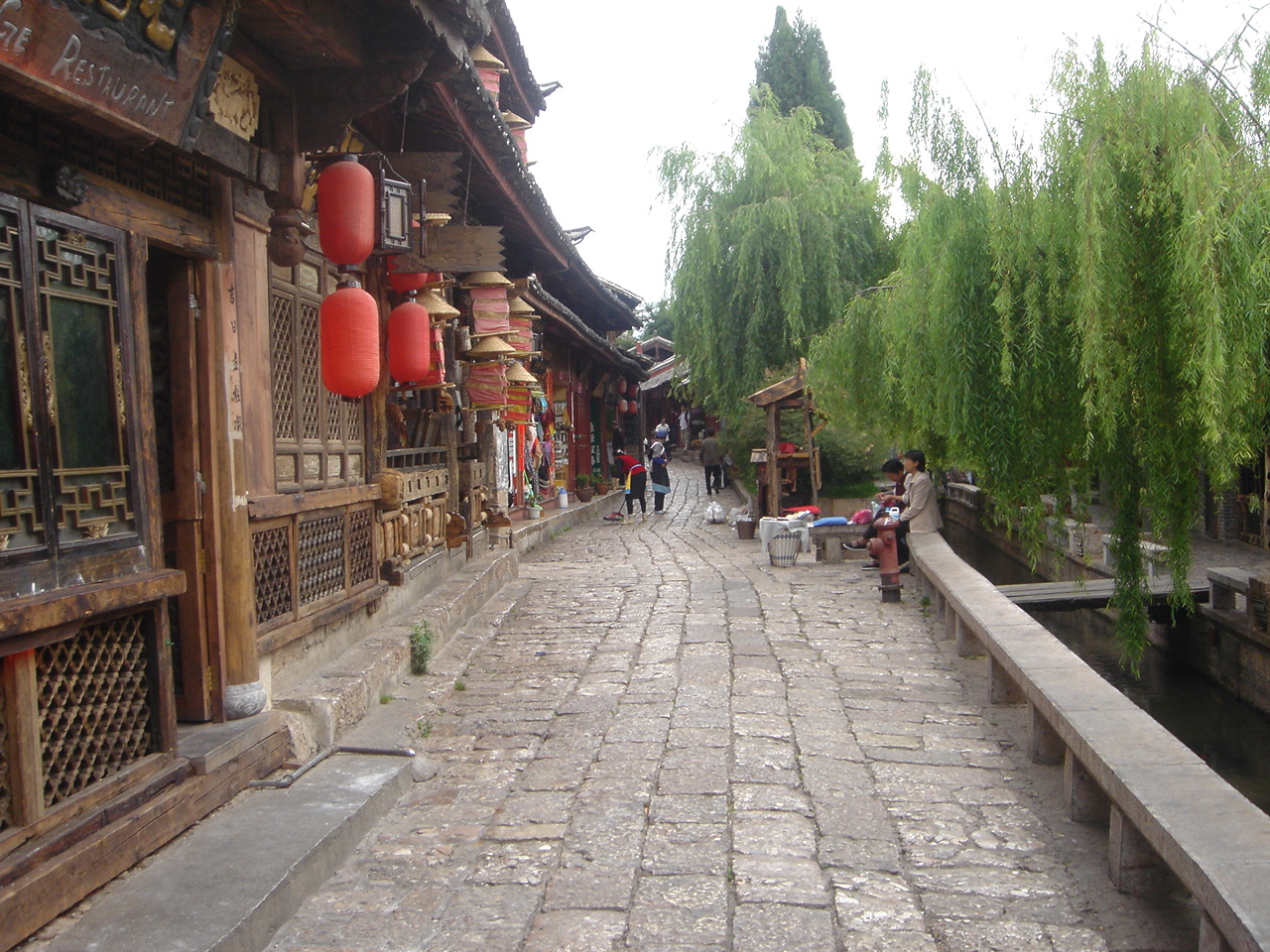
Featured photograph: an archival street scene in Lijiang Old Town, by Mooncooy, released into the public domain. It shows the surrounding town, not Mu Palace’s entrance or interior, today’s conditions or a Vero Trip group. Original photograph and release.
Understand the residence before following the courtyards
Mu Palace is the former administrative residence of Lijiang’s hereditary Mu rulers, or tusi, and is also known as Lijiang Old Town Museum. It is a particular complex within Dayan Old Town, rather than another name for the town or a royal palace used by China’s emperors. A general Lijiang walk does not automatically include a visit inside.
The museum’s importance extends beyond its rooflines. The Mu family governed locally and participated in cultural exchange over many generations. Prince Kung’s Palace Museum’s 2026 account of Mu Palace’s history connects the site with Naxi leadership, literature and learning. That article describes an exhibition held in Beijing; its listed objects should not be assumed to be on display in Lijiang.
Keep the building history in perspective. Yunnan Daily’s report based on museum interviews records systematic restoration and reconstruction and reopening in 1999. The present complex is valuable to explore with that context. It should not be presented as an entirely untouched medieval residence.
Four things to notice on the open visitor route
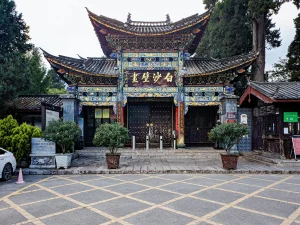
Begin with the entrance inscriptions. At the welcoming archway, Tian Yu Liu Fang (天雨流芳) carries a literary Chinese image of nourishing rain and an association with “go and study” in Naxi. The nearby Zhongyi stone archway (忠义坊) has a different message, concerned with loyalty. Recognising the two names helps you distinguish gateways that can otherwise blur into one photograph.
Then consider the administrative space. The Yishi Ting (议事厅), or council hall, was associated with government business. Look at the relationship between its frontage and the space before it. If guiding is arranged, ask how the hall’s function differs from the family’s scholarly spaces rather than requesting only dates and names.
Pause at Wanjuan Lou (万卷楼), the library building. A Yunnan Daily interview with the museum’s interpreter explains its connection with reading and book collecting, including Chinese works, Buddhist texts and Dongba writings. The interpreter also points out bracket construction and carved doors and windows as evidence of different building traditions meeting here. Use that as a reason to look closely at the join between roof, supports and facade; do not assume every historical book mentioned is available to inspect.
Finally, decide whether to continue farther uphill. The grounds rise with Lion Hill. Reaching more elevated sections changes the effort and return time. Use the current map and staff advice to choose additional open spaces; an upper-level photograph is optional. Stay out of closed rooms and follow signs about stairs, barriers and photography.
Build a half-day around what interests you
| Your priority | Shape the visit around | What to leave flexible |
|---|---|---|
| History and architecture | Gateways, council hall, library setting and a focused explanation | Every upper section and a long afternoon walk |
| A lighter cultural outing | A confirmed shorter route and a seated break afterward | Climbing farther merely to complete the site |
| Photography | Selected courtyards, architectural details and permitted sightlines | Empty scenes, perfect light or access to every balcony |
| Staged storytelling | A separately confirmed evening product with a language plan | Assuming it replaces an independent daytime visit |
Our planning suggestion is one morning or afternoon block for the palace and its pedestrian approach, followed by lunch or another proper break. This is an allowance for the whole outing, not a guaranteed duration inside. The slowest walker, time spent listening and the open route will determine how much you cover.
A simple sequence is to reach the entrance without luggage, establish the route, explore the principal spaces, then reassess whether to continue uphill. Finish with one compact Dayan walk instead of an obligation to cross every famous lane. Agree where to meet if members of the party prefer different walking distances.
With children, try one clear theme: compare the gateways’ messages, find a carved detail, or ask why a ruling family valued a library. Follow with food and a change of activity. A smaller number of understood buildings can be more rewarding than a long succession of names.
Daytime and night visits are different decisions
Mu Palace has developed an immersive night programme using historical stories, live performance and lighting. In a 3 June 2026 interview with the project’s operating and artistic directors, Lijiang’s municipal media centre described a moving visitor route through several buildings. The report also discussed changing content and future foreign-language services. It does not establish that an English-language performance or explanation is available for your date.
For a night visit, confirm the exact product name, date, start and finish, check-in location, language and what happens in rain. Ask how much standing, walking and stair use the route involves. Obtain the current ticket conditions separately from daytime admission. The times, prices and summer promotions in an older article are not a booking confirmation.
If your main interest is reading the architecture, daytime offers a different experience from following a staged programme. If narrative and lighting appeal more, discuss how you will follow the story before buying. Avoid buying both by default when one well-chosen visit would suit the group.
Tickets, documents and guiding: settle the actual arrangement
Use the venue’s current official ticket channel or ticket office to establish admission, opening hours, last entry and the areas available. Save the attraction name 木府 / 丽江古城博物院 with the entrance pin. A general old-town booking or a photograph of a gate does not establish access to the museum.
When using a foreign passport, confirm which official purchase process accepts it, which document to bring and whether collection is required. Keep the booking details consistent with that document. If an online form only accepts a Chinese identity number, ask for the official alternative. Check a child’s or older traveller’s concession eligibility rather than assuming a domestic ID-card rule applies to every visitor.
A Chinese explanation heard by another group is different from a booked English-guided visit. Agree the provider, language, length, meeting point and historical focus in writing. You can request an explanation of the Mu rulers, the library tradition and reconstruction history without expecting a fixed set of rooms or exhibits to be available.
| Budget item | Get a clear answer | Keep separate unless specified |
|---|---|---|
| Daytime admission | Named attraction, date, document and entry conditions | Guiding, transfers and evening tickets |
| English interpretation | Language, duration, meeting point and fee | A general group explanation or a staged show |
| Evening programme | Current session, language, route and change policy | Daytime access and travel back to the hotel |
| Hotel connection | Vehicle-access point and remaining pedestrian section | Luggage storage, meals and onward tickets |
This guide does not quote an unconfirmed current admission price. Compare the total outing cost, including any services you request, and retain the cancellation terms for each booking. A quoted attraction fee alone is not the price of a private guided day.
Include the old-town approach and the walk back
Send your full hotel name and map pin when planning the visit. Dayan, Shuhe and Baisha are different bases. A vehicle meeting point at the pedestrian town’s edge still leaves a walk through lanes; do not assume a car can reach the palace door or your courtyard hotel. Include that approach in the energy budget.
Leave suitcases at the hotel or use an arrangement that has actually been confirmed. For a departure-day visit, work backward from the airport or railway connection, including the walk to collect bags, the meeting point and the onward transfer. Shorten optional sightseeing before making the connection tight.
Stone paving and steps need care in rain, and the complex is not wholly indoors. Wear shoes with grip, bring a waterproof layer and ask about a shorter route. For a stroller, wheelchair or limited walking, confirm gradients, steps and practical assistance before committing. A map’s short distance does not prove a route is step-free.
The existing Mu Palace and Dayan cultural day puts the palace first, then a rest and selected old-town streets. It is an enquiry itinerary with no hotel night. Any transport, admission, meal and guiding service must be identified in the accepted proposal; an evening show is a separate request.
Choose one useful addition instead of every Lijiang highlight
Use the Lijiang stay planner to decide how this half-day fits your usable days. Black Dragon Pool offers a separate park and waterway setting. If the palace’s rising route has been enough walking, keep the rest of the day near your hotel instead of adding the park automatically.
The Baisha murals are another specific heritage visit, with their own conservation and admission arrangements. A craft workshop likewise requires a named host and an agreed activity. Neither is included simply because a programme says “Naxi culture.” For a later meal or music outing, compare the choices in our Lijiang evening guide and leave time for dinner and the return.
Questions travellers ask
Is this the same museum as the one by Black Dragon Pool?
No. Ask for Mu Palace or Lijiang Old Town Museum by name and use its actual entrance pin. Do not rely on the English word “museum” alone when showing a driver or hotel your plan.
Will I see the objects shown in a Beijing exhibition article?
Not necessarily. The 2026 Mu Palace exhibition at Prince Kung’s Palace Museum was in Beijing. Use its research for historical context, and ask what is currently displayed at Mu Palace itself.
Does the day tour include a night performance?
The listed cultural day focuses on Mu Palace and Dayan. A night programme requires its own confirmed product and arrangements.
How can I request a more focused visit?
Tell Vero Trip your dates, hotel, usable hours, walking needs and preferred language. Say whether architecture, Mu family history or an evening experience matters most. Request a written plan naming the attraction and each service, with the confirmed price and conditions.