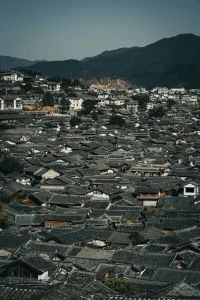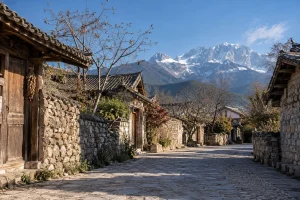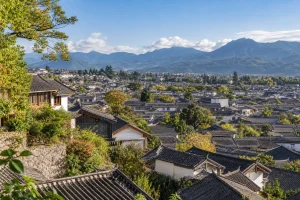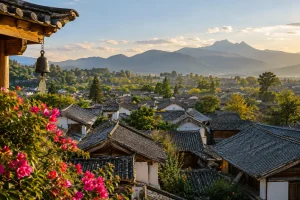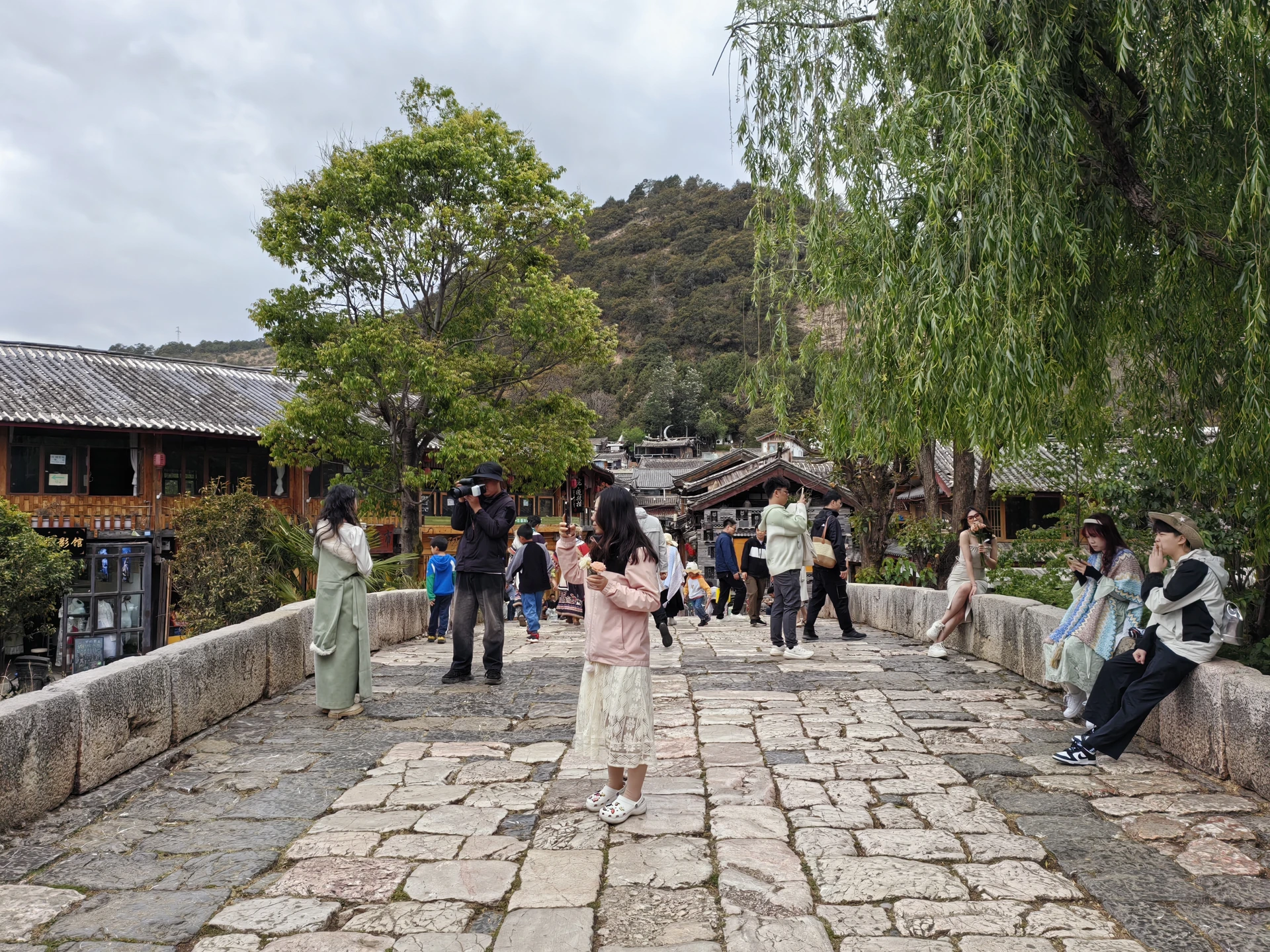
Make Shuhe’s old market square and Qinglong Bridge the shared start, then choose the rest by interest. Follow water upstream to Jiuding Dragon Pool, or spend time with caravan trades at the museum. One extension and lunch make a coherent half-day; both need more room for walking and reading.
Put 束河古镇 on your map. Dayan, Baisha and Shuhe are separate parts of the Old Town of Lijiang World Heritage property. The name “Sifang Street” occurs in both Dayan and Shuhe. For this walk, save 束河老四方街 and 束河青龙桥 together. That small distinction matters if a driver or hotel receptionist is preparing your pickup in another part of the city.
From the old market square to Qinglong Bridge
Stand at the square’s edge and trace the move from open trading space to narrow crossing. Shopfronts face the paving; lanes and channels lead towards the river. Crossing into this market helps explain Shuhe’s caravan role more clearly than a row of souvenirs alone.
See the Ming stone arch from a permitted bank position before crossing it. On the deck, the view changes to worn slabs and buildings ahead. These two angles reveal different parts of the same bridge; a photograph from the top cannot show the span beneath your feet.
Let the paving set the pace. Irregular slabs can be slippery when wet, and the approach may be enough for someone uncomfortable with uneven ground. For a portrait, wait clear of the route so people can still cross; the bridge remains a working passage through town.
A spring walk or a museum visit?
| Your interest | Where to spend the time | What to look for |
|---|---|---|
| Town layout and an easy-to-shorten walk | Old Sifang Square and the approach to Qinglong Bridge | The change from an open trading space to a narrow river crossing. Choose a seat back from the busiest approach. |
| Water and the shape of the settlement | The public lanes upstream towards Jiuding Dragon Pool | The change from shopfronts and crossings to the spring pools and the pavilion beside the water. |
| Caravan trades and local crafts | Tea Horse Road Museum on Zhonghe Road, if open | Ask about the leatherworkers’ displays, the Dajue Palace section and what can actually be seen that day. |
| A relaxed lunch with little extra walking | A waterside restaurant around Feihua Chushui or a table near your return route | Compare the menu and the approach to the table. A river view may involve steps down from the street. |
For Jiuding Longtan (九鼎龙潭), follow the public upstream route after the bridge. At the two pools, look towards the spring at the slope’s foot, then back along the water’s journey into town. Follow signs around a closure or retrace the known route.
Above the pool, Sansheng Palace connects water and working-town history through the Dragon King, Guanyin and the leatherworkers’ patron. The pool remains a useful stopping point if interiors close. Keep worship spaces, fish and water undisturbed; a shaded channel-side pause may suit the group better than more steps.
At the Tea Horse Road Museum on Zhonghe Road, start with a practical question: what did pack-animal traders need made or repaired in leather? Look for tools and materials before moving between the Dajue Palace and other accessible parts of the complex. The museum’s buildings span different periods.
Ask which buildings and mural areas are accessible before paying or setting aside the afternoon. If mural painting is your main interest, Baisha is a separate destination with its own buildings and arrangements. A label referring to Dajue Palace in Shuhe does not give you access to a hall in Baisha. Our Baisha murals guide explains the choices for that visit.
A half-day with lunch and a definite ride home
After breakfast, leave large bags at the hotel and travel to an agreed road-accessible point in Shuhe. If you are coming from Dayan, share the Chinese names of both the town and the bridge. A map pin on the bridge is useful for walking. Give the driver a separate pickup pin on a vehicle-accessible road. Save a picture of the meeting point and the hotel address before setting off on foot.
After the square and bridge, choose the extension while everyone still has the return walk in reserve. Name a frontage on the square side for reunion if some prefer the bank view. The spring suits walkers; the museum suits readers only when the wanted exhibits are open.
For lunch, look for jidou liangfen (鸡豆凉粉), slices of set chickpea jelly. A Lijiang reporter found it served with a sour and spicy dressing in Shuhe in April 2026, along with rose-filled flower pastries. Ask for the dressing separately if spice or ingredients are a concern. The Chinese name can sound like a chicken dish to an English speaker using a translation app. Show the written name and ask what is in the dressing. For a larger meal, choose a table with seating everyone can reach and order from the menu available that day.
Feihua Chushui (飞花触水) is a waterside option if lunch is part of the outing itself. If you need to leave for a train, have lunch closer to the agreed exit. Return on foot to the saved road point, meet your driver or arrange a licensed ride, and finish at the hotel to collect any stored bags. A hotel-to-Shuhe transfer only covers the outward journey unless a return or waiting arrangement appears in your booking.
Where to sleep and how to divide the days
Stay in Shuhe if the chance to revisit the bridge before breakfast or walk back to dinner is a reason for the trip. A room facing a waterside dining street can sound quite different in the evening than it does on an afternoon viewing. Ask which way the bedroom faces, whether there are stairs to it, and how far you would have to wheel a case from the car. For a late arrival, an address at the road edge can be more useful than a room deep inside the lanes.
If most of your evenings will be in Dayan, keep one room there and visit Shuhe by road. Changing hotels for a single night costs you a checkout, a luggage transfer and a second check-in. For practical hotel comparisons, see where to stay in Lijiang. If you are still choosing among the three heritage areas, the Lijiang city guide compares their roles in a first trip.
| Time in Lijiang | Where the nights fall | How Shuhe fits |
|---|---|---|
| 3 days, 2 nights | Both nights in Dayan or Shuhe | Arrive and settle on day one. Give day two to the bridge, one extension and lunch. Return to the hotel that afternoon. Depart on day three. |
| 4 days, 3 nights | Three nights at one Lijiang base | Use the two full days for different parts of the city. Walk Shuhe on one and visit Dayan on the other. Switch their order if conditions favour the outdoor walk. |
| 5 days, 4 nights | Four nights at the same hotel | Allow three full days between arrival and departure. Give Shuhe its own half-day and lunch, reserve a different day for Baisha, and keep a day for Dayan or rest. |
An overnight in Shuhe makes two short walks possible. On arrival afternoon, find the square, the bridge and a convenient place for supper. On the next outing, go directly to the pool or museum. That can suit a traveller who likes to sketch, or a family who wants a break at the room between outings. If you stay in Dayan instead, a change of viewpoint on another day is Lion Hill and Wangu Pavilion, where the effort goes into climbing for a view over the roofs.
When the two-day photography itinerary fits
Verotrip’s two-day Lijiang, Baisha and Shuhe travel photoshoot suits someone who wants to be in the pictures. The first day uses selected Lijiang lanes and returns to the hotel. On day two the published route starts in Baisha, then moves to Shuhe for portraits and a slower lunch before returning to Lijiang for luggage or the agreed onward connection. It allows one suggested hotel night. A dedicated museum visit or a long walk to the pool takes time away from the agreed photography session.
Decide whether you want a portrait with the bridge paving behind you, a small group walking together, or time to study the water and buildings on your own. Those activities use the same stretch of street differently. Ask about the photographer’s hours, language, deliverables and wet-weather arrangements if choosing the product. A private courtyard, a change of clothes and a commercial shoot each need a suitable location and any necessary permission.
Access, weather and costs
International visitors have documented visits to Shuhe’s public lanes. Admission arrangements for an individual museum, special activity or hotel depend on the venue. Carry your original passport and confirm the current ticket or registration process for your travel date. If someone needs help with a counter transaction or interpretation of a display, agree who will accompany them inside. A car booking alone does not provide that assistance.
| What to arrange | Ask for this detail | Why it affects the outing |
|---|---|---|
| Road transfers | Hotel pickup, named road drop-off, waiting or a second pickup, and final destination | The end of the pedestrian walk and the place where a vehicle can stop can be some distance apart. |
| Mobility and rain | Surface near the bridge, steps to the chosen table, route back and an indoor option | Stone paving is uneven. If the banks are wet, shorten the walk before anyone becomes too tired to return. |
| Venue and language | Open museum rooms, ticket channel for your original passport, and the language of any interpretation | Outdoor sightseeing, admission and a guided explanation are separate arrangements. |
| Meals, hotel and portraits | Chosen meal, number of nights, room access and any photographer or location fees | A lunch suggestion and a camera stop in an itinerary do not specify what has been paid for. |
In a shower, let the group settle at lunch and reconsider the next leg after eating. A museum is a practical alternative only if it is open, reachable and of interest. On a clear day, a place to sit by the river may be all you want after the bridge. Neither plan depends on a particular water colour, seasonal flowers or an empty market square.
Questions about Shuhe
Can I see the bridge without booking a photography tour?
Yes. The route described here is a walk to the public square and crossing. Choose the portrait itinerary only if having a photographer with you is part of the holiday you want. For a few personal photographs, allow time to step aside and wait for a safe space.
Which destination should I give my driver?
Give the name Shuhe Ancient Town, 束河古镇, and agree on a road-accessible meeting point. Use the old square and Qinglong Bridge as walking landmarks. Sending “Sifang Street, Lijiang” by itself can point to the square in Dayan.
Can I visit Shuhe between a hotel checkout and a flight?
It depends on the luggage plan and your departure time. Work back from the required airport arrival, including the drive, bag collection and walk from the square to the vehicle. If that leaves little time, keep lunch and the bridge together and leave the pool for another stay.
What should I send a Verotrip travel consultant?
Send your dates, hotel area, party size, walking needs and actual arrival or departure point. Say whether the spring, caravan history, lunch or portraits matter most. Price on request. Ask for a written proposal showing the complete return, any admission and language assistance, meals, accommodation and photography services you select.
Cover photograph of Qinglong Bridge by Yumeto, 3 May 2024. Resized, converted to WebP and cropped for display under CC BY-SA 4.0.