Choose Qingyang Palace for a focused introduction to Daoist architecture in Chengdu, with time to understand the Eight Trigrams Pavilion and the bronze rams rather than rushing through another temple. A selective visit followed by a meal or a short Culture Park walk makes a useful half-day. Add Du Fu Thatched Cottage only when poetry is a separate priority and the full day allows for both visits.
Qingyang Palace, 青羊宫, is also called Qingyang Gong or the Green Ram Temple. It is a Daoist religious site in Chengdu’s Qingyang District. The word palace here does not make it an imperial residential palace. Save the Chinese name together with Chengdu when arranging transport; a district name alone is too broad.
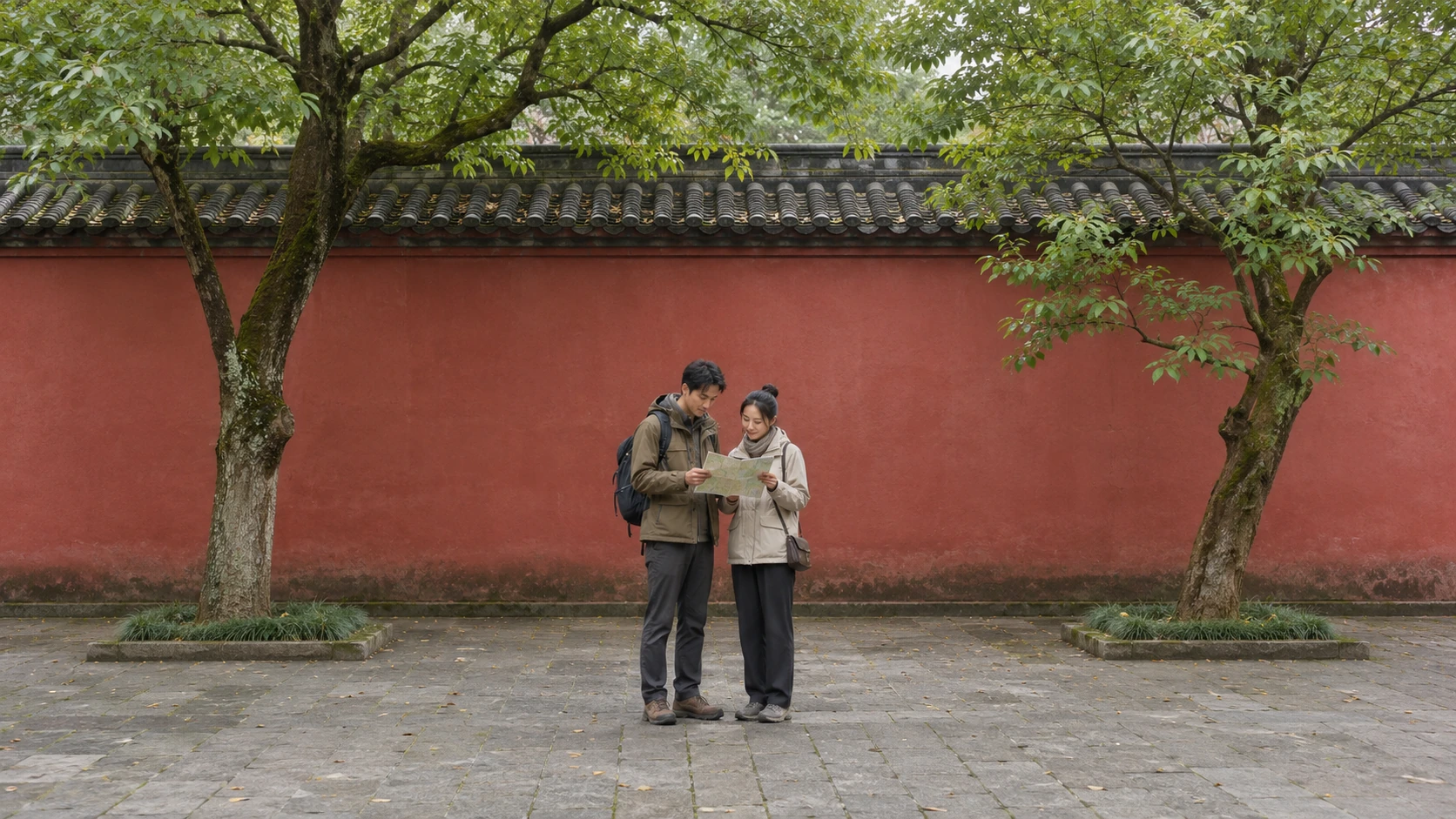
Lead image: AI-generated travel illustration with two fictional adult travellers in a generic Sichuan red-walled courtyard. It is not a photograph or reconstruction of Qingyang Palace, its Eight Trigrams Pavilion, bronze rams, a named religious building, current visitor conditions, real customers or a Vero Trip departure.
Choose the Daoist story before choosing more stops
The clearest reason to visit is an interest in a living religious setting and its built form. Give the courtyards, the pavilion and the principal hall a connected story. Travellers who mainly want a long park walk or an evening performance should identify those separately, instead of expecting the temple entry to cover every activity nearby.
A history published by the Sichuan local-gazetteer office in November 2021, supplied by Chengdu’s local-history office, describes the complex’s successive rebuilding and its connections with Laozi and the Tang court. Those traditions help explain the name. They do not mean that all the buildings visible today survive from the earliest period described in the legends.
For a practical introduction, concentrate on three questions: what makes the pavilion distinctive, how the halls relate to one another, and why the rams became an identifying feature. A short explanation prepared before the visit can be more useful than collecting photographs of every doorway. Interpretation in English needs its own confirmation; attractive architecture does not establish that an English guide is available.
| Your main interest | A useful plan | What to leave separate |
|---|---|---|
| Daoist architecture and symbolism | A deliberate temple visit centred on the pavilion, courtyards and Sanqing Hall. | Ritual participation, private rooms and specialist interpretation. |
| A gentler city half-day | The essential temple area, a meal and an optional short Culture Park walk. | A long cross-city sightseeing circuit or an assumed step-free route. |
| Poetry and religious heritage | Give Qingyang Palace and Du Fu Thatched Cottage their own visiting blocks in a full day. | Other major museums or a fixed evening show unless the remaining time works. |
Read the pavilion and the rams as a connected visit
Look first for the Eight Trigrams Pavilion, 八卦亭, also translated as Bagua Pavilion. The local-gazetteer account identifies it among the complex’s important structures and describes its image of Laozi riding a green ox. Notice the pavilion’s form, roof and relationship to the larger halls from the permitted visitor route. An important building need not have an accessible interior or upper level on your date.
At Sanqing Hall, 三清殿, the paired bronze rams provide another clear point of attention. The Japanese consulate’s April 2018 description of its local sightseeing records one single-horned and one double-horned figure, with the single-horned creature understood through the twelve zodiac animals. Use this as historical interpretation, rather than a promise that every object is presently displayed without barriers.
Look at the figures without assuming that touching is permitted. An old account of a custom is not permission to handle a religious or historic object today. Keep entrances clear, let worshippers pass and follow the notices at each hall. For children, recognising the pavilion shape or comparing the two rams can give the visit a simple purpose without turning the worship space into a game.
The local-history account places much of the surviving complex’s reconstruction in the seventeenth century. Separate that physical building history from traditions about Laozi and the earlier site. There is no need to attach a single foundation date to every courtyard to appreciate the continuity of religious use and rebuilding.
Build a half-day around the temple and a real pause
Begin with the selected temple visit while the group has attention for it. Have a seated meal or drink afterwards, then decide whether to continue walking. This is a suggested allocation of your day, not a published opening timetable or a claim that every visitor needs the same number of minutes.
| Block | A workable sequence | Decision point |
|---|---|---|
| Temple first | Enter through the confirmed visitor entrance and follow the selected courtyards, pavilion and hall route. | Shorten the visit if access, standing or weather makes the full route unsuitable. |
| A proper pause | Sit down for a separately chosen meal or drink before adding more walking. | Read the order and charging basis; do not assume temple admission includes refreshments. |
| An optional nearby extension | Choose a short permitted Culture Park walk or return to the hotel. | Keep the agreed pickup, bag collection and any onward departure achievable. |
The consulate’s historical description places Culture Park, 文化公园, beside Qingyang Palace and identifies Qintai Road, 琴台路, beyond it as another area for strolling. These are useful nearby interests, with their own entrances, surfaces and walking distances. A Culture Park map pin is not interchangeable with the temple entrance.
Do not turn the optional extension into an obligation. After a late flight, the temple and a meal may be enough; with tired legs, finish at the agreed collection point. If the group wants a performance around the area, obtain a current, dated ticket and plan the finish and journey home separately. A nearby theatre name does not establish a show time, a seat or inclusion in a daytime visit.
Give a second cultural attraction its own time
For a longer cultural day, compare the Du Fu Thatched Cottage visit guide. Make one attraction the main interest before reserving the other. A possible sequence is the temple, lunch, then a separately confirmed cottage visit, with the hotel return after the second stop. Reverse the order if actual entry arrangements make that more sensible.
The cottage tells a literary story; Qingyang Palace introduces a Daoist setting. They are not interchangeable simply because both have gardens and traditional buildings. Allow for the journey between entrances, ticket or reservation checks, toilets and the meal. Skip another major museum on the same day if it would reduce both visits to hurried photographs.
If your religious-cultural interest is mainly Buddhist, compare the existing Wenshu Monastery half-day. Choose it for that particular setting and its surrounding food streets. Visiting both can be worthwhile with a genuine interest in the difference, but a short first Chengdu stay does not require collecting multiple monasteries.
Arrange the entrance, luggage and complete return
Ask for the actual visitor entrance and save it in Chinese before setting out. For a car, agree where passengers get out, whether the driver waits and where collection happens. A one-way drop-off is different from a return transfer. Check whether a change of exit or an early finish can be communicated without having to search for the vehicle.
For public transport, use the current route planner for your starting hotel, the walk to the correct gate and the return connection. This guide does not prescribe a particular metro exit, bus number or journey time. Station names and a short line on a map do not account for lifts, road crossings or the final approach.
Leave the main case in agreed hotel storage when possible and take a small day bag. Do not rely on an unverified temple cloakroom. Before a train or flight, include bag collection and the exact station or terminal in the return plan. A visit that works on a free city day may not fit a narrow departure-day window.
Confirm the current entry method, accepted document, last admission and any area restrictions for your date. Sichuan University’s March 2026 overseas-education bulletin, page 8, records international students discussing their Qingyang Palace visits at a December 2025 course presentation. That is historical foreign-visitor context; it does not establish today’s passport-booking workflow or make the university’s organised activities a purchasable tour.
Respect worship and shorten the route when necessary
Wear clothing suitable for a religious visit, keep voices low and ask before photographing people. Check the signs before photographing inside a hall. Do not walk between worshippers and an altar or enter staff and religious residential areas because a door is open. Observing the architecture does not require joining a rite, making a donation or purchasing an additional service.
If you would like to offer incense, first ask what the temple permits and provides. Do not bring an assumed ritual package or accept a paid interpretation without understanding its purpose and price. No incense allowance, ceremony, fortune reading or blessing service is promised here. A sightseeing proposal should keep optional personal religious spending distinct from admission and guiding.
Courtyards can involve thresholds, steps, uneven paving and standing. For a wheelchair, pushchair or limited walking tolerance, confirm the actual gate-to-hall route and resting options; a compact urban site is not proof of complete level access. Decide which feature matters most and a sensible turnaround point before continuing deeper into the complex.
In rain, reduce exposed walking and watch the footing at thresholds. Covered edges of religious buildings are not guaranteed visitor shelters or reserved seating. If the essential route is unsuitable, move the temple visit to another day and choose an indoor attraction only after its own operation and entry are confirmed. An old seasonal photograph cannot establish flowers, autumn colour or a festival on your date.
Keep the costs and service boundaries clear
| Item | Ask the proposal to specify | Do not infer |
|---|---|---|
| Entry and interpretation | The selected public areas, document method, current charge and agreed explanation language. | All hall interiors, rituals or an English-speaking guide. |
| Meals and personal choices | Any arranged meal, refreshments, optional purchases and separately dated performance. | Tea, donations, religious services or an evening show included in temple entry. |
| Transport and the second stop | Hotel pickup, waiting, each attraction entrance and the final hotel or onward station. | A complete return, another museum ticket or luggage storage from a one-way drop-off. |
Price on request. Transport, guiding, admission, meals, performances, accommodation and insurance apply only when itemised in the written confirmation. Ask how the plan changes if a selected hall or second attraction is unavailable. The names of nearby places are planning options, not evidence that their services have been reserved.
Questions before choosing Qingyang Palace
Is Qingyang Palace the same as Culture Park?
No. Plan the religious compound and the neighbouring park as separate places with their own entrances. Choose the temple for its Daoist cultural story and add a manageable park walk only if it serves your day.
Can the temple be a complete visit on its own?
Yes. A selected pavilion-and-halls visit, followed by a meal and the return, gives the half-day a clear purpose. A cottage museum, shopping street or performance is optional.
Does this guide confirm passport entry or a ritual?
No. Historical overseas visits support the visitor context, while your date, document process and open areas still need confirmation. Religious services and specialist explanations are separate choices.
Send Vero Trip your dates, Chengdu hotel, main cultural interest, walking needs and next departure. Use the Chengdu trip planner to place this half-day within the wider stay, then request a written proposal with one clear visiting focus and a complete return.