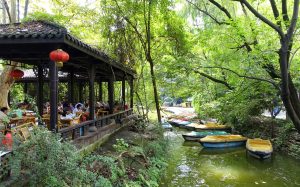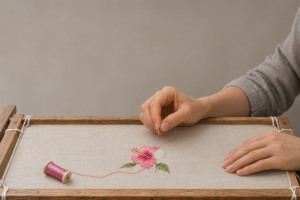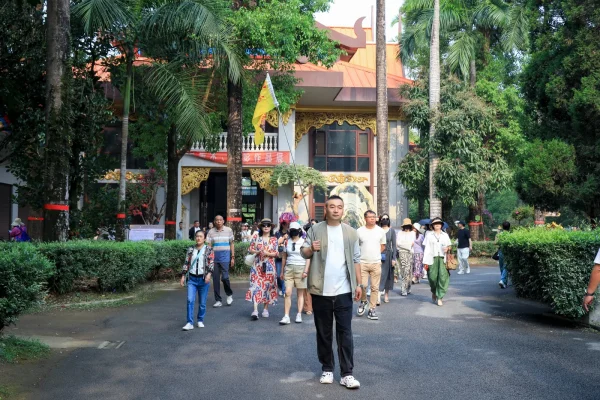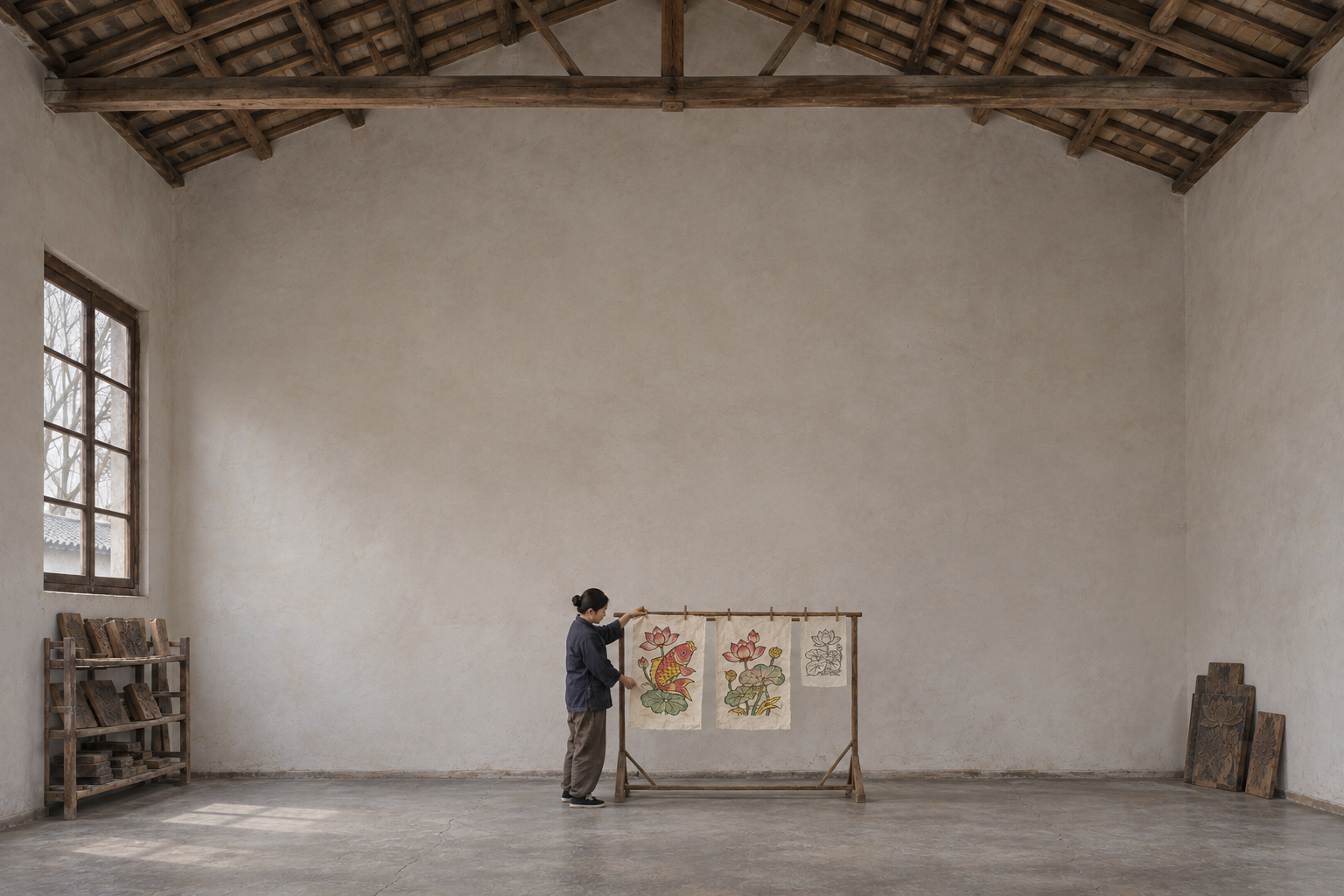
Make one printed outline and one finished picture the starting point for a Mianzhu craft day. Seeing how colour changes the same black lines explains more than a quick walk past a wall of bright souvenirs. Choose a village workshop if you want to discuss making and perhaps try a small exercise; choose a confirmed museum visit if historical prints and old blocks interest you most. Leave room for lunch and the journey back to Chengdu.
Mianzhu is in the Deyang region of Sichuan. Its nianhua, or New Year pictures, belong to a living decorative tradition associated with seasonal wishes and household display. Save 绵竹木版年画 for the craft and 孝德镇年画村 for the village. The village and the Mianzhu New Year Painting Museum are separate destinations, so a pin labelled simply “Mianzhu” is not a useful meeting point.
Look at the black line before the colour
Woodblock printing and hand colouring work together in the familiar Mianzhu process. A February 2026 interview with local practitioner Chen Jian describes a block printing the outline, followed by colour added by hand. The same outline can acquire a different character in another painter’s hands. Rather than judging only the brightest sheet, compare the edges, the areas left pale and the way colour sits within or across a line.
The same interview distinguishes colourful honghuo pictures from heihuo, the quieter printed or rubbed branch of the tradition. This is a useful reminder that a shop full of New Year pictures need not consist entirely of red door guardians. Ask the maker which process produced the particular object you are holding; a monochrome impression, a hand-coloured print and a modern printed souvenir deserve different descriptions.
Begin at a comfortable viewing distance, then move closer to a small passage of the design. Follow a curved black line around a sleeve, a leaf or an animal. Compare a finished sheet with an outline only if the workshop offers that comparison. Do not touch a block or wet paper without permission: tools and drying work are part of someone’s working space.
| Object or surface | A useful looking question | What to clarify |
|---|---|---|
| A black-line impression | How does the outline organise the picture before colour is added? | Whether it is an impression from a carved block, another printing process, or a reproduction. |
| A coloured paper picture | Where has colour changed the emphasis, and which details remain in black? | Which parts of this sheet were printed and which were painted by hand. |
| A carved wooden block | Which raised surfaces correspond to the lines in the picture? | Whether visitors may handle it; an old-looking block is not automatically an antique. |
| A wall painting or decorated gift | How has the design changed with the surface and intended use? | Whether the object is a painted work, a printed reproduction or another contemporary adaptation. |
Read a picture as a wish, then ask about its story
Door guardians and rounded child figures are among the subjects described in a September 2026 reporting visit to Nianhua Village. The account also follows a maker carving a pear-wood block and discusses the shift from pictures pasted on doors towards works bought for framing. These are good starting questions for a visit: where would this picture traditionally be displayed, and how is the present work intended to be used?
Avoid assigning an identity to every armed figure or a single meaning to every animal. Ask for the picture’s title and a short explanation in a language you understand. A photograph of the title label, taken with permission, can be more useful later than several hurried pictures of the whole room. If choosing a pair, check whether the two sheets belong together and how they are meant to face.
The Hong Kong Baptist University collection introduction describes acquiring Mianzhu prints directly from practitioners and their workshops. Its catalogue helps show why the maker and individual work matter. The broader online collection also contains pictures explicitly labelled Yangliuqing; not every New Year print in a mixed collection should be called Mianzhu.
Village lanes, a workshop or the museum?
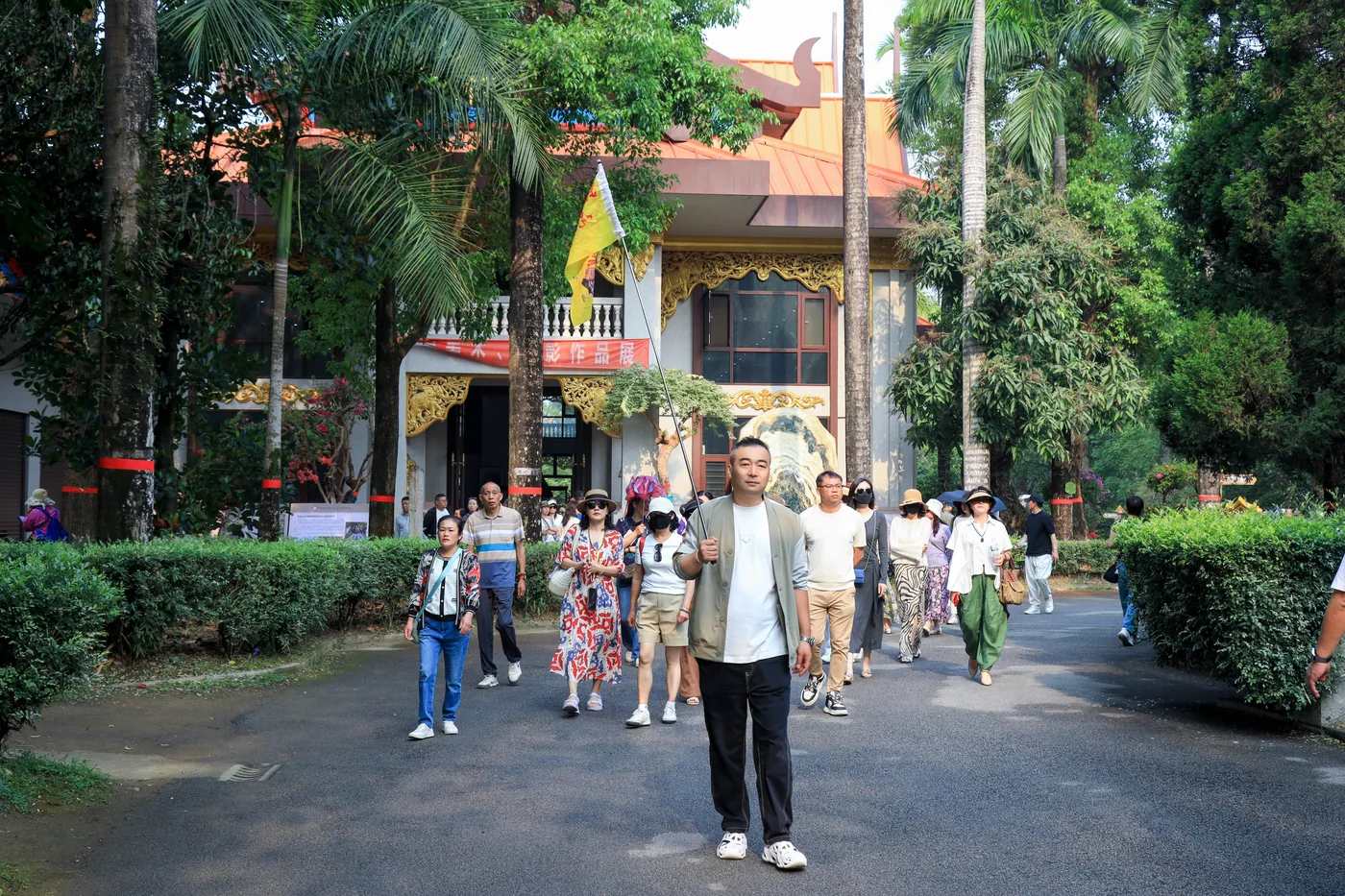
For a first craft visit, the village gives the strongest connection between pictures and the places where they are made and sold. A May 2025 local report describes the painted lanes and workshop learning around Nianhua Lane in Xiaode Town. The wall images are part of the visual setting. They are not evidence that every house is an open studio or that a lesson is available whenever you arrive.
A short walk followed by one agreed appointment works better than entering many shops hoping to find a demonstration. Send the studio’s full Chinese name and entrance pin to the driver. Explain whether the purpose is looking, discussing a purchase, watching a process or taking a lesson; these place different demands on a host’s time. A particular renowned practitioner’s presence needs separate confirmation.
The museum suits visitors who want the historical and collecting side. Local reporting on a February 2026 museum exhibition describes old Qing-period blocks and selected historic works alongside later developments. That dated exhibition is not a promise that its full selection remains on view. Check the current galleries and admission procedure before building your day around a specific object.
If you have only one outing from Chengdu, choose either the village with a workshop or the museum with a shorter surrounding walk. Put both into a longer Mianzhu stay when they are open and you want the distinction. A journey onward to Sanxingdui or another city attraction adds another transfer and a second substantial visit; it should not be squeezed in as an incidental stop.
Watching and making are different bookings
A demonstration can be valuable even without handling a tool. Watch how one stage leads to the next and wait for a natural pause before asking questions. A painting activity, a supervised printing exercise and carving a new block are very different tasks. A short visitor session should have a modest, clearly described outcome rather than imply that you will master the complete craft.
For an activity, confirm the teaching language, whether interpretation is available, seating, materials, duration and the item you can take home. Ask whether the starting sheet is a prepared outline and whether any drying time follows. Carving uses sharp tools; families should agree an age-appropriate activity with the host. A visitor who prefers not to work with tools can still enjoy choosing colours or observing.
The national heritage portal’s 2023 village report describes learning activities and contemporary products, as well as a Spring Festival programme. It supports the distinction between ongoing craft interests and dated celebrations. Do not expect festival processions, giveaways, public classes or evening events on an ordinary weekday. Reserve an actual session if participation is the reason for travelling.
A complete day from your Chengdu hotel
Leave large cases in agreed hotel storage after breakfast and carry your passport, water and a small bag. For a road outing, specify the exact Chengdu pickup address, the named Mianzhu venue and the full return to the same hotel. Ask whether the vehicle waits during the visit and lunch, where it may legally stop and how an earlier return would work.
If considering rail, compare the complete journey rather than a train time alone. The booked station, station-to-village or museum transfer, return pickup and final Chengdu hotel leg all need to fit the appointment. Check current services before buying tickets. A station arrival does not put you at a workshop door, and a loose afternoon collection can undermine a reserved return train.
| Part of the day | Village and workshop choice | Museum choice |
|---|---|---|
| Arrival | Reach the named village entrance, meet the host and take a short lane walk. | Reach the actual museum entrance for the confirmed visiting session. |
| Main visit | Compare an outline and finished work, then take only the activity agreed in advance. | Select a few historic prints or blocks that are actually on display. |
| Lunch and rest | Sit down near the agreed collection area; allow time for any wet work to be packed. | Take a proper seated meal after the gallery visit rather than adding a second rushed venue. |
| Return | Collect purchases, meet the vehicle and return to the agreed Chengdu hotel. | Allow the street transfer and any station stages before the final hotel arrival. |
Set a finish time before starting a lesson or discussing a commission. Keep the driver’s contact and the meeting point offline. If your group splits between shopping and resting, choose one shared collection place. A dry, safely packed picture and an uncomplicated hotel return are a better finish than one more shop visit that leaves everyone hurrying.
Lunch, walking and a sensible place to sleep
Plan a seated lunch between the main visit and the return. Choose a restaurant with a menu the group can understand and food that suits the rest of the day: a bowl of noodles can be a simple individual meal, while rice, vegetables and a few shared cooked dishes give a group more choice. A craft appointment does not automatically include food or a particular local restaurant.
Ask about chilli, broth, cooking fat and ingredients rather than judging a dish by its name. Give important dietary needs in Chinese as well as English and confirm what the kitchen can accommodate. Keep drinks away from paper purchases. For a longer session, agree when everyone can leave the work area for a meal instead of relying on snacks while handling pigments.
For a day trip, keep the Chengdu hotel so the luggage stays in one place. Compare its vehicle access with your other city plans rather than changing rooms solely for this excursion. For two craft visits on successive days, a named Mianzhu town hotel can make the village and museum easier to separate. Check the actual journeys from that hotel; “near Mianzhu” is too imprecise to judge convenience.
| Time available | Where the nights fall | A workable sequence |
|---|---|---|
| 3 days / 2 nights | Both nights in Chengdu. | Arrive and settle in; devote the full second day to one Mianzhu visit, lunch and return; depart on day three. |
| 4 days / 3 nights | All three nights in Chengdu. | Keep a Mianzhu craft day and a separate Chengdu cultural day between arrival and departure. |
| 5 days / 4 nights | Chengdu one night, Mianzhu two nights, then Chengdu one night. | Travel to Mianzhu on day two for one visit; use day three for the other if confirmed; return to Chengdu on day four before departure on day five. |
These are suggested structures, not fixed departures. They count hotel nights explicitly and leave the final Chengdu connection visible. Check the chosen hotel’s actual passport-registration arrangements, room access, lift, bathroom and nearby dinner options. On departure day, include bag collection and the journey to the correct airport or railway station; do not use an uncertain commission pickup as the last stop before a flight.
For the wider city stay, use the Chengdu planning guide. If paper craft is one interest among several, compare the Shu embroidery guide for stitched work or the Shu Brocade Museum guide for weaving. Choose by process, not by collecting every craft venue in one day.
Buying a picture you can bring home comfortably
Start with the intended display space and the way you will carry the work. Ask for the dimensions of the complete sheet or mounted object, not just its central image. A frame can be substantially more awkward than an unmounted sheet. Let the maker advise on drying, a protective sleeve, a flat support or an appropriate tube; do not fold a picture simply because it fits a suitcase that way.
For the individual piece, ask who made it, how it was printed and coloured, what material it uses and whether it is one sheet or part of a pair. Request a receipt and any agreed care instructions. Contemporary reproductions and decorated gifts may be enjoyable purchases, but their production method should be clear. Neither a traditional subject nor a museum shop establishes age, rarity or investment value.
A commission needs its own arrangement: subject, dimensions, price, completion date, packing and collection or delivery. If your return to Chengdu is fixed, buy a ready work or agree another realistic solution. Do not make the day’s transport depend on an unfinished piece being ready sooner than the maker has promised.
Access, weather, language and costs
International visitors have been reported in the village, including ordinary overseas visitors in the September 2026 account. This establishes a general visiting context, not a tested booking channel for every passport. Confirm the current entry or registration procedure for the particular museum, studio and activity, and carry the original identification requested. A public lane and a privately run workshop have different arrangements.
Expect some standing while looking closely at pictures, plus paving, thresholds and transitions between lane and interior. Describe any step or standing limit before booking and ask about seating and the route from the vehicle. Rain changes the comfort of the lane walk and the handling of paper. Shorten the outdoor portion, protect purchases and use only an indoor appointment that is actually confirmed.
An English website description does not establish an English-speaking host. If explanation of symbols and techniques matters, specify an interpreter or an appropriate teaching language. Price on request. Ask for the vehicle and waiting, complete return, admission or activity charges, materials, interpretation, meals and any hotel nights to be itemised in the written proposal. Purchases and commissions are separate unless explicitly included.
Questions about a Mianzhu craft visit
Do I have to visit during Chinese New Year?
The craft can be the reason for an ordinary-day visit, provided the chosen venue and appointment are confirmed. A New Year festival adds a dated programme and may change crowds and transport. Decide whether you want the making process or a celebration; do not expect the latter throughout the year.
Can I make a complete woodblock print in a short lesson?
Ask what the advertised activity actually covers. Colouring a prepared outline, printing from an existing block and carving a new design involve different skills and time. Choose a manageable exercise with clear materials, supervision and a take-home outcome, including any drying and packing needs.
Is the museum the same place as Nianhua Village?
No. Treat them as separate visits with their own addresses, opening arrangements and transfers. The village is useful for lanes, workshops and buying; the museum offers a collection-led approach. With only one day from Chengdu, select the format that matters most to you.
Can I add Deyang Confucian Temple?
It is another destination in urban Deyang, with its own heritage walk. Read the Deyang Confucian Temple guide and give it a separate visiting block or another day. A Mianzhu lesson, lunch, drying and both Chengdu transfers can already fill the time you want to spend out.
Send Verotrip your dates, Chengdu or Mianzhu hotel, party size, language and walking needs through Plan My Trip. Say whether your priority is looking, learning or buying, and whether the village or museum appeals more. A travel consultant can shape an enquiry around that choice, a meal break and a complete return; the named services remain subject to the written arrangements.