Plan Jizu Mountain as a dedicated excursion from Dali, choosing between a temple-focused visit, a transport-assisted upper route and a substantial walking day. The cableway can reduce part of the climb, but it does not make the whole outing step-free. Work back from the day’s last operating transport and your agreed pickup before adding optional stops.
Jizu Mountain, 鸡足山, is in the Binchuan area northeast of Erhai. It combines a living Buddhist setting with forest paths and high viewpoints. It is a different outing from Cangshan above Dali Old Town. Give the journey, transfers inside the scenic area and the descent their own time; a mountain visit is not a spare stop during a complete Erhai circuit.
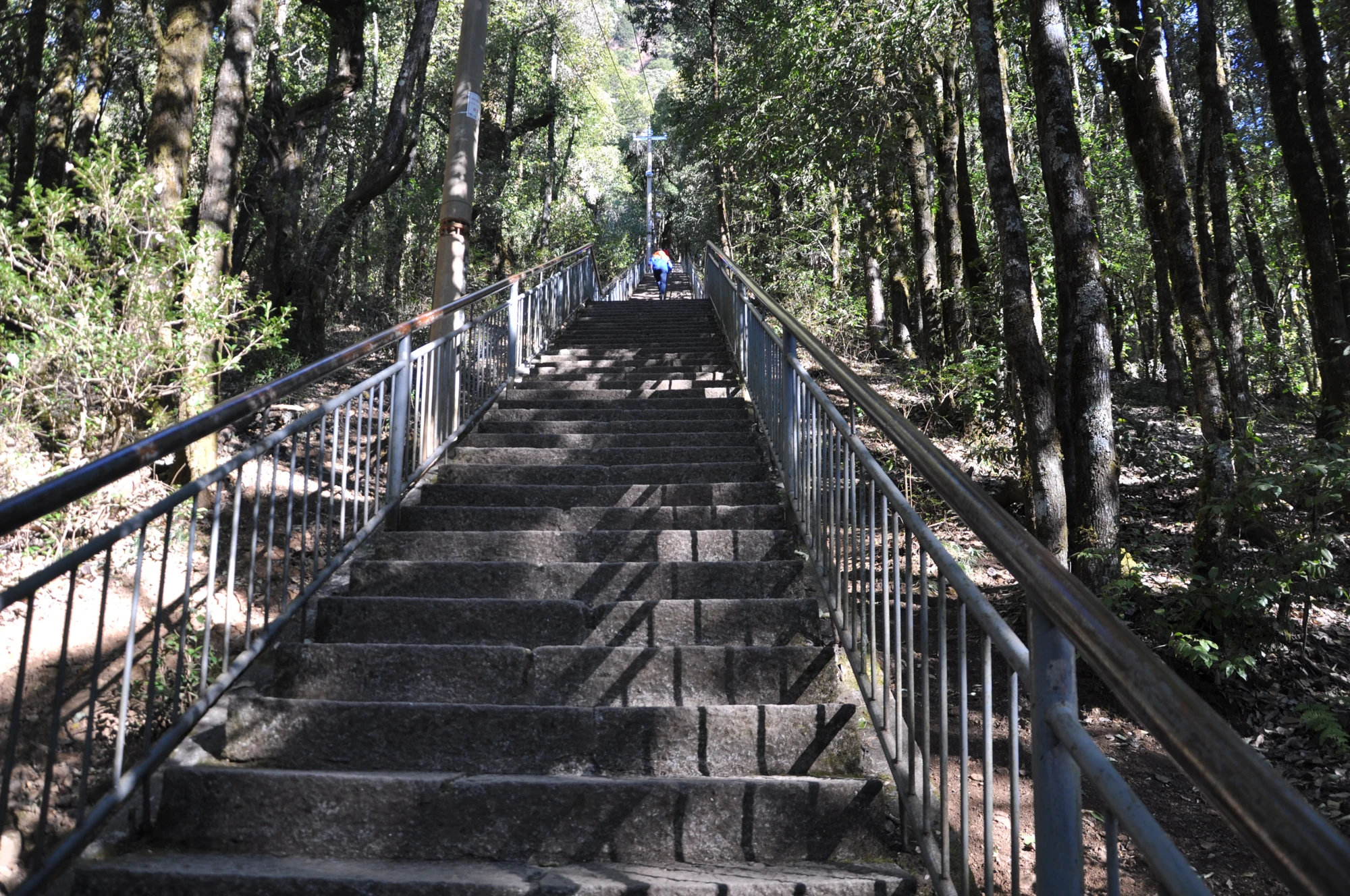
Header photograph: “The sky ladder at Jizu Mountain,” by Zhangmoon618, taken on 3 February 2019. Original photograph and provenance, licensed under CC BY-SA 4.0. Existing adaptation: proportional resize from 4288 × 2848 to 2000 × 1328 pixels and WebP conversion; no scene alteration. The adapted image is shared under the same license. This archival view shows one stepped forest section, not the condition of every path today or a Vero Trip group.
Choose the walking level before the tickets
Decide what would make the visit worthwhile even without a distant view. For some travellers it is time in a temple courtyard; for others it is reaching the upper area or walking through the forest. Agree this within your group before paying for a route designed around the most energetic person.
| Your main interest | A workable approach | The important boundary |
|---|---|---|
| Temples and cultural detail | Choose a smaller number of currently accessible temple stops, with seated breaks and time for explanation. | Specify the actual stops and remaining steps. “Temple visit” does not identify a walking distance. |
| The upper mountain | Use the operating scenic transport and cableway where appropriate, then follow the signed visitor route. | Confirm each connection, the remaining walk and the return cutoff. Riding up does not reserve a late descent. |
| A longer forest walk | Choose an established open path, a realistic turnaround and a descent suited to the whole party. | A long downhill route can be demanding too. Do not assume walking down is a quick substitute for the cableway. |
| More time or an early viewpoint visit | Consider an overnight only after identifying a suitable room and its exact approach. | A room at the foot of the mountain is not a room beside the summit. Weather can still obscure the view. |
If you want a lighter day, ask for a specific temple-focused programme instead of accepting “easy with a cable car.” If nobody wants sustained stairs, compare a different cultural outing through the Three Pagodas and Chongsheng Temple guide. That site also has walking choices; choose the actual route rather than relying on a general accessibility label.
Three names to recognise on the visitor map
Zhusheng Temple, 祝圣寺
Zhusheng Temple is one of Jizu Mountain’s established religious landmarks. It can provide a cultural focus for a visit that does not treat the summit as compulsory. Check which visitor areas are receiving people that day and keep time for the setting and architectural details visible from the permitted route.
Use the Chinese name when agreeing a drop-off or meeting place. The March 2026 Kunming coach announcement names a Zhusheng Temple parking area, but a vehicle stopping there does not establish that it continues to every temple or to the upper cableway.
Jinding Temple and the upper area, 金顶寺
The summit complex stands on Tianzhu Peak. The operator’s profile gives the mountain’s highest elevation as 3,248 metres, while Yunnan Net’s cultural report identifies buildings including Lengyan Pagoda, 楞严塔, and Duguang Terrace, 睹光台. These names help you understand a visitor map; they do not establish admission to every interior or permission to climb the pagoda.
Allow time to stand, look and rest rather than making the upper area a quick photograph between transport rides. Ask about current works or closed sections if a particular building matters to you. Keep any wider viewpoint or additional temple walk optional when conditions, visibility or your return margin do not support it.
Huashou Gate, 华首门
Huashou Gate is a cliffside sacred site associated in Buddhist tradition with Mahakasyapa, or Jiaye, 迦叶, awaiting the future Buddha. Present that as religious tradition, not a verified historical event. Its cultural meaning is a reason to approach respectfully, rather than treating the name as just another scenic checkpoint.
Check its position, path condition and return route on the current map before leaving the main upper visiting area. Do not assume it is a few level steps from your cableway exit. If adding it would make the descent rushed, leave it out; visiting fewer places carefully is a reasonable mountain day.
Build the day around arrival and descent
A useful day has four parts: the journey from your accommodation, the scenic-area connections, the chosen visit and a protected descent. Assign time to all four before filling the middle with attractions. The exact order of temples depends on the transport plan and which routes are operating.
- Before leaving Dali: confirm the entry point, vehicle or coach arrangement, relevant tickets and who checks operational notices.
- At arrival: use the current visitor map to identify transport stops and your final pickup. Ask for the day’s last boarding times rather than relying on a general closing time.
- During the visit: choose the agreed temple or upper route, eat and rest, then reassess any optional extension.
- Before descending: leave a margin for queues and connections. Reach the agreed pickup with enough time for the onward road journey.
This is a suggested structure, not a fixed departure timetable. If you arrive later than expected, shorten the visiting route. Trying to recover the time by skipping lunch, hurrying down steps or relying on the last possible connection creates a less comfortable outing.
Separate the Dali transfer from transport inside the scenic area
Dali Old Town, Xiaguan and scattered Erhai hotels are different starting points. Give the actual accommodation address when comparing a road transfer or public-transport plan. A service advertised as “from Dali” needs a precise pickup location, and a stop at the mountain entrance is not the same as a stop farther inside.
| Component | Ask the booking to identify | What not to assume |
|---|---|---|
| Travel to Jizu Mountain | Pickup address, destination stop, departure date, return point and waiting arrangement. | A hotel pickup, all-day driver or return seat is included merely because the outward journey is sold. |
| Scenic-area road transport | Each section, direction and stop covered by the ticket, plus current vehicle-access rules. | One bus ticket covers every section or a private vehicle can continue to the highest stop. |
| Cableway | Single or return use, the day’s last boarding arrangements and any operational change. | A cableway ticket covers admission, all buses or every remaining stair section. |
| Final collection | Chinese place name, map pin, working contact and how a late finish would be handled. | Your road driver accompanies the mountain walk or can collect you at any path exit. |
For public transport through Binchuan, confirm both the outward connections and the final return. A route described in an older guide does not establish a waiting connection on arrival. If you have a fixed train or flight afterwards, discuss it before booking and keep the mountain programme conservative.
What the 2026 Kunming coach announcement actually says
A Binchuan media-centre article, sourced to the scenic-area company, reports the launch of a Kunming–Jizu Mountain service on 18 March 2026. Its published pattern had an outward journey from Kunming’s Nanyao collection centre and a return from the Zhusheng Temple parking area on the following day. A same-day return package was described as a future plan.
That matters if you are starting in Kunming: the announcement is not proof of a currently bookable same-day mountain visit. Check the present service, exact date, stops, return and package contents. Do not assume a fare that includes a scenic-area package includes every transport segment in both directions, a room or an English guide.
The article is a dated route lead, not a live October timetable. This guide does not repeat its old departure times, prices or journey duration as current promises. An overnight from Kunming and a day from an agreed Dali base are different planning choices.
Check notices instead of carrying an old cutoff into a new trip
Jizu Mountain’s cableway has had date-specific operational changes. A notice reproduced by Yunnan Net covered a rescue drill on 16 March 2026. A later scenic-company notice, reproduced by Kunming Information Hub, covered annual maintenance on 2–10 June 2026, with reopening announced for 11 June. Those are past notices, not evidence of a closure on your travel date or a guarantee of uninterrupted operation afterwards.
Check a current operator announcement before travel and confirm the day’s arrangements on arrival. Ask separately about ticket sales, last upward boarding, last downward boarding and connecting road transport. A published scenic-area closing time cannot answer all four questions.
If the planned transport is unavailable, agree a shorter temple visit or a different day. A closure does not make a long climb an appropriate replacement for everyone. Change the plan around your group’s ability and the open route rather than following an unmarked shortcut.
Admission, meals and an overnight: keep the details separate
Build the cost from admission, scenic transport, cableway, the Dali or Kunming journey, any guiding, meals and accommodation. Ask what is included in each quoted package and what happens if weather or operations remove a component. No single unverified “total price” covers every way to visit.
Be careful with old annual-pass pages. The county government’s notice still accessible online describes a defined 22 March–21 April 2021 sales period and specified resident eligibility. It is not a current ordinary international-visitor ticket offer. For your own booking, identify the ticket category and ask how your passport is entered and checked; do not substitute someone else’s domestic-ID instructions.
Plan a meal and water independently of temple visits. Confirm food availability for the route and date, and explain dietary requirements before relying on a particular meal. A religious setting alone does not confirm a visitor dining service, its hours or suitability for your needs.
For an overnight, request the accommodation’s exact location, room and bathroom description, heating or bedding arrangements, meals, final approach and luggage handling. Ask how you reach the room after transport finishes and how the next morning’s departure works. A temple name or a scenic photograph is not a room reservation, and neither an overnight nor an early start guarantees sunrise or distant mountains in view.
Walking comfort and conduct at temples
Wear shoes with grip and carry a warm layer, rain protection, water and a modest snack. The upper mountain can feel different from your Dali hotel. Keep the load manageable and choose the remaining stairs and descent according to the slowest comfortable pace in the party.
Ask about the route from each transport stop, including steps, surfaces, rest points and toilets. A cableway reduces one part of the journey; it is not an assurance of step-free access into courtyards or halls. Keep a shorter option available if the approach proves unsuitable.
Leave room for worshippers, keep voices low and follow the notices governing halls and photography. The provincial tourism portal specifically advises against photographing Buddha images. Ask before photographing people and do not enter a closed room or monastic living area because it appears in a visitor’s photograph.
Questions before committing to the day
Can I combine Jizu Mountain with a complete Erhai circuit?
Choose one principal outing. The road journey and mountain connections deserve their own day; adding a full lake circuit changes the pace substantially. Keep another Dali day for the lake.
Is this the same cable-car outing as Cangshan?
No. Jizu Mountain is a separate destination in the Binchuan area. Compare the Cangshan cable-car guide if you want to choose between mountain days rather than trying to fit both into one.
Do I have to reach the highest area?
No. Choose the temple stops and walking level that make the visit worthwhile for you. Confirm what remains accessible if your preferred upper route cannot operate.
Can Vero Trip help plan a Jizu Mountain visit?
Send your dates, accommodation address, party size, walking comfort and whether your priority is temples, forest walking or the upper view through Plan My Trip. Price is on request. A written proposal should identify pickup and finish, transport sections, guiding language, tickets, meals or rooms actually included, and the alternative if a component is unavailable.
Sources and dates
Reviewed on 31 October 2026: Dali Tourism Group’s Jizu Mountain profile; the Yunnan provincial tourism portal’s Mount Jizu page; Yunnan Net’s September 2023 cultural report; the March 2026 coach-launch announcement; the March 2026 drill notice; the May 2026 maintenance notice reproduced by Kunming Information Hub; and the county’s historical annual-pass announcement. Historical and general pages explain context; current access, services and prices must be checked for your date.
Related Journeys to Compare
These existing routes offer starting points for the region or travel interests discussed above. Read the full daily itinerary to see what is included. A visit described in this guide, a specialist session or an international border crossing is added only when confirmed in your own programme.