Updated 31 October 2026
For a first Emeishan and Leshan trip, give the Giant Buddha and Mount Emei separate visiting days. Three days and two nights from Chengdu can leave space for Leshan, a lower-mountain approach night and a selected Mount Emei day. If you have only one day, choose the Buddha or a specific mountain programme before trying to combine them.
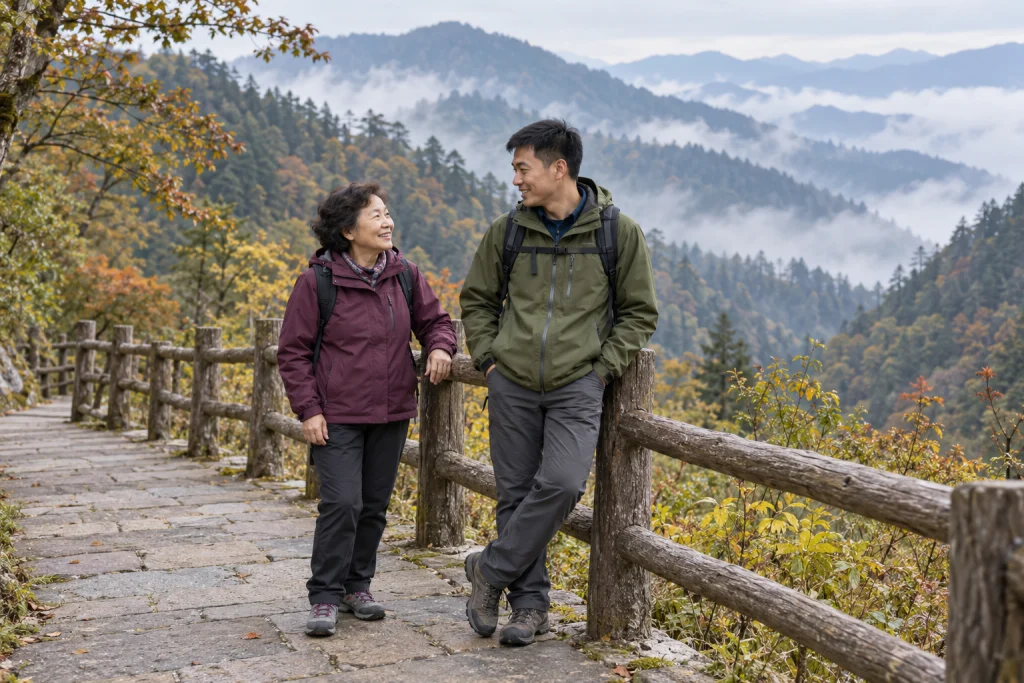
The main image is an imagined forested mountain rest stop created as a travel illustration. It does not show a particular Mount Emei path, real Vero Trip travellers or an assessed accessible route.
Two related places, two different visits
UNESCO lists Mount Emei and the Leshan Giant Buddha together, but they are separate places with different transport, admission and walking choices. A shared heritage listing does not make them one attraction or one easy half-day circuit.
Leshan offers the monumental Buddha, the surrounding cultural landscape and city time. Mount Emei offers a much larger mountain setting: the lower temple area, middle-mountain paths and the Golden Summit are different programmes. Decide what draws you to each before choosing a vehicle or hotel.
If the broader holiday starts in Chengdu, use the Chengdu trip-planning guide for city days and the choice of excursions. This guide connects Leshan and Mount Emei without treating the rest of Sichuan as a list of compulsory additions.
| Base | Why choose it | What to settle |
|---|---|---|
| Chengdu | A city holiday with one selected excursion. | The complete return journey; a visit to both Leshan and the Golden Summit is a much longer proposition than either alone. |
| Central Leshan | The Buddha visit plus an evening for food and the city. | Actual hotel position, the attraction or pier approach, and the next transfer. |
| Baoguo / Huangwan approach area | A lower-mountain room before a Mount Emei day. | Which visitor or coach centre serves your booking, and how you reach it with bags. |
| A named mountain property | A planned pause or possible morning view on an open route. | The walking approach, room, food, heating, passport reception and permitted movement hours. |
A hotel headed Emeishan can mean a property in the city, by the scenic approach or much farther up the mountain. Get its Chinese name and map pin. A low room convenient for dinner and a high room convenient for a nearby morning view solve different problems.
Choose a land or river visit at Leshan
Start with the experience you want. On land, the Buddha is part of a hillside visit with cultural stops, steps and a staff-directed route. On the river, the attraction is a broader view from an authorised boat. A river ticket does not give you the same close encounter or automatically include walking admission.
| Visit | Choose it for | Know the limitation |
|---|---|---|
| Walking visit on Lingyun Mountain | A closer encounter with the monument and surrounding cultural setting. | Steps, the current directed route and possible queues; do not assume the historic cliff stairway is open. |
| Authorised river sightseeing | A view of the Buddha from the water. | A different ticket and pier, boarding conditions, water level and weather; it does not replace the on-land visit. |
| Both land and river | Two genuinely different views when the party has time and interest. | Two programmes and their connections, rather than an automatic combined admission. |
| A city and food stay | A less hurried Leshan visit around a chosen cultural anchor. | Keep a meal break and the actual return; a food checklist is not a confirmed restaurant reservation. |
For an older relative who finds repeated descents difficult, compare the actual land route with the full boat approach. A boat may reduce hillside walking but still involve reaching the pier, boarding steps and waiting. Ask for those details before describing either option as suitable for limited mobility.
Do not make the visit depend on a photograph of someone standing at the Buddha’s feet. The access route and the foot platform can change independently of the wider attraction. The provincial scenic-area description explains the steep historic cliff stairway; it is background to the landscape, not a live notice that the stairway is open.
The scenic authority has previously issued rain-related notices reopening the wider walking area while keeping the foot platform and river services closed. Check the current arrangement for the chosen date and follow the signed route. A change to one part of the visit does not mean every other part operates normally.
For the river option, get the named pier, ticket, boarding time and return location. The authority’s 2026 summer operating notice, reproduced from Leshan tourism, distinguishes the products and makes boat operations dependent on water and weather. Its summer calendar ended on 7 October; use the current season’s issued information for your visit.
Use the winter programme for the Leshan day
The operator’s 7 October 2026 winter notice, reproduced on Phoenix, gives a different calendar from the expired summer notice. Its winter programme runs from 8 October to 31 March. The published daytime land visit is 08:00–17:30, while daytime boat boarding is 08:30–17:30 and the boat ticket window closes at 17:00. These are dated published windows, not a guarantee of a sailing or a last-minute admission.
| Leshan programme | What the winter notice distinguishes | How to plan the day |
|---|---|---|
| Land visit | The historic Nine-Turn Plank Road is under maintenance; the notice identifies the Lingyun Plank Road for the approach to the feet. | Ask for the current directed route before paying; do not build the visit around an old stairway photograph. |
| Daytime river visit | Boarding and ticket-sales windows differ; weather and water can alter operations. | Choose one main format when time is short and keep the transfer to the pier within the day. |
| Evening visit | Lingyun Mountain night visits are closed for maintenance in the winter programme, with holiday changes separately announced. The night river cruise is a different product. | An overnight in Leshan does not automatically include a night walk or a cruise. Confirm the actual evening plan. |
If the party wants both land and river views, make Leshan the main purpose of that day. Allow time after the first programme to eat, reach the correct second entrance or pier and reconsider the remaining daylight. A boat cancellation does not create extra walking capacity for someone who already finds stairs difficult. Likewise, reaching the ticket window just before its cutoff does not mean the whole visit can be completed comfortably.
Keep the onward hotel transfer outside the visit itself. Decide whether the car will wait at the original entrance or meet you at a different signed exit, and keep the hotel name and collection point available in Chinese. With a fixed train, count from the attraction exit through luggage collection, the station approach and boarding procedures. In late autumn and winter, moving the main visit to the morning leaves more room to handle those connections.
Leave Leshan time for a meal and the actual transfer
An overnight can turn the city into more than a rushed stop between a railway platform and the monument. Choose one convenient area for dinner and a short walk, then keep the next morning’s transfer clear. A visitor who comes primarily for food may prefer this rhythm to a very early return to Chengdu.
Restaurant names and long snack lists do not establish availability, ingredients or suitability. Choose a small number of dishes the party wants to try and leave space for a seated meal. Ask about chilli, broth, cooking fat and any allergy or halal requirement separately; a less spicy dish does not automatically meet the other needs.
Book the onward journey around the visit you actually select. A rail service between the two cities covers only the middle of the transfer. Getting from the attraction or hotel to the station and from the arrival station to the mountain base still takes time and effort.
Decide what Mount Emei means for your party
A Golden Summit visit usually combines scenic transport, a pedestrian connection and the selected ropeway or walking stages. A middle-mountain temple visit is a different choice. A multi-day ascent on foot is a substantial walking holiday, rather than the longer version of an effortless sightseeing day.
One personal account headed a two-day, one-night hike actually described four calendar dates including arrival and departure. The author split the walking over two days and stopped when tired. Their text also expressly mentioned a 2025 closure and promotion. Use the experience to understand effort and overnight choices, not as a current closure map or a universal ordinary-fitness itinerary.
Ask the party about stairs, downhill walking, winding coach rides and cold or wet waiting. One visitor’s Golden Summit account described disappointment with the view and unpleasant bus journeys. Other commenters reported different skies on nearby dates. Booking the transport and room buys the visit; it does not buy a sunrise or cloud sea.
If your main interest is a temple and forest atmosphere, choose a currently open middle or lower route with the exact approach and return explained. There is no obligation to reach the highest popular viewpoint for the trip to be worthwhile. A shorter meaningful visit can be a better match than a summit day selected only from a photograph.
| Stage | What you need | Question that prevents a mistake |
|---|---|---|
| Railway station to lower base | The actual station, hotel and transfer. | Is the issued ticket for Emei or Emeishan station? |
| Admission and high-area coach | The correct ticket and reserved coach time to Leidongping. | Does each traveller have the required dated booking with matching passport details? |
| Coach stop to cableway and summit route | The current pedestrian approach and any chosen ropeway tickets. | How many steps and how much uphill walking remain for this party? |
| Descent and return | Actual ropeway arrangements, coach departure and bags. | When must we turn back to make the complete return, not just reach the upper station? |
Choose a temple interest rather than another summit photograph
Mount Emei’s cultural landscape can be a reason to visit in its own right. The UNESCO heritage description identifies Wannian Temple, the Qingyin Pavilion complex, Baoguo Temple and Fuhu Temple among the mountain’s important cultural places. Use that background to decide what interests you, then arrange only the places confirmed open for your visit. The heritage list is not an opening notice or an instruction to join every site into one walking route.
| Your cultural interest | A place to discuss | Something to notice during an open visit |
|---|---|---|
| Religious sculpture and a focused temple visit | Wannian Temple. | Its association with the historic bronze image of Puxian; ask which halls and objects can actually be visited. |
| Architecture within a wooded landscape | The Qingyin Pavilion complex. | The relationship between pavilions, platforms and the surrounding terrain, instead of treating it only as a waypoint to somewhere higher. |
| A lower-mountain cultural introduction | Baoguo or Fuhu Temple. | The courtyards, buildings and garden setting; choose one meaningful visit before adding another transfer. |
For a family with different walking limits, a single agreed cultural focus can make the day easier to share. Ask the guide to explain what you are looking at and leave time to sit where permitted. Confirm the actual steps and approach rather than treating “lower mountain” as a promise of level ground. Photography rules, access to halls and any additional admission remain matters for the specific visit.
Reserve the high-area coach for the correct time
The scenic authority’s March 2026 coach notice introduced hourly reservations for travel to Leidongping, the high-area gateway for the Golden Summit. Arrive at the selected boarding point within the booked period with the same valid document used for the reservation; the notice expressly includes passports.
Admission, the scenic coach and a ropeway ride are separate elements to identify in a proposal. Make sure the booking covers the actual destination and directions you intend to travel. Do not assume a general mountain ticket also secures an unrestricted seat on a high-area coach at any hour.
Use the scenic area’s official booking platform or an identified authorised channel. If the form does not accept your passport, ask the official ticket service for the correct procedure. A driver’s assurance that tickets are easy does not replace successful reservations matching each traveller.
Allow for the current construction arrangements
The authority’s 22 May 2026 high-area notice describes construction at Leidongping and upgrades to the Golden Summit ropeway, with reduced transport capacity. It keeps the mountain open with controlled access to the summit area and moves the coach functions to a temporary arrangement.
Follow the actual temporary boarding signs. The notice also says the old Leidongping station building cannot provide overnight waiting or rest. A plan to spend the night there between an evening arrival and sunrise is therefore not an accommodation arrangement.
The published works programme anticipates completion in 2027. Check for changes when booking, and leave room for waiting and the actual operating services. The September holiday guide provides special holiday dispatch times, but those do not establish the timetable for an ordinary later date.
A ropeway does not remove every step
Ask how you get from the coach drop-off to the selected cableway, and from its upper station to the places you want to visit. Include gradients, steps, places to pause and the route back. Someone comfortable with a short city walk may still find a long uneven approach tiring.
The Golden Summit and Wannian ropeways serve different parts of the mountain. Specify the actual one and the direction in the booking. A cheaper-looking ticket for a different area does not help you reach your selected summit programme.
The authority has also published a separate same-day reservation trial for the No. 2 descending Golden Summit ropeway. Ask staff about the current descent arrangement after reaching the upper area; buying a ride and arranging its boarding are not necessarily the same action. Keep the whole descent in mind before setting a railway departure.
For a family with mixed energy, agree a meeting point and a shorter option that stays within the open visitor route. Do not send someone down an unfamiliar path alone while others climb higher. A clearly chosen return route is more useful than promising the group can decide everything after arriving.
Choose a room you can actually reach and use
The lower Baoguo and Huangwan area offers a different kind of stay from a high-mountain room. Choose the lower base for simpler arrival, dinner and preparation; choose a named mountain property when its location serves a permitted walking or morning-view plan.
The hiking author’s accommodation account described simple temple rooms, shared facilities and electric blankets rather than uniform hotel amenities. A commenter added that a particular room had a distant bathroom and no mobile signal. These are reasons to ask about the actual category, not a guarantee that every temple accepts overnight visitors or that all mountain rooms have the same conditions.
Before paying, obtain the room name, bed arrangement, private or shared bathroom, heating, meal arrangements and the final walking approach with luggage. For foreign-passport travellers, confirm reception and registration with the actual property. A personal recommendation does not settle a different guest’s booking.
Do not substitute a hotel lobby, rented floor space or an unconfirmed temple berth for a reserved room. A summit stay can make a morning outing more manageable, but the permitted route, weather and the property’s position still matter. Stay within the staff-directed visitor area rather than setting off on a long route in darkness.
Hongchunping to Jiulinggang: do not use an old through-hike map
The scenic authority’s 7 October 2026 notice on its verified account closes the Hongchunping–Jiulinggang walking section for slope works from 8 October to 19 November 2026, with possible extension for adverse conditions. The notice identifies the Wannian Temple–Xixinsuo–Jiulinggang line as the alternative during the works and says reopening will be announced. The scheduled end date alone is not evidence that the closed section has reopened.
This affects a continuous hiking plan, not just the name of a viewpoint. Ask for the revised walking stages, overnight place and return before agreeing to a longer ascent. The alternative in the notice is not a guarantee that the same distances, room or daily effort still fit your party. Follow current staff directions and keep the separate night-movement restrictions below in the plan.
Walk only the open daytime route
The published night-visit prohibition closes the specified mountain routes from 18:00 to 06:00 and forbids pedestrian travel on the Zero Kilometre to Leidongping road at all times. The scenic area’s September 2026 visitor guidance repeats the prohibition on night visits.
A recent social post described starting near midnight and reaching the summit the following afternoon. That is not a route to copy. A report that someone passed without a ticket check does not establish permission, and a torch does not turn a closed trail into an open visitor route.
For a longer daytime hike, confirm every named section with the scenic authority, allow for the return or a booked room, and stop adding distance when the party is tired. The author’s old closure dates and hand-drawn map cannot determine today’s access. Keep photographs and wildlife observation on the permitted path without approaching, feeding or provoking animals.
Plan food, water and the small mountain bag
The hiking series described shops and temple meals at several stages, with some businesses closed and meal service at set times. Build the day around the actual open route and a confirmed meal option. Do not rely on every shrine, stall or refill point being available when you arrive.
Carry what you need for the selected outing and keep the larger suitcase at an agreed lower location when appropriate. Confirm storage hours and collection before setting off. A scenic coach is transport between its designated stops, not an assurance that a heavy bag will reach a distant temple room.
Keep passports, booking confirmations, water, a weather layer and essential personal items with you. Use the dated mountain forecast as well as the conditions at the lower base. A warm afternoon in the city does not describe a misty summit wait, and a sunny photograph from a nearby day is not a forecast.
Four days and three nights: keep the mountain return separate
If the final descent is the part that makes the three-day outline feel rushed, add a second night at the same lower-mountain base. The four-day version below uses one Leshan night and two Emei approach nights. Its extra night is useful because the selected mountain day no longer has to finish at a railway station. It does not add a summit overnight or promise two full days of high-mountain hiking.
| Day in the four-day version | Main purpose | Overnight and the decision it protects |
|---|---|---|
| 1 | Arrive in Leshan and take the selected Buddha programme when arrival permits. | Leshan, night 1; keep the evening for a meal rather than a compulsory additional ticketed visit. |
| 2 | Move to the Emei approach base. Add one short, confirmed-open cultural visit only if the transfer and arrival leave enough time. | Lower Emei base, night 2; settle the next day’s reservations and small bag. |
| 3 | Use the day for the selected mountain programme and return to the same room. | Same lower base, night 3; no fixed onward train after the descent. |
| 4 | Collect all bags and make the onward journey. | No fourth night in this outline; arrange any Chengdu continuation separately. |
Choose this version when the group values an easier evening after the mountain, has luggage to collect or would be anxious about an inflexible same-day connection. Keep the three-day version when the chosen walk and complete return fit comfortably and the arrival day works for Leshan. If sunrise or a longer ascent is the essential experience, design another sequence around the actual mountain room and permitted stages instead of inserting it into either table.
For a wider Sichuan holiday, the Sichuan route guide places Chengdu city nights around the regional visit. If a member of the party wants golf as well, use a separate Chengdu day and the Chengdu golf planner. Replacing a city day with a confirmed round is a clear change; adding the round before an already full Leshan transfer is a different, more demanding holiday.
Use three days without promising three full sightseeing days
This example keeps one night in Leshan and one at the Mount Emei approach. It does not include a mountain sunrise stay or a full walking ascent. Change the sequence around confirmed admissions, transport and arrival time.
| Day | Main purpose | Overnight and condition |
|---|---|---|
| 1 | Travel to Leshan, take the selected Buddha visit and leave room for a meal. | Leshan, night 1; a late arrival may mean moving the main visit to the next day. |
| 2 | Finish any deliberately retained Leshan time, then transfer to the Mount Emei approach base. | Baoguo / Huangwan area, night 2; prepare a small day bag and confirm the next coach reservation. |
| 3 | A selected Mount Emei programme, then collect bags and return. | No third night assumed; choose an onward service that allows the complete descent and transfer. |
For a summit overnight, add time or remove the city programme and rebuild the sequence around the named mountain room. For a longer hike, plan separate walking stages rather than squeezing them into this coach-based example. If bad weather closes the intended route, choose an actually open lower visit or a city day; an alternative attraction can still need its own booking.
Compare the Leshan collection and Emeishan collection with the five-day Chengdu outline with a selected excursion. That route offers a choice of day trip; it does not include all the alternatives on one day. Confirm the actual rooms, vehicle, guiding, admissions and changes in the dated proposal.
Send Vero Trip your dates, nationalities, arrival and departure services, party size, children’s ages, walking and stair limits, room preferences and food or prayer needs. State whether the priority is the Buddha, summit scenery, temple culture or a longer daytime walk. A useful plan connects those choices to successful reservations, reachable rooms, meals, bags and the complete journey back.
To compare a selected Emei walk with a high-altitude Yading visit, use the Sichuan hiking planner. It develops walking load, overnight bases, weather changes and the return; use this local guide for the Emei and Leshan itinerary choices.