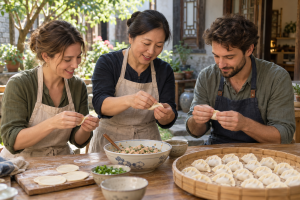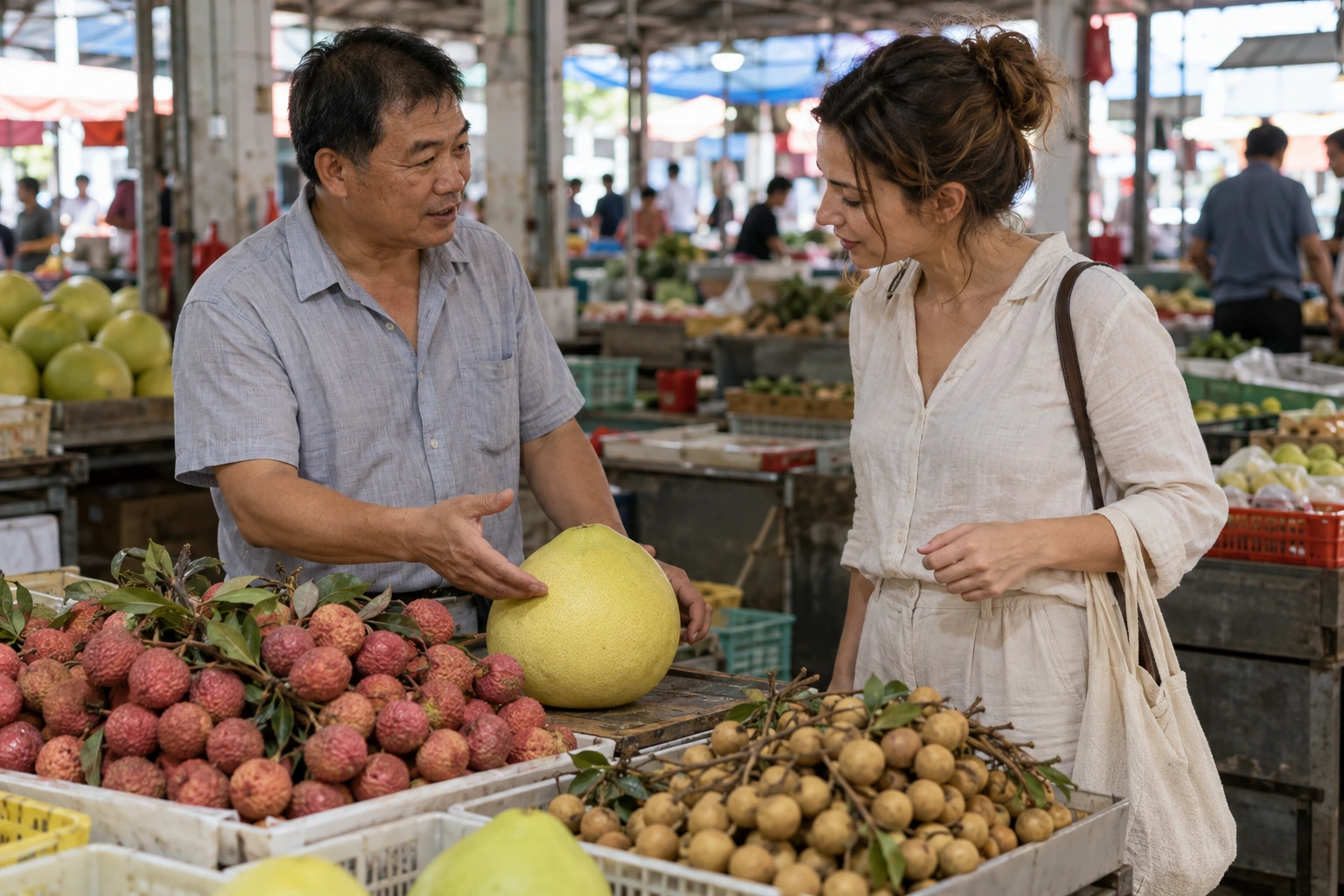
For a first fruit-shopping stop in China, buy a small amount of whatever looks good and is in season locally, then ask the seller to name the variety and explain how to eat it. Lychee, longan, yangmei, loquat, pomelo and fresh jujube are useful names to recognise. You do not need to find all six on one trip, and a fruit grown in a region is not necessarily available at every stall throughout the year.
Start with the practical questions: is it fresh or dried, what quantity does the displayed price cover, and where will you prepare or keep it? One small purchase you can enjoy that day is often more useful than a large mixed bag carried between hotels.
Reviewed 29 October 2026. The hero is an original travel illustration of fictional adults discussing fruit at a generic market stall. It does not show a named market, real customers, a Vero Trip host or guaranteed seasonal stock.
Six fruit names to save before your trip
Keep the Chinese name with the English one on your phone. Show it to the seller and ask which variety is actually being offered. This is especially useful when the stall has several boxes with different prices or when a menu uses a name for a dried product rather than the fresh fruit you expected.
| Fruit | Chinese name | Useful first question |
|---|---|---|
| Lychee | 荔枝 · lizhi | Which variety is this? |
| Longan | 龙眼 · longyan | Is this fresh, or is the product dried guiyuan? |
| Chinese bayberry | 杨梅 · yangmei | Is this batch suitable to eat today? |
| Loquat | 枇杷 · pipa | Can you show me how to prepare it? |
| Pomelo | 柚子 · youzi | Is the price for the whole fruit or prepared flesh? |
| Fresh jujube | 鲜枣 · xianzao | Is this the fresh product rather than dried red dates? |
Lychee and longan: compare the actual variety
Lychee (荔枝, lizhi) is worth investigating during a southern-China stay when fresh local fruit is available. Different varieties can have different flesh, fragrance and pit size. Ask the seller which variety you are looking at rather than treating the most expensive box as the only worthwhile choice.
A June 2026 Huangpu district report describes several Guangzhou lychee varieties arriving in succession. That is a useful example of a seasonal crop with more than one picking window. It is not confirmation that its June market event, any particular variety or a quoted quality description applies to your travel date.
Longan (龙眼, longyan) is another small, peelable fruit to distinguish from lychee. If you see guiyuan (桂圆), ask whether the product is dried. The Hong Kong Department of Health’s longan guide explains this dried form and identifies southern Chinese growing regions.
For a first comparison, choose a modest amount of one fruit, or small quantities of two varieties if the seller permits it. Ask before sampling or opening a piece from the display. Make room for peel and stones, and eat the flesh rather than treating the whole item as a grape. A small container or bag for the remains is useful during a walk.
Yangmei: plan to enjoy it during the stay
Yangmei (杨梅), often called Chinese bayberry, is a particularly seasonal choice. Its textured surface and sweet-tart flavour make it different from a smooth-skinned berry. Buy it because the batch in front of you is in good condition and you have a suitable place to wash and eat it, not because a photograph promises every month is peak season.
The Mawei market regulator’s consumer advice explains that ripening varies by region and variety and recommends buying and eating yangmei on the same day. It advises against fruit that is leaking, badly shrivelled, mushy or has a spoiled or alcoholic smell.
A small punnet after sightseeing is a better starting purchase than a large box before a long transfer. Check the fruit underneath the top layer where practical, without rummaging through the seller’s stock. If you cannot keep a delicate purchase appropriately, choose another fruit or wait until you are back near the hotel.
Loquat and fresh jujube: check the form you are buying
Loquat (枇杷, pipa) is a small fruit you may recognise by its yellow-orange skin. The Department of Health’s loquat page describes round or oval varieties and different flesh colours, with cultivation in China’s Jiangnan region among other places. The label is more reliable than guessing the fruit solely from its colour.
Ask the seller to show you how to open the particular fruit and remove its seeds. Buy a few first if you have never tried it. A box containing attractively arranged fruit may be a gift quantity rather than a convenient snack for one traveller.
Fresh jujube (鲜枣, xianzao) is another purchase to distinguish from dried red dates. A Suzhou government report from August 2026 describes the fresh Mayan jujube harvest on Sanshan Island, including thin skin and juicy flesh. It illustrates a local fresh-fruit crop; its festival and prices do not define today’s availability elsewhere.
If a display contains both fresh and dried products, point to the one you mean. For packaged dried fruit, read the ingredient and storage information rather than assuming it is identical to the fresh fruit with only the water removed. Any added sugar, flavouring or other ingredients matter when that distinction is important to you.
Pomelo: useful for sharing, less convenient for a light bag
Pomelo (柚子, youzi) is a larger citrus choice. Think about where you will open it and how many people will share it before buying a whole one. The rind and pith are part of the weight you carry, while a prepared tray is a different retail product with its own handling and storage needs.
An October 2026 China Daily report carried by Fujian’s government portal describes the autumn pomelo harvest and both red- and white-fleshed Fujian varieties. Ask what the stall actually has; flesh colour does not by itself establish the taste you will prefer.
If you ask for the fruit to be peeled, settle whether the price is based on the whole-fruit weight, prepared-flesh weight or a fixed box. Ask whether the shop can provide a smaller amount before agreeing to a large fruit. This is a good purchase for a pause near your accommodation, rather than an extra burden on a walk with already full bags.
Read the quantity before comparing prices
A price may be per piece, box, kilogram or a smaller weight. On the Chinese mainland, one jin (斤) is 500 grams, so a price per jin and the same number per kilogram are different offers. A 2026 municipal price-monitoring table explicitly notes this unit. Do not apply the mainland shorthand to every place using Chinese: ask for grams when unsure.
There is no useful national price for “Chinese fruit.” Variety, origin, size, season and the shop affect the comparison. Confirm the unit, choose a quantity and see the final weight and total before paying. If you want only a little, say so before the seller fills a bag.
| What to clarify | Chinese to show | Why ask |
|---|---|---|
| Price per weight | 这是每斤还是每公斤的价格? | Distinguish a half-kilogram mainland jin from a kilogram. |
| A small amount | 我只要一点,可以吗? | Agree the quantity before a bag is filled. |
| Fruit variety | 这是什么品种? | Compare the same type rather than just the lowest number. |
| Origin | 这个水果是哪里产的? | Learn whether it comes from the region you are visiting. |
| Final total | 这些一共多少钱? | Check the complete amount for the selected purchase. |
Pay attention to the final purchase rather than a headline number. A mixed fruit box can include fruits of different values, while a large pomelo includes substantial peel. A supermarket’s fixed pack and a market’s weighed bag may both be reasonable choices once you know exactly what each contains.
Whole fruit and ready-cut fruit need different plans
The Hong Kong Centre for Food Safety’s fruit guidance recommends undamaged produce, reliable hygienic premises and refrigerated ready-cut fruit. It also advises washing fruit before peeling or cutting and using clean hands and utensils. A rind does not remove the need to handle the fruit properly.
For a hotel stay, check the actual storage available before buying more than you will eat. A room appliance described as a minibar is not automatically suitable for every perishable food. Keep a fruit purchase modest if you will be away from the room all day or changing hotels soon.
A prepared cup can be convenient when eaten promptly at the venue, but it should not become a warm bag snack for an extended excursion. Buy at the time you intend to eat, and follow the seller’s storage information and the official handling guidance. Skip damaged or spoiled fruit rather than trying to rescue a purchase because it was expensive.
| Travel situation | A practical approach | Check before buying |
|---|---|---|
| Returning to your hotel | Buy a small amount you can prepare and enjoy there. | Washing, clean utensils and appropriate storage. |
| A long sightseeing outing | Wait until a convenient eating stop rather than carrying delicate fruit all day. | How the actual product will be kept. |
| A prepared-fruit cup | Choose a hygienic venue with refrigerated stock. | Portion, ingredients or additions and prompt consumption. |
| Changing hotels or departing | Keep the purchase small or leave it for another day. | Bags, storage and any border requirements on the actual journey. |
Turn a market look into a small part of a good day
A local market can help you learn what people are buying now. Keep the visit near the area you already plan to explore, let the seller finish transactions and ask before photographing people. The conversation about a fruit’s name and origin can be more memorable than buying a large quantity.
The existing three-day Jinghong food-and-culture outline includes a local market with tropical produce. It is one way to place a market visit inside a wider stay, not a promise that all six fruits here will be sold there, that tastings are included or that an orchard visit is arranged.
Use our China food-and-culture planning guide to separate a market walk, a tasting and a producer appointment. If you want fruit picking rather than retail browsing, the actual farm, open dates, participant access, transport and included fruit need their own confirmation. A harvest report is not a reservation.
For a sweet prepared dish instead of fresh fruit, the Chinese desserts guide explains fillings, textures and portions. A dessert with a fruit name is a different order from buying that fruit fresh.
Questions before buying
Can I expect all six fruits throughout China?
No. Growing regions, harvests, transport and the individual shop affect what is available. Use the list to recognise possibilities and ask about the current batch. Imported or stored fruit may also be on sale, so ask the origin if a locally grown purchase is your aim.
Should I take fresh fruit home as a souvenir?
Plan fresh fruit mainly for enjoyment during the stay. Before carrying any across a border, check the destination’s official plant and customs requirements for the actual product and journey. A shop receipt or a sealed container does not establish permission to import it.
How do I request a food-market visit?
Share your city, dates, accommodation, group size and interests through Plan My Trip. Say whether you want a short market explanation, a seated tasting or a separately arranged farm visit. Vero Trip can discuss a realistic place for it in the day; prices are on request and the dated written proposal should identify the actual services.