Choose Jinuo Mountain Village for an introduction to Jinuo culture, with time for interpretation, craft displays and a performance if one is scheduled. Do not book it as another name for a rainforest trek. The visitor attraction, surrounding settlements and separately operated walking routes are different outings. For a first visit from Jinghong, keep the cultural visit as your main half-day activity and arrange the return before adding anything else.
Jinuo Shanzhai (基诺山寨) is associated with Bapo village (巴坡村) in Jinuo Mountain Township, Jinghong, within Xishuangbanna in southern Yunnan. The township is a wider inhabited landscape, not a single attraction with one entrance ticket. Use the exact Chinese destination when discussing transport or buying admission.
Updated 28 October 2026
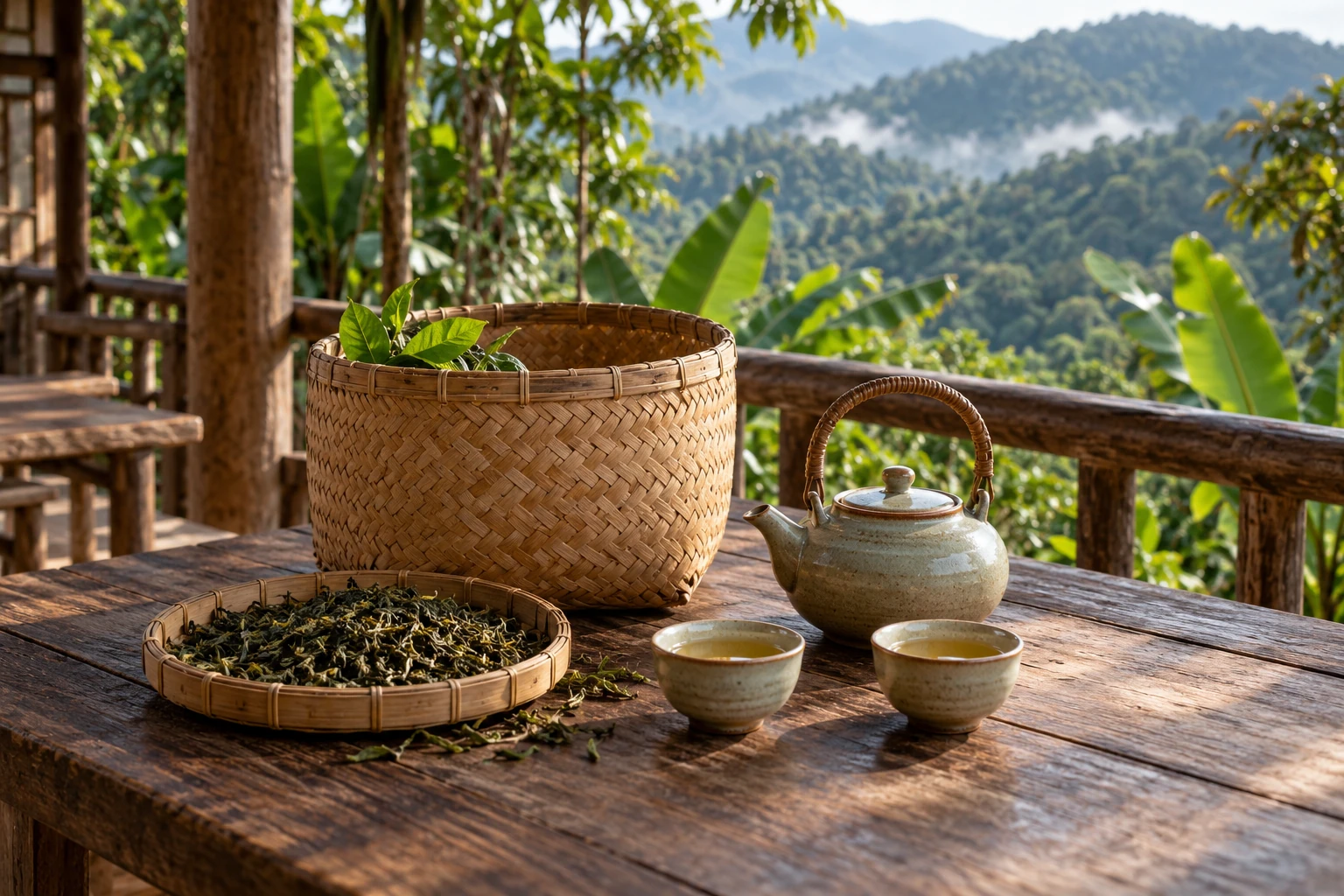
The opening image is a tea-and-bamboo-craft illustration, not a photograph of Jinuo Mountain Village, a particular household or a Jinuo ceremonial object.
Which Jinuo Mountain experience should you choose?
Start with the purpose of the day. A cultural attraction can introduce a community’s stories and artistic traditions; a hosted village visit gives time for conversation; a rainforest outing adds a separate set of physical and safety decisions. One booking does not automatically cover all three.
| Your main interest | Choose this kind of outing | Check before paying |
|---|---|---|
| Culture without a long forest walk | Jinuo Shanzhai cultural visitor attraction | Exact entrance, current programme, interpretation language and walking route |
| Conversation, tea or a particular craft | A prearranged visit with a willing local host | Named village, host agreement, session length and whether participation costs extra |
| Forest ecology and outdoor activity | A separately specified guided rainforest route | Operator, permitted route, terrain, water sections, weather rules and return arrangements |
| A relaxed day with children or limited stamina | A shorter cultural circuit with breaks | Steps, distance, seating and a way to leave before the full group finishes |
The prefecture’s published heritage route lists Jinuo Shanzhai, Bapiao village and rainforest trekking as distinct stops. That distinction matters more than a seller’s broad “Jinuo Mountain” label. Ask for the entrance or meeting-point pin before committing; a vehicle arriving in the township has not necessarily reached your booked activity.
What makes the cultural visit worthwhile?
The attraction is presented by the local authority as a place to learn about Jinuo culture through clothing, handicrafts, cultural displays and the surrounding village landscape. Approach these as starting points for questions rather than a checklist of photographs. A useful visit explains what you are seeing and how it relates to people’s lives.
Jinuo is a distinct cultural identity; it should not be treated as interchangeable with Dai culture simply because both are encountered in Xishuangbanna. The name Youle (攸乐) also appears in historical references to the mountain area. If tea is your interest, mention both names when asking about a suitable visit, but do not assume a cultural admission includes a tea-farm appointment.
Choose two or three questions to give the outing shape: what is a woven object used for, which parts of a demonstration are adapted for visitors, and how is a skill passed on today? Request explanations of unfamiliar terms. Modern buildings, phones and ordinary work belong to contemporary village life; they do not make the community less worthy of attention.
How should you understand the big-drum dance?
The Jinuo big-drum dance, Jinuo Dagu Wu (基诺大鼓舞), appears in China’s national intangible cultural heritage list, first announced in 2006. The heritage record connects the drum with community history, beliefs and ceremonial practice. This gives a performance meaning beyond its rhythm or visual impact.
A presentation for visitors and a community ceremony are different contexts. Watching a scheduled show does not mean you have attended an unrestricted religious or village rite. Ask the interpreter to explain the distinction and whether photography, flash or audience participation is appropriate for that presentation.
Do not strike a drum, handle an object or enter a performance space without an invitation. If joining is offered, let the host demonstrate what is welcome. For children, a short explanation before the music begins can be more useful than trying to follow every spoken introduction during a noisy performance. Current show times and the day’s content should come from the venue, not an old online timetable.
How can you plan an unhurried half-day?
Reserve a half-day block as a planning allowance, including the journey from and back to your Jinghong accommodation. It is not a guaranteed visit duration. The final order should follow the day’s programme and your group’s walking needs, with one clear meeting point for the return.
| Stage | What to do | What keeps the day manageable |
|---|---|---|
| Before leaving Jinghong | Confirm the exact attraction, booking document and return pickup | Keep a written Chinese address and the driver’s or operator’s contact |
| At the entrance | Ask about the current route and any performance you want to see | Choose a shorter circuit before committing to extra activities |
| During the cultural visit | Allow time for interpretation and one craft or display that interests you | Pause for shade and water; avoid rushing between every advertised feature |
| Before departing | Meet at the agreed exit and decide whether a meal or rest comes next | Keep an onward appointment optional rather than squeezing in a second distant outing |
If a demonstration starts later than expected, decide whether to wait or focus on another part of the visit. Do not let the advertised number of activities dictate the day. Two well-explained displays can offer more than several hurried stops, especially when interpretation takes place in two languages.
For a first visit, returning to Jinghong for a rest or an easy meal is a sensible finish. Add a separate rural meal only when the location and food requirements are agreed in advance. A late arrival is a poor reason to rush through the attraction just to reach a performance before closing.
What should an overseas visitor check about tickets?
Buy admission for the named attraction and date, with a clear description of the package. The total day budget may include transport, admission, interpretation, a meal and optional activities. A single low headline price does not explain those separate costs.
| Booking item | Useful question | Keep the distinction clear |
|---|---|---|
| Admission and identity | Can this booking be issued and collected using my passport, and what original document is needed? | A domestic identity-card field is not proof that a passport booking has been completed |
| Interpretation | Is the visit explained in English, or is separate interpretation required? | A local venue guide is not automatically an English-speaking guide |
| Performances and workshops | Which parts are included, scheduled or separately paid? | Seeing a craft demonstration is different from making something yourself |
| Transport and changes | Where are pickup and return, how long will the vehicle wait, and what happens if plans change? | A ticket does not automatically include a vehicle or a particular cancellation entitlement |
Ask about child or senior conditions using the traveller’s actual age, height where relevant and identification type. Do not assume a concession advertised for one document or sales channel applies to every overseas visitor. Keep the booking reference available offline and confirm the admission method before the vehicle departs.
If a booking page cannot accept your document, use a channel that can explain and complete the passport process. Do not enter a fabricated identity number to force a purchase. There is no need to leave a cultural visit dependent on resolving an unfamiliar form at the entrance.
How do you arrange the journey from Jinghong?
Give the driver or transport operator “基诺山寨景区” together with the confirmed entrance pin. Check the pickup point at your actual hotel and the return location at the attraction. Similar English labels on different listings can refer to the broader mountain area or a separate trekking base.
The local authority has described tourist transport from Jinghong, but an older departure list is not a current reservation. Check the service for your date, its boarding point, return departure and luggage policy. For an arranged road journey, agree the waiting time and any extra stops before setting out. This guide does not provide a live bus timetable or fixed fare.
Leave large luggage at your hotel when practical. If travelling onward rather than returning to Jinghong, plan that transfer explicitly: where bags stay, whether the vehicle waits and how much margin remains before the next check-in. A short-looking distance on a map does not account for rural access roads, rain or the time spent finding the correct entrance.
Will the visit suit children, older visitors or reduced mobility?
Choose by the actual route, rather than assuming “village” means level walking. Ask about steps, slopes, uneven surfaces, shade, toilets and seating between displays. A photograph of a welcoming entrance cannot establish access throughout the site. Request the shortest workable circuit if anyone needs frequent rests.
For a wheelchair or stroller, ask specifically about the route from vehicle drop-off to the areas you want to visit, including steps and the exit. Do not rely on a general “suitable for families” label. If the operator cannot describe a workable route, choose a different activity rather than relying on assistance being available on arrival.
Carry drinking water, sun protection and footwear with reliable grip. Keep rain protection easy to reach. When rain makes outdoor movement uncomfortable, shorten the outing or change the day; a cultural attraction is not automatically an all-weather indoor option. Follow current site instructions about areas that are closed or slippery.
What about photography, food and shopping?
Ask before close photographs of people, children or a work area. A paid entrance does not make every household or courtyard a visitor space. Wait for an invitation before entering a home, and follow the host’s directions around personal or ceremonial objects. Explain what you would like to photograph instead of treating hesitation as permission.
Keep purchases voluntary. For a craft item, ask who made it, what material it uses and how to carry it home. For tea, ask about origin, processing, storage and the amount being offered. A tasting need not become a purchase, and a cultural demonstration should not create pressure to buy something you do not want.
If food is part of the day, ask what is actually served rather than assuming that samples form a full lunch. Tell the organiser about allergies, vegetarian preferences or halal requirements before booking. A plant-based dish or chicken dish does not by itself establish halal preparation, separate utensils or freedom from allergens. Plan another meal if the required details cannot be supplied.
Should you add a rainforest trek?
Only add trekking when it is a deliberate second choice with enough time and a clearly specified route. A September 2026 report on the national forestry authority’s website describes multiple operators and approved routes in Jinuo Mountain Township. It does not mean every forest track is open to visitors or every product offers the same experience.
Ask about the named operator, permitted route, distance, climbing, stream sections, footwear, equipment, group pace and weather cancellation procedure. Check how the group returns early if someone cannot continue. English interpretation, insurance, transport and food need their own written scope; they are not implied by the word “guided”.
Stay with the arranged route and follow local access instructions. Do not enter forest alone from a map pin or substitute a nearby trail after a closure. For a gentler plant-focused day, compare the Menglun botanical garden; for a different rainforest visitor setting, read the Wangtianshu planning guide. Neither is the same place as Jinuo Shanzhai.
Questions that help you decide
Is this a Dai village visit?
No. Jinuo and Dai communities have distinct identities and traditions. If your main interest is Dai crafts or community life, start with the Dai village visit guide and arrange a host appropriate to that interest.
Do you need to stay overnight in the mountain area?
Not for a straightforward cultural visit planned from Jinghong. Staying in the city keeps this outing separate from accommodation decisions. An overnight in a surrounding village is a different choice requiring a named property, arrival arrangements and confirmation that it can receive your party.
Can you combine culture, trekking and another major attraction in one day?
Do not start with that combination. Choose one main purpose, then add another activity only if its location, timing and demands genuinely fit. The existence of a suggested regional route is not a promise that your family can complete all its stops comfortably.
Plan a cultural visit that fits your Xishuangbanna trip
Compare this outing with the other choices in the Xishuangbanna attraction guide. If you would like help shaping the day, send Vero Trip your travel date, Jinghong accommodation, party size, preferred language, walking limits and whether culture, tea or forest is the priority through Plan My Trip.
Ask for a date-specific proposal stating the destination, transport, interpretation, admissions and any activity or meal. The final written arrangement should settle those details; this guide is not a fixed-departure package or a promise of a particular performance.
For background, see the prefecture’s cultural route introduction, the national heritage record for Jinuo big-drum dance and the September 2026 forestry report on local rainforest tourism.
Related Journeys to Compare
These existing routes offer starting points for the region or travel interests discussed above. Read the full daily itinerary to see what is included. A visit described in this guide, a specialist session or an international border crossing is added only when confirmed in your own programme.