Updated 2 November 2026
A Chengdu–Xining road trip through Amdo works best as a sequence of overnight bases, with time to adapt before the grasslands and monasteries. Allow around twelve days for the planning framework below, and add time if your health, the road approach or available accommodation requires it. It links Songpan, the Ruoergai grassland corridor, Langmusi and Xiahe, then uses Lanzhou as a practical break before Xining.
Use a date-specific G213 check before booking. The latest road-status item I verified is an Aba Prefecture highway bulletin for 18 September 2026; it reported G213 K2029+200 at Dingziba in Diexi, Mao County, cut off with no reopening time. The prefecture’s 1 October notice repeated that the segment had not reopened by then. I found no later dated reopening announcement in the official pages checked on 2 November; this is not a live status check. Treat the Songpan approach as conditional: verify the same-day traffic notice before dispatch or non-refundable nights, and do not infer access from the separate 1–7 October holiday truck restriction ending.
If the G213 closure still affects your dates
A dated road notice is useful for route design, but it cannot tell you what will be passable on your departure day. If the closure remains active, the passenger-vehicle bulletin published on 16 September listed two diversions to Songpan: Chengdu via the Mianjiu Expressway and Jiuzhaigou, or Wenchuan and Maoxian Lianghekou via Heishui, Rangkou, Waqie and Chuanzhusi. These are the official diversion options named in that notice, not live directions or a promise that either remains open now.
- Before reserving Songpan and higher-altitude nights, ask the driver or rental provider to state the confirmed route, expected overnight town and return arrangement in writing.
- If an official diversion adds a long stage, add an overnight or remove a stop; do not squeeze the same list of visits into a longer drive day.
- If no current route is confirmed, keep the first nights flexible and redesign the Chengdu–Songpan approach before setting out. Never follow a local shortcut around an official closure.
Recheck the Aba Prefecture highway bulletin for 18 September, the 1 October prefectural notice and the 16 September passenger-diversion notice; check for newer traffic instructions on your travel date.
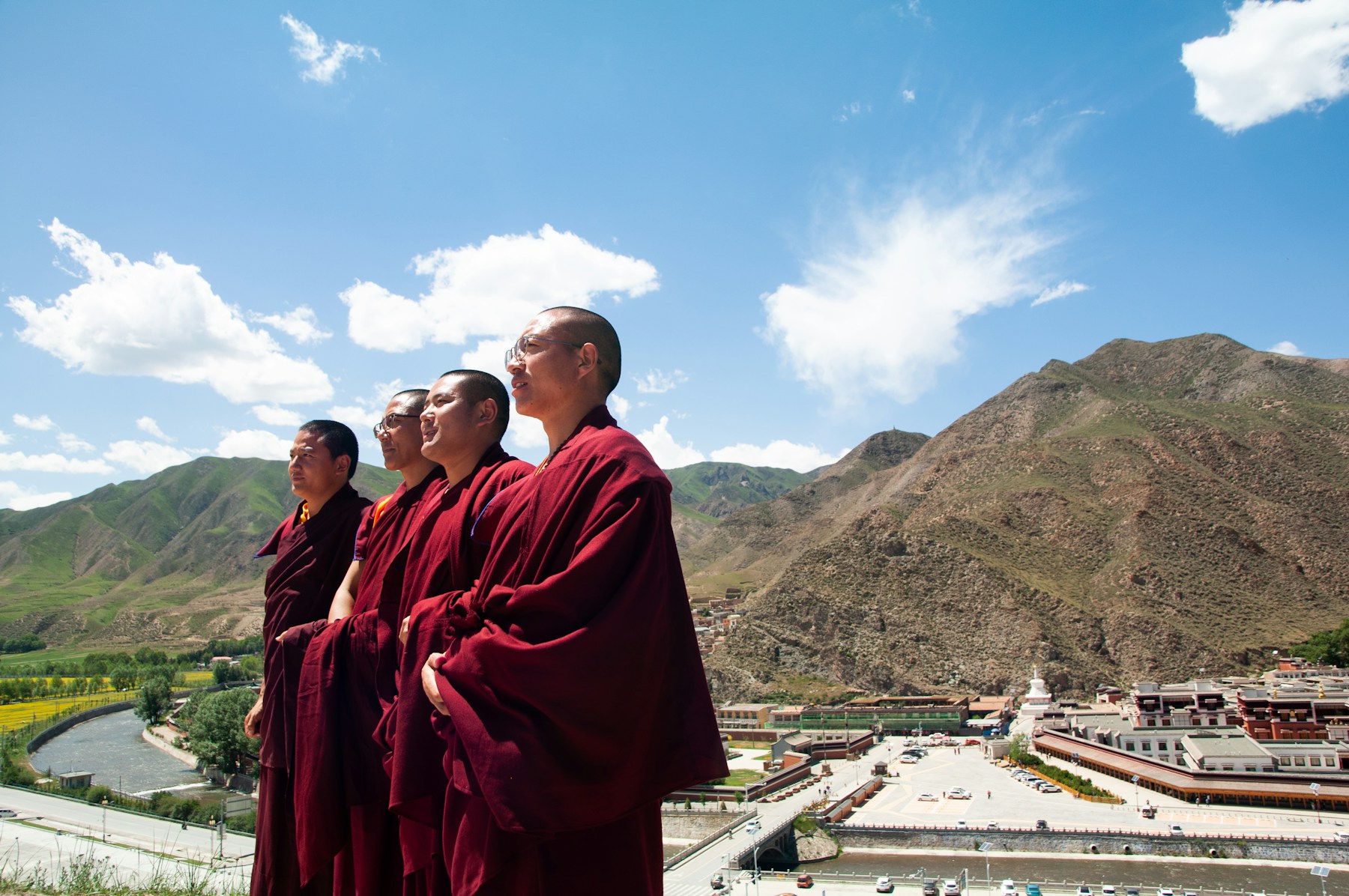
Amdo describes a Tibetan cultural region extending across parts of Qinghai, Gansu and Sichuan. This itinerary stays in those three provinces, outside the Tibet Autonomous Region. That distinction does not make every side road, monastery or county automatically accessible to every foreign visitor.
Choose the journey you actually want
Choose this corridor for a changing landscape and several nights in Tibetan cultural communities. Choose a shorter city-and-monastery trip if sleeping above 3,000 metres, repeated packing or variable road conditions would dominate the holiday. A shorter calendar does not make the full road journey easier.
| Your priority | A useful starting plan | What to settle first |
|---|---|---|
| Grasslands, Songpan and two monastery towns | The twelve-day Chengdu–Xining framework, with flexible extra nights. | The mountain approach, overnight elevations and arrangements at each property. |
| Less driving and fewer high nights | Start with Lanzhou and Xining, adding Xiahe only if its elevation suits you. | The exact highland excursion and an alternative if you cannot continue uphill. |
| Freedom to drive your own daily stages | A domestic rental with confirmed pickup, authorised drivers and a Xining return arrangement. | Chinese driving documents, interprovincial use, breakdown cover and the actual one-way charge. |
| More time interpreting monasteries and handling logistics | A driver arrangement, with an interpreter or local guide where needed. | Vehicle, luggage space, language, working days and responsibility for route changes. |
A driver can take care of road decisions and parking; this does not automatically include English interpretation, monastery guiding or tickets. If your main interest is religion and local life, agree those elements explicitly. Self-drive travellers need an appropriate Chinese driving credential, not just an overseas licence or International Driving Permit. Start with the foreign-passport car rental guide. Bringing a foreign-registered vehicle is a separate process covered in the car and campervan entry guide.
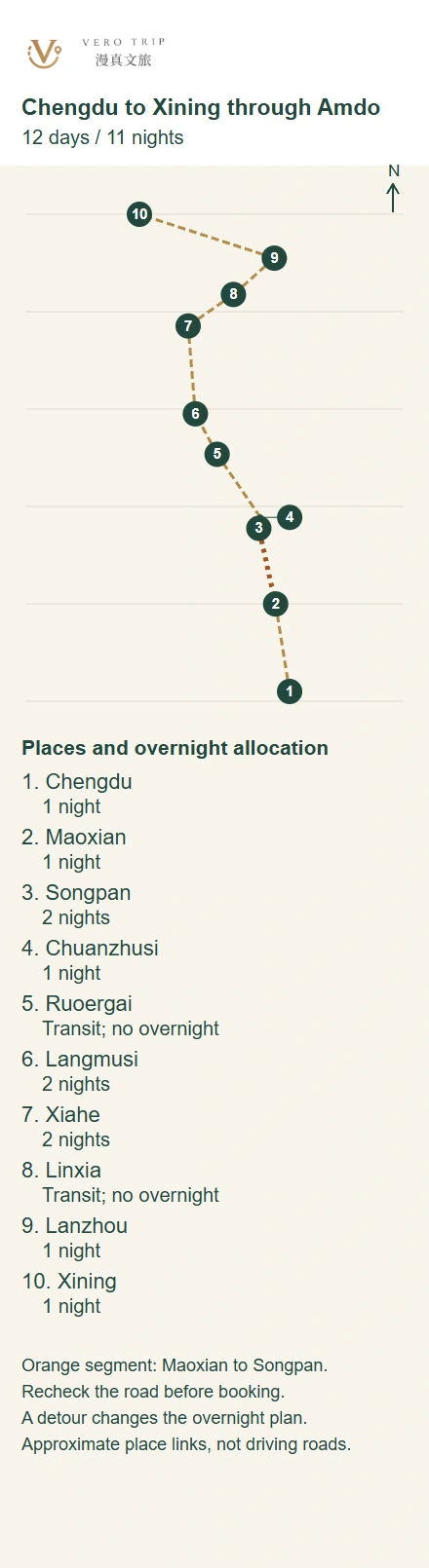
Use twelve days and eleven nights as a conditional framework
This is a planning allocation, not a fixed departure or a medical clearance. The shorter stages around Songpan are deliberate. They leave room to rest, check how everyone feels and choose accommodation before the higher grassland sector. The figures below describe town-level geography; obtain the elevation of the actual hotel rather than treating a county average as your bed height.
| Days and overnight base | Nights | Sleeping-height context | How to use the stage |
|---|---|---|---|
| Day 1: Chengdu | 1 | Low basin starting point; hotel-specific height not listed. | Recover from arrival, resolve vehicle documents and buy practical supplies. |
| Day 2: Maoxian | 1 | Town approximately 1,580 m. | Break the approach only when the onward road plan is workable. |
| Days 3–4: Songpan | 2 | County town approximately 2,850 m. | Keep the arrival day easy; use the second day for town time and a decision about continuing higher. |
| Day 5: Chuanzhusi | 1 | Town approximately 2,980 m. | A short repositioning and rest stage, not a reason to add a strenuous high-altitude excursion. |
| Days 6–7: Langmusi, via Ruoergai | 2 | Town/village sources indicate roughly 3,300–3,500 m; confirm the property. | Make the grassland crossing in daylight, then give Langmusi a full day. Ruoergai is a transit stop in this plan. |
| Days 8–9: Xiahe | 2 | County town approximately 2,945 m. | Give Labrang and the surrounding town their own day; make further grassland outings optional. |
| Day 10: Lanzhou, via Linxia | 1 | Use a city hotel; confirm the exact property if height matters medically. | Break the final approach and agree the next transfer before the evening. |
| Day 11: Xining | 1 | City average approximately 2,261 m. | Leave room for vehicle handover or a quiet city afternoon. |
| Day 12: Depart Xining | 0 | No further high overnight in this framework. | Use a separate departure day instead of combining a remote road stage with an inflexible flight. |
The plan contains eleven nights. It does not include Huanglong, Jiuzhaigou, Qinghai Lake or a detour through Garze. Each would change the time, elevation or access checks. In particular, a lake excursion from Xining is not automatically a low-altitude rest day.
If your main goal is to continue into the Silk Road cities, compare the existing fourteen-day Eastern Tibetan Plateau and Silk Road itinerary. Its Hongyuan approach and continuation beyond Xining make it a different trip. Its published itinerary does not establish vehicle availability or inclusions for this twelve-day framework.
Plan the sleeping ascent before adding attractions
The CDC’s high-altitude guidance recommends gradual ascent and avoiding a direct first sleeping ascent from below 1,200 metres to 2,750 metres or above. Above 3,000 metres, it advises limiting increases in sleeping elevation to about 500 metres per night, with additional acclimatisation time. Fitness does not remove the risk, and children can also develop altitude illness.
The Songpan arrival is still a substantial rise from Maoxian. Extra nights alone cannot certify that this sequence suits you. Discuss previous altitude problems and relevant health conditions with a clinician before choosing it; identify a workable lower stop or redesign the trip if needed. If symptoms develop, do not continue to a higher sleeping place. Worsening symptoms require descent and medical assessment; confusion, difficulty walking or breathlessness at rest require urgent help.
Keep arrival afternoons light. Do not turn a scheduled rest day into a high mountain excursion simply because a car is available. Ask the accommodation about heating, stairs and vehicle access, and identify medical help and a descent route before the grassland stage. A bedroom oxygen device does not make a higher itinerary suitable for someone who should descend.
Resolve the mountain approach as a separate decision
The 16 September road notice identifies G213 K2029+200 and gives alternatives for passenger vehicles. One goes through Heishui, Rangkou, Waqie and Chuanzhusi; another approaches Songpan through Jiuzhaigou from the Mianjiu Expressway. These are route alternatives to assess, not instructions to follow without a fresh road check.
A detour through higher country can undermine the overnight sequence even if a navigation app calls it faster. Ask for the revised route, actual stop and hotel height together. If the road approach cannot be made comfortable, investigate a rail arrival and a separately arranged local vehicle; confirm the station, available train, luggage and pickup before buying tickets. If neither arrangement works, retain the Chengdu stay or choose the Lanzhou–Xining alternative.
Check the relevant traffic-police and transport notices shortly before departure and again before the affected stage. Ask whether the notice concerns cars, trucks, construction windows or a complete closure. Rain, snow or a local event can change a usable route; an old all-clear from another county does not settle this road.
Choose accommodation by access, warmth and food
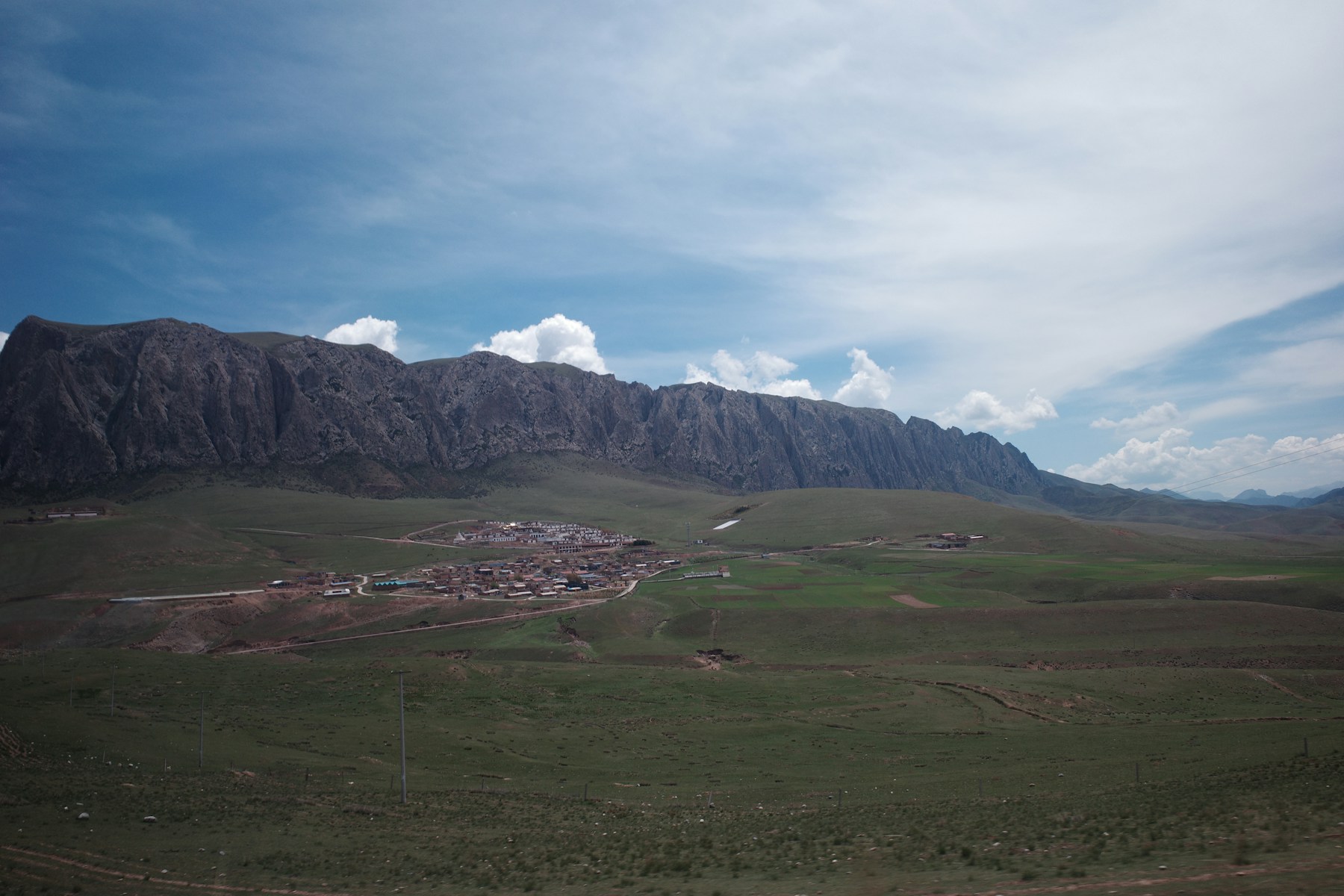
For a grassland guesthouse, agree the final approach before leaving the last town. Save the Chinese property name and pin, ask whether the last stretch is paved, and obtain a contact who can guide you to the agreed parking area. Arrive before dark and buy water or a simple backup meal while shops are still available; a remote room with a view may have no nearby shop.
Ask what heats the room, when it operates and what happens during a power problem. An electric blanket warms a bed, not the whole bathroom or room. Confirm that the actual arrangement suits the people travelling, and keep a more accessible town property as a fallback instead of treating a late arrival as a reason to accept unsuitable conditions.
Book the room around the people travelling, not a photograph of a mountain view. A remote guesthouse with many stairs may be a poor fit for an older traveller, large suitcase or child who needs an early dinner. Tell the property the passport nationalities and children’s ages, and obtain a clear confirmation of the room and registration arrangement.
China’s accommodation facilitation measures reject qualification barriers that restrict hotels from receiving foreign guests. Practical confirmation still matters: staff must be able to register the passports and provide the booked stay. Hotel reception and access to a particular locality are separate questions.
| Base or need | Ask before booking | Make the day easier |
|---|---|---|
| Songpan and Chuanzhusi | Room heating, hot-water hours, stairs and nearby evening meals. | Keep a small overnight bag ready and leave the first afternoon flexible. |
| Langmusi | Which province and side of the stream, the exact hotel height and car access. | Use the Chinese property name and map pin; do not assume two similarly named monastery entrances are interchangeable. |
| Xiahe | Distance from Labrang, parking arrangements and any event-day road changes. | Stay long enough to visit without packing and driving onward the same afternoon. |
| Children, older travellers and luggage | Suitable seat restraints, actual seat-and-bag capacity, lift or ground-floor room, toilet breaks. | Keep warm layers, snacks, medicine and waterproofs accessible inside the vehicle. |
| Halal meals and prayer | A named restaurant’s ingredients and preparation, opening on your date, and a private space for prayer. | Carry a written dietary brief and reserve meal breaks; do not infer halal status from beef or lamb on the menu. |
For Muslim travellers, distinguish a meal preference from a confirmed halal arrangement. Ask about pork, cooking fats, alcohol in cooking and shared preparation according to your requirements. A mosque on a map is not a guarantee of visitor entry, ablution facilities or access at your planned hour. Keep the option of prayer in a clean private room, and avoid a schedule that depends on reaching one particular building.
Give Langmusi and Labrang time without assuming access
Choose the visit after arrival according to weather, open areas and how everyone feels. Hail can interrupt a walk even when the morning was clear. Keep a short town visit or an early return to the room available. A canyon walk behind a monastery is a separate activity: confirm its permitted route, footing, weather and distance rather than assuming a temple ticket makes it a gentle outing for everyone.
Langmusi straddles the Sichuan–Gansu boundary. The monasteries on the two sides are separate visits: name the Gansu Serti monastery or the Sichuan Gerdi monastery when arranging an entrance or guide. Confirm current visitor access, tickets and permitted photography directly. One town name should not become a promise that every hall, walk or religious activity is available.
At Labrang in Xiahe, arrange the permitted visitor route and any interpretation you need. Leave religious practice space, ask before photographing people and obey restrictions inside halls. Do not seek access to private ceremonies or funerary practices. Festival travel needs its own traffic plan: Xiahe police have issued event-specific controls around the monastery, so ordinary parking arrangements may not apply.
The National Immigration Administration’s restricted-area guidance distinguishes ordinary destinations from places requiring permission. Give the organiser the actual counties, side trips, travel dates and passport details so local restrictions can be checked. An “Amdo” label is neither a Tibet Autonomous Region permit requirement nor a blanket exemption for every surrounding area.
Agree the alternative before a problem occurs
| What changes | A useful response | Avoid this assumption |
|---|---|---|
| The Maoxian–Songpan approach remains closed | Rebuild the approach and its overnight heights, or arrange a workable rail-and-local-vehicle combination. | A higher detour fits the same day and the same acclimatisation plan. |
| Someone cannot continue higher | Stop the ascent; seek medical advice and arrange descent or an appropriate lower itinerary. | A prepaid hotel or a stronger vehicle is a reason to press on. |
| Snow, heavy rain or a traffic instruction affects a stage | Stay in a suitable base while the driver checks a lawful alternative and available rooms. | A grassland track is a shortcut around a closure. |
| A monastery or locality is unavailable | Use an accessible town visit or rest day and adjust the next reservation. | A cultural-region itinerary guarantees entry everywhere. |
| The one-way vehicle arrangement fails | Compare a driver transfer or split journey before paying non-refundable hotel deposits. | A rental brand’s presence in both cities guarantees that branch will accept the return. |
Send Vero Trip a route brief with your practical limits
For an enquiry, send your dates, passport nationalities, party size, children’s ages, preferred driver or self-drive arrangement, luggage and your main reason for choosing this route. Add dietary and prayer requirements, room needs, previous altitude difficulties and any fixed departure from Xining. Share sensitive medical details with your clinician; tell the planner the resulting travel limitations.
Ask for an itemised proposal stating the actual vehicle, permitted route, rooms, guiding language, meals, tickets, driver costs, one-way return, cancellation conditions and disruption arrangements. Medical evacuation and travel insurance need their own scope check. These details cannot be inferred from this planning guide or from another tour’s inclusions. Use the China self-drive enquiry collection to describe the journey you want and which decisions need help.
For a shorter stay after the overland arrival, the Qinghai trip-planning guide compares Xining, Qinghai Lake and Chaka with the longer western loops and explains overnight choices.
For a journey returning to Lanzhou, compare the Gannan planner for Xiahe and Langmusi. It develops the gateway, highland rooms and a slower two-town core, with Zhagana treated as a separate extension. Use this Amdo guide for the longer Chengdu–Xining through-route.