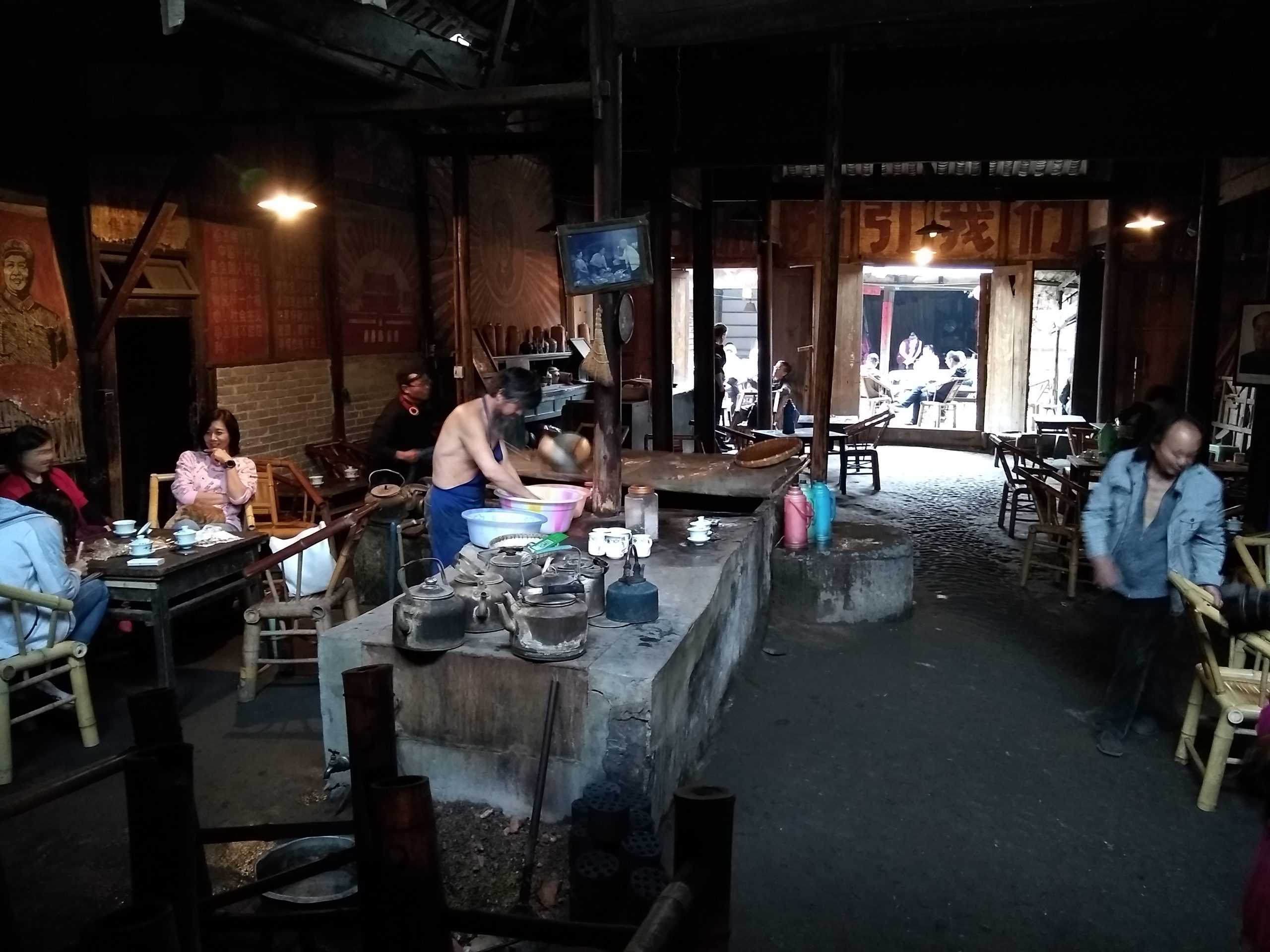
Pengzhen is worth a separate outing from Chengdu if you want to spend time inside a working old teahouse and understand the building around it. Make Guanyin Hall the focus, allow a short old-street walk and lunch, and arrange the return to your Chengdu hotel before setting out. This is a good visit for patient observers; it becomes less rewarding when treated as a quick photograph between distant attractions.
The name appears as Guanyin Hall, Guanyinge and Guanyin Pavilion Old Teahouse. Save 彭镇观音阁老茶馆, 成都市双流区 on your phone, with the current entrance pin confirmed locally. The subject here is Pengzhen in Chengdu’s Shuangliu District. A similarly named temple or pavilion elsewhere is a different destination.
What makes this teahouse worth the journey?
Its interest lies in the relationship between a modest building and the people who use it. Sit as a customer when space and service allow, look at the roof structure and wall surfaces from your seat, and give the room time to become more than a backdrop. An elaborate tea ceremony is not necessary for this kind of visit.
The Guanyin Hall Teahouse Conservation Project received an Award of Merit in the 2024 UNESCO Asia-Pacific Awards for Cultural Heritage Conservation. UNESCO’s account recognises the work on traditional materials, practical use and community participation. The distinction is a conservation award; it should not be described as a World Heritage inscription. See the official award account.
That background changes what is worth noticing. Ask how an old building can continue to serve its customers, rather than looking only for surfaces that appear untouched. Repair and daily use belong in the story. A worn wall is not evidence that nothing has been maintained, and an old-looking room does not establish the age of every part.
Southwest Jiaotong University’s heritage team describes investigating changes in the building through roof structures, materials and drainage. Its January 2025 account records local repairs to floors, walls, roofing, doors and drainage, including work with bamboo and mud mixed with straw. The team also interviewed regular customers and residents. These are useful details to understand the space without touching fragile surfaces or entering work areas. The university’s project report concerns conservation work, not a promise that its accompanying exhibition remains open today.
Choose a seated visit, a street walk or a broader day
| Your priority | A useful format | The practical trade-off |
|---|---|---|
| Tea and the historic interior | One unhurried tea stop with a short look along the public street | The experience depends on available seating and ordinary business conditions; it is not a private room reservation. |
| A neighbourhood outing | Tea, a modest street walk and a separate lunch | Leave room for closed businesses, rain and a slower return; a long list of shops adds little. |
| Cooking or a hands-on activity | A separately arranged day with a named venue and instructor | Workshop availability, language, meal content and transport need their own written arrangements. |
The first format suits visitors who enjoy observing architecture and ordinary routines. If your main aim is an accessible city pause between appointments, compare People’s Park and Heming teahouse before committing to a separate Pengzhen transfer. The park visit and this suburban teahouse visit have different travel demands and settings.
Avoid adding every activity mentioned in an article about the town. A performance, photography exhibition, cooking session or craft workshop may belong to another business or a dated event. Choose it independently if it matters to you; a tea order should not be assumed to include it.
Read the room without turning people into props
Start with your own table and the view from it. Roof timbers, the relationship between the drinking area and the tea-service area, and the contrast between the interior and doorway light give you plenty to observe. Use the current public areas and follow staff directions. Do not climb on a chair, lean on an old wall or enter behind a service counter for a better angle.
The historical photograph on this page shows the teahouse in April 2019. Kettles, a substantial service area, bamboo chairs and customers help explain how the room was used at that time. It is not a current floor plan, an architectural survey or evidence that a particular seat and view will be available on your visit.
Ask before making an identifiable portrait or photographing someone’s game. Keep passages clear and do not ask customers to move into a shaft of light or repeat a gesture. If someone declines, photograph your tea or building details instead. Buying a drink does not purchase other customers’ participation.
The town is also a contemporary visitor destination. A November 2025 report by Shuangliu media and Financial Investment News described foreign visitors, photography activity and new businesses around the old streets. It also recorded a vendor selling tangyou guozi, a local sweet snack. That report supports a mixed neighbourhood and visitor setting, rather than a guaranteed quiet scene. Its shop counts, events and named businesses are historical context. See the reported visit to Pengzhen.
Ordering tea and deciding on lunch
Before settling in, ask which teas are available and what the stated price covers. Clarify whether the charge is per person, per bowl or for a shared pot; whether hot-water refills are included; and whether a particular table has different conditions. Use the current menu or a clearly understood quoted amount rather than an old internet price for regular customers.
If you are unfamiliar with a gaiwan, ask for help with the bowl and lid. There is no need to copy an elaborate pouring movement. Let hot tea cool and keep refill vessels away from children. Ask what tea you are ordering if caffeine or an ingredient matters; a floral name alone does not answer that question.
A short phrase can be more useful than a long translation: 请问这款茶怎么收费? means “How is this tea charged?” 可以续热水吗? asks about more hot water. Show the number of people as well as the question. Confirm the total and accepted payment method before ordering extras; do not assume a foreign card or an overseas app account will work at every small business.
Plan lunch separately from tea. One option is a simple bowl of noodles or a rice meal at an open local restaurant whose ingredients you can understand; another is to return to Chengdu for lunch when menu choice or dietary requirements matter more. Tangyou guozi can be a snack to look for if available, but a sweet snack is not a substitute for a full meal on a long outing.
For a shared Sichuan meal, explain whether you want less chilli, whether organ meats are acceptable, and which ingredients must be avoided. Ask about the stock, sauces and cooking oil as well as the main dish. A vegetable dish is not automatically vegetarian, and neither a no-pork request nor a menu translation establishes halal certification or protection from cross-contact.
Do not bring another business’s food into the teahouse without asking. If a cooking lesson is your preferred lunch, identify the venue, instruction language, menu and dietary arrangements in the proposal. An article mentioning countryside cooking does not establish that a walk-in class will be running when you arrive.
A half-day sequence with a complete return
Treat this as a suggested order for a relaxed outing, with road travel added according to your hotel and the actual date. It is not a published departure schedule. Protect the seated tea stop and lunch before adding another attraction.
| Part of the outing | Suggested plan | What to settle beforehand |
|---|---|---|
| Leave the Chengdu hotel | Have breakfast, leave large luggage in agreed storage and travel to the confirmed Pengzhen approach | Correct Chinese destination, lawful drop-off, expected traffic and who arranges the return. |
| Arrive and drink tea | Find the entrance, ask about seats and prices, then sit and observe the interior | Current business opening and any group, photography or seating conditions. |
| Walk and eat | Choose a short public-street out-and-back walk; have lunch locally or return for a city meal | A suitable food option, walking distance, toilet needs and a wet-weather alternative. |
| Return to the same hotel | Meet at the agreed public pickup point, complete the drive and collect stored bags if needed | Vehicle waiting or a new pickup, contact method, charges and the full final leg. |
For the seated part, you might reserve about an hour in your own plan, then decide whether to stay longer. That is a planning allowance, not a service entitlement or a recommendation to occupy a busy table indefinitely. Give the street walk a turning point rather than continuing until everyone is tired.
If the room is full, ask about a reasonable wait and decide whether another available tea business would meet your purpose. If the historic interior is essential and cannot be visited, an alternative café is a different experience. It is reasonable to change the day instead of pretending the original visit has been delivered.
Hotel base, language and a complete return
For most visitors combining Pengzhen with city culture or pandas, keep a Chengdu hotel base. Choose the property against the whole trip: road access with luggage, the city activities you will use, room comfort and the final departure. A hotel described as “central” still needs a practical entrance and a clear pickup point.
Staying in Shuangliu can make sense when another part of your trip is already based there, but the district name does not establish a short walk to the teahouse. Before choosing a Pengzhen or nearby property, confirm its exact location, passport registration, reception hours, room access, luggage arrangements and evening food options. This guide does not identify a verified bookable hotel inside the historic building.
Keep CTU and TFU separate in every transfer plan. They identify Shuangliu and Tianfu airports, not two terminals of one airport. Do not turn a Pengzhen visit into an assumed stop between flights just because the district shares the Shuangliu name. Use the Chengdu airport guide to work through the actual ticket, terminal and hotel approach.
For a car, specify the full hotel-to-Pengzhen-to-hotel arrangement. Ask whether the driver waits, where the vehicle can legally stop, and how delays or additional stops affect the quote. For a public-transport approach, check a dated journey to the actual town and include its final local connection; no direct metro stop at the teahouse is assumed here.
English assistance is a separate choice. An English-speaking companion can help with ordering and context if arranged, but a driver, a shopkeeper and a specialist guide provide different services. Save the hotel address, return meeting pin and an offline contact method. Do not make the return depend on being able to translate a complicated pickup instruction with a flat phone battery.
Fit Pengzhen into a Chengdu stay
| Trip length | Hotel nights | A balanced use of the days |
|---|---|---|
| 3 days / 2 nights | Chengdu 2 | Arrive and settle on Day 1; devote Day 2 to Pengzhen with lunch and hotel return; depart on Day 3. Add city walking only where the actual arrival allows. |
| 4 days / 3 nights | Chengdu 3 | Arrival, one separate city or panda day, one Pengzhen outing, then departure. Each major visit keeps its own travel and admission arrangements. |
| 5 days / 4 nights | Chengdu 4 | Arrival, a city day, a Pengzhen day, another independently planned cultural or countryside day, then departure. Keep all four nights at one base if that suits your transfers. |
These are suggested holiday structures, not fixed departures. On the longer stay, an additional day could focus on a museum or another neighbourhood rather than adding a distant mountain excursion automatically. The Chengdu trip-planning guide helps compare city time with wider Sichuan travel.
Our Pengzhen Old Teahouse and Chengdu Countryside Food Tour is a broader one-day outline: its itinerary combines the teahouse with a local morning market and countryside cooking, with a craft activity conditional on workshop availability. Choose that route if the food activity is important. For a simpler tea-and-street outing, ask for the reduced scope and its own price rather than assuming the full programme is included.
Comfort, weather and costs
Expect the practical demands of an older interior and local streets: check thresholds, uneven surfaces, the distance from a lawful stopping point and the availability of a suitable seat. A short distance can still be awkward for a wheelchair or someone who finds low seating difficult. If access is essential, request confirmation of the complete approach, seating and toilet arrangement before committing.
In rain, shorten the street portion and allow extra time between the entrance and pickup. Covered seating is useful only if it is available and reachable. Do not assume that being indoors guarantees a smoke-free room, heating, cooling or a quiet atmosphere. If those conditions matter to your group, make them part of the suitability check and keep an alternative city plan.
Budget separately for transport, tea, lunch, optional activities and any language support. A private outing is Price on request. The written proposal should identify the named places, date, actual reservation or identity requirements, payment arrangements, vehicle waiting and return, language, meals and any accommodation. No fixed tea price, opening timetable, workshop place, performance or insurance inclusion is promised here.
Questions about visiting Pengzhen
Is Pengzhen suitable for international visitors?
The 2025 local reporting describes foreign visitors in the town and at the old teahouse. That is ordinary visitor context, not a test of every passport, booking channel or payment method. Confirm the current arrangements for your date and any separately booked activity, and carry the identity document required by your wider trip.
Is the UNESCO award a World Heritage listing?
No. The documented recognition is an Award of Merit for a conservation project in the 2024 Asia-Pacific programme. The useful visiting question is how the building and its everyday tea use have been cared for, rather than expecting a large ticketed monument complex.
Should I visit Pengzhen and People's Park on the same day?
You can discuss that combination, but two seated tea visits may repeat the same part of your day while adding a transfer. Choose Pengzhen for the historic interior and town outing, or People’s Park for a city walk and tea stop. Give both time only if comparing their different settings is a particular interest.
How do I request a visit through Verotrip?
Use Plan My Trip and send your dates, Chengdu hotel, group size, mobility and dietary needs. Say whether you want quiet observation, architectural context, a street walk or a separately arranged cooking activity. Ask for the complete return and the agreed services in writing before payment.
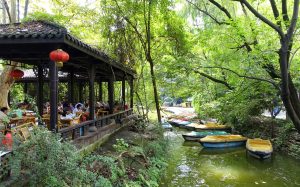
Cover photograph: Pengzhen Teahouse, photographed by Danmen2 on 12 April 2019. Original image and author, CC BY-SA 4.0. The existing website image is resized; responsive display crops may apply. This historical interior photograph predates the conservation award and does not show today’s seating or a Verotrip group.