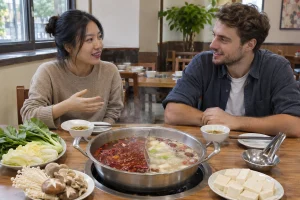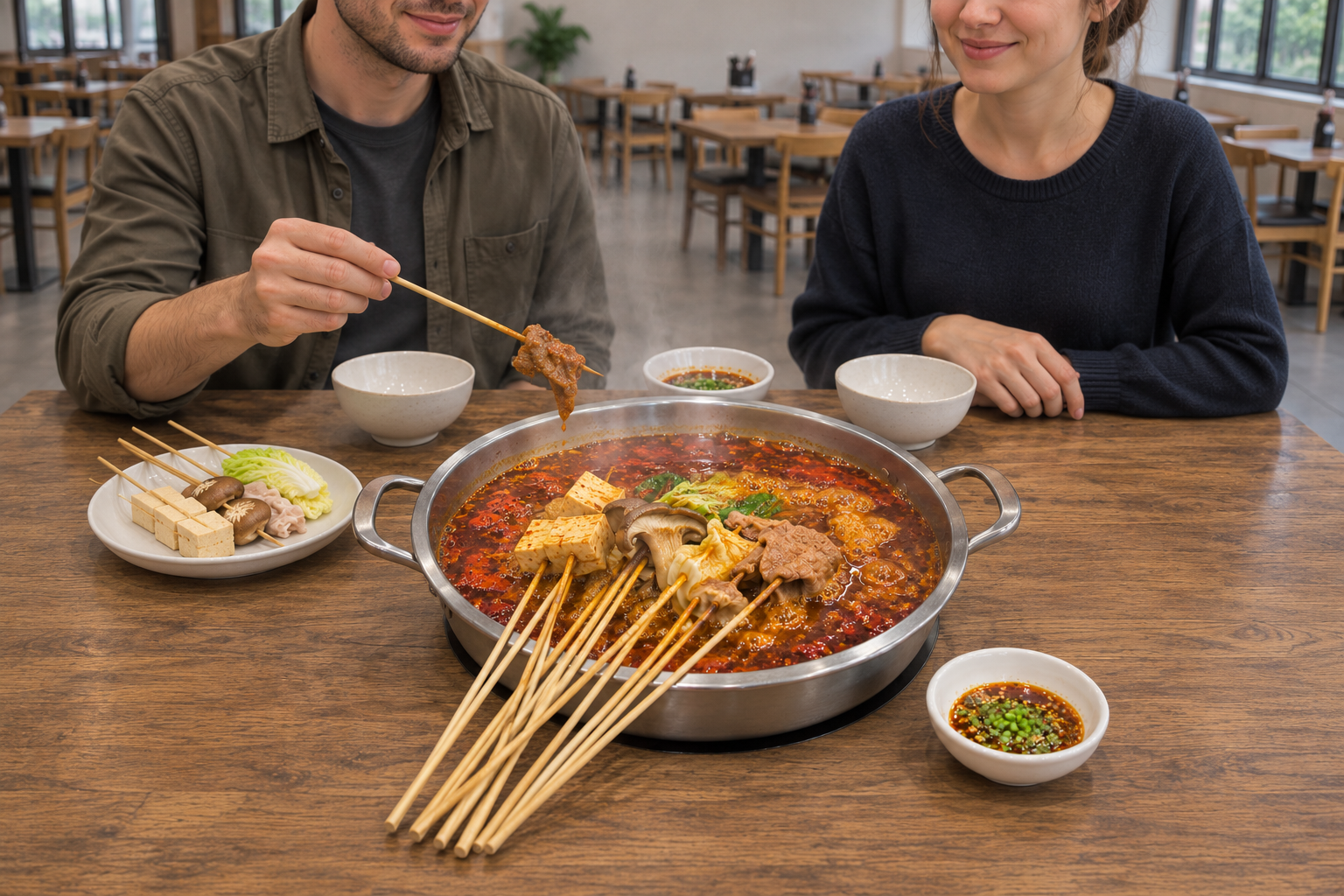
Chengdu chuanchuan is a good meal for travellers who want to choose a little of several ingredients and spend time around a shared pot. Look for 串串香, ask whether you cook the skewers at the table, and establish how the restaurant calculates the bill before selecting food. A bamboo skewer is a serving format, not a universal price or cooking instruction.
For a first visit, choose an indoor restaurant with seating that suits your party, order a modest selection, and keep the evening free of a tightly timed connection. The enjoyable part is comparing textures and sharing a meal. You do not need to collect famous shops, order unfamiliar offal or turn dinner into a chilli challenge.
What makes chuanchuan worth trying?
The defining image is small pieces of food threaded onto bamboo sticks and cooked in seasoned hot-pot broth. A People’s Daily Overseas Edition account of Chengdu’s Yulin neighbourhood describes both meat and vegetable skewers. The sticks let you identify and choose individual items rather than committing the table to a large plate of each ingredient.
That changes the rhythm of the meal. You can start with a few foods you recognise, compare the result and decide what you want next. The selection becomes part of the conversation: which texture did you enjoy, which item needs explaining, and does the table actually want another round? Take that opportunity instead of treating a crowded display as a challenge to try everything.
Food names and service formats need distinguishing. Chuanchuan belongs beside hotpot in a Chengdu food plan, but it is not a synonym for every spicy bowl or every grilled skewer. For a plate-based shared meal and a fuller comparison of broths, use our Chengdu hotpot guide. Here the emphasis is choosing skewers, understanding their charging basis and fitting the meal into the day.
Hot-pot skewers or a prepared serving?
Ask what will arrive before choosing a table. A restaurant offering a pot for you to use creates a different experience from a counter that cooks your selection and brings it ready to eat. A photograph of bamboo sticks alone cannot tell you who does the cooking.
| What you are considering | Why it might fit | Question before ordering |
|---|---|---|
| Hot-pot chuanchuan / 火锅串串香 | A seated, shared meal with time to cook and add ingredients. | Do we cook these ourselves, and which broth choices are available? |
| A prepared skewer serving, including a cold-pot menu / 冷锅串串 | You prefer staff to prepare the selected food. | Is this ready to eat when served, and what temperature and seasoning should we expect? |
| An individual noodle or dumpling meal | You want a simpler portion or companions prefer separate meals. | Which bowl, portion and sauce suit each person? |
A 2024 restaurant interview published by CNR describes one business combining hot-pot skewers, cold-pot preparations and plate dishes. It is a useful example of why the service matters more than a broad sign. It does not establish that today’s branch has the same menu, prices or promotions.
Likewise, a 2023 CNR report on Chengdu’s evening markets encountered cold-skewer vendors. That historical report is not a current opening list. If you want a full seated dinner, confirm seating and preparation directly instead of assuming every skewer stall offers a bubbling tabletop pot.
For a short arrival-day meal, the separate Chengdu noodles and dumplings guide may fit better. Save chuanchuan for a day when you have the time and appetite to enjoy the selection.
Choose ingredients by texture and recognition
Begin by identifying the actual foods on offer. Point to an item and ask its name before putting it on the order. If there is a self-selection display, first establish which trays belong to your menu and whether staff should handle them. If the restaurant uses table service, ask for a small first order rather than assuming you may take ingredients yourself.
For a comparison, look for a few different textures among foods you already enjoy: a mushroom, a tofu product, a vegetable and a preferred meat if offered. These are selection ideas, not a promise about a particular shop’s range. A skewer can carry a thin slice, a folded piece or several small pieces, so count the food as well as the sticks when judging portions.
Be especially careful with mixed or wrapped items. An attractive roll may contain something you did not recognise from the outside. Ask about its filling and marinade. Meatballs, sausages and other prepared foods need their own ingredient question; their shape does not reveal their composition.
Anyone avoiding organ meats should say so before staff assemble a mixed selection. There is no need to identify every unfamiliar cut yourself or to order a house speciality simply because its name is prominent. Choose identifiable alternatives that the restaurant can explain.
Keep the first selection manageable. When two people choose independently, it is easy to duplicate ingredients and discover that nobody wants the extra tray. Agree on a shared first round and ask whether you can add more later. Leave enough table space to keep uncooked items separate from food ready to eat.
Understand the skewers before you understand the bill
Ask for the charging method before selecting a large bundle. Does the shop count sticks, weigh a category of items or use another stated basis? Do different colours, sizes or plate dishes have separate prices? These are questions for the actual menu, not rules that every Chengdu restaurant follows.
Where sticks are counted, ask whether an item held by several sticks counts as several units. Keep the used sticks in the container staff provide until the bill has been settled. Do not discard them during the meal if they form part of the restaurant’s calculation.
If weighing is involved, clarify what is being weighed and the unit shown on the menu. A price per unit cannot be compared with a per-skewer price by looking only at the number. Ask staff to show the quantity, unit price and resulting charge for your selection. Plate dishes and drinks may still be recorded separately.
| Part of the order | What to confirm | How to compare clearly |
|---|---|---|
| Skewers | Counting or weighing method, categories, and any item using multiple sticks. | Read the unit and ask about the food you actually selected. |
| Broth and seasoning | Charge per pot, per person or another stated basis; dipping-bowl arrangements. | Separate these amounts from the ingredient bill. |
| Plate dishes, rice and drinks | Portion size and whether each is included in a set. | Keep a simple list of extras ordered by the table. |
| A promotion or set menu | Eligible branch, date, party size, redemption and exclusions. | Compare the complete meal you want, not only the advertised starting amount. |
Take the final comparison slowly. A skewer price is not a per-person dinner budget, and a photographed promotion is not evidence that an overseas visitor can redeem it. Ask about the payment methods you can actually use before ordering. If a table code or membership offer does not work for you, request staff assistance and the ordinary menu.
There is no fixed restaurant price quoted here. The practical aim is a transparent order that fits your appetite and budget. For a planned visit, agree a meal allowance or specified menu in advance if that is part of the arrangement.
Six questions to show the server
These short phrases help with the points specific to a skewer meal. Show the question alongside the dish or menu entry and wait for an explanation you understand. A nod should not substitute for an answer about an important ingredient or charge.
| Chinese to show | Meaning | What you need to establish |
|---|---|---|
| 这些是我们自己煮,还是你们煮好? | Do we cook these ourselves, or do you cook them? | Who handles preparation before the food can be eaten. |
| 这个里面是什么? | What is inside this? | The filling or ingredient in the item you are pointing to. |
| 是按签数,还是按重量收费? | Is the charge by the number of sticks or by weight? | The charging method for this selection. |
| 这个用了几根签,怎么算钱? | This uses several sticks; how is it charged? | Whether the item has a different counting or pricing basis. |
| 锅底和蘸料另外收费吗? | Are the broth and dipping ingredients charged separately? | The additional amounts and their units. |
| 可以先少点一些,不够再加吗? | Can we start with less and add more if needed? | Whether a second order is practical under this menu or set. |
For spice preferences, separately mention chilli, 辣椒, and Sichuan pepper, 花椒. Ask which prepared broths can meet the request; removing a visible chilli later does not change the ingredients already in the pot. Start with a seasoning choice everyone sharing the broth accepts.
Make cooking and dietary needs straightforward
If the meal involves cooking raw ingredients, follow the restaurant’s instructions for the actual food and ask for help when unsure. The Hong Kong Centre for Food Safety’s hotpot advice recommends clean hands and utensils, separating raw and cooked food, and thorough cooking. Use distinct tools for raw ingredients and ready-to-eat food; keep their plates separate as well.
Do not apply one cooking time to every skewer. Different ingredients and thicknesses require different handling. Avoid overcrowding the pot, and ask staff to manage refills or unfamiliar heating equipment. A child should have a comfortable seat away from the hot vessel and pointed skewer ends. Have staff help remove food from sticks when that makes the meal easier.
Vegetable skewers do not establish what is in the stock, cooking fat or sauce. Explain vegetarian, halal or allergy requirements before agreeing to the meal, including any need for separate preparation. This guide does not certify a restaurant for those needs. If the kitchen cannot give a clear, suitable answer, select a different meal.
Put dinner beside one manageable city activity
Choose the meal area around the day you are already having. Yulin offers a useful neighbourhood context for learning about Chengdu’s food culture, as the dated People’s Daily account shows. It is a reason to consider the area, not a requirement to cross the city for an old brand mention. Check the exact currently operating branch, menu and route from your hotel.
A relaxed sequence is one cultural visit, a normal lunch, a hotel break, then a short neighbourhood stroll and dinner. Leave large bags at your accommodation under its actual storage arrangements. Reach the restaurant with time to understand the menu, eat at your own pace and settle the bill before returning to the same hotel.
For rain, shorten the walk and choose indoor seating with a straightforward drop-off. For limited mobility, ask about entrance steps, chair height, toilets and the distance between vehicle and table. A small street-front restaurant and an upstairs dining room can involve very different effort. An accessible-looking photograph is not enough to settle those details.
Do not put an uncertain dinner queue between you and an airport check-in or a fixed train departure. On a late arrival, choose a convenient meal the kitchen can still serve and protect sleep. On departure day, keep luggage collection, the actual station or airport and the final transfer ahead of an ambitious food plan.
Hotel base, language and a complete return
A chuanchuan evening does not require changing hotels. Choose your Chengdu base for the whole stay: the cultural visits you want, transport access, room comfort and the final walk from a vehicle. A central location is useful only if the exact entrance, lift and luggage arrangements work for your party.
With three days and two Chengdu nights, keep one full day for your main visit and the dinner. With four days and three nights, separate that evening from a demanding excursion. Five days and four nights leave more room for a second food style or a quiet city day. Arrival and departure are still real travel days; count usable hours rather than treating every calendar day as a full sightseeing day. The Chengdu trip-planning guide compares those wider choices.
An English menu does not guarantee an English-speaking server or someone to explain every ingredient. If accompanied dining is important, specify the language, meeting place, duration and return in the written plan. A driver waiting outside and a consultant helping you plan are different services.
Price on request for an arranged Verotrip visit. The restaurant selection, food allowance, additional dishes, language assistance, transport, vehicle waiting and final hotel drop-off must be stated separately. Accommodation, sightseeing admissions and other meals are included only when identified in the accepted programme. No existing city itinerary should be read as including chuanchuan solely because it visits Chengdu.
Questions about a Chengdu chuanchuan meal
Is chuanchuan the same as barbecue?
No. This guide concerns skewered ingredients associated with seasoned broth and hot-pot or prepared-serving formats. A stick can also be used for grilled food, so identify the actual dish and preparation instead of ordering from a photograph of skewers alone.
Does every stick cost the same?
Do not assume that. Ask about the actual charging method, categories, plate dishes and items held by multiple sticks. Confirm broth, seasoning and drinks separately before comparing the complete order.
Can one person enjoy it?
Ask whether a smaller pot or prepared individual portion is available and compare the total charge. A large shared-pot image does not establish a suitable solo portion. Choose a simpler bowl meal if the available format is too large or time-consuming.
Can Verotrip build it into our Chengdu stay?
Send your date, party size, hotel area, preferred meal format, spice preferences and specific dietary needs through Verotrip’s planning enquiry. Add any fixed evening appointment and the required return point. The written proposal should identify the actual meal and services, with enough time to enjoy dinner and get back comfortably.