Give Pilu Cave’s two main subjects different kinds of attention: the turning pose of Zizhu Guanyin, then the ordered episodes around Liu Benzun. Leave time to stand, compare details and sit down for lunch. An Anyue night makes this rural sculpture visit less dependent on a long Chengdu return day.
Pilu Cave, 毗卢洞, is in the Shiyang area of Anyue County, Sichuan. Save 安岳石羊镇毗卢洞 with your driver. It is separate from Yuanjue Cave near the county town and from the Dazu Rock Carvings in Chongqing. Decide which sculpture you want to see before booking transport under the broad name “Anyue Grottoes.”
Start with Zizhu Guanyin
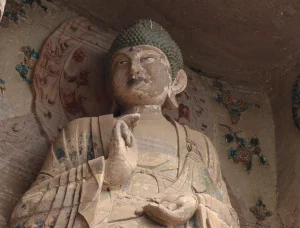
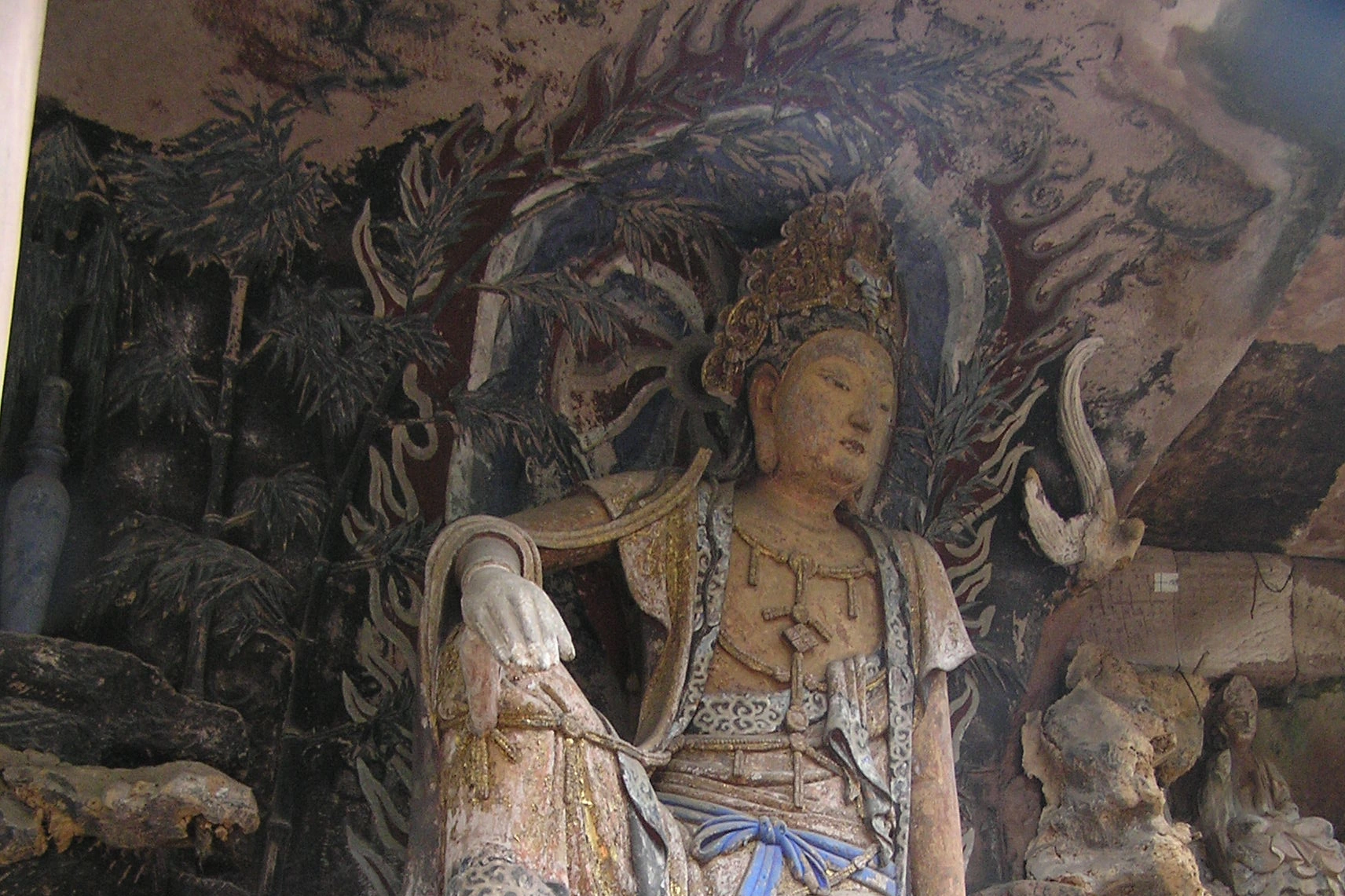
Zizhu Guanyin, 紫竹观音, is the Purple Bamboo Guanyin. Xinhua’s January 2026 field report identifies the figure as Song-period work and describes its seated pose against a bamboo setting. Its appeal lies in a sense of movement within a solid cliff: a raised knee, a gently turned upper body and a face looking away from the frontal axis. Xinhua’s report on Anyue’s carvings and their conservation.
From the permitted area, take in Guanyin’s whole outline before following one line. The crown lifts the head, jewellery draws the eye towards the chest and drapery turns around the raised leg. Let that change of direction hold your attention rather than moving on to collect every recess.
The cover photograph records the sculpture in November 2005. It is useful for recognising the subject, but the colours, surrounding surfaces and viewing arrangements in an older photograph should not be treated as a promise of today’s appearance. Keep the current barriers and signs as your guide to where you may stand.
Look once before reading, then again with the explanation: which elements feel ceremonial and which suggest someone resting? If arranging an interpreter, ask them to connect the pose to its Buddhist setting. One figure explained closely can be more useful than a rapid succession of dates.
Change pace at the Liu Benzun carving
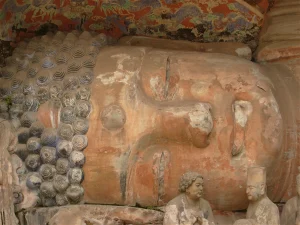
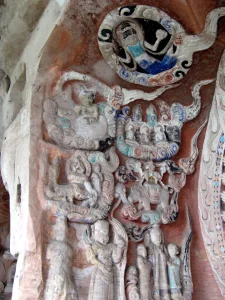
The main Pilu cave presents a more narrative composition. A survey hosted by Sichuan’s archaeological institute describes Vairocana at the centre, with scenes of Liu Benzun’s ten acts arranged in tiers on the sides. This is a useful contrast with the single Guanyin figure: you are looking at how several episodes have been organised around a central image. Archaeological survey, opening page.
In the main cave, locate the central figure before comparing one scene on either side. Ask how inscriptions identify those episodes. From a comfortable permitted position, trace the difference in scale and the carved divisions between groups rather than trying to read every character.
Some episodes depict severe religious austerities. With children, choose how much detail to discuss and focus on belief, storytelling and composition when appropriate. The contrast between a single symbolic figure and an organised sequence remains clear without dwelling on disturbing scenes.
If Thousand Buddha Cave is accessible, choose a few small figures to compare for pose and attributes. This is a third scale of looking after Guanyin and the narrative composition. Stop before detail becomes tiring; not every chamber or viewpoint will necessarily be open.
Choose the visit that fits your day
| Your main interest | A satisfying focus | What to leave optional |
|---|---|---|
| Recognising the famous sculpture | Zizhu Guanyin, its outline and the relationship between hands, drapery and bamboo | Additional caves if the approach or standing becomes tiring |
| Understanding carved stories | Guanyin followed by the central figure and selected Liu Benzun scenes | A complete explanation of all ten episodes |
| A longer art visit | The two main subjects, then a few smaller figures if their viewing area is open | A second rural site requiring another road journey |
| Travelling with mixed interests | Agree on two viewing stops, a turning point and a shared lunch | Extra standing time for companions who have already seen enough |
Treat the suggested couple of site hours as an allowance, with the road journey outside it. Open sections, queues and the group’s standing pace determine the actual circuit. Ask about seats before taking on a longer visit, keeping attention for the sculpture that brought you here.
Stay with the managed Pilu public route. Anyue’s many scattered carvings appear in fieldwork for archaeological reasons; that does not provide permission to cross farmland, climb cliffs or enter closed recesses. One well-understood site gives this day enough purpose.
From an Anyue hotel to Pilu and back
Have breakfast before leaving the county town and carry water. Leave large cases at your hotel when returning to the same room. Confirm the exact entrance and pickup point before departure; a pin labelled Anyue can be a long way from the Shiyang-area carvings.
At arrival, check open viewing areas and put the priority sculpture first if the route allows. If staff require another order, follow it while reserving time for that subject. After Guanyin, decide whether the narrative cave still fits the group’s energy rather than treating every section as compulsory.
Agree the return meeting place before walking away from the car. Save the location and the driver’s contact details offline. Vehicle waiting, parking and collection need to be part of the arrangement, especially when a member of the party may want an earlier return. An outbound ride alone leaves the most inconvenient transport question until the end.
Choose lunch according to where you will finish the day. A confirmed restaurant in the Shiyang area can break the outing before the drive back. Returning to Anyue town gives you a chance to eat near your hotel and rest afterwards. Let the real restaurant and road sequence determine the stop rather than assuming food will be available beside every entrance.
If you are moving on that afternoon, collect stored bags before leaving Anyue and specify the onward hotel. For a Chengdu return, protect the road journey and dinner rather than adding a final unplanned cave. Keep an important flight or train on a separate departure day where possible.
Rice rolls, lemon flavours and a seated meal
Ask about Anyue mijuan, 安岳米卷, when choosing food in town. The local gazetteer office describes these rice rolls alongside dishes such as Wu Ming chicken and chicken-giblet sweet-potato noodles. It also records the use of lemons as an ingredient, seasoning and serving vessel in the county’s cooking. Ziyang’s account of Anyue food and heritage.
For a simple lunch, start with a small portion of rice rolls, then choose vegetables, rice or another shared dish. Ask about dressing before ordering more: chilli, oil and sauce shape the flavour and suitability. Check stocks and seasonings even in a vegetable dish.
If a lemon dish is available, ask whether it is sweet, savoury or spicy before adding it. Two people need not turn lunch into a banquet to try a local flavour. A food-focused group can instead agree a specific menu in advance and allow a longer seated break.
State allergies and other dietary requirements in Chinese as well as English where possible. Ask the restaurant to confirm what it can prepare; a translated menu alone cannot establish the ingredients. Lunch is a useful point to reassess energy before deciding whether to return directly to the hotel.
Where to stay and how many nights to allow
An Anyue county-town base works well when you want restaurants, luggage storage and another day for heritage. A room nearer Shiyang may reduce one part of the drive, but assess the exact property’s dining, access and onward transfer before choosing it. Proximity on a map does not establish comfortable room access or a reliable evening meal.
| Trip shape | Where the nights go | How Pilu fits |
|---|---|---|
| 3 days, 2 nights from Chengdu | Two nights in Chengdu | Arrive on day 1; reserve day 2 for a selective Pilu road excursion and full hotel return; depart on day 3 |
| 4 days, 3 nights with an Anyue stay | Chengdu, Anyue, Chengdu | Travel to Anyue on day 2; visit Pilu on day 3, eat and collect bags before returning to Chengdu |
| 5 days, 4 nights for two carving visits | Chengdu, Anyue, Anyue, Chengdu | Reach Anyue on day 2; give Pilu day 3; choose a separate shorter visit on day 4 before returning to Chengdu |
The three-day version suits travellers who value keeping one room and are comfortable with a substantial driving day. Check a realistic road estimate from your actual hotel before accepting it. If that leaves too little time for the sculpture and lunch, choose the Anyue overnight instead.
The four-day version gives the Pilu visit a locally based morning. On the arrival day, settle into the hotel, find dinner and confirm the next day’s departure. On day three, the return to Chengdu still needs its own block after the carvings and meal. Do not count that afternoon as another full sightseeing day.
For five days, use the second Anyue night to separate Pilu from Yuanjue Cave. Yuanjue offers a different group of subjects near the county town. The extra night also gives some flexibility if weather changes the order. Confirm both sites individually; one admission or transport booking should not be assumed to cover the other.
Ask your chosen hotel about the actual room, lift or stair access, luggage arrangements and reception requirements for your travellers. A quiet room and an accessible breakfast may matter more than an elaborate lobby after a day of standing and road travel.
Pilu, Dazu or a shorter city visit?
Choose Pilu when Zizhu Guanyin and the Liu Benzun composition are the subjects you most want to study. Choose a Dazu outing when your trip is centred on Chongqing and the particular carvings there are your priority. Baodingshan’s Great Buddha Bend and Beishan’s carved caves are separate visits with their own approaches.
A tour that names Dazu does not thereby visit Pilu, even though both belong in a wider discussion of Sichuan and Chongqing stone carving. When comparing an existing itinerary, look for the named attraction in the daily programme. Request Pilu explicitly if you want it added, with the resulting road journey, hotel nights and costs explained.
If you only have a short gap before leaving Chengdu, use it for a city visit and give Anyue a later trip. The Sichuan trip-planning guide helps separate a city stay from a regional extension.
Admission, walking and a wet-weather alternative
China’s tourism office in London includes Pilu Cave in its English Sichuan route booklet. This supports planning it as a destination for overseas travellers; it does not verify every passport’s purchase channel or admission on a particular date. Confirm the current booking method, original documents, fee and opening arrangements before setting out. Official Sichuan route booklet, Route 7.
| Arrange before the drive | Name the practical requirement | Keep the plan workable |
|---|---|---|
| Admission and interpretation | Pilu Cave, travel date, passport documents and an English-speaking companion if required | Confirm the actual channel and guiding scope; written English booking support does not establish on-site interpretation |
| Walking and weather | Steps, slopes, surface conditions, seating and the return from the main viewing area | Shorten the visit or change the day if the available approach does not suit the party |
| Transport and costs | Pickup, waiting, lunch stop, bag collection and the final hotel address | Have tickets, meals, interpretation, transport and accommodation itemised separately |
Xinhua’s conservation reporting describes moisture and fragile sandstone as challenges for Anyue’s carvings. Keep hands and bags away from the stone and follow the photography rules for each area. Do not assume that possessing a historical photograph establishes permission to use flash or a tripod today.
For rain, consider an indoor visit only after checking that venue’s own opening and admission. The Ministry of Culture and Tourism reported the Anyue Grottoes Digital Exhibition Center’s trial opening in May 2025. Its digital interpretation is a different experience from seeing original stone. If it cannot confirm a suitable visit, a town meal and rest can be the better replacement. Ministry report on Sichuan cultural visits.
Price on request. Send your Verotrip travel consultant the date, start and finish hotels, number of travellers and whether Guanyin or the narrative carving is your priority. Include walking limits, language, food and room needs. The written proposal should identify the complete return journey and specify what is included; this guide does not make tickets, meals, hotels or an English-speaking guide automatic inclusions.
Questions about visiting Pilu Cave
Is Pilu Cave the same as Yuanjue Cave?
No. Pilu is in the Shiyang area, while Yuanjue is near Anyue’s county town. They have different sculptural subjects and need separate transport planning. Save the Chinese name of the attraction you intend to visit.
Can I visit from Chengdu without changing hotels?
A dedicated road day may work if the current journey estimate, opening arrangements and your party’s stamina leave enough time. Include lunch and the complete return to your Chengdu hotel. An Anyue overnight is the more comfortable option when you want extended viewing.
Will we be able to photograph Guanyin?
Check the rules at the particular viewing area on the day. Photography permissions, flash restrictions and barriers can differ between sections. Enjoy the view from the permitted position even if photography is restricted.
Should we add all the other Anyue caves?
Choose another site only when its subject interests you and a separate travel block fits. Two nights in Anyue allow Pilu and a county-town visit to fall on different days. A shorter, well-explained visit can be more satisfying than repeatedly getting into the car.
Zizhu Guanyin at Pilu Cave, photographed by landagent on 13 November 2005. Original photograph, CC BY-SA 3.0. Cropped to an upper-body detail and converted to WebP under the same license.