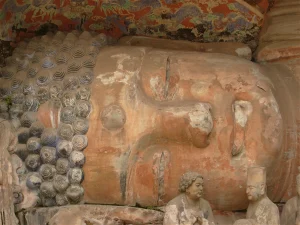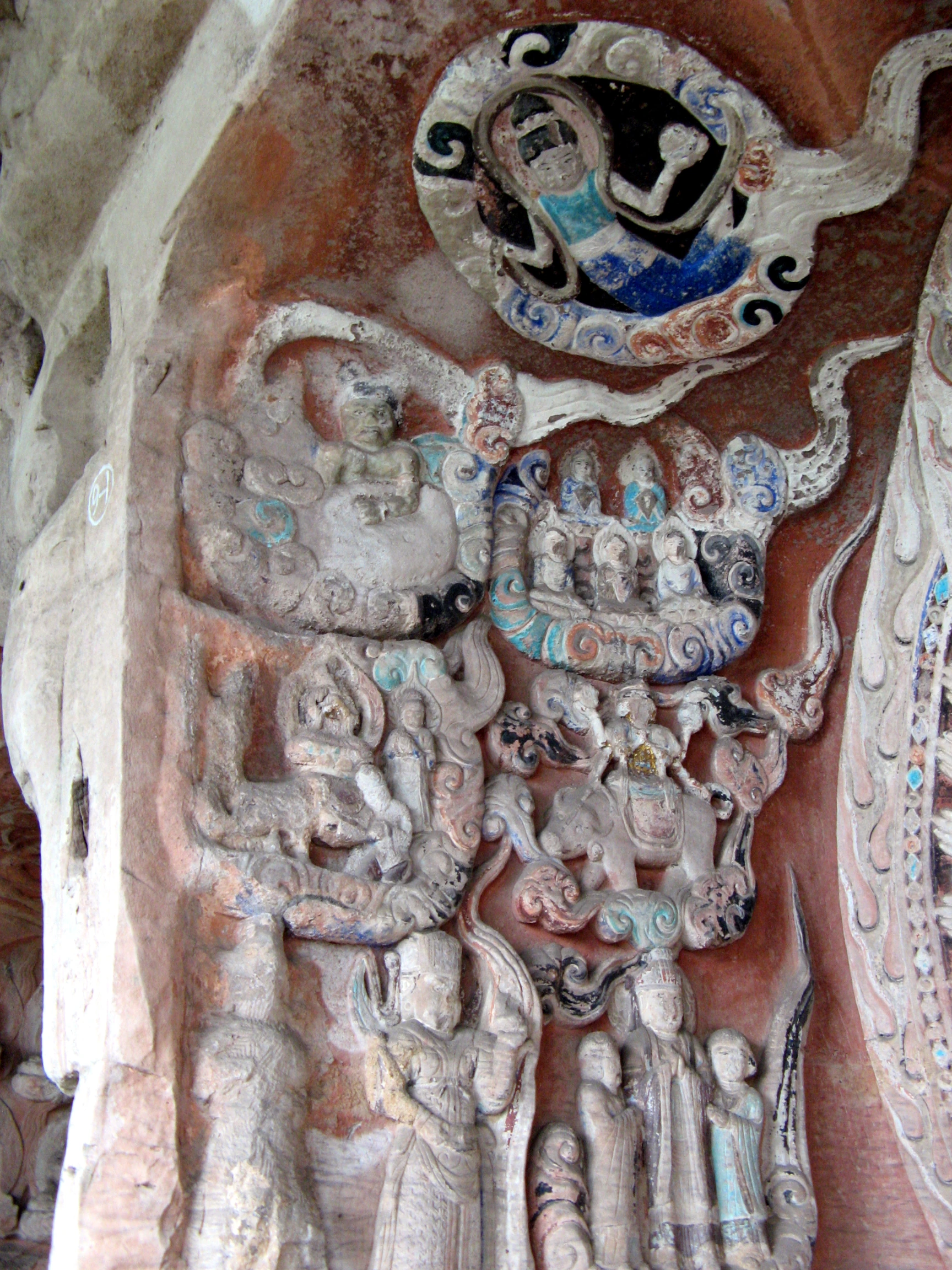
At Beishan, begin at the edges of a carving: clouds gather attendants beside Guanyin, while a peacock’s sturdy feet support another figure. Give your eyes time in the shade. Finding one detail can be more rewarding than identifying every name.
Make Fowan, 佛湾, the core of a visit from Dazu town, with the pagoda optional. From central Chongqing, allow the full outward journey, lunch and hotel return. Name Beishan specifically; “Dazu Rock Carvings” covers different hillsides.
Three ways to look at Beishan’s carvings
Walk a little of Fowan’s crescent-shaped cliff before choosing a recess. Deep caves, shallow niches and reliefs sit close together. Begun under Wei Junjing in the late ninth century, the carving continued under successive local patrons rather than one planned narrative.
| Look for | Start with this detail | What to do if the view is restricted |
|---|---|---|
| Niche 9: Thousand-Armed Guanyin | Find the main figure, then follow the bands of carving out towards the sides. | Use the nearest permitted viewpoint. A few clearly visible attendants tell you more than a count of indistinct arms. |
| Cave 136: Revolving Scripture Repository | Find the central octagonal structure before looking for the lion and rider against the left wall. | Read the plan or label outside. The central structure and barrier can both limit the angle. |
| Cave 155: Peacock Wisdom King | Look low for the bird’s feet and up along its neck to the lotus seat and figure. | If the lower section is in shadow, wait for your eyes to adjust. Don’t light the rock with a phone flash. |
Use Niche 9 to distinguish this Thousand-Armed Guanyin from Baodingshan’s. Follow the layered arms and cloud-like curved borders around attendants. The cover is a close detail, not the whole niche.
In Cave 136, find the central stone scripture repository, then the lion on the left wall carrying Manjushri with a scroll. Locating the animal first helps resolve the smaller figure. The repository represents a revolving type; visitors have no mechanism to turn.
In January 2026 the institute reported replacing the iron gate at Cave 136 with a wooden barrier. An improved view does not mean permission to step inside. From a permitted angle, you may see the central carving clearly and only part of one wall. Before moving on, try looking at the empty space between the central structure and the figures behind. It gives a sense of how the carvers planned an interior out of what began as solid rock.
In Cave 155, trace the peacock’s legs and neck towards the lotus throne. Its base inscription records 1126 and names a carver and son. You can appreciate that personal history even when the lettering is not visible.
For a shorter visit, compare an animal carrying a figure with a building carved inside a cave. These are useful family questions. If one area is unavailable, give the other more attention rather than seek a way past protection.
The pagoda across from Fowan
At Duobao, or North Pagoda, compare Southern Song brick courses with the two Buddhas carved in the rock below. The octagonal tower is a separate architectural stop from Fowan.
Decide on the pagoda after the grottoes, checking the open exterior view, extra steps and pickup. A distant tower view and its base niche require different approaches. End at Fowan when lunch or energy calls; no tower entry is required.
From the hotel to Fowan, lunch and back
Show the driver 北山石刻 and the day’s entrance. Agree the return point before leaving, sharing the same Chinese name with walkers or another pickup driver. Save the hotel and meeting addresses offline.
At the visitor centre, deal with tickets before setting off towards the sculptures. The institute’s published instructions direct passport holders to a staffed counter; its online instructions describe a resident identity card. Bring the original document. For an offline purchase the institute describes checking the ticket and document and matching the visitor’s face at entry. A reseller’s booking screen is a separate matter. If someone is buying on your behalf, confirm whose name goes on the ticket, where the original passport is checked and which hillside it admits you to.
Return to Dazu town for lunch. Youting crucian carp can include bean paste, pickled peppers and fine bones; check a mild option before ordering for everyone. Rice and a separate vegetable dish accommodate different appetites. Admission includes no meal by itself.
From central Chongqing, leave the big bags at the hotel if you are returning to it. Drive to the Beishan entrance, see Fowan, decide about the optional tower view, then eat in Dazu before returning to the same Chongqing hotel. If you want to see both hills, consider sleeping in Dazu instead of asking the driver to squeeze in Baodingshan at the end of the afternoon. The guide to Baodingshan’s Great Buddha Bend shows what the second site offers: much larger narrative scenes and a different visitor route.
Where to stay and when to travel between the hills
| Trip length | Where to sleep | How Beishan fits |
|---|---|---|
| 3 days, 2 nights | Two nights at one central Chongqing hotel. | Arrive and settle in on day one. Use the middle day for Beishan and a Dazu lunch, return to Chongqing, then leave on day three. |
| 4 days, 3 nights | One night in Chongqing, one in Dazu, one back in Chongqing. | Travel to Dazu on day two for lunch and Beishan. Use the next morning for Baodingshan, then return to Chongqing ahead of departure. |
| 5 days, 4 nights | Two nights in Chongqing, one in Dazu, one back in Chongqing. | Leave a whole day for the city first. Visit Beishan on day three; use day four for Baodingshan or a slower return before the final city night. |
Choose a Dazu night for two unhurried cliff visits. Compare the hotel with Beishan’s actual entrance, vehicle access and dinner. “Near Dazu Rock Carvings” may favour the wrong hillside.
For hotel changes, establish bag storage or secure vehicle custody, keeping passports, medication and valuables with you. Confirm early check-in or lockers before relying on them. A final Chongqing night separates onward travel from the hills’ return drive.
Verotrip’s five-day Chongqing and Dazu itinerary puts Beishan and Baodingshan together on day four of a Chongqing stay. The eight-day Chengdu, Dazu, Chongqing and Wulong itinerary instead reaches Dazu from the Chengdu side and continues to Chongqing after the carvings on day five. Choose the first if you want to unpack in one city; consider the second if Dazu belongs between two cities in a longer journey. Neither itinerary is a standalone sale of this half-day walk.
Walking, language and the cost of the outing
| Before you leave | What to ask | Why it matters here |
|---|---|---|
| Footing and rest | How far is the walk from the permitted vehicle drop-off to Fowan, and can we return the same way? | The length of the carved cliff says little about the approach or the extra walk to the pagoda. |
| Interpretation | Will an English-speaking guide accompany us at the cliff, and which cave names should we save? | An English booking message does not help you locate a specific side-wall figure on the day. |
| Transport and admission | Which hill, staffed ticket window, vehicle waiting period and final hotel address does the quote cover? | A transfer to Dazu district or a ticket for one attraction does not by itself provide the return journey. |
Notice standing and looking up as well as walking. Move on before neck or back discomfort, and shorten a wet approach. Essential seating or step-free needs require the whole route, toilets and return to be checked.
Price on request. For a written proposal, send Verotrip your start and end hotels, travel date, party size and whether your priority is Cave 136, the peacock carving or an exterior view of the pagoda. A travel consultant can distinguish admission, English interpretation, vehicle waiting and the complete return from lunch, hotel rooms or onward travel. Check the items in the written quote before relying on any of them. For the city part of the trip, see the Chongqing planning guide.
Questions about visiting Beishan
Is Beishan the place with the huge reclining Buddha?
The monumental reclining Buddha at the Great Buddha Bend is on Baodingshan. Come to Beishan for closely spaced niches, detailed figures and carved interiors at Fowan. If a photograph inspires the trip, save the name of the hill as well as the image.
Do I need both hills on the same ticket?
For a Beishan-only visit, ask about admission to Beishan for your chosen date. If you also want Baodingshan, ask what a combined ticket covers, how and when it can be used, and how you will travel between the entrances. The answer about admission doesn’t settle the transport.
Can we see the peacock without entering the cave?
Plan to look from the current public viewing line. The central bird and the figure above it are the things to look for; the precise angle and light will depend on the arrangements that day. If this cave is a particular priority, ask about No. 155 before the drive.
Is Beishan worthwhile if only half our group likes sculpture?
Yes, especially from a Dazu base. Agree on two stops and a meeting point near the exit. Those interested in the carving can take a closer look; no one else has to add the pagoda walk just to stay with the rest of the party. Meet for lunch in town and share the same return ride.
Cover: carved attendants beside Guanyin at Beishan, photographed by G41rn8 in 2007. Original photograph, CC BY-SA 4.0. Resized, converted to WebP and cropped to fit the screen; this version uses the same license.