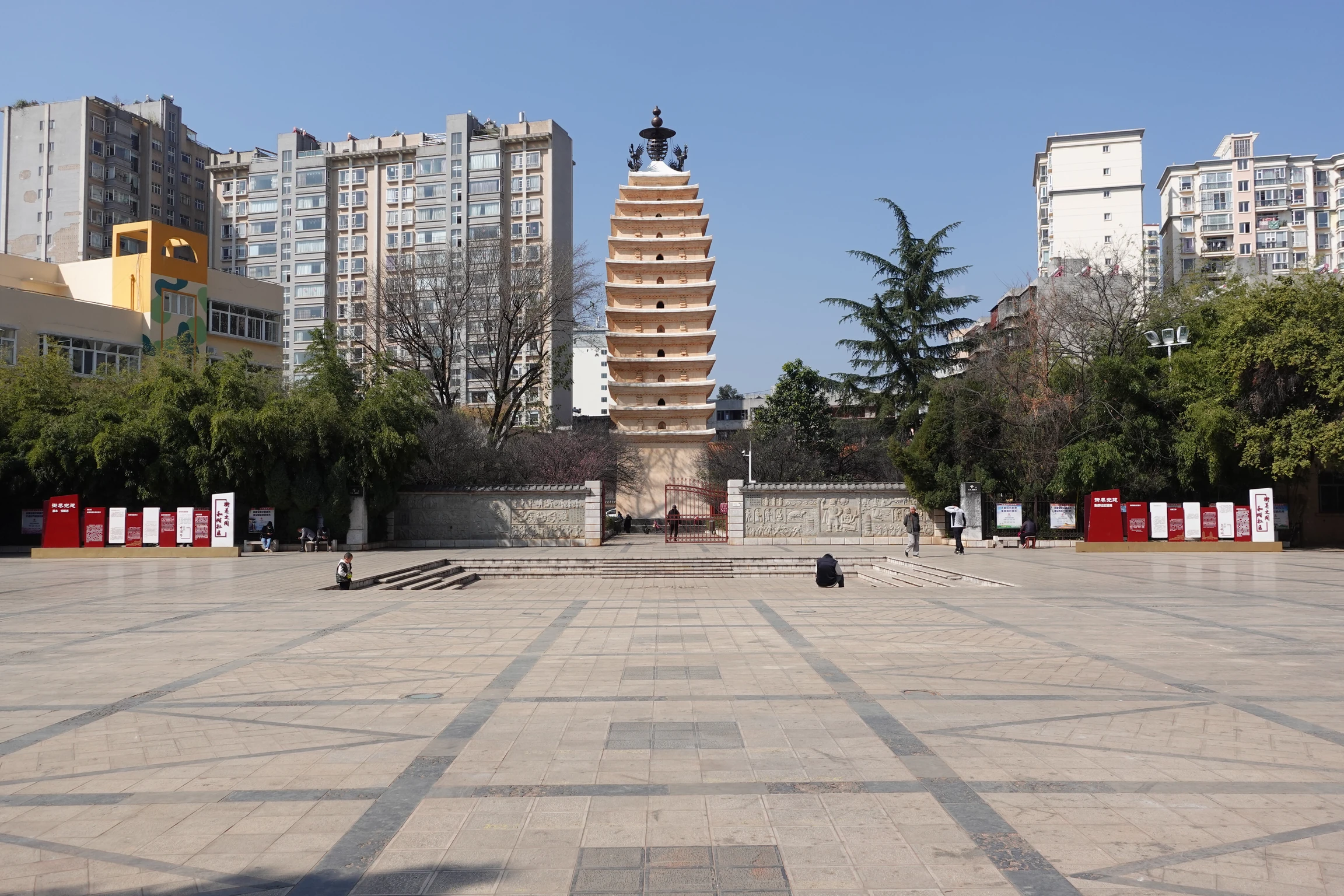
Walk from the Western Pagoda on Dongsi Street to the Eastern Pagoda on Shulin Street, saving both pins first. Dongsi means East Temple, although its tower is the western one. The pair makes a central Kunming half-day with lunch and a city-hotel return.
Compare similar brick outlines with different histories. The west tower remained on its site through repairs; the east fell in the 1833 earthquake and was rebuilt farther east in the late Qing.
Which pin to save
| Landmark | What to enter on your map | What to look for on arrival |
|---|---|---|
| Western Pagoda, also called the Huiguang Temple Pagoda | 西寺塔 or 惠光寺塔, on 东寺街 (Dongsi Jie) | A square with a view towards the brick tower. Start far enough back to see how the tiers narrow towards the crown. |
| Eastern Pagoda, also called the Changle Temple Pagoda | 东寺塔 or 常乐寺塔, on 书林街 (Shulin Jie) | The tower on the Shulin Street side. Use a closer public viewpoint to pick out the eaves and the small silhouettes around the top. |
| Return pickup | Your chosen road-accessible point on the Shulin Street side, plus your hotel’s Chinese name | Save a second pin for the vehicle. A pin directly on a tower works for walking and can be awkward for a driver. |
Send the Chinese tower and street names together. Street-only directions can reverse the intended start. The walk works either way, so begin on Shulin Street if that is nearer your hotel.
Start with the Western Pagoda
From the western square, take in base, eaves and crown together. Compare the tight brickwork view with the wider tower-and-city setting recorded in the 2023 photograph.
Follow one corner up the thirteen tiers of either square-plan tower. The eaves narrow into a curving outline; closer arched openings reveal another scale. Both observations are possible from the ground.
A local historian described craftsmen’s names on base bricks. Treat them as a reason to look closely, even if too small or protected to read. Zoom or binoculars are preferable to pressing against the masonry.
A reported Ming inscription evokes lights after dark in an earlier city. Use that image as history; daylight gives the more practical brickwork comparison without depending on present decorative lighting.
Follow the pedestrian street to the Eastern Pagoda
Follow the pedestrian connection towards Shulin Street, keeping the saved pin through any tea stop. Its traditional-looking frontage is modern: the 2015 account dates the street to 2002 and describes the rebuilt Jinri gate.
Compare the taller Eastern Pagoda with your first view. Look up the eaves towards bird forms by the finial. The “golden chickens” and former wind whistle are local recollection, not a sound promised today.
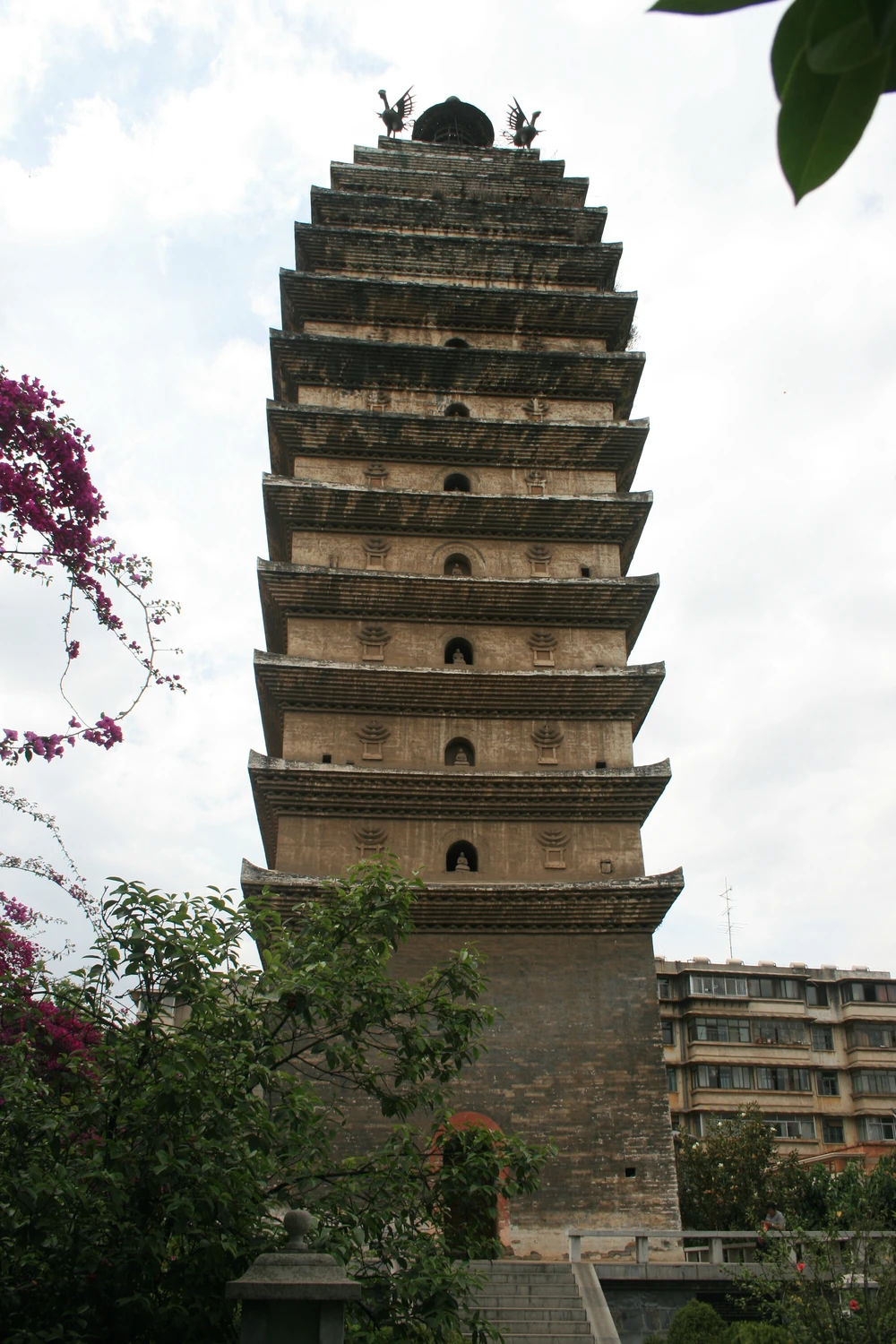
Keep Nanzhao origins separate from the rebuilt brickwork. The east tower moved after the earthquake during nineteenth-century rebuilding. The national register’s Tang and Qing periods help explain the pair’s different histories.
Use open public exterior viewpoints. Barriers can still leave a street comparison. Historical stairs and map labels do not establish an available climb or interior visit.
How much of a day to give the walk
| Time available | A workable visit | Where to finish |
|---|---|---|
| A short gap before lunch | Choose the western square. Look at the tower once from the approach and once from closer to the public boundary. | Retrace the approach to an agreed street corner. Skip the crossing to Shulin Street if you have a fixed appointment. |
| A free morning or afternoon | Walk from Dongsi Street to Shulin Street, with a pause along the pedestrian connection. Leave time to compare the two views. | Sit down for lunch at the end of a morning visit, or meet your return car on the side you finish. |
| A full day in Kunming | Put both pagodas in the morning, followed by lunch and one contrasting city visit. Choose an indoor collection if you would like to see objects at closer range. | Return to the hotel after the second visit. Make the last transfer a separate part of the plan if you are collecting luggage. |
Leave cases at the hotel before an arrival-day street walk, or save the towers for daylight after a late arrival. For a train, include bag collection and the exact station: Kunming and Kunming South are different destinations.
Lunch, rain and an easier walking option
After the second tower, find a seated mixian lunch. Check broth, topping and chilli separately, including stock for vegetarian needs. Save the restaurant pin to identify the afternoon start.
For different walking speeds, regroup at one western-square corner. Confirm kerbs, seating, steps and the whole vehicle approach for step-free needs. Nearby road access can still leave a final walk.
If rain starts between the towers, make the meal your break. Wet paving is a good reason to skip a second circuit of the square. In steady rain, the Kunming Municipal Museum offers a different look at Buddhist stone carving around its Dizang Temple sutra pillar. Check its opening and entry arrangements before making the transfer. For a day when you want a working Buddhist temple and waterside courtyards, choose Yuantong Temple as a separate visit.
Where to stay and how the walk fits a Kunming trip
| Trip length | Hotel base | How to place the towers |
|---|---|---|
| 3 days / 2 nights | Both nights in central Kunming. | Arrive and check in on day one. Walk between the towers and have lunch on day two. Keep day three for the hotel-to-station or airport transfer. |
| 4 days / 3 nights | Keep all three nights in the same city hotel. | Give the pagodas and one city museum a full day between arrival and departure. The other full day can go to a longer outing such as the Stone Forest. |
| 5 days / 4 nights | Four nights in Kunming if you prefer day trips with a consistent base. | Use the first full morning for the towers and a leisurely lunch. Put the Stone Forest and a lakeside outing on separate days so that either can move with the weather. Leave from the same hotel on day five. |
A central hotel within a straightforward ride of Dongsi Street makes an early start easy. When choosing between two hotels, ask where a vehicle can actually stop, whether staff can hold bags on your departure day, and whether you can get back to collect them without crossing the busiest part of your route. For more on choosing a base and allocating your days, see the Kunming city guide. If eating and browsing stalls matter more to your party than comparing the architecture, the Kunming market and seasonal itinerary gives you a different way to spend the day.
You can follow the public streets independently with the two Chinese place names and your return address saved offline. For a visit with Verotrip, tell your travel consultant your hotel, onward plans, walking pace and the language you prefer. Price on request. The written itinerary should say where a driver will meet you at each end, whether the vehicle waits during lunch, and whether a guide walks with you. Meals, accommodation and any ticketed garden or museum should each be identified in the quotation. Carry your original passport if adding a venue that checks identification, and confirm its process for your visit date.
Questions about Kunming’s East and West Pagodas
Which pagoda stands on East Temple Street?
The Western Pagoda, 西寺塔, stands on Dongsi Street, 东寺街. The Eastern Pagoda, 东寺塔, stands on Shulin Street, 书林街. The separate temple names Huiguang and Changle are useful if a map search returns several places.
If I can only visit one, which should I choose?
For a short first stop, choose the Western Pagoda. The approach across the square makes it easy to study its outline and to turn back at a point that suits your energy. Choose the Eastern Pagoda if you are already on Shulin Street or particularly want to see the late-Qing reconstruction.
Do I need a ticket to climb the towers?
Plan to see the towers from public street viewpoints. An interior climb has not been established as a visitor activity. Check any separate garden entrance on the day. The architectural comparison works from outside even if a closer approach is unavailable.
Are these the Three Pagodas near Dali?
Kunming’s pair is a city walk between two streets. Dali’s Three Pagodas belong to the Chongsheng Temple site and require a separate stop in Dali. If the three-tower mountain backdrop is the photograph you have in mind, use the Dali Three Pagodas guide to plan that visit.
Cover photograph of the Western Pagoda across its square, taken on 9 February 2023 by XuasdYX. Resized and converted to WebP under CC BY-SA 4.0.