

China crossing cost sharing works only when travellers can use the same agreed services on the same route and dates. Compare the total cost for your vehicle and its occupants, then separate the money paid for the trip from any security funds tied up until later. A low headline price is useful only if the quote explains the group size, included services, exclusions and what happens when plans change.
This guide is for travellers bringing their own foreign-registered car or campervan through China, including a proposed journey through Yunnan. It helps you prepare and compare a written quotation. Each vehicle, driver, border and itinerary still needs the appropriate arrangements; joining a group does not establish permission to cross.
Featured image: an illustration of travellers planning together, not a photograph of a VeroTrip departure, property or vehicle fleet.
Updated 12 October 2026
Compare a complete journey before comparing a price
Write a short common brief before approaching operators: entry and exit countries, intended ports, date flexibility, the route through China, vehicle details, occupants and all proposed drivers. Send the same version with every enquiry. A short transit ending at another border and a leisurely Yunnan visit are different jobs, even if both are described as a China crossing.
Compare where responsibility starts and ends. Does support begin at an agreed meeting point outside China, after immigration, or at the vehicle document appointment? Does it end at the last hotel, the Chinese exit procedure, or a handover to the next country’s team? Request a named contact for each stage. A cheap quote with a gap between two providers may leave you buying an extra transfer, hotel night or assistance service.
Keep ordinary holiday budgeting separate. The Yunnan tour inclusions guide helps compare hotels and travel styles; the questions here concern the additional organisation of an overseas vehicle and a group travelling together.
Ask how every line in the quotation is charged
Use the categories below to ask for a breakdown. They are questions for the receiving operator, not a list of services automatically included in a VeroTrip package. A provider may combine several services into a package price; it should still explain the scope and the traveller’s total liability.
| Possible cost category | Basis to clarify | Question to put in writing |
|---|---|---|
| Trip organisation and accompanying staff | Group, day, route or package | Which services are shared, and when do their charges start and stop? |
| Vehicle and driver documentation | Vehicle, driver or application | Which applications, translations and appointments are covered? Who handles a correction? |
| Staff transport and accommodation | Included, separately shared or otherwise charged | Is a support vehicle needed, and whose fuel, tolls and room costs are included? |
| Your accommodation, meals and activities | Person, room, night or chosen activity | What room arrangement and meal standard does this price assume? |
| Your vehicle’s running costs | Actual use or an agreed allowance | Are fuel or charging, road tolls and parking paid directly or reconciled later? |
| Security funds and exceptional costs | Separate from the service price | What is held, by whom, and what release or additional-payment conditions apply? |
Ask the operator to distinguish an authority’s charge, an insurer’s premium and its own service fee. A label such as “permit fee” alone does not tell you which document it covers or whether translation, inspection, delivery and handling are included. Request the document name and the relevant receipt or invoice.
China’s temporary-entry vehicle rules distinguish vehicle admission, temporary vehicle documents, driving permission and compulsory motor liability insurance. The vehicle documents specify the permitted area or route. Treat these as separate checks when comparing a quotation; a driver’s document or a payment receipt alone does not authorise the whole journey.
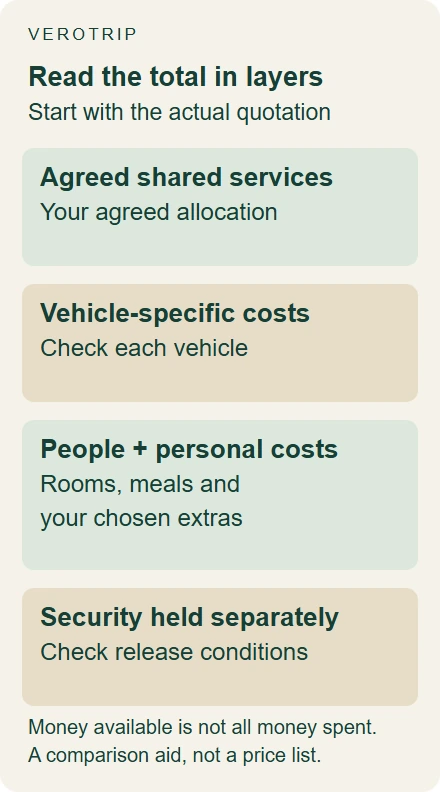
What can a group actually share?
Begin with the services the operator explicitly agrees can be shared. Then establish the allocation rule: equal shares per vehicle, shares per person, a package for each travelling party, or another stated method. Do not assume that all fees are divided by the number of cars. Two adults in one car, a solo driver and a family in a campervan can have different room, document and passenger costs.
A simple comparison is: your agreed share of common services + your vehicle-specific charges + your occupants’ charges + your personal spending. Keep any refundable security outside this trip-spending total and show it separately in the funds you need available. Avoid counting an item again if it is already included in the package.
If the provider divides a fixed common amount equally, an additional confirmed participant can reduce that particular share. The common amount may also change: another vehicle can create different staff, transport or coordination needs. Ask for a revised written total instead of calculating an automatic discount yourself. An expression of interest in a chat group is not a confirmed participant.
Do not offer a spare seat for the guide solely to lower the quote. First agree the required staff arrangement, lawful seating capacity, luggage space, suitable insurance and everyone’s comfort. A campervan seat count or sleeping berth count does not establish the number of usable travelling seats.
Choose compatible companions before pursuing a larger group
A shared departure needs more agreement than a border date. Discuss the following before paying a deposit or making non-refundable bookings around the proposed trip.
| Decision | A workable match | Resolve this difference first |
|---|---|---|
| Direction, ports and dates | Everyone can follow the same confirmed plan | One vehicle needs a different exit or has an inflexible onward booking |
| Daily driving and rest | Shared expectations for starts, breaks and rest days | A fast transit is being combined with a family sightseeing holiday |
| Vehicle and fuel needs | Road suitability and stops work for every vehicle | Height, range, charging or servicing needs change the day’s plan |
| Rooms, meals and prayer | Personal requirements are included in the planning brief | Shared-room or group-meal assumptions do not suit everyone |
| Changes and emergencies | The operator explains who coordinates and who decides | The group has no plan for a delay, illness or a vehicle leaving |
For a family, specify children’s ages, child seats, sleeping arrangements and how long they can comfortably remain in the vehicle. Older travellers may prefer easier room access and shorter days. These are route and service decisions, not details to negotiate at the first overnight stop.
For Muslim travellers, state your food requirements, whether separate meals are acceptable and the breaks you need for prayer. A group agreeing to split costs does not confirm halal food or a prayer room at every stop. Use the Yunnan meals, hotels and prayer guide to make the requirements specific.
Give the Yunnan section its own time and spending plan
A journey entering or leaving through southern Yunnan may be a transit, a Yunnan holiday, or both. Decide where the border-support stage finishes and where sightseeing begins. Compare the Yunnan regional route map before adding Dali, Lijiang or other destinations to a southbound or northbound crossing proposal.
If some travellers want extra nights in Dali while others must continue, ask the operator whether separate arrangements are possible and what permissions, staffing and costs would change. Do not simply leave an organised inbound group or drive outside the permitted route. A plan for extra sightseeing is useful only when it fits the actual travel arrangements.
For campervans, ask about suitable parking, vehicle height, overnight arrangements and access to services. Sleeping in your vehicle does not automatically remove an included hotel cost or establish permission to park overnight. Get the accommodation and parking arrangement agreed before treating it as a saving. For ordinary rooms, compare Yunnan accommodation bases and allow for luggage handling and local transfers.
Keep security funds separate from money spent
Ask for two figures: the expected trip spending and the additional funds that may need to remain available or be held as security. “Refundable” describes a conditional future return; it does not mean the money is available for your fuel and hotels during the journey.
Different parties may hold different sums. Separate the booking payment, any customs-related security, a home-country vehicle-document arrangement where applicable, and any other provider deposit. For each one, record the recipient, currency, purpose, evidence of payment, release conditions and the person responsible for following up. Do not transfer a payment because another traveller says their deposit was the same.
Ask how a change of exit port, an accident, delayed re-export or a vehicle that cannot move would affect the procedure. Get the case-specific answer from the responsible provider or authority. A quoted customs period, an immigration stay and the validity of vehicle or driver documents must not be treated as interchangeable.
Keep copies of the documents and receipts needed at the end of the arrangement. Confirm whether any currency conversion, transfer charge or provider fee applies to the return. Avoid promising yourself a particular refund date until the responsible organisation explains its actual process.
Agree what happens if the group or itinerary changes
Separate the scenarios below. A shortfall in the operator’s minimum group size, your own cancellation and an unavoidable disruption can have different consequences. A group-chat vote should not replace the contract or override applicable traveller protections.
| Scenario | Ask before paying | Evidence to retain |
|---|---|---|
| Too few confirmed participants | What is the confirmation deadline, and what lawful alternatives or refund apply? | Minimum size, written departure status and any revised offer you accept |
| One travelling party cancels | How are its cancellation costs assessed, and can the remaining quote change? | Cancellation terms, dated notice and an itemised calculation |
| Border delay or route interruption | Who arranges extra rooms, staff time and a revised onward plan? | Updated itinerary, reason for change and written cost explanation |
| Vehicle breakdown or early exit | Who handles recovery, storage, passengers and any re-export obligations? | Assistance contacts, insurance terms and authorised instructions |
Where the arrangement is a package tour, China’s Tourism Law requires a written contract covering matters such as itinerary, minimum group size, service standards, price and payment. It also distinguishes cancellation for insufficient participants, traveller cancellation and unavoidable disruption. In particular, termination because the agreed group size is not reached requires refunding the fees collected. Ask how the applicable provisions are reflected in your arrangement; do not accept a blanket statement that every payment is non-refundable.
For an extra waiting day, identify whose costs are affected and why. Your room and meals, staff time, a support vehicle and a changed onward booking are different items. Request an explanation before accepting a revised price, and retain receipts for costs you pay directly. In an emergency, prioritise assistance and preserve the records needed to resolve payment afterwards.
Use a clear payment and confirmation sequence
Agree the scope and conditions before paying. Confirm the contracting company and payee, the currency and payment method, the payment schedule, quote expiry, and whether charges for transfers or currency conversion are included. Keep the original quotation and each accepted revision together.
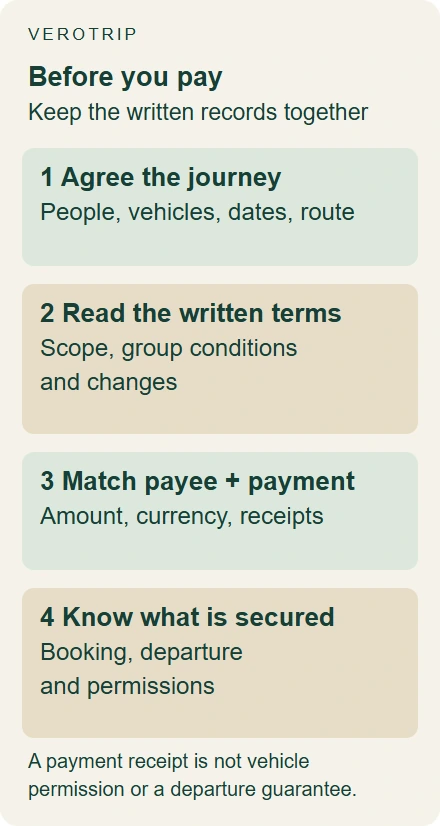
A booking payment, a confirmed departure and permission for a particular person or vehicle are separate things. Ask what each payment secures and which conditions remain outstanding. Before fixing surrounding transport, request the current departure status and a practical plan if approval is refused or delayed.
Keep a small journey-expense record for shared costs paid on the road. Note the date, purpose, currency, receipt and participants covered; agree when the group will reconcile it. Separate optional meals, room upgrades and activities so that someone who declines them is not silently included in the split.
Send a brief that can produce a useful quotation
Begin with an outline rather than posting passport or vehicle-document scans in a public group. The receiving company can explain which documents it needs and how to provide them through an appropriate private channel.
| Information to provide | Useful detail | Why it changes the plan |
|---|---|---|
| People and drivers | Nationalities, occupants, children’s ages and who intends to drive | Different entry, document, room and seating needs |
| Vehicle | Registration country, type, dimensions, ownership and modifications | Admission assessment, road suitability and practical support |
| Journey | Countries, intended ports, dates, route and flexibility | Scope, duration, staff positioning and compatible companions |
| Travel preferences | Rooms, food, prayer, rest days and must-see stops | Whether a shared departure suits the whole party |
| Budget priorities | What you want included, what you can pay directly and your spending limit | A meaningful comparison without inventing a headline rate |
Send VeroTrip your crossing plan with these details and say whether you are already travelling with other vehicles, so that the Yunnan itinerary and onward travel needs are clear. Before paying for a foreign-vehicle crossing, obtain the written acceptance, itemised quotation and contract from the identified provider responsible for those border arrangements. An enquiry is not a confirmed group place or a guarantee that the chosen border accepts your vehicle.
Questions about sharing crossing costs
Is a larger group always cheaper?
It may reduce the agreed share of some common services. It can also change staffing, transport and the pace of the journey. Compare the revised total and conditions for your own party, rather than the number of interested drivers.
Can we share only the border paperwork and then travel separately?
Do not assume that arrangement is allowed. Ask the receiving operator how the approved route, organised-group requirements and accompanying support apply. A shared invoice does not create permission for independent travel.
Does compulsory motor insurance cover recovery and personal medical costs?
Do not treat one policy as proof of all cover. Ask the relevant insurers separately about your vehicle, occupants, planned driving, recovery and medical needs, including exclusions and who pays first if assistance is needed.
What if I prefer a Yunnan holiday without bringing my vehicle?
Compare a separate locally arranged holiday, such as the private Yunnan tour options, and discuss its transport and inclusions. That choice removes the need to bring your own overseas vehicle into that holiday plan; it is a different quotation, not a discount on the border arrangement.
Build the document checklist with the car and campervan entry guide, and agree the route assumptions using the China overland route planning guide before comparing prices.