

Updated 12 October 2026.
For a Hekou–Lao Cai border crossing by car, arrange permission for your particular vehicle and drivers before travelling to the border. Agree the exact crossing channel, receiving contact, permitted onward route and a place to wait if the vehicle cannot continue that day. Hekou is in Yunnan, China; Lao Cai is on the Vietnamese side. A successful pedestrian crossing, an e-visa or a ride to the border does not settle the vehicle arrangements.
This guide focuses on arriving in Yunnan from Vietnam with your own car or campervan. It also explains what changes if you park the car and cross as a passenger, or plan to drive back into Vietnam. The opening image is a travel illustration of preparing luggage; it does not show an actual border facility or a booked service.
Choose the journey you actually need
Start with the car’s registration country and where you want it to finish. A Vietnam-registered car, a third-country vehicle already touring Vietnam and a China-registered rental are different cases. Give the organiser those details before discussing sightseeing or a headline package price.
| Your plan | What must be arranged | Before paying |
|---|---|---|
| Bring your vehicle from Vietnam into China | Vietnam departure, Chinese temporary admission, driving permission and the accepted route. | Obtain a written plan matching the vehicle, drivers, passports, ports and dates. |
| Leave the vehicle in Vietnam and visit Yunnan | Lawful parking or storage, your personal entry conditions and onward passenger transport. | Check the vehicle’s existing stay deadline and how you will retrieve it. |
| Cross on foot after a taxi or bus journey | Passenger documents, both local transfers and luggage handling. | Confirm precisely where each booked service ends and the next begins. |
| Return to Vietnam in a foreign vehicle | Vietnam’s applicable vehicle approval and your right to re-enter. | Have the return leg accepted separately; do not infer it from the outbound journey. |
If the car is leased, borrowed, company-owned or financed, explain that at the first enquiry. Ask which ownership or permission documents the authorities and owner require. A rental contract permitting ordinary local driving is not evidence that the vehicle may leave its registration country.
Which Hekou–Lao Cai channel should you approach?
The Honghe commerce authority’s published channel explanation assigns the Nanxi River road bridge to passengers, business vehicles and self-drive tour vehicles, and the Red River road bridge to freight and border-trade traffic. The document is dated 31 October 2024. That functional distinction helps you ask the right question; it is not an appointment or approval for your car on a future date.
Ask the receiving organiser for the channel name in Chinese and Vietnamese, an agreed approach point, and the person who will meet you. Match those details to the written vehicle arrangements. Do not select a gate simply because a map calls it the international border, or follow a truck queue because its lanes look easier.
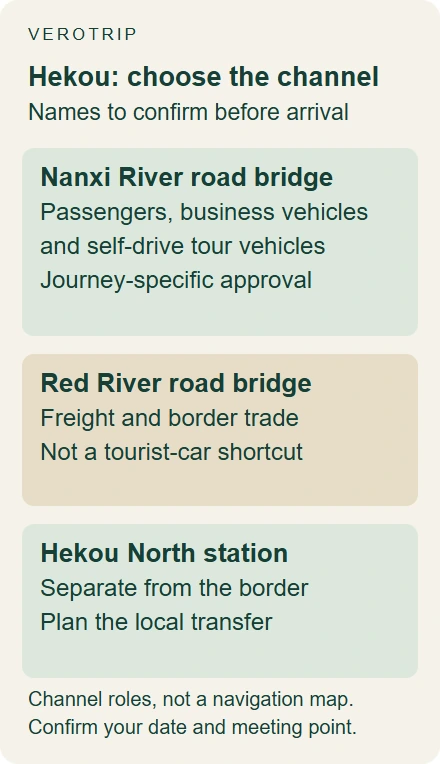
For a passenger journey, save Hekou North railway station — 河口北站 separately from Hekou Nanxi River inspection building — 河口南溪河联检大楼. The station and the passenger border facility are different places. Have the full arrival station and pickup address written down, particularly when arranging transport in another language. A border destination on a bus ticket does not, by itself, describe the last transfer.
Keep the two countries’ paperwork separate
The Chinese side: people, vehicle and driving
China’s temporary-entry vehicle regulations distinguish vehicle admission and road documents from the driver’s permission. They require relevant registration and admission evidence, Chinese compulsory motor insurance and, where applicable, organised-activity evidence. The vehicle’s authorised route and validity constrain the drive. Ask the receiving team for the local submission, inspection and document-collection arrangements, including any movement allowed before all documents are issued.
Do not turn a limited procedure for reaching a document-issuing office into permission to start a sightseeing drive. Likewise, an international driving permit does not replace the required Chinese permission. The traffic police’s temporary driving guidance explains the driver-permit category and validity rules. A longer driver-permit validity does not extend the car’s temporary admission. See the China temporary driving permit guide for the separate driver task.
The Vietnamese side: exiting now and returning later
Establish how your vehicle is legally present in Vietnam and what is needed to close or continue that arrangement. If it is registered elsewhere, send the organiser the existing admission and route documents. If it is registered in Vietnam, ask about its own export-and-return procedure rather than borrowing a checklist for foreign vehicles entering Vietnam as tourists.
For foreign vehicles brought into Vietnam for tourism, the government’s explanation of Decree 151/2024 describes written approval through a Vietnamese international travel business. Decree 236/2026, effective from 1 July 2026, amends that framework, including applications and changes to approved vehicle journeys. Ask the Vietnamese organiser to use the current application channel and to document any changed route, vehicle, driver or departure date. Do not treat a processing deadline for a complete application as a promise of border clearance on the same day. These requirements are not replaced by buying a tourist visa.
Use the official Vietnam e-visa portal for the current designated border-gate list and application instructions if an e-visa is appropriate for your passport. Check the approved name, passport number, dates and entry conditions before leaving. A forum report about a Hong Kong passport or a Chinese passport cannot establish the paperwork for every nationality.
The information pack to send before a quote
Send a short trip outline first, then supply sensitive document copies through the agreed private application channel. Keep one consistent spelling of every traveller’s name across the application, tickets and booking records. Do not hand documents to an unconnected person offering to fix an apparent mistake in the queue; ask the responsible official or your named organiser which correction is actually required.
| Information | Include | Clarify in the reply |
|---|---|---|
| People and drivers | Passport nationality, travel dates, driver-licence issuing country and vehicle category. | Entry conditions for each person; accepted translation and driving-permission process. |
| Vehicle | Registration country, owner relationship, make/model, year, dimensions, seats and any trailer. | Acceptance of that category; inspection, original documents and access limits. |
| Route and exit | Vietnam approach, intended China route, overnight stops, exit country and date. | Accepted ports, permitted route, local appointments and amendment procedure. |
| Money and support | Party size, language needs, waiting flexibility, dietary and mobility needs. | Itemised fees, insurance, any guarantee, refund terms, named receiving contacts and support scope. |
For a campervan, include its registered vehicle class and any conversion paperwork. Ask separately about roof height, overnight parking and where occupants will sleep during processing. Carrying beds inside the vehicle is not evidence that sleeping in a customs-controlled area or a roadside car park is permitted.
Keep copies of the agreed route and relevant documents available offline. Record which person holds each original. If a guarantee is required, obtain its written amount, recipient, conditions, release process and the evidence needed at exit. There is no useful universal crossing price without that scope.
Build the crossing day around the clocks and handovers
China is one hour ahead of Vietnam: 08:00 in Lao Cai is 09:00 in Hekou. This is a clock comparison, not the border’s opening time. Label every appointment and ticket with its local time zone; ask which clock an organiser is using when they send a meeting time.
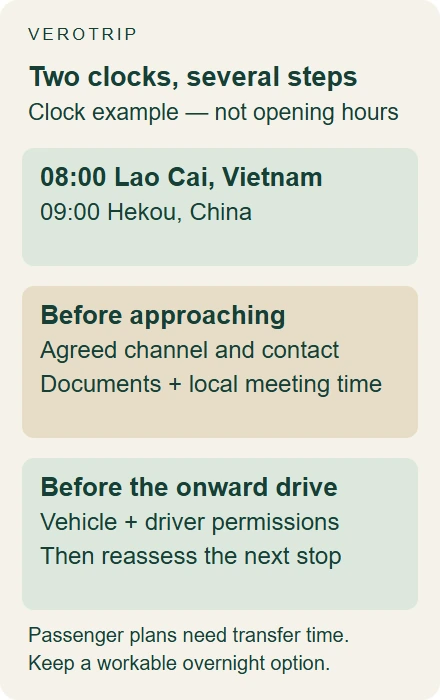
For a first crossing, a practical planning choice is to stay on the approach side the previous night and keep the first night after entry flexible. This allows rest and leaves room for appointments or delays. It is not a promise that all vehicle procedures finish in one day. Confirm accommodation only where you and the vehicle can lawfully reach it at that stage.
| Stage | Your action | If the plan changes |
|---|---|---|
| Before leaving the approach hotel | Check the appointment, channel, contact, documents and exact local time. | Stay at the agreed lawful waiting point until instructions are clear. |
| Departure and arrival procedures | Follow the authorised sequence for people, luggage and the vehicle; keep receipts and papers together. | Ask the responsible official and organiser where each party should wait. |
| Road documents and release | Confirm where the car may move and which driver may drive it. | Arrange an allowed transfer or overnight stop rather than starting the tour unauthorised. |
| After entry | Reassess fatigue, daylight and the first destination before setting off. | Shorten the day or take an agreed rest night; revise later reservations promptly. |
Passenger travellers need their own buffer between Lao Cai transport, the border and Hekou North. Do not buy the earliest onward train merely because somebody else’s passport check was quick. Your queue, document checks, luggage and local transfer can differ. Check the live railway service and booking conditions through China Railway 12306; the Yunnan train booking guide explains the booking task.
Waiting comfortably: children, meals, prayer and luggage
Make a small bag that stays with the travellers if the car is waiting elsewhere: water, permitted snacks, essential personal items, a charging cable, offline addresses and the documents needed at the next desk. Keep anything subject to customs restrictions out of a casual snack bag and follow the relevant declaration rules. Tell the organiser if stairs, prolonged standing or carrying luggage would cause difficulty.
Ask a proposed hotel to confirm foreign-passport registration, the room arrangement, step-free access where needed and parking suitable for the vehicle’s actual size. Clarify whether parking is on site, whether you retain access to the car and what happens if your arrival is delayed. A photograph of a large courtyard does not establish permission to park there overnight.
For Muslim travellers, discuss meals before the journey. Ask about ingredients, meat sourcing and cooking arrangements; a nearby noodle shop or a vegetarian label does not establish halal preparation. Carry suitable permitted food for uncertain meal times. Request a clean private place for prayer and a workable stop schedule, without assuming the checkpoint has a prayer room. Use the local time and location for prayer planning after crossing.
Separate a hotel’s accommodation charge from any storage, parking or waiting-service charge. Ask for the cancellation deadline and the contact to use after hours. If different people handle the passengers and the car, agree how they will update each other when mobile reception or an app fails.
After Hekou: choose one realistic onward direction
Keep the first drive within the accepted route. Once onward travel is permitted, choose the next base around rest, services and the purpose of the Yunnan visit. Avoid promising yourself a terrace sunrise immediately after an unpredictable border day.

| Your priority | Planning option | Decision to make first |
|---|---|---|
| Rest and regroup | A suitable Hekou overnight stop. | Lawful vehicle access, room availability, meals and the next appointment. |
| Honghe towns and onward services | Discuss Mengzi as the next base. | Whether the accepted route and remaining daylight support the transfer. |
| Terraces and photography | Plan a separate Yuanyang stay, with a workable gateway and local transfers. | Hotel access, walking effort and enough nights to avoid chasing one sunrise. |
| A wider Yunnan holiday | Continue toward the agreed regional route, with Kunming or another base as appropriate. | Route permission, driving days and the final vehicle exit arrangement. |
The Jianshui and Mengzi gateway comparison helps with that next-stage choice. If you arrange a separate hosted stay after entry, compare the 4-day Yuanyang visit from Mengzi. Its sightseeing itinerary does not include an implied vehicle-border service; ask for each requested arrangement in the written proposal.
If the car cannot cross as planned
Ask what must change: the documents, appointment, route, vehicle category or date. Do not substitute another port or cross on foot while leaving a vehicle under an unresolved admission obligation. If you choose to store the car and continue as passengers, confirm lawful storage, insurance, the applicable vehicle deadline and the collection plan first.
A separate passenger journey may be workable once personal entry and storage are settled. Arrange the Chinese-side transport independently and confirm whether the pickup is at the passenger facility or the railway station. If a return to Vietnam is involved, establish your re-entry conditions and any vehicle approval before cancelling the original plan.
Questions travellers ask
Can a tourist e-visa get my car through the border?
No. Personal entry and vehicle admission are separate. Use the visa for the purpose and conditions it authorises, then arrange the car’s paperwork and the driver’s permission separately.
Does driving to Hekou count as a cross-border self-drive trip?
No. Many accounts describe parking in the town and crossing as a passenger, or visiting Hekou without leaving China. Look for the actual vehicle registration, direction and scope before comparing that experience with yours.
Should I follow the freight route to avoid passenger queues?
Use the channel specified for your approved journey. Passenger convenience and freight operations do not determine where a particular foreign car may enter.
Can I add Jianshui or Yuanyang after arrival?
Discuss those stops when submitting the route. If your plan changes later, ask whether an amendment is needed before driving beyond the accepted area.
Send VeroTrip a clear route enquiry
Send your passport nationality, intended crossing direction and dates, vehicle registration country and category, party size, preferred Yunnan stops and intended exit. Add any mobility, meal, prayer or language needs. VeroTrip can help shape the onward Yunnan itinerary; any requested border handling needs its own named provider, accepted scope and written terms before booking. Browse China self-drive itinerary ideas for route context.
Discuss your Hekou arrival and Yunnan route
For the broader paperwork sequence, use the guide to bringing your own car or campervan into China. Then compare your entry and exit with the China overland route planning guide.