Settle motorcycle entitlement, vehicle arrangement and permitted roads before choosing a China riding region. Visa-free entry, a foreign licence and a bike booking each answer different questions. Together they still do not automatically authorise riding.
Updated 14 October 2026
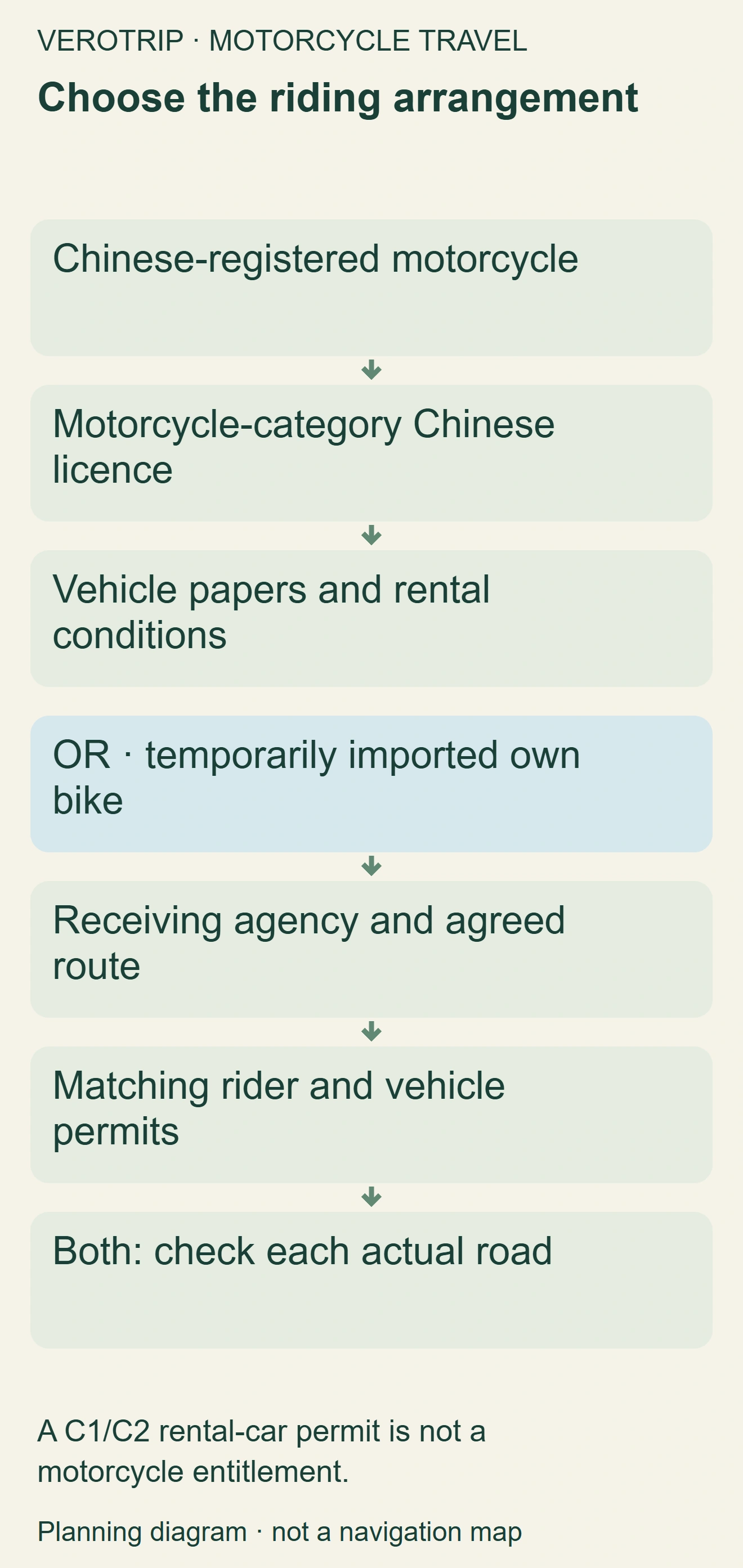
A Chinese-registered rental bike and your own temporarily imported motorcycle have different requirements. The standard temporary permission for rented Chinese vehicles covers C1/C2 small cars, not a rented motorcycle. If your motorcycle entitlement cannot be arranged for the trip, choose a car-based or other non-riding journey rather than treating paperwork as something to solve after collecting the bike.
Choose the rider and motorcycle arrangement first
| Your starting point | What must fit | The useful next step |
|---|---|---|
| You have a Chinese motorcycle-category licence | The exact motorcycle class, valid vehicle papers and permitted roads. | Ask the supplier to match the licence, registration and rental terms to the actual bike. |
| You have only an overseas motorcycle licence | A lawful China licensing arrangement for the intended vehicle. | Ask the issuing vehicle-management office about eligibility before reserving a local motorcycle. |
| You want to bring your overseas-registered bike | Rider permission, temporary vehicle entry, insurance and the organised reception plan. | Start with the receiving agency and entry/exit plan before freight or border bookings. |
| Your party includes non-riders | A separate lawful passenger or support arrangement. | Agree seats, luggage, daily meeting points and what happens if a rider stops. |
The Shanghai traffic-police explanation expressly limits temporary permission for rented Chinese vehicles to C1 and C2. For an eligible person bringing a vehicle temporarily into China, the permitted class must match both the overseas licence and the imported vehicle. Keep the temporary permit with the original overseas licence and its Chinese translation.
A regular Chinese motorcycle licence is a separate process
An International Driving Permit is not a substitute: Beijing’s official overseas-licence application guide excludes IDPs as application licences. An ordinary car licence also does not establish a motorcycle entitlement.
The current national licensing rules make an overseas-licence application a separate procedure, with eligibility, identity, health and translated-licence requirements and the usual theory examination, subject to applicable recognition agreements. Foreign applicants also need the appropriate stay or residence basis and accommodation registration. Confirm your own eligibility, documents, category and appointment with the issuing office; a short tourist visit is not a promise of a quick motorcycle conversion.
Send the issuing office your licence country, category and acquisition details, identity and stay documents, and proposed motorcycle. Ask about accepted translations and issue timing before a bike reservation or restrictive departure.
For the wider distinction between a car permit and a motorcycle journey, use our China temporary driving permit guide. That car-oriented application is background, not proof that a rental motorcycle is covered.
Bringing your own bike: reception, entry and exit
The published joint-department framework for foreign own-vehicle tourism requires reception by a licensed Chinese travel agency, an accompanying guide with appropriate language ability and an organised itinerary. Its reception-plan submission is 60 days before entry. Obtain the actual preparation schedule from the receiving operator; shipping, document corrections and restricted-route arrangements can require additional time.
Vehicle entry and rider permission are separate. The temporary-entry rules require the relevant registration and translation, customs entry basis, inspection documentation and Chinese compulsory vehicle liability insurance. Temporary road-use papers specify an area or route and a validity period, with a maximum of three months and no extension under those vehicle rules. Do not confuse that vehicle limit with a longer immigration or driving-permit period.
Agree who handles the customs guarantee, the vehicle’s release, the intended exit and proof of re-export. A changed port or scenic detour may affect more than the hotel booking. Ask for the procedure and costs if the motorcycle cannot leave under its own power.
Our own-motorcycle entry guide, border-route comparison and shipping and recovery guide develop those decisions. This overview helps you choose the journey; it does not replace the route-specific entry process.
Choose a region before collecting distant highlights
For a first China riding journey, fewer overnight bases and a route you can shorten are more useful than the longest line across a map. Choose the scenery and riding load you want, then establish permitted door-to-door connections for your licence, plates and dates. City arrival, luggage handling and the bike handover may need to be separate from the scenic riding.
| Regional choice | Why consider it | What changes the plan |
|---|---|---|
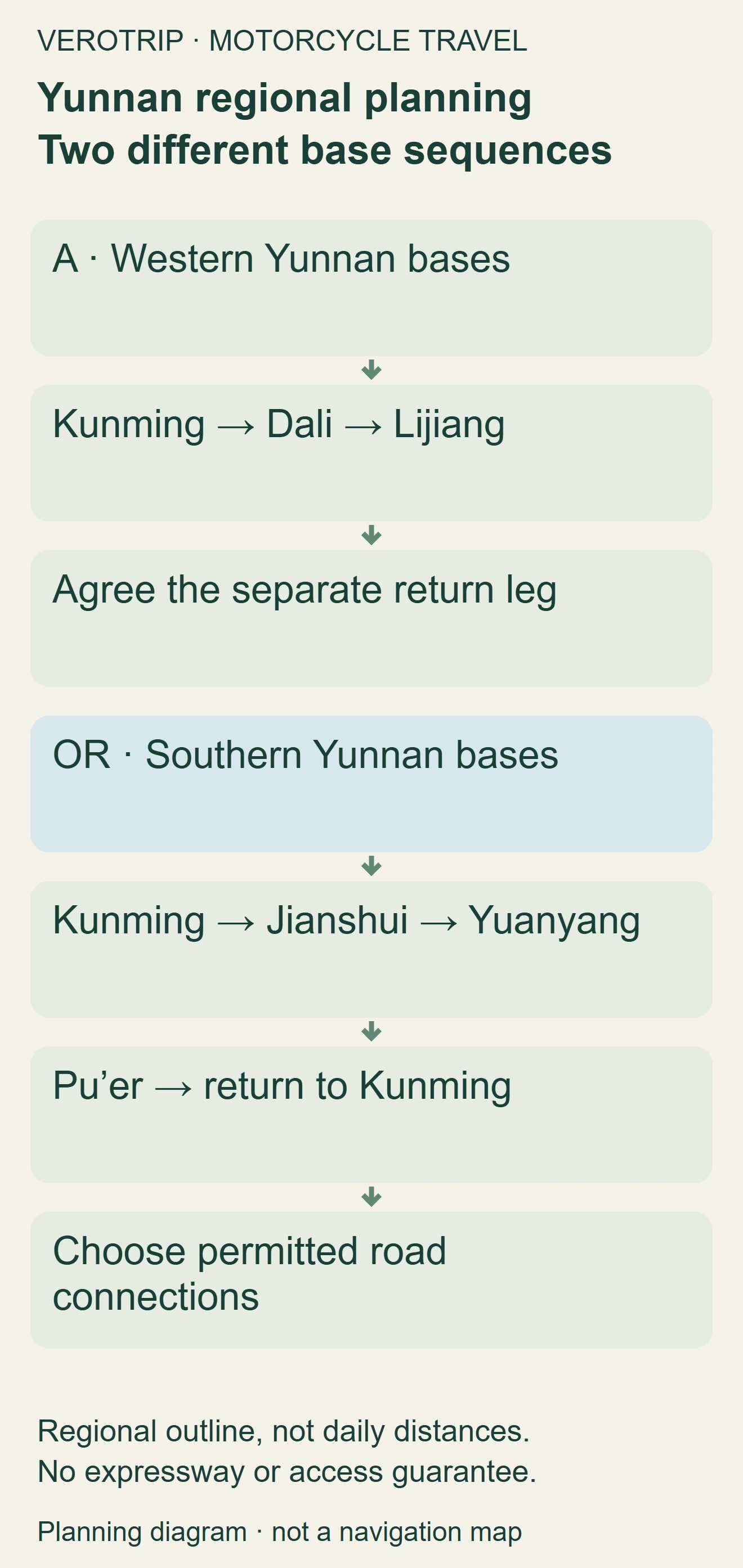
| Western Yunnan: Kunming, Dali and Lijiang bases | Town stays and different valley and mountain settings within one regional plan. | The legal city approaches, actual surface-road connections, handover location and return leg. |
| Southern Yunnan: Jianshui, Yuanyang and Pu’er bases | Historic-town, terrace and tea-region stops with a different purpose from the western towns. | Wet or winding sections, border-area checks where relevant, fuel, accommodation and the return to Kunming. |
| Western Sichuan highland extension | A separate mountain-focused journey for riders prepared for its demands. | Altitude, cold, passes, route restrictions, support and a lower alternative. |
| Tibet or a cross-border corridor | A specialised organised journey rather than a casual extension. | Destination permissions, reception, exact entry/exit points and the dated operating plan. |
The two Yunnan sequences below describe regional bases. They are not day-by-day routes, road permissions or a promise that every connecting highway allows motorcycles. Choose one main region rather than linking both into a rushed circuit. The China road-trip comparison supplies wider context; each motorcycle proposal still needs its own road and vehicle plan.
Check roads and passenger arrangements separately
A motorcycle navigation option helps with planning but does not grant access. The Huainan public-security explanation distinguishes the national motorway rules from locally imposed access restrictions. Check the actual entrance signs and current restrictions; do not ride through a prohibition because an app draws the route.
The national road-traffic implementation rules prohibit passengers on two-wheel motorcycles on motorways. A couple’s riding plan therefore needs a separate route and passenger decision, not just a second helmet. Confirm lawful passenger arrangements for ordinary roads and any support vehicle, including seating capacity and the insurer’s conditions.
Choose pickup and parking that the actual motorcycle can legally reach. A hotel inside a restricted city area may require a different vehicle transfer or parking base. Ask how luggage moves if the bike starts outside the city, and retain the full hotel address and agreed meeting point in Chinese as well as English.
Build a riding day that can finish early
Use the first riding day to assess the bike and your party’s comfort. Seat height, weight, riding position, controls and loaded handling matter more than an adventure-bike label. Complete a supervised handover and condition record, and settle who checks tyres, brakes, lights and any existing damage before departure.
A car-navigation time is not a motorcycle schedule. Allow for road checks, unfamiliar junctions, fuel, food, photographs and rests. Agree a modest riding section, an overnight base reachable in daylight and a shorter alternative. Do not turn another rider’s long-distance achievement into the minimum your holiday must reach.
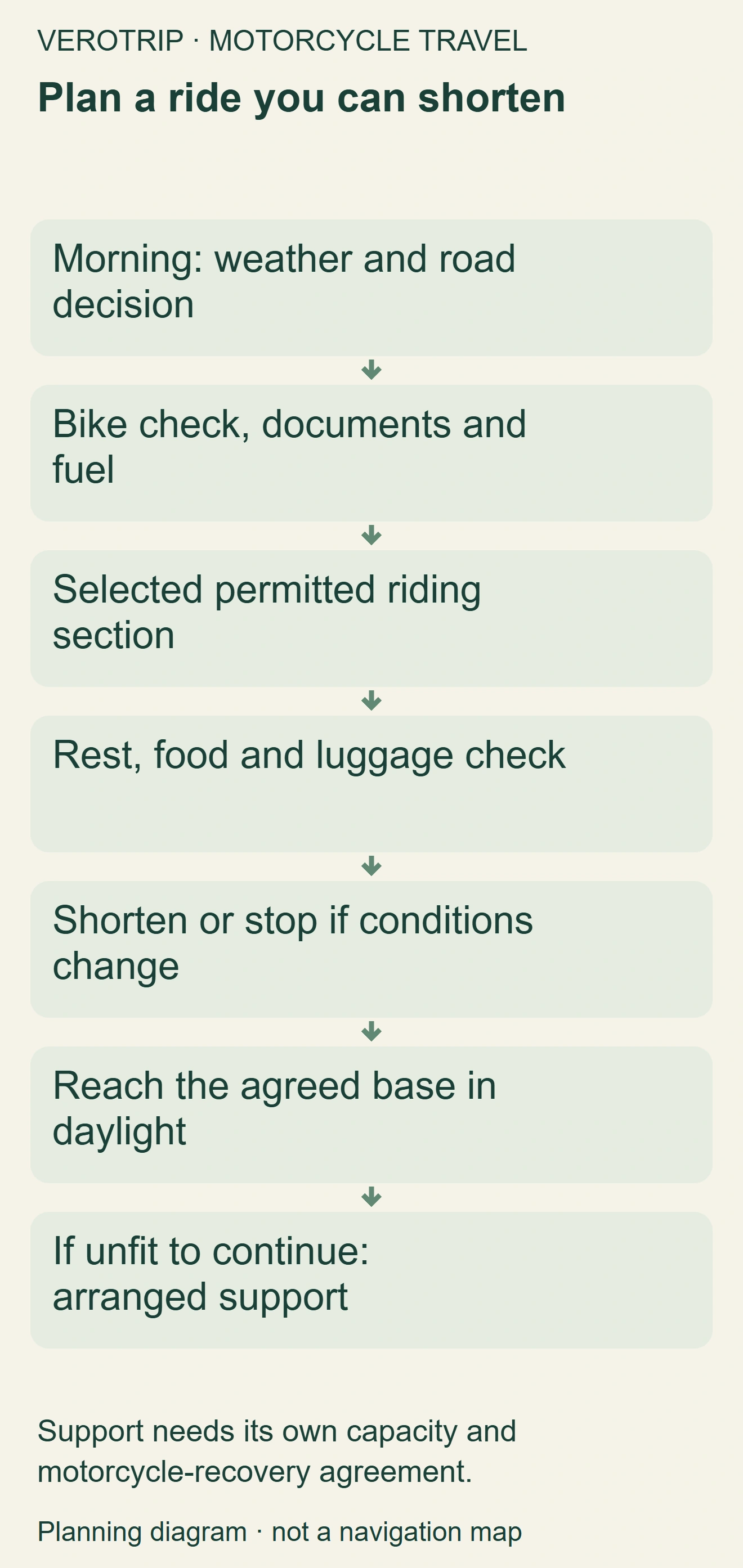
Stop and reassess when visibility, the surface, fatigue or the motorcycle’s condition no longer suits continuing. A rain suit does not solve poor visibility, slippery surfaces or a mechanical fault. If a bike is unsafe to ride, contact the arranged assistance and recovery provider; do not plan to keep riding until you find a repair shop.
Season, luggage, fuel and support
Match the dates to the actual region and elevations. A lower southern stay and a northern mountain pass can have different conditions on the same day. In cold weather, shaded sections can remain a different riding problem from the sunny town. Read the motorcycle season guide, then check the current forecast and road notices before each planned section.
| Decision | Arrange before setting off | Useful alternative |
|---|---|---|
| Rain, fog or cold | Accessible rain layers, dry storage and a decision to postpone or shorten. | A rest day or non-riding transfer when conditions are unsuitable. |
| Luggage | Secure attachment, handling with the actual load and bags kept clear of moving or hot parts. | Send larger bags with an agreed support vehicle; do not rely on an unspecified van. |
| Fuel and communications | The fuel type, reachable stops, registration/identity documents and offline contact details. | Refuel before the range becomes tight; confirm support where payment or signal is difficult. |
| Support and breakdowns | Named assistance, legal passenger seats, mechanical help and motorcycle recovery scope. | A separate recovery arrangement if the support vehicle cannot carry a motorcycle. |
A support van can help with bags and an agreed passenger transfer, but it is not automatically a motorcycle transporter or emergency service. Ask which equipment it carries, who drives it, where it meets the riders and what happens if it must assist one person while the rest continue. Compare those details in the packing and support guide.
Check motor-vehicle liability cover separately from your personal travel, medical and evacuation cover. Ask the insurer about the licence, motorcycle type, passenger, destination and activity conditions. No general “insurance included” sentence establishes cover for every rider or recovery cost.
Meals, hotels and a proposal you can assess
Plan enough time for meals and rest rather than skipping lunch to meet a riding target. For halal requirements, identify the actual restaurant or packed-meal arrangement; vegetarian food is not automatically halal. Discuss prayer breaks and a suitable stopping place without assuming a dedicated prayer room along the route.
Ask each accommodation provider about foreign-passport check-in, lawful parking, luggage and wet equipment. For a party with children, older relatives or non-riders, plan the non-riding journey explicitly. A support seat must be available when required, not allocated only after someone becomes exhausted.
Use the motorcycle programme collection and the published Kunming–Lhasa motorcycle programme to identify a route you want to discuss. Obtain a dated proposal stating the actual motorcycle arrangement, lawful rider entitlement, reception and guide, support, permits, insurance, included costs and changes if a section cannot operate. A published route does not replace those trip-specific answers.
Through Plan My Trip, send your nationality, dates, licence country and class, recent riding experience, rider and passenger numbers, height or handling concerns, preferred region, luggage and meal or prayer needs. State whether you already hold a Chinese motorcycle licence or want to bring your own bike. For the latter, include the registration country, model and intended entry and exit points.
Questions that change the booking
Can I use an IDP or temporary car permit for a rented motorcycle?
No. An IDP is not the required Chinese entitlement, and the standard rental-car temporary permit covers C1/C2 cars. Establish a lawful motorcycle-category arrangement before reserving a local bike.
Does a guide remove the licensing requirement?
No. A guide can help with the journey, language and documents but cannot replace the rider’s entitlement or the motorcycle’s road-use papers.
Can I change the route if my own bike is temporarily imported?
Stay within the area or route and dates on its temporary road-use documents. Agree a proposed change with the receiving operator before riding it; other permissions and exit arrangements may also be affected.
What if my group cannot obtain the right riding permission?
Use a non-riding itinerary or change the journey and preparation dates. Do not make a deposit on the assumption that a car permit, borrowed plate or informal promise will solve the motorcycle requirement.