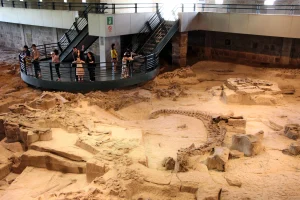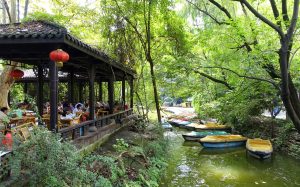
Choose the Salt Industry History Museum for the story and architecture; choose Shenhai Well for the industrial site. If salt heritage is your reason for visiting Zigong, give the two places separate sightseeing blocks, with lunch and a local transfer between them. A Zigong night can make that easier than squeezing both between journeys from Chengdu.
The museum occupies Xiqin Guildhall, 西秦会馆, in the urban area. Shenhai Well, 燊海井, is a separate site in Da’an District. Save both Chinese names and the agreed entrances on your phone. A booking for one does not establish admission, guiding or transport at the other.
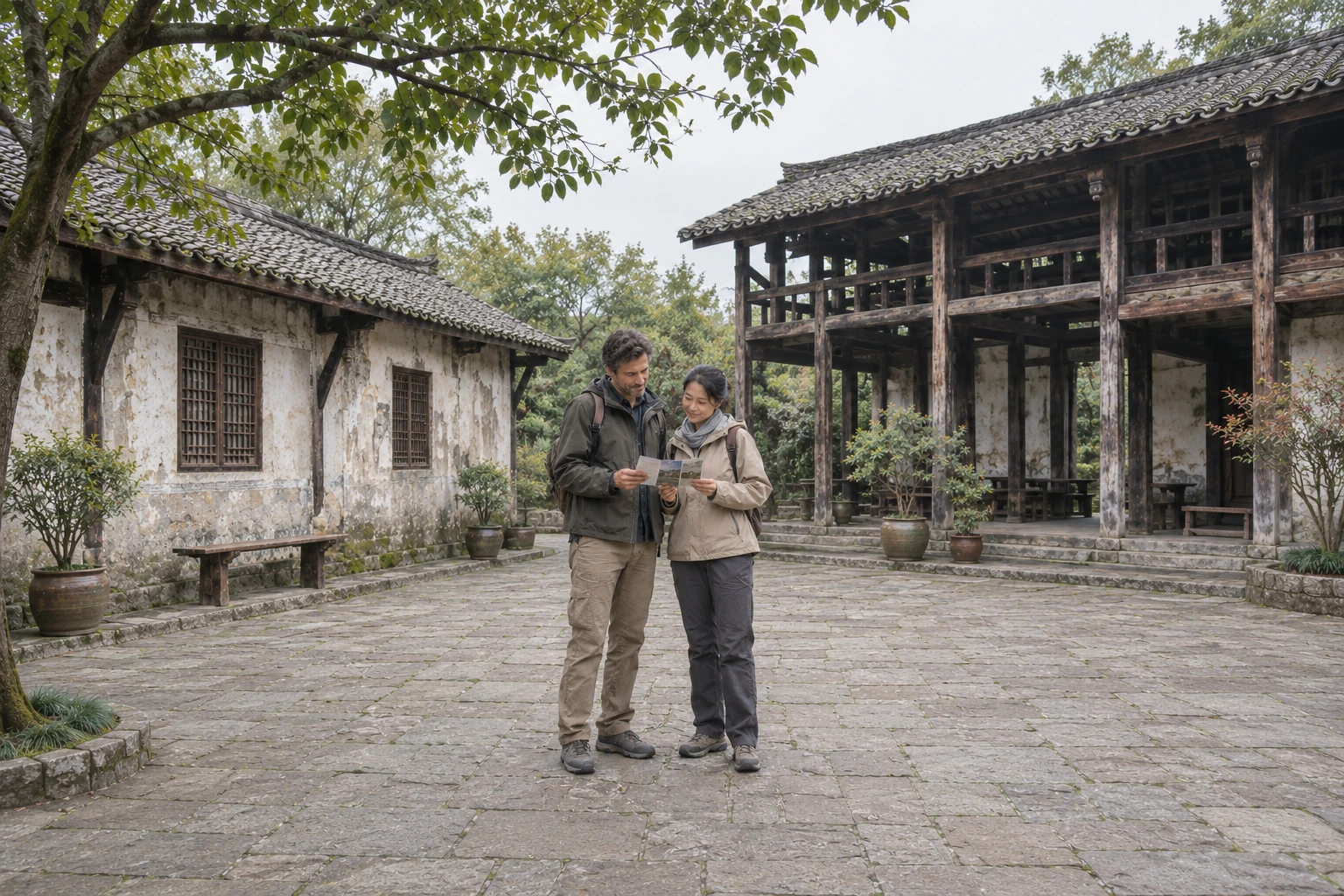
Lead image: AI-generated travel illustration with two fictional adult travellers in a generic heritage courtyard. It is not a photograph or reconstruction of Xiqin Guildhall, Shenhai Well, a real museum exhibit, current access or Vero Trip guests.
Which salt-history visit suits your interests?
Zigong’s salt story connects an underground resource with technology, commerce and the city that grew around it. Decide which part interests you before choosing a route. Looking at the guildhall and looking at a well site ask different questions, even when both visits appear under “salt culture.”
| Your priority | Start here | Give the visit a question |
|---|---|---|
| Architecture and the people who financed salt | Salt Industry History Museum at Xiqin Guildhall | What does a merchants’ meeting place tell you about the industry around it? |
| Tools and an explanation of the process | The museum’s salt-history displays | How were drilling, brine and fuel connected, and how were the work and trade organised? |
| The setting of a historic deep well | Shenhai Well | Which structures belong to the well site, and how does their scale change your understanding of the work? |
| A fuller introduction | Museum first, then the well site in a separate block | Use the first visit to form questions for the second; keep demonstrations optional. |
Read the guildhall as well as the exhibits
The municipal heritage description identifies a guildhall-and-temple complex established by salt merchants from Shaanxi. It also describes displays on well-salt technology, salt taxation and salt geology. These provide three useful ways into a visit: how the resource was obtained, how its business was organised, and what lay beneath the ground.
Begin with a short look at the building before concentrating on objects. Notice the relationship between the entrance, courtyards and rooms along the visitor route. Ask how a place for merchants also expresses status, community and belief. You do not need to identify every decorative detail to appreciate that this was more than a storehouse.
Inside, choose a sequence you can explain in your own words. For a first visit, connect drilling to obtaining brine, then consider the role of fuel and the work needed to produce salt. Use the current labels, models and displayed tools to follow that sequence. Do not assume that an unfamiliar object’s shape explains its use; a good question for a guide is where it fits in the process.
A history enthusiast may prefer to follow the taxation and commercial material, while a family may do better with one tool and one clear question. Agree that focus before booking a long guided explanation. A child who understands one problem solved by a tool can get more from the visit than a child taken quickly past every cabinet.
The Japanese consulate’s visitor introduction also draws attention to both the salt displays and the guildhall architecture. That page is dated 2018. Its admission price is historical and is not used here as a current offer.
What Shenhai Well adds
The municipal description of Shenhai Well places it in Da’an and identifies its importance as a manually drilled well extending beyond a kilometre. That physical scale is a useful reason to visit after the museum: the subject moves from explanation and objects to a particular industrial place.
Follow the current public route and ask staff which historic structures and equipment can be viewed. Think about how a deep underground operation required an organised surface workplace. Keep the difference between a historical process, an interpreted display and an actual operation clear; they are not interchangeable evidence.
If seeing saltmaking is essential, ask precisely what will operate on your date, where you can watch and whether it requires a separate booking. A photograph of workers, a boiling pan or a workshop does not establish today’s demonstration. This guide does not promise a timetable, hands-on work, tasting or access to machinery.
Stay outside barriers and work areas. Do not climb a frame, handle tools or enter a workshop because another visitor has done so. Ask separately about photography and equipment restrictions. Choose a shorter public circuit when the party is tired rather than looking for an informal entrance or a route through a working area.
Build the day around your actual starting point
A traveller already staying in Zigong can give the museum a comfortable morning, take a seated lunch and decide whether there is energy for the well site afterwards. A traveller arriving from Chengdu has another set of stages before the first exhibit: hotel departure, the booked intercity journey and the local transfer.
For rail travel, use the exact departure and arrival stations printed on your tickets. Establish how you will get from the Zigong arrival station to your hotel or first attraction, and how you will reach the return service. A railway journey is one part of the outing; it does not deliver you to either salt-history entrance.
For a road vehicle, specify whether it waits, collects you later or continues to the overnight hotel. Confirm the passenger and suitcase capacity, pickup pin and duty period. Do not base the day on an assumed journey time from an old blog. Give the road and station stages their own allowance before allocating the sightseeing.
| Pattern | A realistic sightseeing emphasis | What it needs |
|---|---|---|
| Return to Chengdu the same day | One priority salt-history stop; add the second only if the complete journey leaves a generous margin. | A confirmed return connection and a clear leaving time at the attraction. |
| Two days, one Zigong night | Arrive and choose one site; stay in Zigong; visit the second site next day before returning. | One hotel night, separate local transfers and a luggage collection plan. |
| Three days, two Zigong nights | Arrive and settle in; keep a full middle day for salt heritage; depart the following day. | Two nights in the same base; useful when the arrival or departure day is constrained. |
The two-night version has exactly one complete day between arrival and departure. Use that middle day for the museum, lunch and the well site when both are open. If you also want the dinosaur museum, add suitable time or replace a sightseeing block rather than quietly turning the same plan into three full days.
Choose a hotel and decide where the bags stay
An urban Zigong base can suit a museum-led visit with a meal nearby. A property chosen mainly for a dinosaur attraction may require another transfer for the salt-history day. Compare the actual hotel location, dinner options, entrance access and the next morning’s route, rather than relying on a “central” or “nearby” label.
Have foreign-passport registration, room arrangements and any step or lift needs confirmed with the named property. Check when you can leave luggage before check-in or after checkout. Keep the main suitcase at a confirmed storage point and carry a small day bag; do not assume either heritage site will accept a large case or reserve space for it.
If leaving Zigong after the second visit, put baggage collection into the return calculation. Going back across the city to fetch cases is a travel stage. A different finish, such as continuing to another city, needs its own route and quotation rather than being treated as the same Chengdu return.
Check the calendar, language and document procedure
The Salt Industry History Museum’s signed 30 April 2026 visitor notice covered the May holiday. It included holiday hours, a roadwork-related approach warning and English interpretation by advance arrangement. Those details show what to ask about; they do not establish November hours, continuing road restrictions, current guide availability or a guaranteed fee.
Check both venues for your actual date. Ask which entrance is in use, the last admission and enough time to make the visit worthwhile. For a passport booking, confirm the document type, name format and entry or ticket-collection procedure. Carry the real document and do not substitute an invented Chinese identity number if an online form does not accept it.
Ask whether English support is a live guide, a device, written material or something you arrange separately. A museum guide’s subject knowledge and the language used matter more than a general promise of “English service” in a route title. Concession rules and the evidence required should be checked for each traveller rather than inferred from a domestic discount headline.
Do not build the evening from an old festival announcement
A February 2026 on-site report described a Shenhai Well night programme scheduled from 10 February to 3 March. It is evidence of that event, not a year-round night-opening calendar. Have a later dated programme confirmed before adding a night ticket, performance or market to your stay.
Even when an evening activity is available, arrange dinner, the finishing point and the final hotel transfer. A daytime vehicle’s duty period may end earlier. Keep a plan for cancellation that does not depend on finding an unverified activity late at night.
Walking, rain and a comfortable pace
Request a route-specific assessment for a wheelchair, stroller or anyone who needs frequent seated rests. Ask about the entrance, steps between visitor areas, surfaces, toilets and the longest walking block. A short visit or a historic building should not be described as universally step-free without that information.
Keep shoes with grip and a rain layer accessible. Covered displays can help on a wet day, but hotel transfers, courtyards and approaches can still be exposed. Shorten a visit when footing or fatigue becomes a problem. If a closure removes your main reason for coming, change the day or rest in the city rather than adding another distant stop merely to fill the schedule.
Compare the full quotation
| Item | Have the proposal identify | Why it matters |
|---|---|---|
| Admission | Each named venue, traveller category and date. | Two sites are separate visits; a route title does not combine their tickets. |
| Interpretation | Guide or device, language, duration and which venue it covers. | Museum explanation and road transport are different services. |
| Transport | Intercity tickets or vehicle, local transfers, waiting and the complete return. | A cheap single travel stage can leave the rest of the journey unresolved. |
| Hotel, meals and extras | Actual room nights, luggage arrangements, meals and any evening activity. | A suggested overnight rhythm does not reserve a hotel or an event. |
Price on request. Admissions, guiding, transport, meals, rooms and insurance are included only when itemised in the written proposal. Ask which arrangements can change if a museum day moves; transport, accommodation and attraction bookings can have separate terms.
Questions before you choose
Is one site enough?
Yes. Choose the museum for an introduction through displays and architecture, or the well site when the industrial place is the main interest. One attentive visit can be a better use of a limited travel day than two rushed arrivals.
Should I start at the well or the museum?
Museum first is a useful learning sequence, but the actual opening calendar and your starting hotel may make the reverse order more practical. Protect a proper visit at the priority site, then arrange the second around it.
Can we add dinosaurs or a lantern evening?
Each needs a separate time and ticket decision. Read the existing Zigong Dinosaur Museum guide for that visit’s calendar and transfer questions. Do not assume a salt-history ticket includes a theme park, fossil museum or lantern event.
Send Vero Trip your dates, starting hotel, return connection, party size and walking needs. Say whether architecture, industrial history or family learning comes first, and whether you want a Chengdu return or a Zigong night. Use the Sichuan trip planner to place this specialist heritage stop within a wider journey, or the Chengdu guide to decide which city day you would be trading for it.
Reviewed 3 November 2026. Suggested sequences and overnight rhythms are Vero Trip planning advice. Dated source notices are identified as historical; actual opening, entry procedures and services require confirmation for the travel date.