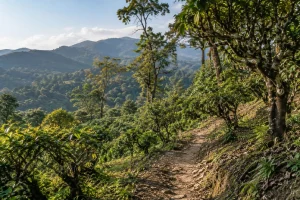
Visit Yiwu Ancient Tea Town for a focused look at Pu’er tea culture: walk the old streets, learn the trade story and arrange a tasting with someone who can explain the tea. If you also want a tea-garden visit, start with one night and two days rather than squeezing several rural appointments into a return trip from Jinghong. That is a planning suggestion, not a fixed tour or a guarantee of access to a producer.
This is Yiwu (易武镇) in Mengla County, Xishuangbanna, southern Yunnan. Give the full Chinese location when checking a map or arranging transport. Yiwu in Zhejiang uses different Chinese characters, 义乌, and is a different destination. Within the Yunnan tea region, the town, a named tea-producing village and an individual garden also require different arrival points.
Updated 28 October 2026
The opening image is an illustration of a stone-paved tea-town lane, not a photograph of Yiwu, a named tea shop or a protected building.
Is Yiwu worth adding to your Xishuangbanna trip?
Yiwu suits travellers who enjoy looking closely: the texture of an old street, the story behind a tea business and a conversation that follows a leaf from its growing area to the cup. It is a more purposeful choice when tea is part of the reason for travelling. If you simply want one casual tasting during a short Jinghong stay, a separate journey to Yiwu may be more than you need.
A county-level introduction published by Xinhua in March 2026 connects the town’s tea-culture museum with tea businesses, traditional skills and surrounding villages. That gives the visit several possible layers. It does not turn them into one attraction with a single ticket, a set circuit or a daily programme that any visitor can join without arranging it.
Decide which layer matters most before booking transport. A town walk can be rewarding without a production demonstration; a producer appointment is more useful when it matches your knowledge and interests. Seeing a celebrated place name on a packet of tea is not the same as knowing which household, business or garden will receive you.
Should you make a day trip or stay overnight?
One night gives room for the outward journey, a town visit and an unhurried conversation, followed by a separate rural appointment if it has been agreed. A return day trip is a narrower choice: build it around one main experience and a realistic transport plan from your actual starting point.
| Trip shape | What to concentrate on | What you give up |
|---|---|---|
| Return day trip | Old-town walking and one confirmed museum visit or tasting | Less flexibility if the road journey, host or opening arrangements change |
| One night, two days | Town and tea history first; one hosted tea-garden or producer visit on the other day | An extra hotel check-in and the need to settle dinner and departure arrangements |
| Longer specialist stay | A small number of appointments chosen for distinct learning goals | More coordination; extra days do not guarantee access to rare tea or working production |
| No separate Yiwu journey | A suitable tasting close to your existing base | You miss the town context, but keep a short regional trip manageable |
Do not judge the day from a straight-line map distance. Obtain a current estimate for the whole journey, including your hotel pickup, rural access, stops and return. If it leaves little time for the reason you are going, choose an overnight or leave Yiwu for another trip. Avoid a tight flight or train departure immediately after a rural visit.
What should you actually do in the town?
Walk the old street with a tea-history question
Yunnan’s official tea-travel introduction describes Yiwu’s stone-paved streets and old buildings in connection with Tea Horse Road history. Take a short, attentive walk rather than treating the town as a backdrop between tastings. Ask an interpreter to connect a building, business name or display with the wider tea trade.
Keep to public areas and respect signs and residents’ privacy. An old doorway is not an invitation into a courtyard. Photograph street scenes without obstructing people at work, and ask before close photographs of a resident, workshop or business interior. Do not handle a displayed object or step over a barrier for a better angle.
Use the museum to give tastings a context
The county’s March 2026 account identifies the Pu’er tea-culture museum as a place where objects and stories are used to explain local tea history. If it is part of your plan, ask for the current visitor entrance, opening arrangements, admission process and language options before leaving your base.
A museum visit and a private tasting answer different questions. The museum can help you understand the town’s context; a tasting can explore the particular teas offered by your host. If the museum cannot receive visitors on your date, decide whether an arranged tasting and street walk still justify the journey. Do not simply substitute an unconfirmed workshop and expect it to be open.
What is the difference between tasting, making and visiting a garden?
Describe the experience you want in plain terms. “Tea tour” can mean a seated tasting, a walk among plants, a demonstration or a practical session. The differences affect time, price, clothing and whether the visit is possible on a given day.
| Experience | What it can help you learn | What it does not automatically include |
|---|---|---|
| A seated tasting | How the host prepares and describes a particular tea | A garden visit, independent proof of origin or a requirement to buy |
| A tea-garden walk | Growing conditions and the work involved in managing plants | Picking leaves, access to every plot or walking anywhere without permission |
| A processing demonstration | The purpose of a stage that the producer is showing | A complete live production sequence or hands-on use of equipment |
| A practical workshop | An agreed task with instruction and suitable materials | The right season for harvesting or a finished product ready to take away |
| Old-town and museum time | Trade history, objects and the town setting | A reservation with a producer or interpretation in your preferred language |
The county introduction describes skills demonstrations and organised learning visits, including activities involving tea makers. These examples show what may be arranged, not what every walk-in visitor receives. Ask which stage is meaningful on your date, how much of it you can observe and whether participation is appropriate for your party.
In a working area, follow the host’s hygiene and safety directions. Do not touch leaves, equipment or packaged tea without permission. If you are offered a practical task, understand what supervision is provided and what happens to the product afterwards. A demonstration using prepared material can still be educational when it is described honestly.
How could a two-day Yiwu visit work?
Keep the first day centred on the town and the second on one appointment. The example below is an original planning sequence; it is not an official circuit or a promise that a named venue will be available. Put a garden visit first instead if the host’s agreed timing makes that more sensible.
| Part of the visit | A workable focus | Practical condition |
|---|---|---|
| Day 1: travel and settle in | Reach Yiwu, leave luggage and have a proper meal | Book a property that can receive your party; arrange arrival and parking or drop-off |
| Day 1: town and history | A short old-street walk and the museum if accessible | Check the museum before travel and keep an indoor alternative agreed |
| Day 1: tea conversation | One tasting with time for questions and interpretation | Know the fee, the teas being offered and whether any purchase is optional |
| Day 2: one hosted appointment | A tea-garden visit, producer explanation or suitable workshop | A named host, permitted route, current conditions and a clear return point |
| Day 2: onward journey | Collect luggage and leave with time for stops | Work back from the next hotel, station or airport rather than adding another remote village |
If a second appointment repeats the first, use the time for a slower meal or a conversation about a different part of tea production. More addresses do not necessarily add insight. A beginner may learn more from one patient host; a knowledgeable traveller can send specific questions in advance to avoid a generic sales presentation.
How do you handle transport and accommodation?
Yiwu needs a road journey from your chosen regional base or arrival point. Ask the transport provider for the actual route and realistic date-specific timings. Do not assume a railway station named for a wider area is in the old town, or that reaching a town stop covers the last stretch to a rural host.
For an arranged car journey, settle the pickup and return addresses, waiting time, luggage space and any extra village stops before paying. If using a public service, check the current departure point, service day, ticket method and return option with the operator. This guide does not provide a live timetable or a fixed transfer fare.
For an overnight, choose accommodation for a confirmed location and the needs of your party. Ask about stairs, road noise, meal arrangements and the time you can arrive. Give the property the passport details it requires through its normal booking process and confirm it can receive the travellers concerned. A tea-themed room description does not establish access to a garden or a workshop.
If continuing to Menglun for the botanical garden, arrange that as a separate transfer with its own timing. The fact that two places are in Xishuangbanna does not make them one short excursion. Use the Menglun botanical-garden guide to plan that visit on its own terms.
What changes with the season or the weather?
Choose your date for the activity, not an online promise of year-round picking. Yunnan’s official introduction explicitly ties leaf picking to the picking season. Ask the producer what is happening at the time of your visit; a tasting or discussion of prepared tea is a different, often more flexible experience.
Outside the relevant harvest, do not ask a host to stage work as if it were routine production. Instead, compare finished teas, ask about storage or learn how the producer explains an earlier batch. Processing and drying depend on real work and conditions, so agree a useful alternative if an outdoor part cannot proceed.
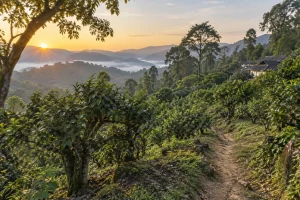
For garden paths, ask about the surface, slopes, recent rain and the point where a shorter visit can turn back. Wear shoes with grip and carry water and rain protection. If conditions make the planned path unsuitable, stay with the agreed indoor option or reschedule. A pleasant town walk does not prove that a distant forest or garden route is suitable that day.
How can you taste and buy tea without pressure?
Agree whether the session is a paid lesson, an informal shop tasting or part of another booking. Tell the host your level of interest and how much time you have. You do not need to taste every tea offered; ask for water and take a break when you want one.
Make comparison easier by writing down what is being presented: the claimed growing area, producer, year, style, quantity and preparation. Distinguish what you can observe from what the seller tells you. A place name, attractive wrapper or story about an old tree is not independent proof of authenticity or a reason to make a rushed expensive purchase.
If buying, obtain a clear description and receipt, understand the amount and packaging, and check any shipping arrangement before committing. Ask your destination country’s official border or biosecurity service about bringing tea home; do not assume that all plant material or food can travel under the same rules. No visit should depend on a compulsory purchase unless that condition was made clear and accepted beforehand.
Who may prefer a different tea outing?
If your party has limited walking stamina, a seated tasting and short town section may fit better than a garden route. Ask about steps, toilets, seats and vehicle access to the exact meeting point. Families should agree whether a practical session is appropriate for their children’s ages and attention spans, with breaks and an easy way to finish early.
If your itinerary is already based around Jinghong and spare time is short, compare a nearer tea visit rather than adding Yiwu automatically. The Nannuo and Jingmai comparison explains other trip shapes, while the Yunnan tea-and-coffee planning guide helps you choose a broader theme. These are alternatives, not additional stops to squeeze into the two-day example.
Questions visitors often need to settle
Is there one ticket for Yiwu Ancient Town and all tea activities?
Do not book on that assumption. Obtain the terms for the exact museum, session, host or transport you want. Public street walking, a hosted tasting and a workshop are separate experiences, even when sold under the same destination name.
Will a local tea host explain everything in English?
Only if that has been arranged. A knowledgeable producer and an English-speaking interpreter have different roles. Send specialist questions beforehand, and check whether interpretation is included in the quoted session rather than expecting a driver to provide it.
Should you travel for a tea festival?
Only after checking a current announcement for the correct year and date. Past tea competitions and cultural events are not a recurring daily programme. Make sure the particular public activity interests you, and arrange transport and accommodation around the confirmed event.
Build Yiwu around the experience you want
Send Vero Trip your dates, starting and finishing places, party size, preferred language, walking limits and the type of tea experience you want through Plan My Trip. Mention whether a town walk and tasting are enough or whether a garden, producer or hands-on session is the main reason for travelling.
Ask for a written proposal that identifies the host or venue and specifies transport, accommodation, interpretation, admissions, activities and meals. Availability and the agreed scope should be settled before booking. A suggested route is not confirmation of a particular producer appointment or a fixed package price.
Background reading: the March 2026 county introduction to Yiwu’s museum and tea-culture activities and Yunnan’s tea-travel introduction. Activity access and transport still need arrangements for your date.
Related Journeys to Compare
These existing routes offer starting points for the region or travel interests discussed above. Read the full daily itinerary to see what is included. A visit described in this guide, a specialist session or an international border crossing is added only when confirmed in your own programme.