Updated 27 October 2026.
Wuliangshan Cherry Blossom Valley is a seasonal tea-garden outing in Nanjian County, south of Dali, rather than a quick stop beside Erhai Lake. Plan around winter cherries, usually associated with late November and December, and confirm the current flowering before committing to the detour. Choose a dedicated day with a settled return arrangement, or stay locally if a relaxed visit and a possible morning photography session matter more than returning to Dali the same night.
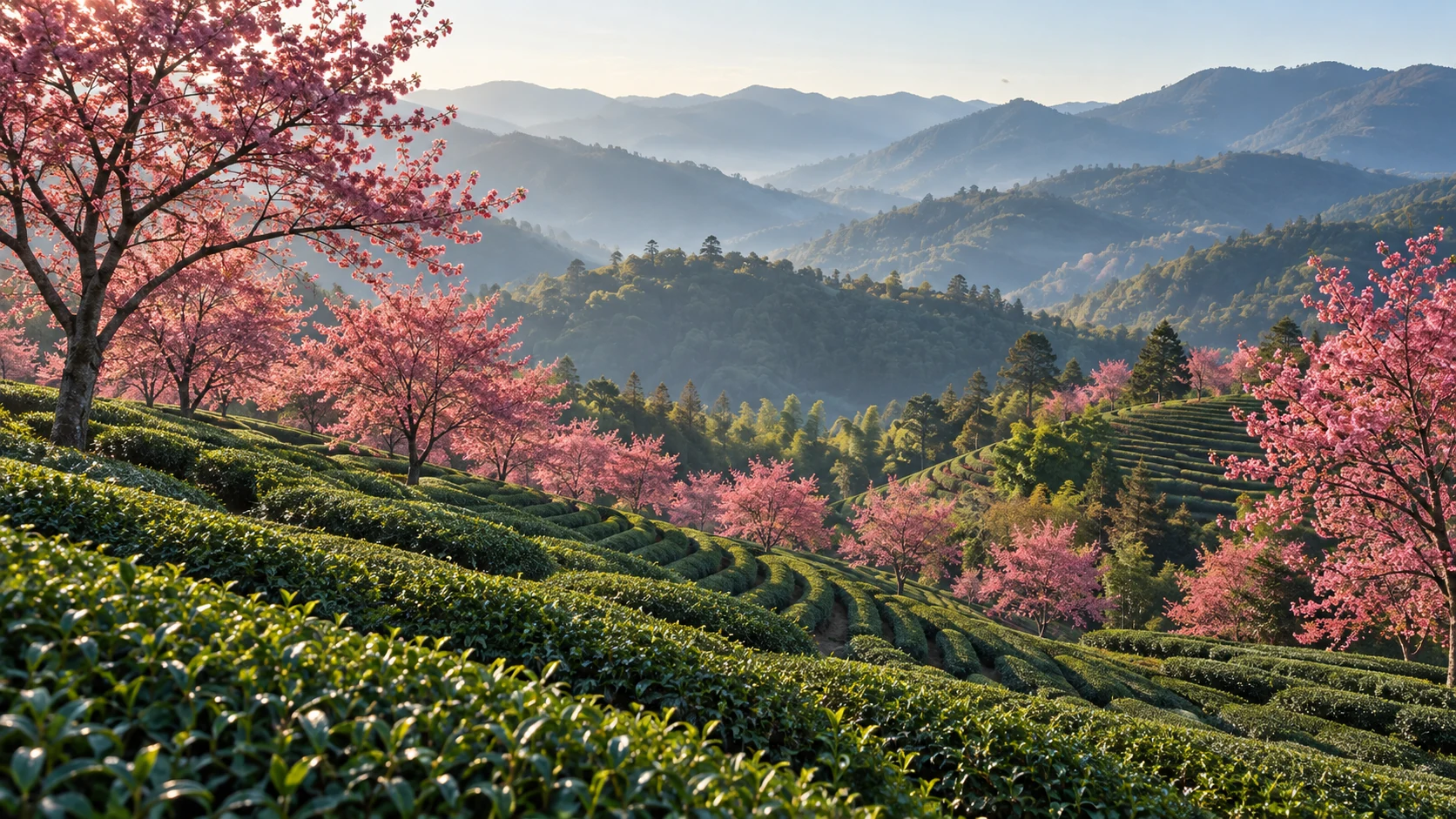
The opening image is an illustration of a Yunnan-style tea garden with winter cherry blossoms, not a photograph of a particular viewpoint or the current flowering.
Where the valley fits into a Dali trip
The destination to save is 无量山樱花谷, in De’an Village, Wuliangshan Town, Nanjian County. Include the county and the actual visitor entrance when arranging transport. “Wuliangshan” also describes a wider mountain area; a broad mountain pin is not enough for a driver, accommodation booking or meeting point.
The attraction is the contrast between tea rows and flowering trees across the hillsides. It suits people who enjoy looking slowly at a landscape and can accept that weather and flowering determine much of the experience. It is less convincing as a compulsory stop for someone with only a short Dali stay, a fixed onward connection, or little interest in gardens outside peak bloom.
Use the Dali stay planner to protect time for your main priorities first. A seasonal trip south should have its own space in the route. Adding it after a full Cangshan outing or a long circuit of Erhai would leave too much of the day dependent on road travel.
When to go: use a season, then check the actual flowers
The provincial tourism route description published in October 2026 identifies winter cherries here with late November and December. That is a planning window, not a promise that every tree will be in full flower throughout those months. Weather, different sections and the progress of the season change what you will see.
Before booking a trip primarily for blossom photography, ask for recent, dated pictures from the visitor area you intend to enter. Establish whether they show buds, widespread bloom or the end of flowering. A beautiful image without a date may be from another year, and a close-up of one tree does not establish the condition of the whole valley.
Check again shortly before departure. If the flowers are early or late, decide whether the tea-garden scenery alone justifies the journey. If it does not, retain your Dali base and choose a different day locally. Do not assume that a general spring cherry-blossom calendar for another Chinese city applies to this winter-flowering destination.
| Your priority | A sensible choice | Accept this limitation |
|---|---|---|
| Blossoms are the main reason | Keep dates flexible within the winter window and check recent flower reports | No calendar date guarantees peak bloom. |
| A comfortable outing from Dali | Give the valley a dedicated day and agree the return in advance | Road travel, breaks and entry leave less time than a nearby park visit. |
| A possible early photography session | Consider an overnight close to the entrance you will use | Morning access, light, cloud and mist are separate uncertainties. |
| Only a short Dali stay | Prioritise the old town, lake or chosen cultural visit | A distant seasonal detour may not be the best use of limited time. |
Getting there: settle the final road stage and the return
The province’s published route links Dali, Weishan and Nanjian before reaching the valley. Its public-transport outline involves transfers through Nanjian, with a further local road connection towards the attraction. Treat that outline as a way to understand the geography, not as a live timetable or evidence of a direct train to the scenic entrance.
For an independent public-transport trip, confirm each service with the relevant station or operator for your date. Ask where the last vehicle stops, how you reach the visitor entrance, whether luggage can be carried and when the usable return leaves. A service travelling in the general direction of Shale does not by itself establish the exact stop or a convenient journey back.
If those connections cannot be established, compare a pre-arranged road transfer or an overnight plan before setting out. Do not depend on finding an unplanned return car at the end of the visit. Save the hotel address, entrance pin and driver’s contact details in a form you can use without a fresh internet search.
For a quoted vehicle, ask whether the price covers a return journey, waiting time, parking and any agreed stops. State the actual Dali hotel location: the old town, modern city and lakeside accommodation are different starting points. If anyone needs a child seat, space for large luggage or frequent breaks on winding roads, include that in the request.
Plan the road stages in daylight where practical and leave room for changing conditions. The operator’s 2025 reopening notice included road and construction cautions. Those were dated notices, not proof of the current condition; use the latest scenic-area and transport information rather than assuming the approach is unchanged.
One day or an overnight?
A one-day plan is simplest when you have confirmed transport both ways and are content with a selected part of the valley. An overnight removes the pressure to return immediately, but introduces a room booking and the need to establish how you will reach the entrance the next morning. Neither option guarantees ideal light or flowers.
| Plan | Suggested sequence | What to establish first |
|---|---|---|
| Dedicated day from Dali | Travel south; take a meal or rest break; visit a selected open area; return on the agreed road plan | Current entry, pickup and finish points, road allowance and return time |
| One night near the valley | Travel and visit at a relaxed pace; stay locally; consider a further visit next morning before departure | Room location, passport registration, heating, meals and morning access |
| A longer southern extension | Give Weishan and Nanjian their own time rather than collecting stops in one day | The overnight sequence and onward destination; do not assume every published scenic point fits |
These are suggested planning structures, not a fixed tour timetable. Keep the valley day clear of a tight train or flight connection. If you want to add Weishan Ancient Town, allow it meaningful time in a longer trip instead of treating lunch, an old-town visit and the valley as interchangeable roadside pauses.
Choose accommodation by access and comfort
Compare a Nanjian town base with a property closer to your chosen entrance. The useful question is the actual journey between the room and the visitor area. A hotel marketed as “near Wuliangshan” may not be near the entry point you need.
Before paying, confirm that the property can register guests using your passports. Ask about room heating, hot water, breakfast timing, stairs, car access and how late you can arrive. For a morning visit, establish whether breakfast and transport fit the plan. Keep the booking confirmation and the full Chinese address.
Travellers with halal, vegetarian or allergy requirements should discuss specific meals separately. A remote location, a vegetarian-looking dish or a general promise of local food does not establish suitable ingredients or preparation. Carry an appropriate snack and drinking water, and decide where a proper meal will take place.
Walking, photography and a useful weather alternative
Choose the currently open visitor paths and viewing areas with the staff’s advice. Ask about gradients, steps, resting places and the nearest vehicle access before deciding how much ground to cover. Tea terraces are working agricultural land; do not enter planted rows, climb trees or cross barriers to reproduce a photograph.
For children or someone with limited walking stamina, one accessible viewing area and a seated break can be enough. A stroller is not a substitute for checking the surface and steps. Wear shoes with grip, bring a layer for an early start and protect camera equipment from damp conditions.
Photographers should choose a manageable view first and let the light develop. Mist, sunrise colour and a clear view across the hills are weather outcomes, not bookable activities. Ask whether tripods are permitted at busy viewpoints and keep routes clear. Do not assume a drone can be flown; establish the applicable local and site rules before using one.
If cloud or rain removes the view, shorten the exposed walk. A seated tea experience is an alternative only if an actual host and appointment are available; ordinary admission does not establish a tasting, factory visit or tea-picking session. If blossom condition or access makes the detour unattractive before departure, keep the day in Dali or use an independently planned Weishan visit.
Tickets and costs: ask for the current total
Use the scenic area’s current information for admission, entry hours, any internal transport and the rules for re-entry. Do not rely on an old “free” recommendation or assume that a reopening notice fixes today’s ticket terms. If staying overnight to return the next morning, ask whether a second admission is required.
| Cost or condition | Ask this before booking | Keep separate |
|---|---|---|
| Scenic-area entry | What does the current ticket admit, and when is the last entry? | Internal transport, special activities and re-entry rules |
| Road transport | What are the pickup, waiting, return and parking arrangements? | A one-way drop-off versus a full return service |
| An overnight | Which room, heating and meals are specified for the actual dates? | An attractive landscape photograph versus the room and its location |
| Guiding or a tea experience | Who hosts it, in which language, and what is included? | A driver, a guide and a producer are different roles |
Questions before you commit
Is the valley in Dali Old Town?
No. It is in Nanjian County. Plan the southern road journey and the correct entrance rather than looking for a short transfer within the old-town area.
Does staying overnight guarantee a sunrise view?
No. It can make a morning visit easier, but access conditions and the weather still determine what is possible.
Can I pick tea while looking at the blossoms?
Only with the landholder or host’s permission and an actual arrangement. Tea bushes beside a visitor path are not an invitation to harvest them.
Is there a fixed blossom festival date?
Do not make a booking around a previous year’s programme. Check a current dated announcement for any event, and distinguish that event from ordinary scenic-area access.
Fit the detour into your Yunnan route
Compare the Yunnan winter route choices before fixing a whole trip around one flower display. If your priority is an easier cultural day around Dali, the Three Pagodas guide describes a different outing; it does not replace a blossom visit or include a journey to Nanjian.
Send Vero Trip your travel dates, Dali hotel, party size, luggage, walking comfort and whether flowers, photography or tea is the priority. Say whether you prefer a day trip or one night away. Request a written proposal specifying the actual route, available accommodation, transport, guiding language and any admission or hosted activity; this guide does not imply those services are included.
For the seasonal and access distinctions, see the October 2026 publication of the provincial flower-tour routes and the scenic operator’s dated reopening announcement reproduced by Yunnan Daily. The latter records a December 2025 reopening and should not be used as a current entry timetable.
Related Journeys to Compare
These existing routes offer starting points for the region or travel interests discussed above. Read the full daily itinerary to see what is included. A visit described in this guide, a specialist session or an international border crossing is added only when confirmed in your own programme.