For a first Wawu Mountain visit, choose between a cableway-assisted summit walk and a substantially more demanding mountain walking day before booking transport. Keep the mountain as the main outing. An overnight near the entrance can make the following morning less rushed; combining a full mountain walk, Liujiang Ancient Town and a return to Chengdu needs more time than a list of nearby map pins suggests.
Wawu Mountain, 瓦屋山, is in Hongya County, Meishan, Sichuan. Save that full location with the attraction name when checking tickets, accommodation and pickup. The appeal is its forested table-mountain landscape, waterfalls and changing seasons. It suits travellers who enjoy the walk itself and can accept cloud or rain obscuring a distant view.
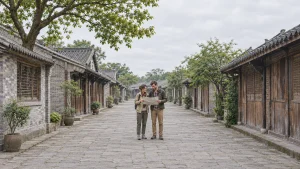
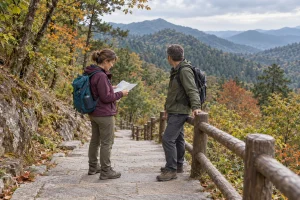
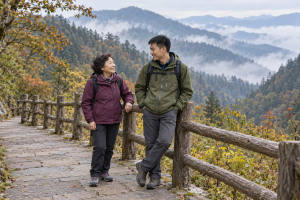
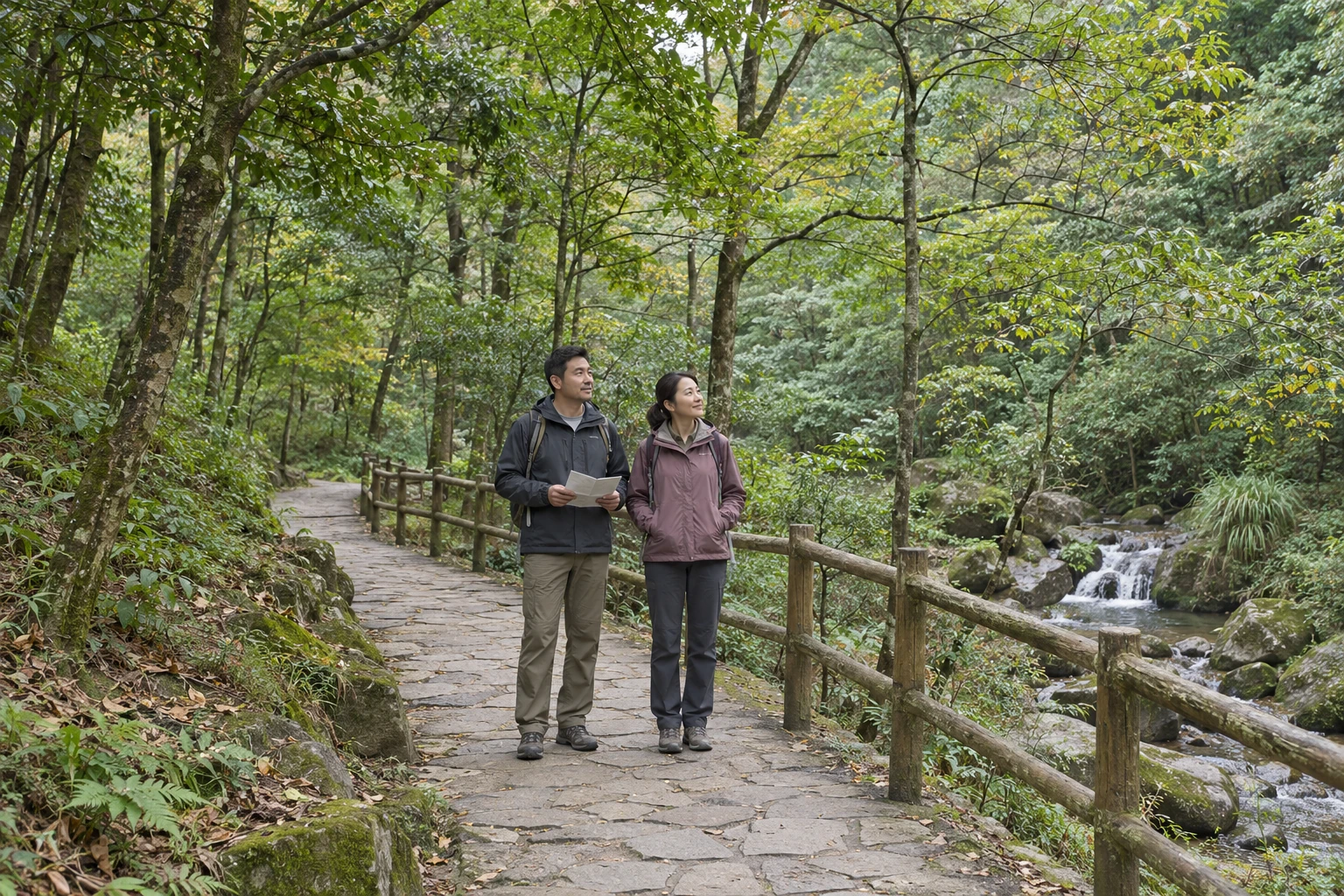
Lead image: AI-generated travel illustration with two fictional adult travellers on a generic maintained Sichuan forest path. It is not a photograph of Wawu Mountain, an exact trail, its cliff boardwalks, current weather, real customers or a Vero Trip departure.
Choose a summit visit or a demanding walking day
The useful distinction is the amount of mountain ascent you intend to walk. A China Tourism News field report from April 2026 describes both cableway access to the upper mountain and walking trails. Its description places the upper landscape around 2,800 metres. A cableway helps with ascent, but it does not turn the remaining forest paths into an indoor, level or weatherproof visit.
For a first visit, ask for a selected upper-mountain route with an identified turning point and a confirmed way down. For a longer hike, obtain the actual entry point, ascent, descents, distance and expected walking surface. The phrase full-mountain challenge describes a different commitment from a summit visit supported by cableways.
| Approach | A sensible focus | What must be established |
|---|---|---|
| Cableway-assisted upper mountain | A selected forest walk and permitted viewpoints, with time to pause and return. | Which cableways and paths are operating, the remaining steps and the return cutoff. |
| Longer managed mountain walk | A walking day on the route currently designated open by the scenic area. | The exact ascent and descent, fitness match, weather decision and exit point. |
| Lower-effort nature interest | A separately confirmed visitor-centre or museum visit, with a short permitted walk if suitable. | Independent opening, entry arrangements and whether this actually satisfies the group. |
A route advertised for a sporting event is not automatically the everyday route for every visitor. Do not substitute an old race map or a social-media shortcut for the current scenic-area instructions. A short option should still name where you turn back, rather than depending on everyone completing a large loop.
Know what the forest and cliff paths offer
In its October 2026 report on the autumn walking season, China County Economic News identifies Banshan Gallery, 半山画廊, and the Lanxi Cliff Boardwalk, 兰溪绝壁栈道, among the named landscape interests. Treat these as specific route choices to discuss, with their own access and effort, rather than additions that must fit every summit visit.
A cliff-side boardwalk may be unsuitable for someone uncomfortable with exposure, narrow passing spaces or wet surfaces. Ask which section is being proposed, how it connects to your selected ascent and where the exit is. A picture of a dramatic waterfall does not tell you the amount of climbing required to reach its viewing path.
For a quieter forest-focused visit, reduce the number of named stops. Pause where the permitted path has room for others to pass, listen for birds and look at the changing vegetation. Keep to the managed visitor route. Do not enter unmarked woodland, follow wildlife away from the path or approach a closed barrier in search of an unobstructed photograph.
The National Forestry and Grassland Administration’s September 2026 account describes nature education around Wawu Mountain, including a Giant Panda National Park museum and interpretive walking activities. This explains the area’s conservation context. It does not make a forest walk a panda-viewing excursion, and access to a visitor attraction does not authorise entry into protected habitat.
Choose the base before fixing the mountain day
There are two useful ways to organise the trip: retain Chengdu as your base and accept a substantial road outing, or sleep nearer Wawu Mountain so the mountain visit begins without the same morning approach. Choose based on walking ambitions and the following day’s commitments, rather than treating either as universally better.
| Plan | Suggested sequence | Main tradeoff |
|---|---|---|
| Return to Chengdu that day | Confirmed pickup, mountain access and the selected walk, then a complete return. | Road time, queues and descent compete with walking time; avoid a tightly timed onward departure. |
| Overnight near the mountain | Approach and check in on one day; visit the mountain the following morning, then return or continue. | Confirm the actual hotel location, passport check-in and transport between the hotel and visitor entrance. |
| A broader Hongya stay | Give Wawu Mountain its own day and put Liujiang on a separate part of the stay. | The old town and mountain need separate time, luggage arrangements and transport. |
These are planning sequences, not fixed tours or a published timetable. For the overnight version, send the exact hotel address to whoever arranges transport. A room described as being in Hongya may not be near the mountain entrance. Check dinner availability, breakfast timing and the next morning’s collection point before choosing a remote base.
Use the Liujiang Ancient Town road-trip guide if a slower town stay is part of the appeal. The town is an alternative cultural block within Hongya, with a different pace from mountain walking. Adding it after a demanding ascent should remain optional; do not let a prepaid second stop dictate a hurried descent.
Keep the return inside the operating day
Confirm the current opening arrangements and the last usable descent for your selected route. Set a turning time that leaves room for queues, rest and the walk back to the relevant station. The last advertised departure is a limit, not a sensible arrival target for a group still on a trail.
For road transport, specify the entrance drop-off, collection location, waiting arrangement and final destination. Agree how to communicate if weather or a queue changes the descent. A driver waiting at the wrong entrance, or a return quotation that stops in Hongya rather than Chengdu, can change the whole day’s practicality.
Keep large luggage at an agreed hotel or in confirmed vehicle storage and carry a day bag on the mountain. Ask whether collection after checkout is possible and whether bags remain accessible during a hotel change. Do not assume a cableway, museum or ticket window provides suitcase storage.
A fixed flight or train after the visit makes the return less flexible. Allow an independently checked road and station buffer; if that cannot be made comfortable, move the mountain visit to another day. No timetable or guaranteed driving duration is implied here.
Match clothing and the fallback to the mountain
Check the forecast and the scenic area’s route notices together. A city forecast does not describe every part of a high mountain. Bring layers, rain protection, footwear suitable for wet walking surfaces, drinking water and food appropriate to the selected day. Keep essentials usable if the day is colder or slower than expected.
In poor visibility, a shorter forest walk can still be worthwhile if the operator keeps the route open and the surface suits your group. Heavy rain, ice, strong wind or a suspension notice can require a different outing altogether. Do not use a cliff path as an automatic fallback for a closed cableway.
Spring flower reports, autumn colours and winter snow describe different visits. The April report records rhododendrons during that season; it does not promise flowers in November. Likewise, an earlier winter carnival does not establish snow conditions, a current activity programme or equipment availability for your dates.
Give mixed-ability groups a route that works for the least comfortable walker, or agree separate arrangements before entry. Ask about steps, slippery stretches, resting places and the distance back from the chosen turning point. Cableway access alone does not establish wheelchair or pushchair suitability.
Passport entry and the difference between a visit and an event
There is first-party evidence of overseas visitors here: Southwest Jiaotong University describes its international students taking sightseeing transport and cableways to Wawu Mountain. That historical account does not publish a current individual ticket workflow. Chengdu University also records international students at the May 2026 birdwatching event; an invited competition is distinct from an ordinary sightseeing booking.
Before paying, have the selected ticket channel confirm how it accepts your passport, how the name is entered and what document is checked on arrival. Carry the document required by that confirmation. Resolve an unsupported document field before travelling rather than assuming that another person’s identification can be used.
Keep this plan within the established scenic-area visitor setting. It does not include a birdwatching competition, a protected-area expedition, night climbing or specialist cliff activities. Announced projects and future resort plans also need their own current operating confirmation before they belong in a proposal.
Separate the Wawu Mountain visit costs
| Cost or service | Ask the written proposal to state | Do not assume |
|---|---|---|
| Entry and mountain transport | Dated admission, each required cableway or sightseeing transfer, and what a promotion covers. | Free admission means a free complete visit or includes all rides. |
| Road travel and accommodation | Pickup, waiting, complete return or onward destination, luggage and any specified overnight. | An entrance drop-off includes the return, or every Hongya hotel is close to the gate. |
| Walking support and personal needs | Route, language of interpretation, meals, equipment and any separately arranged assistance. | An English guide, food, specialist activities or insurance is included. |
Price on request. Services apply only when itemised in the written confirmation. Ask how closures affect the selected route, unused transport and any overnight arrangements. A dated seasonal promotion should be checked against the exact travel date and ticket type; an old screenshot is not a confirmed entitlement.
Questions before choosing Wawu Mountain
Can I visit without doing a full mountain hike?
A cableway-assisted upper-mountain visit is a distinct option, subject to operation and the walking left on your selected path. Specify a manageable route and turning point; do not book a challenge itinerary simply because it uses the same attraction name.
Should I add Liujiang on the same day?
Keep the mountain as the main outing. Put a substantial old-town visit on another part of a longer stay, or make a short stop conditional on the actual descent and return arrangements.
Will I see wild pandas or guaranteed cloud-sea views?
No such sighting is promised. Conservation interpretation and a forest visit are worthwhile without a wildlife encounter, and the weather determines what can be seen from a viewpoint.
Send Vero Trip your dates, Chengdu or Hongya hotel, preferred walking effort, passport booking needs and next departure. Compare the Sichuan hiking guide and the Emeishan and Leshan guide when deciding which mountain experience deserves time in the wider trip, then request one clear route and a complete return.