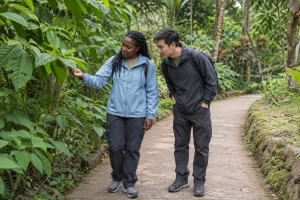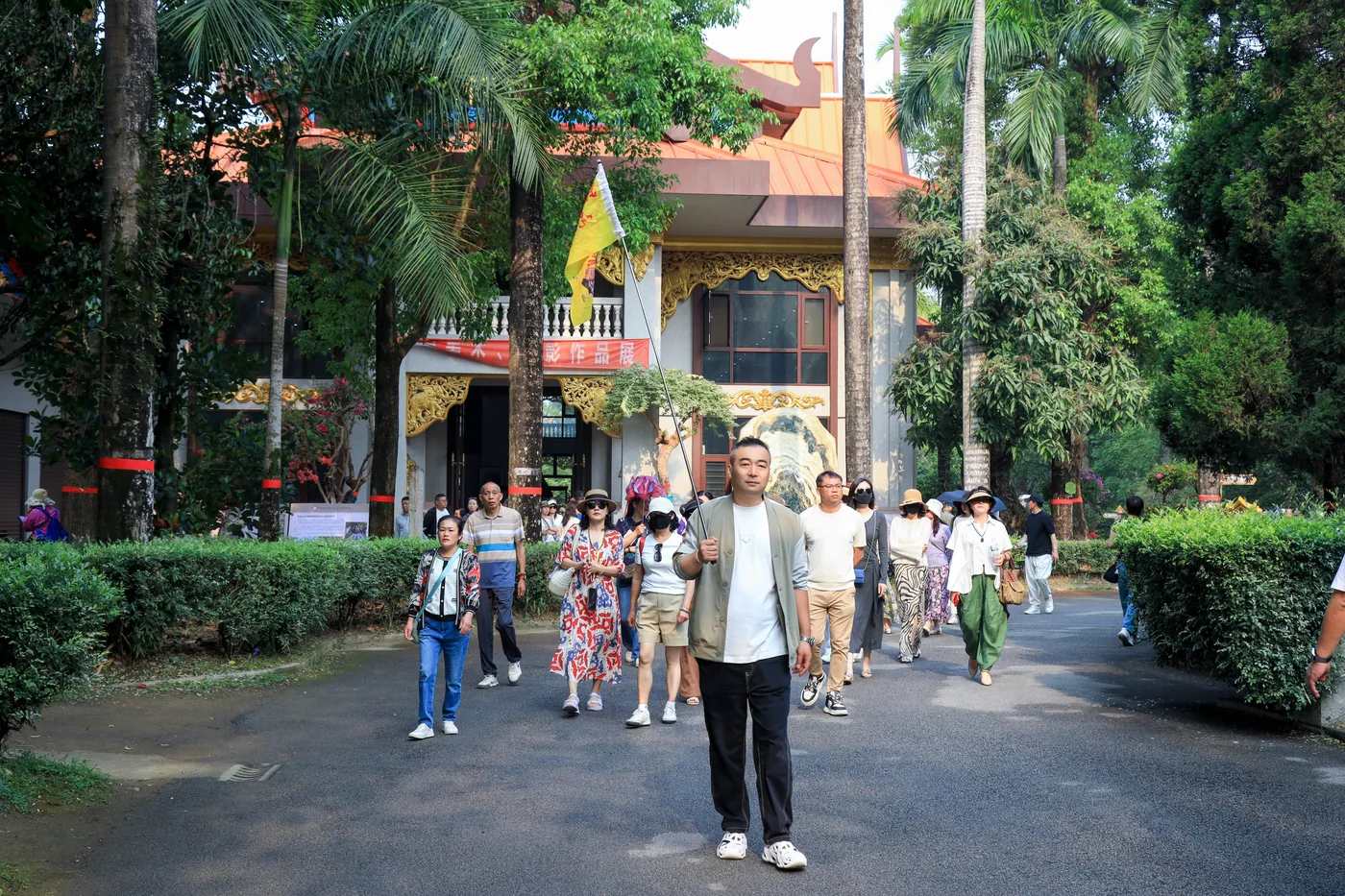
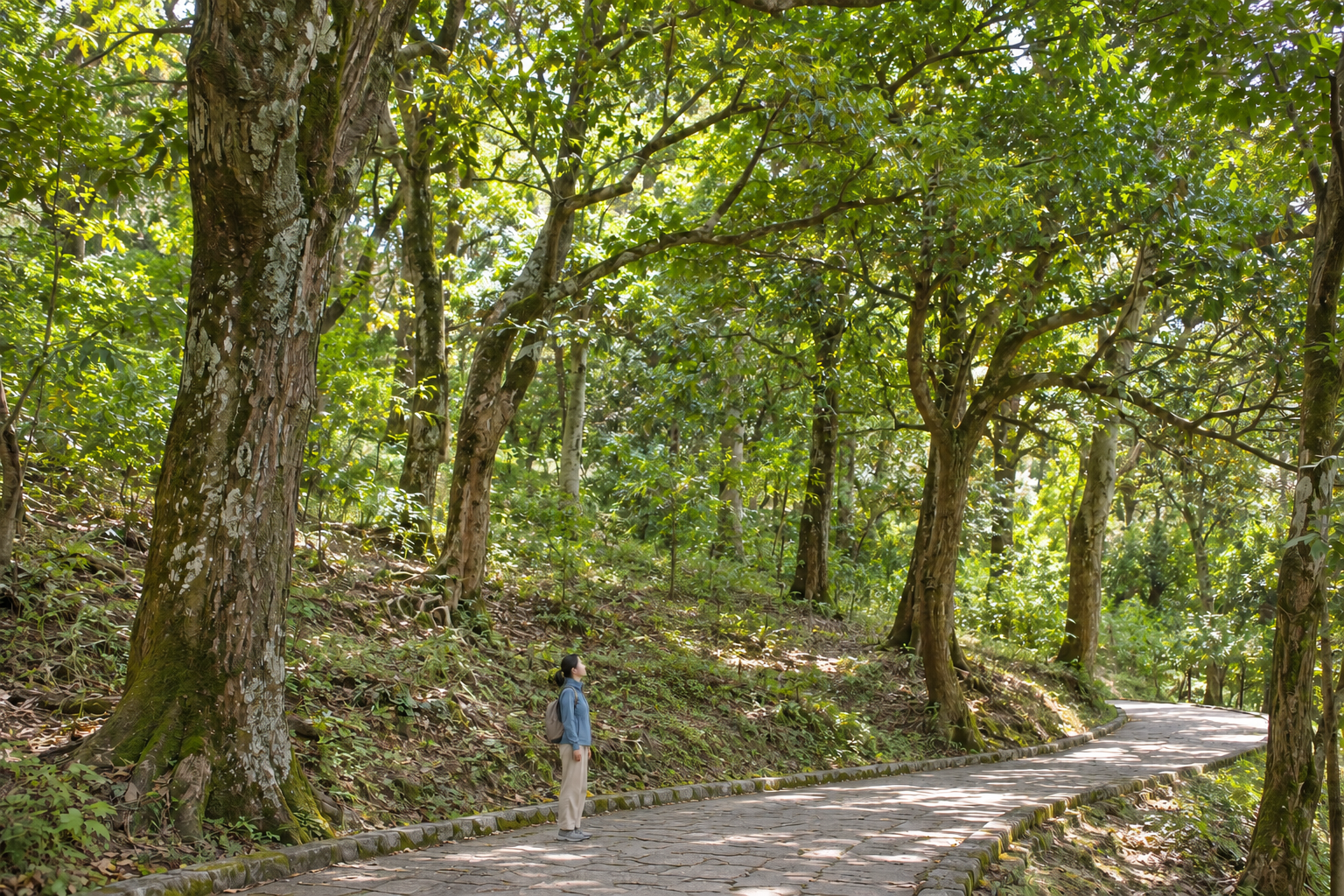
Give Tonghai’s Xiushan a morning for wooded paths, one or two temple courtyards and a slow look at its calligraphy. Have lunch back in town, then leave the afternoon for rest or your onward journey. Staying in Tonghai makes this a more relaxed outing than squeezing the hill between two long transfers.
Xiushan — 秀山 — rises beside the southern edge of Tonghai town in Yuxi, Yunnan. Its appeal comes from the relationship between trees, buildings and writing: a path leads into a courtyard, a roof frames a view, and a short inscription adds another way to understand the setting. This is a cultural hill walk on established visitor routes, with a return you can shorten.
Choose a wooded walk with selected courtyards
The county culture and tourism bureau’s introduction to the historic buildings names Qingliang Terrace, Yongjin Temple, Yuhuang Pavilion and other groups of buildings. Treat those names as choices. Visiting every compound is unnecessary for a rewarding first morning, particularly if stairs or prolonged standing tire someone in your party.
At the entrance, use the current visitor map to choose a public route, a main courtyard and a turnaround point. Confirm the way back before climbing farther. A loop drawn on an old map does not establish that every connecting path or doorway is open today.
| Priority | A manageable focus | Decision on arrival |
|---|---|---|
| Trees and a shorter walk | An open lower visitor section, with pauses and the same-route return. | Ask where the first sustained climb begins and choose a turnaround before fatigue. |
| Architecture and writing | Qingliang Terrace and a small selection of accessible inscriptions. | Confirm the public approach and open courtyard or room boundaries. |
| More hill walking | One open continuation toward Yongjin Temple, with time reserved for descent. | Check the path and your party’s energy before committing to the extension. |
| Modern history | An optional Haiyun Building exhibition stop if it fits the chosen route. | Confirm current access and whether the extra standing and interpretation suit the party. |
Qingliang Terrace — 清凉台 — is a useful subject for a selective cultural visit. Look at how a gate, the space beyond it and surrounding roofs organise your view. Pause outside before stepping through: the building is easier to understand when you can see how it sits against the hill. Choose only rooms and passages marked for visitors.
For a longer walk, ask about the open route toward Yongjin Temple — 涌金寺. A 2022 park maintenance report identifies main visitor paths from Qingliang Terrace toward Yongjin Temple and White Dragon Temple. It helps explain the network, but it is not a current condition report. Choose one continuation rather than assuming both branches belong in the same morning.
Allow time to descend while you still feel comfortable. People who enjoy the ascent can underestimate how much attention a downhill staircase needs. If the first section already feels strenuous, make the shorter return your plan and give the rest of the day to lunch and Tonghai town.
Read a little calligraphy, then look back at the landscape
Xiushan is associated with bianshan lianhai — a mountain of plaques and a sea of couplets. You do not need to read every character to enjoy the connection between writing and place. Pick one inscription, learn its subject, then look at the courtyard, tree or view it accompanies.
The county’s 2018 guide to Xiushan’s inscriptions records a reversible couplet at Yongjin Temple’s Gubai Pavilion: “秀山轻雨青山秀,香柏鼓风古柏香”. Its paired lines play with rain, the hill, cypress and fragrance, including their order when read backwards. This is a historical example to ask about, rather than a guarantee that the original is hanging in an accessible spot on your date.
Start with the shape of the writing. A horizontal plaque above a doorway has a different relationship to the building from a pair of vertical panels beside it. Then ask about the writer, the meaning and whether the object you are seeing is an original, a replacement or a reproduction. These are more useful questions than trying to photograph every panel.
Reading ornate calligraphy through a phone camera can produce uncertain translations. Save a photograph only where photography is allowed, and ask for an explanation of a few selected pieces if this is your main interest. An English-speaking companion needs to be arranged specifically; a driver is not automatically a calligraphy interpreter.
Keep a respectful distance from inscriptions and carved surfaces. The park announced a supervised rubbing activity in September 2021, at Huanhe Building in the Yuhuang Pavilion area. That dated programme is not permission to make rubbings yourself or a promise that a workshop runs daily. Ask about a current organised session separately if it matters to your visit.
One optional history stop at Haiyun Building
If modern Chinese history interests you, ask whether the exhibition at Haiyun Building — 海云楼 fits your chosen route. Yuxi’s July 2025 report describes the reopening of an exhibition about Zhu De’s connection with Tonghai following repairs and revised displays.
The report distinguishes historical documents, photographs and reconstructed living scenes. Keep that distinction when visiting: a recreated room helps tell a story, but it is not evidence that every item remains exactly as it was during the original occupancy. Ask which parts are open before treating this as the main indoor stop.
This is an optional addition, especially for readers with an interest in twentieth-century history. A family mainly interested in trees and buildings can give that time to a shorter outdoor visit. There is no need to add another interior simply to complete a list.
Build the day from hotel departure to the return
From a Tonghai hotel, keep the morning for Xiushan and the meal in town. Have breakfast, leave larger bags with the hotel if storage is agreed, and travel to the confirmed public entrance. Save its Chinese name and the hotel address offline. “Xiushan” alone is an ambiguous destination name outside this local context.
Walk the selected open route, stopping for a courtyard and a few inscriptions. Decide whether to continue while you still have time for the descent. Agree a collection point that a vehicle can legally reach; the place where someone drops you off may not be a permitted waiting place.
After returning to town, have a seated lunch and a proper break. If you are staying another night, an optional short public-street stroll can follow. If you are moving on, collect stored luggage and go to the booked hotel or station. Do not leave the final stage as an unexplained “free afternoon” when it actually contains a substantial transfer.
A visit from Kunming is possible to discuss as a dedicated road outing, but compare the whole hotel-to-hotel day. Do not combine Xiushan, a full Tonghai town programme and Jianshui sightseeing on the same return day. A night in Tonghai gives the hill more attention and removes the pressure of returning to Kunming immediately after lunch.
For rail, check the date’s available services and the exact stations before choosing transfers. Kunming and Kunming South are different departure points. A ticket to the wider Yuxi area does not deliver you to the park entrance. Include the station approach, boarding margin, arrival pickup and hotel connection in your comparison; this guide does not prescribe an unverified train or bus timetable.
What to eat after the walk
Tonghai copper hotpot — 通海铜炊锅 — suits a seated shared lunch. The Yuxi commerce bureau’s food introduction describes a meat-based broth with layered vegetables. Ask about the actual stock, portion size and ingredients before ordering; a pot with plenty of vegetables is not necessarily vegetarian.
For a smaller meal, consider rice noodles and ask whether the shop serves a hot or cold preparation. For something sweet to take away, doumo tang — 豆末糖 is a local layered confection made with soybean powder and sugars. Check the packaging and ingredients rather than assuming all versions use the same recipe.
Tell the restaurant about ingredients you avoid, including sauces and stock, and use written Chinese if communication is difficult. For strict dietary requirements, settle a suitable meal option before the outing. Keep enough drinking water for the walk; buying a few sweets is not a substitute for the lunch break.
Choose the overnight base before the route
Tonghai town is the natural base when Xiushan is the main purpose. Compare properties by their real entrance, vehicle access, nearby dining and the walk with luggage. A room advertised near the old town may still involve steps or a narrow approach. Ask about lift access, bathroom layout and room warmth if these affect your comfort.
Hongta, Chengjiang and Fuxian Lake serve different kinds of Yuxi trip. They are not interchangeable hotel locations for this walk. Our Yuxi base comparison explains the city and lake choices; add Tonghai as a separate stay when its hill and town are priorities.
Kunming remains useful for international arrival and departure connections. If a flight leaves early, compare a final Kunming night with a very early road departure from Tonghai. Protecting the last transfer is often more valuable than adding another sightseeing stop.
| Length | Suggested sequence | Nights and main trade-off |
|---|---|---|
| 3 days / 2 nights | Day 1: arrive in Tonghai, check in and eat locally. Day 2: Xiushan morning, town lunch, rest and same-hotel return. Day 3: breakfast, checkout and booked onward transfer. | Tonghai 2 nights. This starts with arrival in Tonghai; allow the full journey from your preceding city. |
| 4 days / 3 nights | Day 1: arrive in Kunming and transfer to a hotel. Day 2: road to Tonghai, check in and a short town orientation with meals. Day 3: Xiushan, lunch, collect bags and return to a Kunming hotel. Day 4: checkout and departure transfer. | Kunming 1 + Tonghai 1 + Kunming 1. One full Tonghai morning; the afternoon is a transfer. |
| 5 days / 4 nights | Day 1: Kunming arrival and hotel. Day 2: travel to Tonghai, check in and eat locally. Day 3: Xiushan, lunch, rest and return to the same hotel. Day 4: optional short town time, lunch and road back to Kunming. Day 5: checkout and departure. | Kunming 1 + Tonghai 2 + Kunming 1. A separate local day gives more weather and walking flexibility. |
These examples count arrival and departure days honestly. In the four-day version, the hill has one focused morning. The five-day version adds a second Tonghai night so you can keep town time separate or adjust the walk for weather. None promises that an attraction will be open whenever the calendar allows a visit.
If you continue toward Jianshui, use the southern Yunnan gateway comparison to decide how much town time remains before a terrace journey. A Tonghai overnight is an additional base, not a replacement name for a night in Jianshui. For a broader holiday, the southern Yunnan route guide helps identify which longer transfers deserve their own day.
Walking effort, rain and language
Describe your needs in practical terms: how long you can stand, whether downhill steps hurt, whether you need frequent seats, and how far you can walk before a break. A “small hill” can still be a poor fit for someone who needs a reliably level route. Obtain current access information for the exact visitor section if using a wheelchair or pushchair.
Wear shoes with grip and carry a light layer for shaded pauses. In rain, exposed paving and steps deserve extra care. Follow any closure or maintenance barrier and turn back if the chosen route is unsuitable. Do not use a wooded slope or an unsigned shortcut to get around a closed path.
The simple poor-weather alternative is a shorter outing, a town meal and rest. An indoor exhibition only works as a substitute when its entrance and approach are open and manageable. A temple roof does not make the whole walk sheltered, and tree cover does not make a storm a good time to climb.
Keep your accommodation address, entrance name and return arrangement available in Chinese. If you want detailed interpretation of plaques or history, request an English-speaking travel companion for that purpose. Confirm their role separately from transport and ticket assistance.
Admission and the scope of a quoted visit
Foreign travellers have described visits to Xiushan, including in a 2021 first-person account. That provides ordinary visitor context, not proof that every current online booking channel accepts every passport. Establish the actual purchase or collection method, the document to carry and the date’s opening arrangements before travelling.
Check park admission and any separately managed exhibition or activity individually. Older reports of ticket prices, hotel rates and bus departures are not a current quotation. This guide therefore leaves exact charges and operating times to the applicable booking or operator confirmation.
| Part of the trip | Specify in writing | What remains separate unless agreed |
|---|---|---|
| Vehicle and return | Starting hotel, lawful park collection point, waiting, baggage and final hotel or station. | Extra stops, overtime and a change of return city. |
| Admission and interpretation | Named public sections or venues, date, original-passport procedure and guiding language. | Rubbing activities, special exhibitions and access to non-public rooms. |
| Food and accommodation | Lunch arrangement, dietary communication, exact hotel nights and room basis. | Snacks, drinks and hotel upgrades. |
| Price and changes | Current quotation, payment and cancellation terms, weather changes and any insurance arrangement. | A published example does not confirm availability, a departure or insurance cover. |
Price on request. To discuss a Tonghai visit with Verotrip, send your dates, arrival city, party size, walking needs, preferred hotel base and interest in nature, inscriptions or history. A travel consultant can help shape the proposed route; the written itinerary should identify the visits and services actually agreed for your trip.
Questions about visiting Tonghai Xiushan
Is Xiushan a serious hiking destination?
This guide is for established public visitor paths and selected courtyards. It is not a backcountry route. Plan for slopes, stairs and the descent, and choose a short return if a longer hill walk is unsuitable.
Should I stay in Tonghai or make a Kunming day trip?
Choose Tonghai when you want an unhurried morning, a local meal and time in town. A Kunming return requires a dedicated day with the complete transport arrangement settled. Avoid attaching a tight onward flight to it.
Can I visit every hall or book a rubbing session on arrival?
Do not assume so. Public paths, individual rooms and organised activities may have different arrangements. Ask about your named priorities for the travel date and keep the walk worthwhile if an optional interior is unavailable.
Is this the same outing as Tonghai’s Najiaying mosque visits?
No. Xiushan’s wooded hill, courtyards and inscriptions form a different sightseeing purpose. A route mentioning Tonghai or Najiaying does not automatically include this park; Xiushan must appear explicitly in your accepted itinerary.