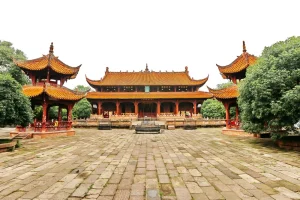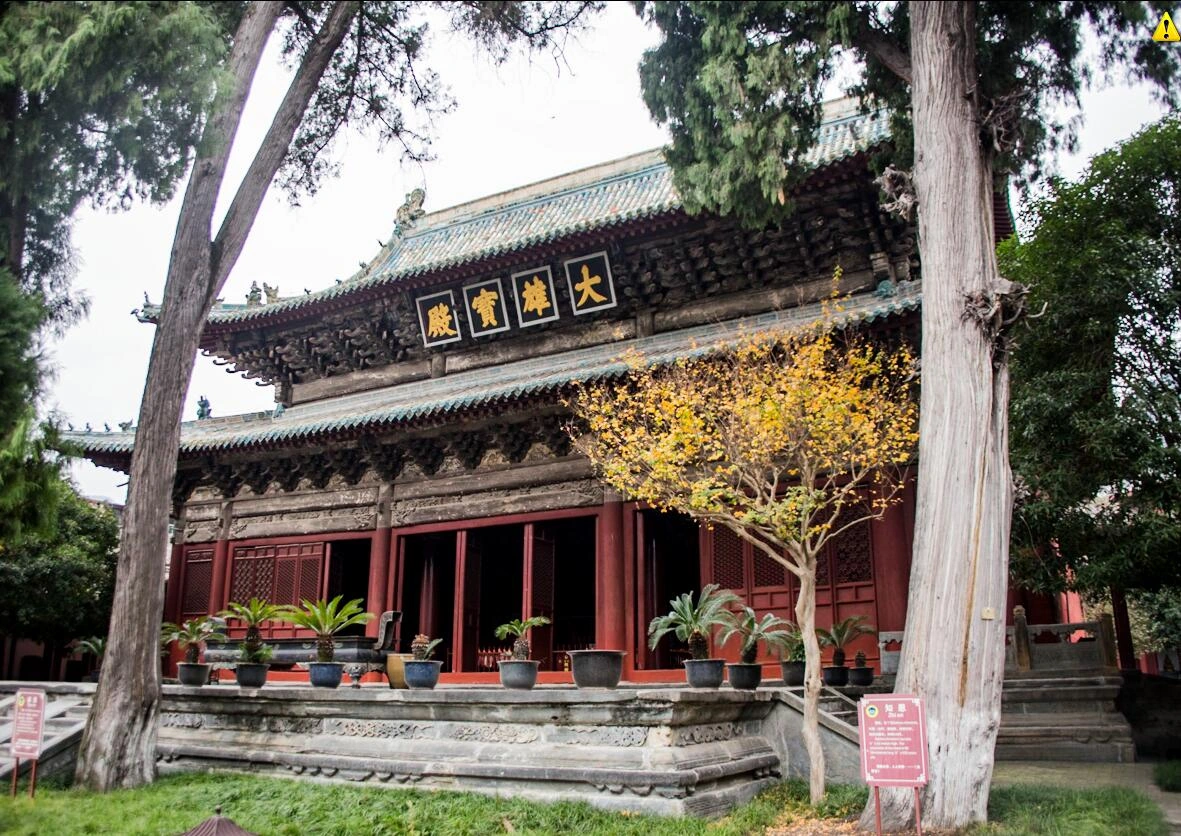
Give Bao’en Temple’s second courtyard most of a short visit. The green double eaves of the main hall rise between two smaller buildings: one houses a rotating wooden scripture cabinet, the other a gilded Guanyin with hands fanning around the standing figure.
Save 平武报恩寺 in Long’an, Pingwu, since other Chinese temples share the name. A county-town stay makes the temple, historic-quarter lunch and return a comfortable half-day. Chengdu requires a separate road journey and overnight.
From the stone pillars to the main hall
Read the three rising courtyards of this east-facing temple alongside the patrons’ story. It faces the Fu River. Fifteenth-century officials Wang Xi and his son Wang Jian oversaw construction; the Ming imperial tablet and rear inscriptions explain their relationship with the court and historical Longzhou.
Begin with the two many-sided stone scripture pillars in the square. The archaeological institute identifies Chinese and Tibetan writing; walk a little around the shafts to see its placement. Assess the rise to the gate before continuing.
In the first court, find Jinshui Bridge and Heavenly Kings Hall. Small figures seem to carry the nameboard on chains. Remember the pose and compare the separate characters beneath the main hall’s eaves.
Step back from the main hall staircase to see both rooflines and the widening timber brackets. Follow one column upward into the interlocking pieces carrying the overhang, then compare with the close view under the eave.
Which hall should you give more time?
| Where to pause | What to look for | When to choose it |
|---|---|---|
| Huayan Hall, 华严藏 | The scripture repository has an eight-sided base and upper tiers shaped like tiny timber buildings. | Choose it first if you like joinery, models or objects with a working mechanism. |
| Hall of Great Compassion, 大悲殿 | Look from the central face of Guanyin to the objects held in the outer hands. | Choose it first for devotional art and figure carving. |
| Main hall, 大雄宝殿 | Compare the two rows of eaves and the platform below. If visible, look for the openwork dragons around the imperial tablet. | A good common stopping point when people in your party want different things. |
| Rear courtyard | Two stone inscriptions stand in matching pavilions in front of the Pavilion of Ten Thousand Buddhas. | Continue if the route is open and the whole party still has energy for the return. |
At the scripture cabinet, work upwards from the eight-sided plinth to its miniature roofs and pavilions. Compare those eaves with the full-sized hall outside. The structure housed sutras — Buddhist scriptures.
The cabinet was designed to rotate, but leave its mechanism to the custodians. At rest, the sides, corners and stacked tiers still explain the construction from the permitted viewpoint.
At the nanmu Guanyin, start with one pair of hands. Find the small Buddha overhead, then a mirror or vessel farther out. The main body came from one large timber; let your eyes adjust to its gilded silhouette and follow photography instructions.
From the court, compare Huayan Hall’s cloud motifs with the lions-and-ball decoration on the Hall of Great Compassion, where visible. Companions staying outside can look here, with a courtyard meeting point kept clear of doorways.
The Palace Museum conservation account explains timber testing and replacement difficulties after the 2008 earthquake. Use that context to ask about an individual repaired beam; colour alone cannot establish its age.
A Pingwu morning, from hotel to lunch and back
After breakfast, leave cases at the hotel and confirm the current visitor entrance. Walk from a suitable central base or agree a legal drop-off and collection from farther out. Save the hotel return address in Chinese.
Begin with the square, steps and bridge, reserving most time for the second court. Restricted side halls can leave an exterior-focused walk. If the cabinet is essential, confirm Huayan Hall viewing before arranging the road transfer.
Walk on to the rear courtyard only if the signs allow and the group is comfortable with more steps. The two inscription pavilions have square lower roofs and eight-sided upper roofs. The pair makes an easy last stop before retracing the public route to the exit. Someone intrigued by the Wang family might prefer to end the temple visit earlier and spend the remaining time in the neighbouring Pingwu Museum. The county museum opened in May 2026. Its opening display included a painted porcelain vase from the tomb of Wang Xi and his wife. Ask what is showing and check its own admission arrangements before setting aside time.
At the Bao’en food quarter, compare menus before sitting down. Walnut cake can be a snack, while hot-and-sour noodles or selected malatang ingredients make a meal. Ask about chilli and any nut allergy before buying shared pastries; vendors vary.
Finish lunch with enough time to walk back to the agreed pickup point. Return to the hotel to collect bags or rest. If you are continuing by road, give the driver the onward destination when arranging the first leg. A transfer that ends at the temple gate leaves the lunch and luggage stops to arrange separately.
Where to sleep and how to divide the nights
Choose a Long’an room for the temple-led stay. Compare the actual dinner walk and vehicle unloading, especially with cases. A rural property elsewhere in Pingwu County can add another journey each way.
| Time available | Suggested nights | What the extra time buys |
|---|---|---|
| Three days, two nights from Mianyang | Two in Pingwu town | Drive to Pingwu on day one. Visit the temple on day two and return to Mianyang on day three. |
| Four days, three nights with a Chengdu start | One in Mianyang, two in Pingwu | Reach Mianyang first, travel to Pingwu the next day and keep day three for the temple. Reserve day four for the agreed return to Chengdu. |
| Five days, four nights with a Chengdu departure | One in Mianyang, two in Pingwu, one in Chengdu | Follow the same route and sleep in Chengdu after the return drive. Leave a separate day for the flight or train. |
Protect the Pingwu night before the visit. A delayed arrival then costs an evening stroll instead of the morning in the halls. A second town night may be more useful than a distant mountain addition for art-focused or slower travellers.
When comparing different Sichuan routes, choose the subject you most want to spend a morning with. The Deyang Confucian Temple guide follows the courtyards used for ceremonies and music. At Huangze Temple in Guangyuan, the connection to Wu Zetian and the cliff carvings give the visit a different focus. For someone especially interested in how a sculptor represents Guanyin, the Yuanjue Cave guide to Anyue describes figures carved in rock. Each calls for its own travel time and base.
Access, weather and costs
For international travellers, China’s London tourism office includes Pingwu Bao’en Temple in its English-language Sichuan itinerary. When arranging your own visit, confirm how a traveller with your original passport can buy or collect admission on the date you plan to go. Keep the temple and the county museum separate when you ask. Take the passport with you and save the booking information offline.
| If this matters to you | What to establish before travelling |
|---|---|
| Steps and standing | Ask about the route from the vehicle to the first court, the side-hall thresholds, places to sit and the way back out. A view of the roof from the courtyard may be easier than reaching a raised interior. |
| Wet weather | Leave room to shorten the walk. Wet paving and steps make the return as important as the climb. Check road conditions with the driver before a long transfer. |
| Language | Request English interpretation for the cabinet, Guanyin and the inscriptions if those are your interests. Agree where the interpreter joins and finishes. |
| Transport and expenses | Specify vehicle, luggage space, waiting through lunch and the final hotel or station. Request separate figures for transport, admission, interpretation, meals and accommodation. |
For a wheelchair user or someone who needs handrails, ask for photographs or a description of the current approach to the particular hall you want to see. The presence of a sloping passage in an architectural plan does not establish a continuous accessible route. If a transfer is already long, leave room for a seated lunch before deciding whether to visit a second building.
Questions about Pingwu Bao’en Temple
What should I prioritise on a short visit?
Go to the second courtyard, look at the double eaves of the main hall, then choose Huayan Hall for the scripture cabinet or the Hall of Great Compassion for the wooden Guanyin. The first courtyard and its bridge will already have given you a sense of the approach. Leave enough time to return by the signed exit.
Can I include it on the way to Jiuzhaigou?
It can work on a road itinerary routed through Pingwu. First check the exact overnight towns on your itinerary and the planned arrival at the temple. A rail journey or a different road approach to Jiuzhaigou may take you elsewhere. An overnight in Pingwu protects a proper morning visit if the previous drive runs late.
Should I choose the county museum as well?
Choose it if you want to follow the patrons’ story from the temple to objects excavated in the area. If timber architecture is the attraction, spend that time studying the eaves and side halls instead. Agree on lunch first if the group has different interests, and check that the museum is admitting visitors that day.
How do I request a Pingwu itinerary?
Send a Verotrip travel consultant your starting city, next hotel or station, travel dates and party size. Mention whether seeing the scripture cabinet, the Guanyin or the complex from its courtyards matters most. Include the number of cases and any difficulty with steps. Price on request. Ask for the complete road journey, hotel nights, meals, admission and language assistance you want to see itemised in the written proposal.
Cover photograph of the main hall by Nekitarc, 22 November 2016. Converted to WebP and cropped for display under CC BY-SA 4.0.