To experience Munao Zongge in Yunnan, choose a confirmed public event in Dehong, then arrange accommodation and transport around that event’s actual venue and date. A traditional lunar-calendar reference, a short dance video and a visitor participation session are different kinds of information. None alone confirms that a particular celebration will welcome visitors when you arrive.
Munao Zongge (目瑙纵歌), also written Manau in some English material, is associated with Jingpo communities in Dehong in western Yunnan. Longchuan (陇川) is named in the national heritage record. Plan with the full Chinese event name, year and venue; “Dehong” describes a region, not one festival gate.
Updated 28 October 2026
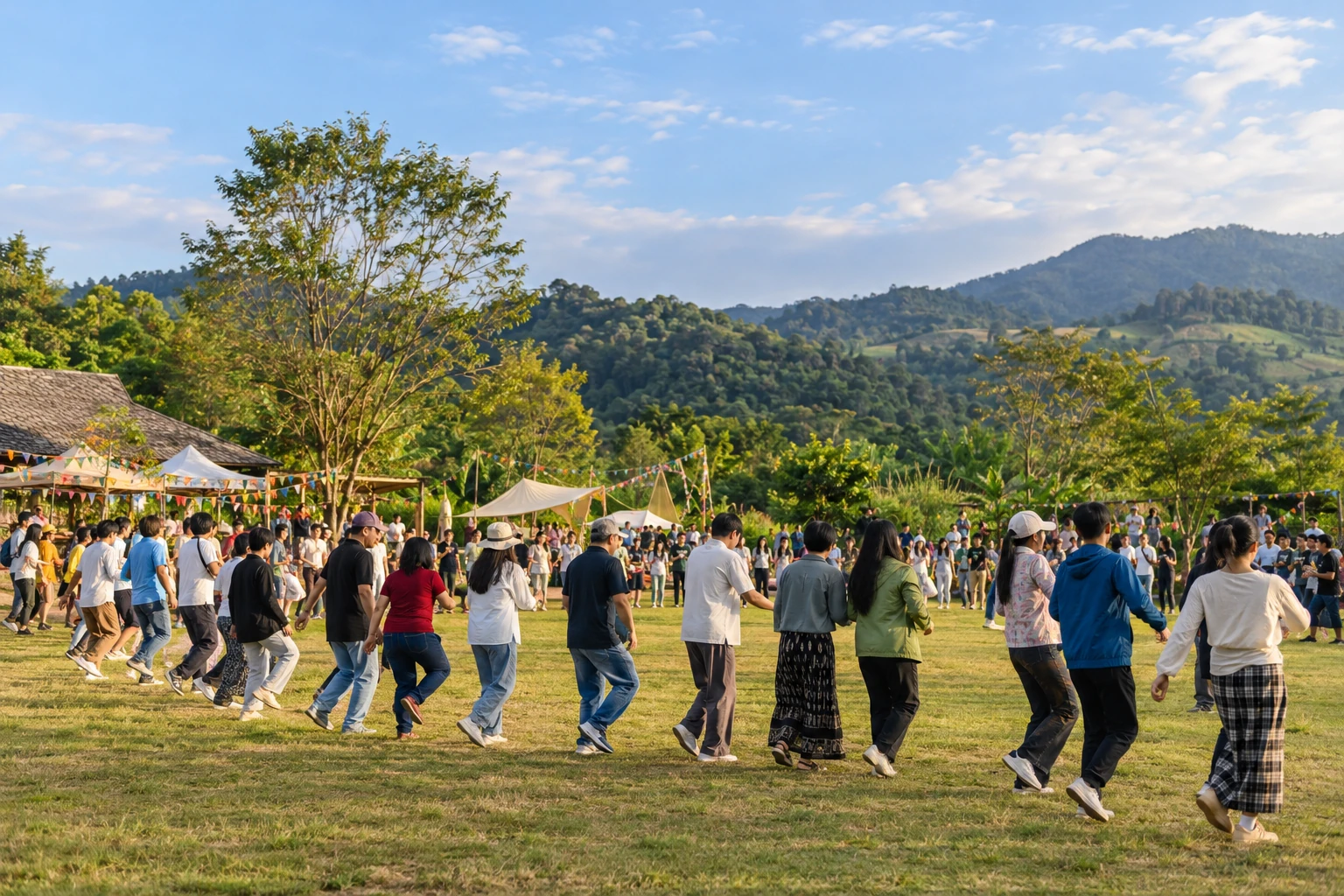
The opening image is a festival-participation illustration. It does not document a Munao Zongge event, Jingpo dress, traditional choreography or a Verotrip group.
What are you going to see?
China’s national intangible heritage register lists Jingpo Munao Zongge in its first batch, announced in 2006. It describes a tradition of collective celebration in which organised dancing is central. The cultural setting includes music, meaningful objects and community practices; it is more than a tune that visitors can copy from a screen.
The provincial heritage centre describes dedicated dance leaders, called naoshuang and naoba in its Chinese account, who guide the formation. As a visitor, the useful lesson is to observe the direction and follow the organiser’s instructions rather than inventing a route into the dancing area. Watching respectfully is also a complete way to participate in the day.
Heritage records explain the significance of the decorated central posts and related objects. Treat them as part of the host community’s cultural space. Do not climb, lean on, handle or move anything for a photograph, and do not assume an open event makes every ceremonial area available to spectators.
How do you choose an event and a date?
The heritage descriptions associate the traditional festival with the first lunar month. That background is useful for understanding the celebration, but it is not a published visitor programme for every future year. Choose your date from the relevant organiser’s current announcement, including which portions are public.
| What you found | What it tells you | What you still need |
|---|---|---|
| A heritage description | Cultural background and the traditional calendar association | A current event announcement for the year and venue |
| A festival programme | A dated set of activities at named places | Public access, admission or registration conditions and any changes |
| A visitor dance session | A particular participation opportunity | Its own date, meeting point and instructions |
| A social-media clip | What the creator chose to show at one time | Original location and date; it is not a booking or live schedule |
Read the year as carefully as the day and month. A previous celebration may remain prominent in search results long after it has ended. Do not convert a lunar date yourself and assume that all associated activities will happen on the resulting Gregorian date.
A June 2026 provincial publicity article describes both the tradition and its circulation through adapted music and online dance videos. This helps explain why the same name can appear in very different settings. A performance using the music elsewhere is not automatically the festival you intend to attend in Dehong.
Before non-refundable travel, establish what is actually being offered: a public gathering, an organised demonstration, an invitation-based community event or a separate visitor activity. If there is no current announcement you can use, keep the wider trip flexible instead of selling yourself an imaginary fixed festival day.
Where should you stay?
Choose the event venue first, then compare accommodation. Mangshi can be part of a wider Dehong trip, but a room there is not proof of a short transfer to an event in Longchuan or another county. Ask for the whole road journey from the hotel’s actual address to the authorised drop-off point.
For an event-led visit, staying near the confirmed venue may reduce repeated road travel. The trade-off is that you need to settle meals, room suitability and arrival arrangements in the same area. Check the exact property, bed arrangement, stairs and check-in requirements for your party before reserving.
Do not choose a room only because its name includes the festival or the region. Ask how you will reach the site, where the vehicle can wait and how you return if the programme runs late. If availability is tight, compare a different event date or a different regional itinerary rather than accepting an unsuitable transfer plan.
How should you arrange the event day?
Keep one confirmed event session as the main purpose of the day. Leave time to understand the layout, find the spectator area and hear the instructions. A crowd can make the final approach slower than a road map suggests.
| Stage | A practical action | Avoid this problem |
|---|---|---|
| Before leaving the hotel | Check the current programme, entry method and meeting point | Arriving with a screenshot from another year or another town |
| On arrival | Locate the spectator area, rest point and exit | Standing in a route needed by dancers, staff or emergency access |
| Before joining | Ask whether visitors may enter and where to follow | Cutting across the formation for a photograph |
| During the visit | Take breaks and keep your group together | Assuming everyone wants to dance or remain in a dense crowd |
| After the session | Meet at the agreed landmark and use the planned return | Expecting a driver to find you inside the crowd |
If your party includes children or people who prefer a quieter experience, arrange a shorter visit and an obvious place to regroup. One person can enjoy the music while another rests without either having to complete an identical programme. A named meeting point is more useful than “near the entrance” when several approaches are in use.
Can visitors join the dancing?
Join only when the organiser or host indicates that your part of the event welcomes participation. Watch first, listen to the briefing and enter where directed. Follow the leaders and the flow of the formation; do not push through a line or make an improvised route to the centre.
Wear comfortable clothes and footwear suitable for standing and moving on the actual ground. Traditional clothing is not a costume requirement to infer from photographs. If a rental or dress activity is offered, ask what it involves and how the host wishes the clothing to be used; do not turn cultural objects into props without permission.
You do not need to carry a ceremonial object, imitate a filmed display or perform for social media to have a worthwhile visit. Leave specialised roles and objects to the people responsible for them. Ask an interpreter to explain an unfamiliar detail when there is an appropriate pause.
What should you check about access and costs?
A festival name does not settle entry conditions. Check the exact session and the actual sales or registration channel. If an offer has eligibility conditions, make sure they apply to your passport and party before relying on it.
| Arrangement | Question to ask | Keep this separate |
|---|---|---|
| Public attendance | Which activities welcome visitors, and is registration or admission required? | An open square does not establish access to every ceremony or performance |
| Participation | Where and when may visitors join, and what instructions apply? | Watching and entering the dance formation are different choices |
| Language support | Who will explain the programme and practical instructions? | A driver is not automatically a cultural interpreter |
| Transport | What are the pickup, permitted drop-off, waiting and return arrangements? | An event ticket is not a vehicle reservation |
| Quoted total | Which meals, admissions, accommodation and services are included? | A promotional benefit or demonstration is not a complete package |
Keep confirmations and contact details available offline. If a form does not accept your identification, ask the organiser for the appropriate visitor process rather than entering invented information. Do not assume an invitation, discount or giveaway seen in an advertisement is available to every traveller.
How do you photograph without disrupting the event?
Use the public spectator positions and follow the event’s camera rules. Ask before close portraits, especially of children or someone preparing for a role. A wide public scene and a close photograph of an individual are different requests.
Do not stop a line of dancers, block a leader’s route or move into the centre for a dramatic angle. Let an agreed photograph take a reasonable amount of time, then leave the person free to continue. Paying for transport or a ticket does not buy personal photography permission.
Keep your account of the visit accurate. A public demonstration, a traditional celebration and an informal group dancing to the same music need different descriptions. Do not label unfamiliar clothing or identify someone’s community from appearance alone.
What makes the day comfortable for your party?
Plan for standing, walking, weather and noise rather than assuming a festival means a seated show. Ask about the ground surface, steps, toilets, shade, seating and the distance from vehicle drop-off. For a wheelchair or stroller, obtain details of the whole route, including the return.
Carry water, sun or rain protection appropriate to the forecast, and keep a meal plan that fits your dietary requirements. Ask about ingredients and preparation rather than assuming every stall can meet a particular allergy or halal requirement. If the necessary information cannot be supplied, use another agreed meal option.
Follow current weather and crowd-management instructions. A delayed or changed programme is a reason to adjust the day, not to enter a restricted area. Keep a less crowded alternative in your plan and leave enough time before an onward flight or another long transfer.
How does it fit a wider western Yunnan journey?
Separate the event appointment from the ordinary sightseeing route. If Tengchong and Mangshi are also interests, the existing seven-day Tengchong and Mangshi culture-and-nature itinerary shows one regional travel pattern, with four nights around Tengchong and two in Mangshi.
That itinerary covers Heshun, Rehai, Beihai Wetland and Mangshi visits; it does not include a Munao Zongge event or a Longchuan festival transfer as a stated daily stop. Use it to discuss the wider journey, then ask whether a confirmed event can be added with the necessary nights and transport. Do not replace one of its days with an unconfirmed festival promise.
Questions before building the trip
Can you travel on the traditional lunar date and find a public event?
Use a current organiser’s programme. The cultural calendar explains the tradition but does not guarantee the public venue, attendance conditions or timetable for your visit.
Do you need to dance to enjoy the day?
No. Watching, listening and understanding the cultural setting can be the purpose of the visit. Make participation optional within your party.
Does a festival trip mean crossing an international border?
Do not add a crossing by assumption. This guide concerns a Yunnan visit. Any international extension is a different journey with its own current entry and transport requirements.
Ask for an event-led plan with clear conditions
Send Verotrip your dates, the event announcement you are considering, starting and ending places, party size and preferred language through Plan My Trip. Mention whether you want to watch or join, together with walking, crowd, food and room requirements.
Ask for a written proposal that names the event and venue and states what transport, interpretation, accommodation, admissions and meals are arranged. A planning discussion does not confirm access to a community event, a particular performance or an English-speaking host.
Cultural background: the national Jingpo Munao Zongge heritage record and the Yunnan heritage centre’s description. For the distinction between the tradition and online adaptations, see the June 2026 provincial publicity article.