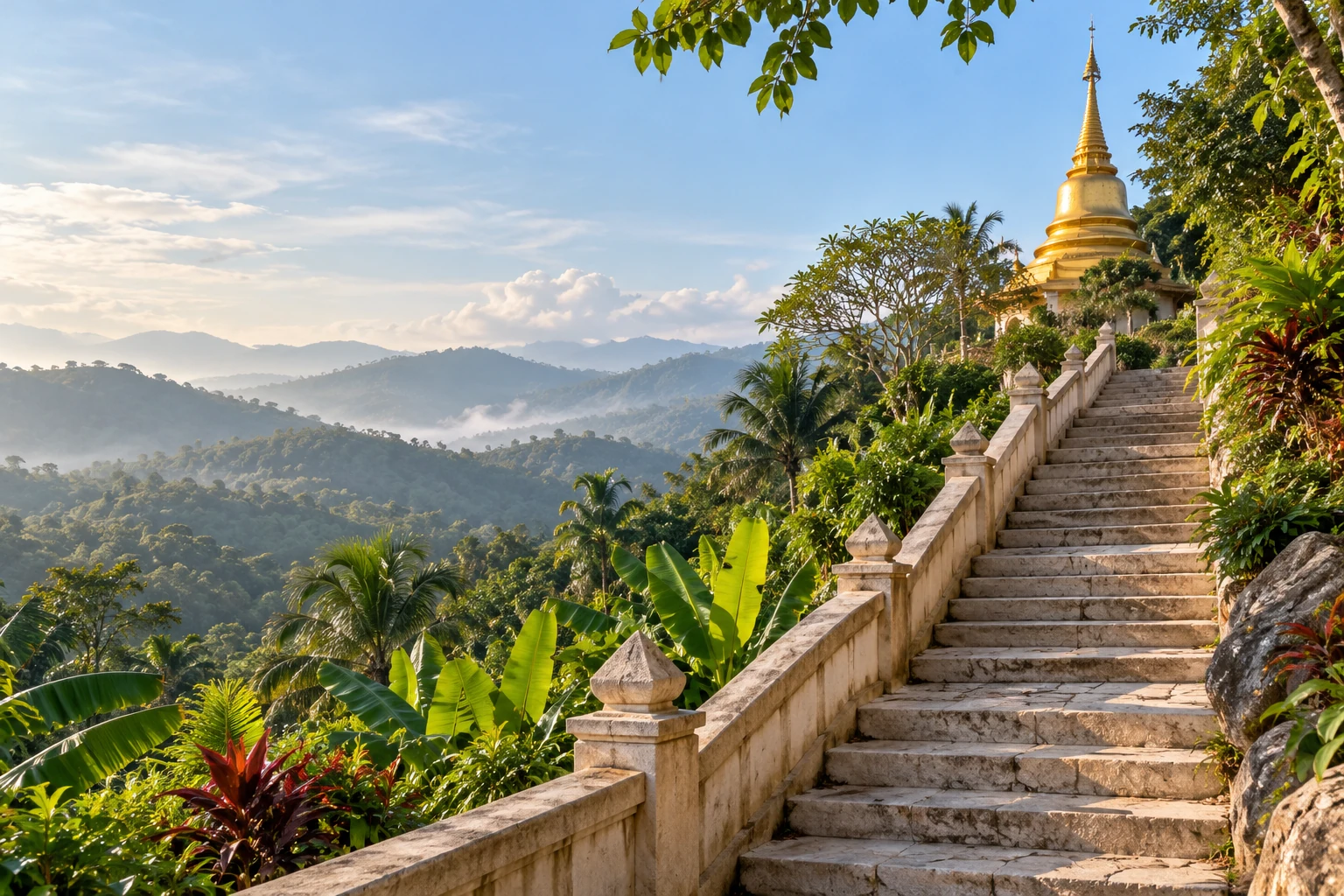
Choose Mengle Cultural Tourism Area for a hillside outing combining Buddhist architecture, cultural interpretation and views over Jinghong. Allow a half-day as a starting point, choose your walking level before buying transport extras, and treat any theatre performance as a separate booking decision. It is a different destination from Zongfo Temple beside Manting Park.
The name “Mengle Buddhist Temple” remains common in English travel searches. For bookings and transport, save 西双版纳勐泐文化旅游区, the full Chinese name of Mengle Cultural Tourism Area. This guide helps you choose the visit, understand the names and avoid relying on an old ticket bundle. The opening image is a hillside-stupa illustration, not a photograph of Mengle, its actual buildings or its walking route.
Mengle Temple, Mengle Cultural Tourism Area and Zongfo Temple
The attraction’s own website identifies the destination as Mengle Cultural Tourism Area. A 2019 report of its religious-site handover records the change from the former Mengle Buddhist Temple scenic-area name. That history explains why older maps, photographs and tour descriptions still use “Dafo Temple” or “Big Buddha Temple.” They do not establish which ticket or visitor service operates today.
For a location reference, Amap lists the attraction on the lower section of Puti Avenue in Jinghong. Send the full place name and pin to your driver or accommodation. “Take me to the big temple” is too ambiguous for a city with several Buddhist sites.
| Place name | What it means for your plan | Avoid this mix-up |
|---|---|---|
| Mengle Cultural Tourism Area — 勐泐文化旅游区 | The destination commonly searched as Mengle Buddhist Temple or Dafo Temple | Do not substitute a booking for another temple with “Big Buddha” in its name |
| Xishuangbanna Zongfo Temple — 西双版纳总佛寺 | A separate religious destination associated with the Manting area | It is not a connecting entrance to Mengle |
| Manting Imperial Garden — 曼听御花园 | A city-garden visit with its own ticket and activity choices | A Manting day or evening purchase does not establish access to Mengle |
If you mainly want a garden walk and a respectful temple visit within a city half-day, compare the Manting Park planning guide. Choose Mengle when its larger architectural setting and hill views are the priority. You do not need to visit both simply because both appear in a short Xishuangbanna highlights list.
What to look at, beyond taking a quick photograph
Use the buildings as the reason for the outing. The 2020 renaming report identifies Jingpiao Hall (景飘大殿), the auspicious Buddha image (吉祥大佛) and other religious buildings within the wider site’s history. It also distinguishes religious spaces from tourism operations. A sightseeing ticket should not be read as permission to enter every hall, interrupt worship or stage photographs anywhere.
The golden tower known as Zhuangkai Dajinta (庄凯大金塔) is another useful name to recognise on a visitor map. The operator’s website shows its distinctive grouped golden spires above the city. Look at the relationship between the tower, the hillside and the urban view rather than searching only for the angle in a social-media photograph.
Select two or three interests: exterior roof forms and ornament, a permitted religious-space visit, and a viewpoint if conditions allow. Ask a guide to explain the difference between a building’s cultural references and the age of the visible structure. The site’s royal-temple history does not mean that every building you see is an unchanged ancient original.
Walking, sightseeing vehicles and the outdoor lift
Start with the amount of climbing your group can comfortably do. A hillside attraction can require both uphill effort and a tiring descent. Ask for the current visitor map, the location of each transport stop and the walking still needed between that stop and your chosen buildings.
A 2025 report by Xishuangbanna newspaper reporters describes a completed outdoor sightseeing lift and newer cultural attractions. This helps explain why older advice focused entirely on stairs may be incomplete. It does not guarantee the lift is running on your date, that it is included in admission or that the entire visit is step-free.
Ask which direction a vehicle ticket covers, where you board and whether it returns you to the entrance you need. An uphill ride followed by walking down is only useful if everyone is comfortable with the descent. Do not choose that arrangement solely because another visitor described it as easy.
| Your group | Choose the route this way | Ask the operator |
|---|---|---|
| Comfortable with steps | Choose a limited walking circuit with a rest before the return | Which paths are open, where the climb ends and how to shorten the descent |
| Older relatives or children | Prioritise a few buildings and reduce repeated climbing | Current vehicle stops, queues, seating and toilets near the selected route |
| Wheelchair or stroller users | Confirm a continuous usable route before committing | Steps, boarding gaps, lift operation, doorway access and the return route |
| Travelers who dislike heights | Choose architecture and lower sections if those are suitable | Which optional viewpoints or transport involve exposed heights; alternatives if skipped |
A wide terrace in a photograph does not establish accessible travel from the gate to that terrace. If a specific lift or vehicle is essential to your visit, make its availability a decision point before payment. If the route cannot meet your needs, choose another city outing rather than relying on companions to carry equipment or a traveler on steps.
Read the ticket by its components
Compare the exact product name and visit date. Admission, internal transport, a named performance and a hotel transfer solve different needs. A discounted bundle is useful only when the included elements are ones you want and can use at the stated times.
Before paying, ask the seller to confirm:
- The visit date, admission session, last entry and applicable exit time.
- Which internal vehicle or lift, if any, is included, with direction and boarding point.
- The exact performance, seating or viewing arrangement, entry location and finish time.
- Whether a transfer covers both journeys, the pickup area and the agreed return location.
- The identity document and booking procedure for each foreign-passport holder, plus any concession evidence.
- The change and cancellation terms for the selected product.
If a booking form requires a Chinese ID number and offers no passport option, ask the operator for the appropriate channel. Do not enter invented details. Keep the booking record and the contact method you can actually use in China; a translated attraction name alone will not resolve a mismatch at entry.
Separate religious giving from tourism purchases. The historical handover reports describe distinct management of religious spaces and the tourism business. If you choose to make an offering, first establish what it is and who receives it. Do not assume a paid ritual or a separate purchase is required to complete an ordinary sightseeing visit.
How to arrange a relaxed half-day
Use a half-day as a planning allowance, not an official visit duration. A short architecture visit and an extended visit with a performance use very different amounts of time. Your actual walking route, weather, queues and interest in interpretation determine the pace.
| Part of the outing | Useful sequence | Keep this flexible |
|---|---|---|
| Before departure | Eat, confirm the ticket and return pickup, and carry a suitable covering layer | Delay the visit if an essential access question is unresolved |
| At the entrance | Check the current map and choose the walking and transport arrangement | Remove an upper section if the return route would be too demanding |
| Main visit | Choose architecture, a permitted hall and a viewpoint, with a seated pause | Follow current access and photography instructions at each space |
| Finish | Meet at the agreed gate and return for a meal or rest | A performance needs its own confirmed schedule and meal plan |
For a day with no performance, keep the remaining time open for lunch and a hotel break. For a performance-focused day, work backwards from its confirmed start and finish rather than filling the morning with another demanding outing. A ticket title that includes “night” does not establish a continuous all-day stay or permission to leave and re-enter.
On arrival day, only retain the visit if your actual arrival, hotel transfer and rest leave enough usable time. On departure day, protect the airport or railway connection first. A sightseeing-vehicle queue is not included in a map’s drive estimate.
Deciding whether to add a performance
The local reporters’ 2025 account describes two different productions: Heart of the Elephant (象之心), with an elephant-conservation narrative, and Night Banna: Dai Charm (夜版纳之傣魅), drawing on the Peacock Princess story. Use the Chinese production names when asking what is currently offered. They should not be treated as interchangeable translations of one ticket.
Ask about language, how much movement is involved, seating, sound and lighting, weather changes and the return journey. For children or someone sensitive to effects, obtain the current programme description before choosing. Decide whether the performance adds something your group wants; it need not be attached to an architecture visit.
Do not expect a dramatic production about elephants to be a wild-elephant viewing activity. Likewise, a tourism performance is a different context from a religious ceremony. Keep those purposes distinct when deciding what you want to experience and photograph.
Clothing, photography and respectful visiting
Wear clothing that covers shoulders and knees as a practical starting point for religious spaces, and bring a light layer if your sightseeing outfit does not. Follow posted instructions about shoes, hats and photographs at each hall. Dress for walking as well: shoes chosen only for a portrait may be uncomfortable on a longer stair route.
Ask before photographing worshippers or staff. Leave entrances and steps clear, lower your voice around worship and follow any restriction on posing or camera equipment. A rented costume or a photographer’s agreement does not establish venue permission. Commercial photography requires its own arrangements.
For a wider introduction to cultural visits, read our Dai village etiquette guide. Courtesy at a temple, an invitation into a home and permission for a staged shoot are different matters.
Heat, rain, food and the return journey
Carry water and sun protection, and shorten the climb if the group is already uncomfortable. Use footwear with grip on wet surfaces. In heavy rain or thunderstorms, follow staff instructions and change the outdoor plan; rain protection is not a reason to continue onto a closed route. Our heat and rainy-season guide explains how to leave alternatives in the itinerary.
Choose the meal before extending the visit into the evening. For specific dietary needs, arrange an appropriate restaurant rather than assuming a temple setting establishes vegetarian or halal food availability. Use the Xishuangbanna food and ordering guide for practical ingredient questions.
Save the Chinese hotel address and the agreed meeting pin. Confirm whether pickup is at the same entrance as drop-off, particularly if you leave after a performance. Keep large luggage at accommodation when storage is agreed; ask the attraction directly about any storage you would need on site.
Questions before visiting Mengle
Is Mengle the same as the temple beside Manting Park?
No. Use the full Chinese names and separate map pins. Mengle Cultural Tourism Area and Xishuangbanna Zongfo Temple are different destinations.
Does internal transport remove all the walking?
Do not assume it does. Ask about the route between the boarding point, buildings, toilets and exit, as well as the operating status of any essential facility.
Must I buy a show ticket to visit?
Choose the actual sightseeing or performance product you want and read its scope. Do not infer compulsory show admission, universal bundles or re-entry rights from an old travel post.
Fit Mengle into your Xishuangbanna trip
The Xishuangbanna attraction guide helps you balance a Jinghong cultural outing with a botanical day or an arranged community visit. Avoid pairing distant attractions just to fill a day.
Through Plan My Trip, send your dates, hotel or arrival point, party size, children’s ages, comfortable walking level and whether architecture or a named performance is your priority. Identify any essential mobility or dietary requirement. Ask for the proposed admission, transport, guiding, meals and performance scope to be listed separately in the written plan.
Related Journeys to Compare
These existing routes offer starting points for the region or travel interests discussed above. Read the full daily itinerary to see what is included. A visit described in this guide, a specialist session or an international border crossing is added only when confirmed in your own programme.