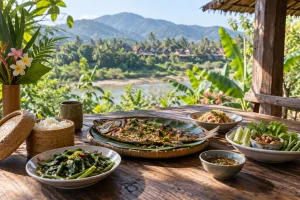
For a first taste of Xishuangbanna food, start with a seated Dai-style meal in Jinghong, then use a market visit for a few small tastings. Choose a rice dish, a vegetable dish and a fully cooked main dish that suit your group. Check the seasoning and portion size before adding more. A comfortable meal often tells you more than a long list of stalls visited in one evening.
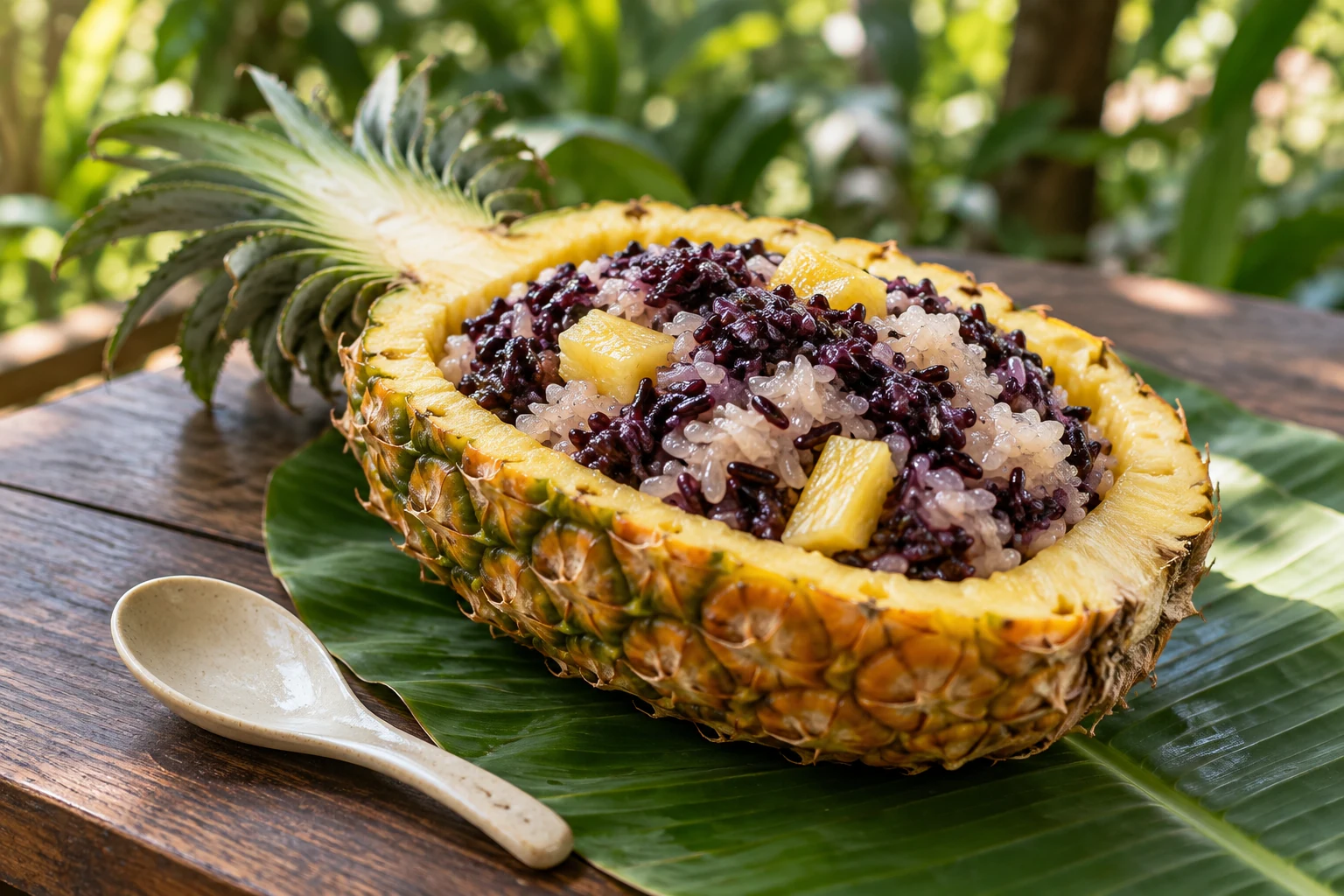
This guide explains useful dish names, how to choose restaurants and what to ask about chili, sauces and dietary needs. Dai food is an important part of Xishuangbanna’s food culture, but it does not represent every community or every restaurant in the region. The opening image is an illustration of pineapple sticky rice, not a photograph of a particular restaurant or its serving.
What makes a Dai-style meal distinctive?
Sticky rice, sour flavors, herbs and dipping condiments provide a useful starting point. The National Ethnic Affairs Commission’s introduction to Dai food customs describes bamboo-tube rice, pineapple purple rice, sour bamboo shoots and nammi dipping condiments. Treat these as an introduction to a varied cuisine, rather than a fixed recipe that every kitchen follows.
When reading a menu, separate the main ingredient from the cooking method and the seasoning. A leaf-wrapped dish may contain fish, pork or another filling; a rice dish served in a pineapple is not necessarily the loose fried rice you have eaten elsewhere. Point to the Chinese name and ask the kitchen to explain the particular version it makes.
Six dishes and preparations to recognise
Use the names below to start a conversation, not to order everything at once. For two people, first establish how large the rice and main dishes are. Add another dish if needed rather than assuming each photographed serving is intended for one person.
| Menu name | What you are choosing | Question before ordering |
|---|---|---|
| Pineapple purple sticky rice — 菠萝紫米饭 | A sticky-rice preparation with pineapple; different from loose fried rice | Is it sweet, how large is the serving, and what else is added? |
| Bamboo-tube rice — 竹筒饭 / 香竹饭 | Rice prepared in bamboo; the contents and portion vary | What is inside this version, and is one tube a snack or a substantial serving? |
| Lemongrass grilled fish — 香茅草烤鱼 | A seasoned fish dish; expect to ask about bones and chili | Is the fish whole, and can the seasoning be adjusted before cooking? |
| Leaf-wrapped preparation — 包烧 | A preparation name, not a guarantee of one particular filling | Which ingredient is wrapped inside, and what sauce or seasoning is used? |
| Pounded chicken feet — 舂鸡脚 | A chicken-foot dish with a distinctive texture and sour seasoning | Are there bones, how spicy is it, and what is in the dressing? |
| Green papaya salad — 青木瓜沙拉 | A papaya-based salad whose dressing determines much of its flavor | What is in the dressing, and can chili or other ingredients be left out? |
A recent regional food introduction describes lemongrass fish, pounded chicken feet and pineapple purple rice among local food interests. A published resort menu also illustrates English and Chinese names for papaya salad, pineapple rice and leaf-prepared fish or pork. That undated menu is useful for terminology; it is not a current price list or a promise that a dish is available today.
Choose one unfamiliar flavor or texture at a time. If chicken feet do not appeal, there is no reason to order them to complete a checklist. Ask about a fully cooked fish or chicken dish instead. If a whole fish is inconvenient for children, ask whether another preparation can be served with bones removed, and check the actual serving yourself.
Restaurants, night markets and hosted meals: how to choose
Choose the setting by the job you need the meal to do. A restaurant is useful when everyone needs a seat and a complete dinner. A market works better when the group is comfortable browsing and sharing a small number of purchases. A hosted visit requires an arrangement with a willing host; it is not an invitation to enter someone’s home.
| Setting | Best reason to choose it | Check first |
|---|---|---|
| A seated restaurant near your hotel or day route | A complete meal, a rest and time to discuss the menu | Seating, toilets, opening on your date, ingredients and the full order price |
| Gaozhuang Xishuangjing market area | Browsing and a few tastings alongside an evening out | Where you will sit, payment, portion units and the return pickup point |
| A produce market visit | Understanding herbs, vegetables and ingredients | Whether food is ready to eat; ask before photographing vendors or handling produce |
| An arranged meal with a local host | Conversation and food in a cultural-visit context | Host agreement, meal scope, language support and dietary requirements in advance |
A current provincial report describes Gaozhuang Xishuangjing as a mixed area of accommodation, dining, photography and entertainment. It can be a convenient evening choice if it fits your accommodation and transport. Its popularity does not establish that every stall is cheaper, more traditional or better than a restaurant elsewhere.
For accommodation choices, see Jinghong versus Menglun. Avoid making dinner in Jinghong the fixed end of a day based elsewhere without checking the return journey. If you have only just arrived, a nearby seated meal can be a better first evening than a cross-city food search.
Order a balanced meal without ordering too much
Begin with the staple. Decide whether you want plain rice, sticky rice or a sweet pineapple-rice dish, and ask how many people a serving suits. Then choose a vegetable dish and a cooked main dish. Ask whether a sour salad or dipping sauce would add a different flavor, rather than ordering several dishes that all use the same strong seasoning.
When dining as a group, tell the server the number of adults and children and ask whether the quantities are sensible. A large shared platter may be attractive, but compare its actual contents with what your party wants to eat. Confirm whether rice, sauces, drinks or other items are included in the stated price.
Read the price unit before agreeing to fish, barbecue or a large fruit purchase. A price may refer to a portion, an item or a weight. Ask the seller to show the total for the quantity you have selected before preparation. This is more useful than planning around an online average spending figure that may describe a different order.
Useful ordering questions in English and Chinese
Save these questions on your phone. Point to the dish as you ask, and wait for a specific answer. A translation app helps with communication, but a short translated label cannot establish every ingredient or kitchen practice.
| What you need to know | Chinese question | How to use the answer |
|---|---|---|
| Can this be made without chili? | 这道菜可以不放辣椒吗? | Ask before cooking; a premixed marinade may not be adjustable |
| Can the dipping sauce be separate? | 蘸水可以分开放吗? | This does not remove seasoning already in the dish |
| Does it contain meat, meat stock, fish sauce or shrimp paste? | 里面有肉、肉汤、鱼露或虾酱吗? | Name your own exclusions too; this is a question, not a complete ingredient list |
| Is the price per portion or by weight? | 这是每份价格还是按重量算? | Ask for the selected order total before preparation |
| How many people does this dish serve? | 这道菜够几个人吃? | Compare the answer with your other dishes and appetites |
Mild food, vegetarian meals, halal needs and allergies
Less chili is a preference that needs an ordering conversation. Ask whether chili can be omitted, rather than assuming “a little spicy” means the same thing to both of you. A separate sauce gives you more control over that sauce, but it does not change a prepared dressing or marinade. Keep a plain staple alongside stronger dishes if that suits your group.
For vegetarian or vegan meals, describe ingredients. A vegetable name or a tofu photograph does not settle the question of stock, sauces or added meat. State whether you avoid eggs and dairy as well as meat and seafood. Ask the kitchen to propose a specific suitable preparation. Do not assume that every version of sticky rice or salad has the same additions.
For halal requirements, establish the standard you need before choosing the venue. A fish dish or a meat-free appearance does not confirm halal ingredients, preparation or certification. If you require a certified venue, ask to see the relevant current evidence and confirm the meal arrangement. Tell a trip planner your requirements early rather than expecting a general Dai restaurant to meet them automatically.
For a food allergy, explicitly name the allergy and the ingredient. Explain it to staff each time, including when ordering by QR code, and ask about sauces and shared preparation equipment. The NSW Food Authority’s eating-out guidance supports this communication approach. It does not establish how any particular restaurant in China operates. If the kitchen cannot give a clear answer or accommodate the requirement, choose another meal arrangement.
Fruit, drinks and freshly cooked food
For an uncomplicated fruit purchase, select a whole fruit and ask for it to be cut fresh, or peel it yourself where practical. Ask what is added to a juice or blended drink if sugar, milk or another ingredient matters to you. Confirm the size and price before ordering several drinks for the group.
Choose fully cooked meat and fish, and do not treat a sour dressing as a substitute for cooking. An official food-safety reminder specifically warns that acid and alcohol do not reliably make raw aquatic foods safe. This is a general food-handling point, not a reason to avoid the cuisine. Look for food being handled and prepared in a way you are comfortable with, and leave a dish if its preparation is unclear.
A comfortable food evening for families
Protect the main meal first. After a day outdoors, let the group sit, order something familiar enough for everyone and discuss which local dish to share. Once people have eaten, a short market browse can be enjoyable without the pressure of finding dinner for a tired child.
Choose a meeting point before splitting up to buy food, keep bags together and agree how you will return to the hotel. Save the hotel name and address in Chinese. If rain changes the plan, use a nearby indoor meal rather than trying to visit every intended stall. Do not place a long tasting evening immediately before an early departure if it removes the time needed to pack and rest.
Make food part of a longer Jinghong stay
The existing three-day Jinghong Dai Food and Culture Tour uses two nights in Jinghong, with a local-market and temple day and a possible village-host visit when arranged. It gives food and cultural conversations room between meals and midday rest. A late arrival or early final-day departure requires the schedule to be adjusted.
Ask for the actual meals, tasting scope, host arrangements, guiding language, admissions and transport to be listed in the written proposal. The itinerary name does not mean every tasting, dietary adaptation or workshop is included. Read the Dai village etiquette guide before a hosted visit, and use the Xishuangbanna travel guide to balance food with your other interests.
Common questions about eating in Xishuangbanna
Is every Dai dish spicy?
Do not judge the whole meal by one dish. Ask about chili in each preparation and choose a combination your group enjoys. Sourness and chili heat are different qualities; a sour dish is not automatically mild.
Can I have dinner entirely at a night market?
You can choose that format if seating, ingredients and payment work for your group. For a first evening with children or strict dietary needs, a seated meal followed by a few tastings is often easier to organise.
Should I reserve a hosted meal in advance?
Yes. Confirm that a host is willing and available, the meal scope and your requirements before traveling. A village visit does not automatically include a family meal, cooking activity or permission to photograph people.
Plan meals with Vero Trip
Through Plan My Trip, send your dates, accommodation area, group size and ages, food interests and specific dietary needs. Say whether you want a relaxed restaurant meal, market introduction or arranged cultural visit. Ask for a proposal that identifies the meal arrangements and their limits, so food fits naturally into the holiday.