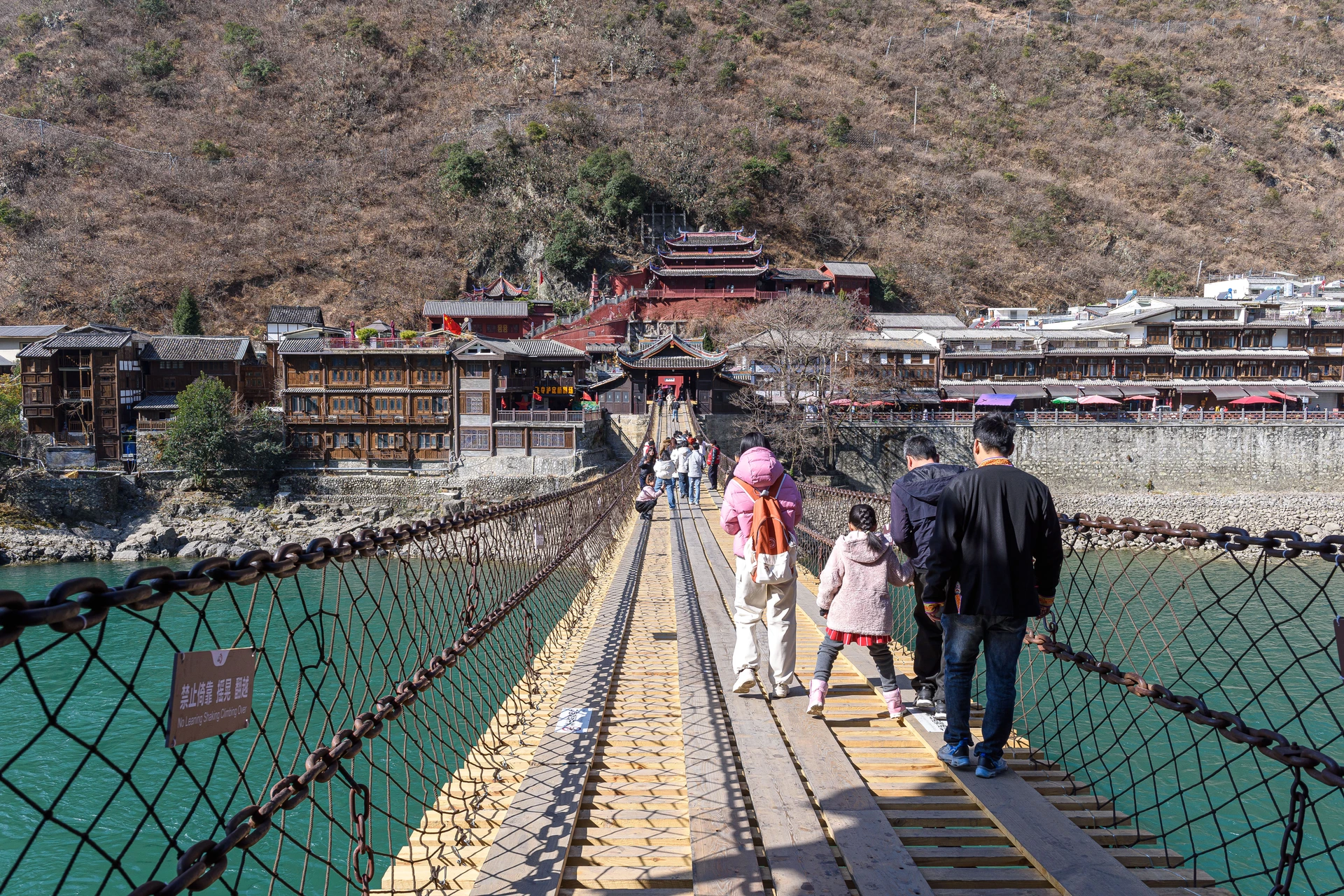
Begin on the Dadu riverbank at Luding Bridge, tracing the chains between its two roofed entrances. Cross only if the deck is open and you are comfortable with movement and views through to the water. A bank visit, lunch and the separate Long March memorial museum offer another complete way to experience the town.
A Luding night on the Chengdu–Ya’an road gives the bridge a morning before the next drive. A passing stop can also work. Name the arrival and collection bank; the landmark pin in mid-river gives a driver no pickup place.
Reading the bridge from the riverbank
Begin where you can see the span from the side on an open, marked public path. At just over 100 metres, it is short enough to take in both ends at once. The lines along the top frame the footway. Lower down you can see the curve carrying the deck. The traditional design has thirteen iron chains. Nine run underneath the decking and two on each side form the handrails. The large interlocking links are easiest to distinguish near a bridgehead.
At a bridgehead, follow the chains into their land anchorages and look at the timber pavilion framing the narrow footway. The eastern end has the Kangxi-associated inscription. Built from 1705 to 1706, the crossing replaced reliance on ferries and simpler rope routes.
Keep later engineering distinct from the thirteen-chain design. A worker’s 2026 interview describes supporting steel cables added below the deck. The downstream red-arched road bridge and other high valley crossings are separate structures.
| What interests you? | Where to spend your time | What to look for |
|---|---|---|
| The construction | Start with a side view, then approach one bridgehead on the signed route. | The sag of the lower chains, their individual links and the change from a hanging deck to solid ground. |
| The experience of crossing | Read the entrance notice and ask where you will emerge before joining the queue. | The feel of the wooden deck and its movement. Take photographs from firm ground. |
| The Long March | See the crossing from the bank, then give the memorial museum a separate block of time. | On a map, trace where the approaching troops came from and why the river constrained their choices. |
| A short road stop | Use a single bridgehead, with a seated lunch near the same meeting point. | The Qing-era crossing in the middle of a working county town. |
Deciding whether to cross
Before paying, look at the moving deck and the gaps above the river. Long-distance walking ability does not establish comfort here. Companions can stay on the bank; save a named meeting place in Chinese before separating.
The scenic area’s published visitor notice lists restrictions for people with limited mobility, pregnant visitors and people with certain conditions, including vertigo, a fear of heights, high blood pressure or heart disease. It advises visitors of advanced age to stay off the bridge and requires a parent to accompany children under twelve. Check the posted notice on arrival for the complete rules. For a group that includes someone who cannot cross, make the shared part of the visit the bank and lunch. Anyone eligible who wants to cross can do so separately.
Follow the direction staff are using that day. Keep to the designated boards, give the person ahead room and put the phone away while moving. The visitor notice prohibits shaking the chains, lingering on the span or setting up a selfie stick or other photographic equipment there. Plan your photographs before or after the crossing. If the exit is on the other bank and traffic is one-way, ask staff for the current pedestrian route back or have the driver meet you at an agreed legal stop on that side.
Why add the Long March memorial museum?
Read two histories at the same crossing: the early-eighteenth-century route and the Red Army’s capture in May 1935. The bridge gives the river scale; the memorial museum can explain the campaign’s geography, Anshunchang and the approach along the valley.
Plot the memorial museum entrance in the monument park southwest of the centre. It is separately listed from the bridge. Compare the actual walk and bank connections, using another vehicle drop-off if that better suits the group.
In the museum, begin with a route map or chronology when available and connect it to the river just visited. Check open galleries and interpretation language separately. One historical visit can work without a performance or a promised display object.
A county-town lunch and a complete visiting day
For lunch, consider Luding liangfen with guokui — cool starch jelly and crisp flatbread — asking for the chilli dressing separately. A warm alternative is douhua fan, soft bean curd with rice. Check the day’s dishes, broth, sauce and toppings for anyone avoiding meat.
From a Luding hotel, leave bags after breakfast and begin at the riverbank. Guests can choose different crossing plans and meet for lunch. Add the museum if open, then rest or collect bags; a nearby dinner venue is useful in rain.
For a road stop, agree the latest departure before leaving the vehicle. Keep to one bridgehead, a workable crossing return and lunch on the collection side. Drop a rushed museum visit if traffic has shortened the stop, checking a local room if the onward drive becomes impractical.
Where to sleep and how to divide the drive
Choose a county-town hotel for the bridge and museum. Check the bank, unloading point, steps to reception and breakfast route. Compare a specific river-facing room with a quieter street position rather than relying on the hotel’s map pin.
| Time available | Overnight bases | How the visit fits |
|---|---|---|
| 3 days, 2 nights from Chengdu | First night in Ya’an, second in Luding. | Travel to Ya’an on day one. Continue to Luding on day two, eat lunch and visit the bridge. Leave time on day three for the road back to Chengdu. |
| 4 days, 3 nights from Chengdu | One night in Ya’an and two in Luding. | Use the transfer afternoon for the bank. Spend the full day on the crossing, a local lunch and the museum. Return to Chengdu on day four. |
| 5 days, 4 nights with a split return | First night in Ya’an, two nights in Luding, final night in Ya’an. | Keep the full Luding day. Break the return drive in Ya’an on day four. Reach Chengdu on day five. |
If your flight or train departs Chengdu early, spend the preceding night in Chengdu and shorten the earlier programme accordingly. The table ends at the city rather than at a particular terminal. On the five-day plan, a Ya’an night also gives you the option of a short separate visit if the road and your departure allow it. Shangli Ancient Town has a different bridge-and-courtyard walk. Allow it its own time instead of trying to fit both towns into a single sightseeing stop.
On a longer trip, check where Luding falls in the daily itinerary. Day twelve of Verotrip’s 13-day Gongga and Kham self-drive route descends from Kangding through Luding to Chengdu, with a vehicle hand-back at the end of the day. A bridge stop or museum visit needs to fit that return and be agreed separately. For the larger geographical picture, see the G317 and G318 route comparison. The county-town visit described here ends in Sichuan.
Access, weather and costs
Bring your original passport for ticket collection. One booking channel describes redemption for foreign passports at the visitor centre. Check the instructions attached to the exact ticket you intend to use, particularly if an online form asks only for a mainland identity number. Ask separately about the museum. The bridge and the museum are different entrances, and a confirmation for one does not establish entry to the other.
| Before you leave | What to establish | Why it changes the day |
|---|---|---|
| Approach and collection | Arrival bank, open entrance, place to store luggage, pickup address and waiting time. | A one-way crossing can finish some distance from the vehicle. |
| Rain or river conditions | Open approach road, staff instructions, bridge operation and whether the museum is receiving visitors. | A museum visit or a meal in town can replace the crossing. Follow closures and stay away from unmarked banks. |
| Tickets and help | Passport handling, admission to each place, language support, meal arrangements and any room charges. | It lets each traveller choose the bank, bridge or museum and understand what they are paying for. |
Price on request. State the starting point, next overnight and who wants to cross. Separate the vehicle, waiting, interpretation, tickets, meals, baggage and rooms. For an independent visit, save the hotel, meeting point and museum in Chinese offline.
Questions about visiting Luding Bridge
Is it still worth visiting if I stay off the bridge?
Yes. From a permitted bank viewpoint you can see the dip of the chains and how the bridge ties the two sides of town together. A close look at one bridgehead followed by the memorial museum is a complete visit for someone interested in engineering or history.
Which way should I cross?
Ask at the open entrance on the day. The workable direction depends on how staff are managing visitors. Arrange to meet your companions on a named bank and check how you will reach lunch or the vehicle before stepping onto the deck.
Can I include the bridge on the drive back from Kangding?
It can fit as a town stop if conditions and the final journey allow. Account for leaving the through road, parking, walking in, lunch and getting back to the car. A vehicle hand-back or evening departure in Chengdu makes a long museum visit harder to fit.
Do I need to stay in the county town?
A short bank visit can work while passing through. Choose an overnight if you want time to read the museum displays, eat locally and approach the river again in different light. Two nights give you a complete day between drives.
Visitor information comes from the scenic area’s account of the bridge, its bridge and memorial museum directory, a 2026 interview with a bridge repair worker, the visitor notice reproduced with ticket information and Ganzi’s suggestions for meals in Luding.
Cover photograph of Luding Bridge from the east by N509FZ, 5 February 2026. Resized and converted to WebP, with responsive cropping. The adapted photograph uses the same CC BY-SA 4.0 licence. Original photograph.