Plan Wangtianshu as a dedicated rainforest outing near Mengla, with the elevated canopy walk as a choice rather than an obligation. If you are staying in Jinghong, compare the complete outward and return journey before booking. A forest-floor walk can still be the main reason to visit if you prefer to avoid heights, provided the ground route suits your group.
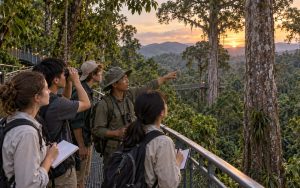
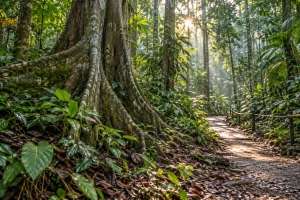
Wangtianshu Scenic Area (望天树景区) is not the tropical botanical garden in Menglun and is not a short city-garden stop. This guide explains how to choose the forest, canopy and river elements, arrange the last transfer and keep a workable alternative when conditions change. The opening image is a rainforest illustration, not a photograph of Wangtianshu, an identified tree or a visitor route.
Where is Wangtianshu, and why make the trip?
Save 望天树景区售票大厅, the scenic-area ticket hall, when discussing the destination. The operator’s published travel information uses that name for navigation. Ask the operator or your driver which entrance and meeting point apply to the product you are actually buying, especially if a boat journey is involved.
The provincial location reference places Wangtianshu outside Mengla county town. Mengla, Menglun and Jinghong are different places: a booking near the Menglun botanical garden does not put you beside Wangtianshu. Write the Chinese place names beside your hotel and transport reservations.
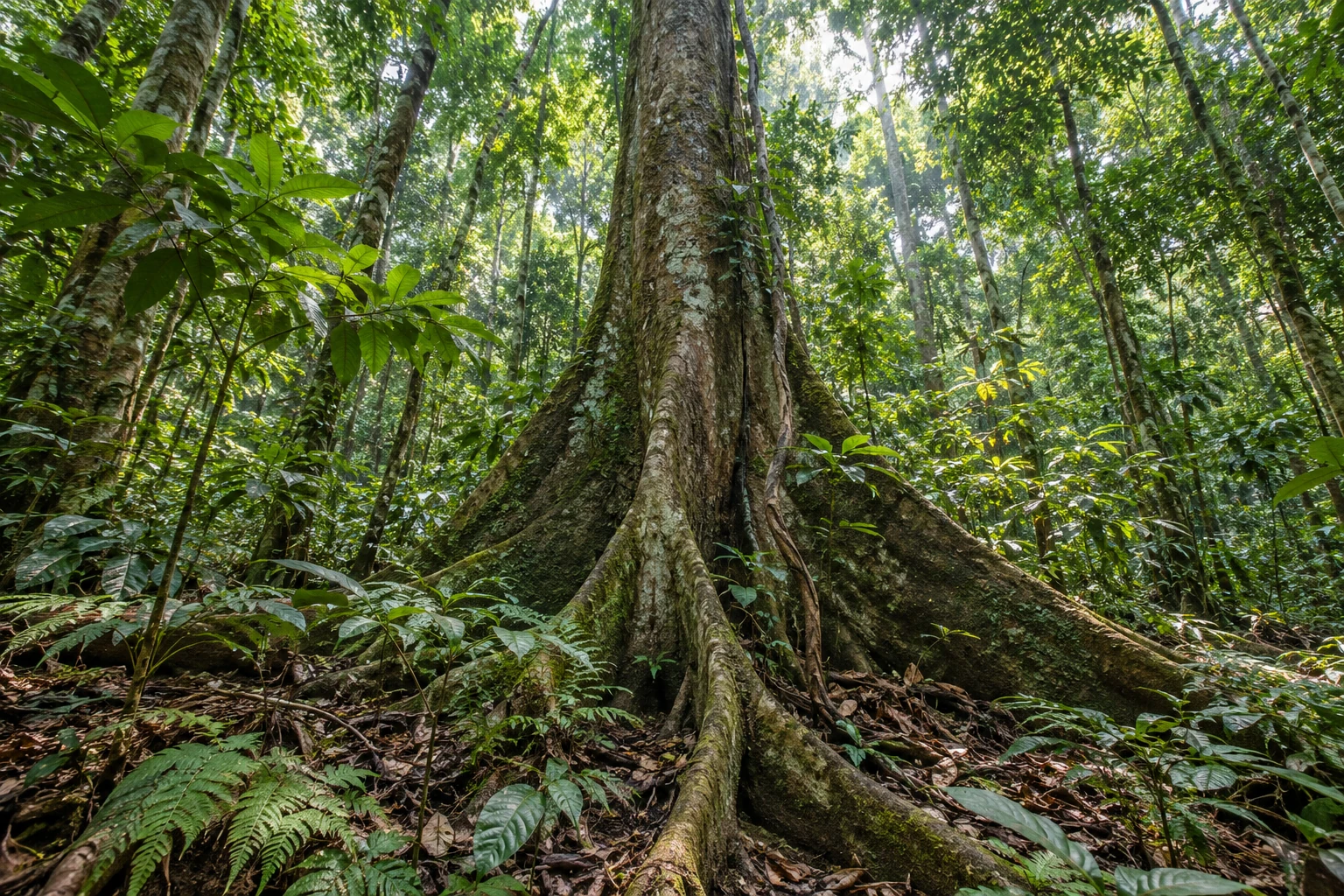
The forest is the attraction, not only the bridge. An account hosted by the Chinese Academy of Sciences botanical garden describes wangtianshu as a representative tall rainforest tree, with a straight trunk, a high crown and buttress roots. Looking at the tree from the ground and understanding the layers around it is a different experience from moving through the canopy.
Choose your experience before choosing a bundle
A regional media-centre introduction distinguishes the elevated walkway, forest walking and Nanla River sightseeing. These offer different viewpoints on the same landscape. You do not have to buy every activity to make the journey worthwhile.
| Experience | Choose it for | Check before committing |
|---|---|---|
| Forest-floor walking | Looking closely at trunks, roots, vines and the layered forest | Current route length, steps, surface, rest points and exit options |
| Elevated canopy walkway | A high-level view of foliage and the feeling of walking above the ground | Which walkway, operating status, entry restrictions, approach and exit route |
| Nanla River sightseeing | A separate riverside perspective or a boat element in the visit | Boat type, boarding point, direction, weather arrangements and what the ticket covers |
For a first visit, make the forest walk the core, then add the canopy or river element that interests you. If someone in the group does not want the elevated walkway, agree the permitted alternative and a meeting point before anyone enters. Do not leave a child or a traveler needing assistance to wait alone.
Is the canopy walk right for you?
Decide about height exposure before standing in an entry queue. Ask staff to show you the current approach, walkway and exit arrangement. Photos taken from a platform may not show the steps needed to reach it or the entire crossing.
“Canopy walkway,” “tree-crown corridor” and “glass walkway” can appear in translated descriptions. Ask which exact facility the ticket names. Do not assume two photographs show the same route, or that buying general admission automatically includes every elevated activity.
Follow the operator’s current eligibility rules, staff instructions and weather closures. For children, ask about the applicable age or height conditions and required supervision. A concession category is not proof that a child can participate in every activity. If you have a health condition that affects participation, discuss your own situation with an appropriate clinician and give the operator the information it needs to apply its rules.
If you dislike heights, you can choose not to enter. Do not plan on staff being able to reverse the route midway through a crossing. If the elevated activity is the sole reason for your journey, ask what happens to that ticket component if it cannot operate, before making a non-refundable booking.
What to notice on a ground-level rainforest walk
Slow down at a few points rather than making the walk a race to the canopy entrance. Look from the base of a tall trunk towards the crown, then compare the vegetation at eye level with what is growing overhead. A guide can help explain which features belong to the tree itself and which belong to plants using it for support.
Where visible from the permitted path, compare the broad plates of buttress roots with smaller roots, notice a woody climber’s route towards the light and look for plants growing on branches. Ask your guide to identify a feature before assigning it a name. A plant on another tree is not automatically a parasite.
For families, give each person one observation task: find different leaf shapes, compare two trunk textures, or sketch how the canopy closes above the path. These activities do not require leaving the route, collecting leaves or touching unfamiliar plants. Keep the task short enough that children still have energy for the return.
Do not expect a particular bird, insect or mammal to appear on schedule. The useful outcome is understanding more of the forest, not obtaining a guaranteed wildlife photograph. Stay on the visitor route and leave roots, plants and animals undisturbed.
Jinghong day trip, rail connection or Mengla overnight?
Count door-to-door travel, not just the train journey or the attraction visit. The operator’s 2025 visitor information describes road travel and a rail journey to Mengla followed by a scenic-area transfer. Its old departure times are not a timetable for your travel date. Confirm each link in the journey before reserving the activity.
| Travel arrangement | When it may work | Resolve the weak point |
|---|---|---|
| Road return from a Jinghong hotel | You want one hotel base and control over the departure and return | Both journeys, the actual entrance, driver waiting and a realistic meal break |
| Train to Mengla plus local transfer | The available trains leave enough time for the visit and a comfortable return | Station-to-entrance transport, the final pickup and time to enter the station again |
| Stay in Mengla | You want to separate the forest visit from a longer travel day | Hotel location, meals, luggage storage and onward transport rather than an assumed walk to the attraction |
Check the station printed on your ticket; the train does not deliver you to the forest entrance. If a scenic-area shuttle is advertised, confirm whether it will operate for your actual arrival and whether you need to reserve. If it does not fit, establish a suitable alternative before leaving your hotel.
Agree the return first. Save the pickup pin and the driver’s or operator’s contact method. Leave enough time for a delayed exit or transfer, and do not rely on finding a car at an isolated pickup point just because one was available in the city. For booking and passport procedures, use the Yunnan train guide.
For a Jinghong day trip, avoid attaching another distant major attraction. If you already plan to stay in Menglun for the botanical garden, compare an onward route with returning to Jinghong and starting out again. The Jinghong versus Menglun accommodation guide explains the base choice, but Menglun remains separate from Mengla.
Tickets: match the components to the people traveling
Read what each traveler is purchasing. A concession on basic admission does not automatically cover boats or elevated activities. A one-way boat is not a return transport booking, and an educational session is not necessarily part of ordinary admission.
| Component or requirement | Question to ask | If it does not fit |
|---|---|---|
| Admission and elevated activities | Which items are included, and which facility or route does each name refer to? | Choose a simpler product if the omitted activity is not important |
| Boat element | Where do we board and finish, and how does it connect to our entrance and pickup? | Use the confirmed land route or change the plan before departure |
| Foreign-passport booking | What document details and entry record are required for this product? | Ask for the appropriate booking channel rather than entering invented Chinese ID details |
| Children, access and weather changes | Which conditions apply to each activity, and what are the change or cancellation terms? | Keep a permitted alternative or reschedule when the essential activity cannot work |
For a guided visit, confirm the working language, meeting point, time with the guide and whether the guide covers only the forest or other parts of the day. A page written in English does not establish an English-speaking on-site guide. Save the accepted description rather than depending on the picture at the top of a sales page.
A practical sequence for the day
Before departure, have breakfast, confirm the return and check the operator’s current notices. At arrival, use the map to establish the open route and the location of the canopy entrance. If a boat forms part of your purchase, follow the agreed boarding sequence rather than improvising a second entrance.
Begin the walk at a pace that lets the group look around. Make the canopy decision at the appropriate staffed point, then regroup as agreed. Keep time for water, toilets and a proper meal before the return. A guided explanation and two or three good observation stops are more useful than adding an activity that consumes the connection margin.
For travelers staying locally, a shorter visit with rest afterwards can be easier than combining arrival, all available activities and an onward train in one day. For an evening observation session, arrange the programme, supervision, permitted area and return separately; a daytime ticket is not permission to stay in the forest after normal visitor access ends.
Rain, heat, insects and sensible equipment
Wear comfortable shoes with grip and carry water, rain protection and sun protection. Light long clothing and an appropriate insect repellent can make the visit more comfortable. Keep documents and electronics protected from rain, with enough charge to reach your pickup contact.
The operator’s 2025 visitor advice stresses walking and lists restrictions on drones and pets. Follow current entry instructions and do not assume that a photography booking or small drone creates an exception. Keep hands free where the route requires it, and follow staff directions about bags and camera use on the elevated facility.
Rainforest shade does not guarantee a cool, dry walk. If heavy rain, wind or thunderstorms change the operating plan, take the closure seriously. Do not replace a closed visitor route with an unmarked trail. For broader alternatives, read the Xishuangbanna heat and rainy-season guide.
Wangtianshu or the Menglun botanical garden?
Choose Wangtianshu when a rainforest setting, tall trees and the option of an elevated walk are the priority. Choose the Menglun botanical garden for a visit organised around plant collections and botanical interpretation, with a route chosen for the group. They are separate visits, with different transport and walking decisions.
If you have enough days and a strong plant interest, both can have a purpose. If your trip is short, select the experience you most want instead of compressing both into a rushed transfer day. Use the Xishuangbanna attraction guide to keep the rest of the itinerary balanced.
A study itinerary that includes Wangtianshu
The existing six-day Xishuangbanna biodiversity and Dai plant-knowledge study itinerary includes a Wangtianshu canopy and forest-floor day alongside other plant and cultural learning. It suits groups looking for an educational programme rather than only a photograph on a bridge.
Ask for the actual hosts, participant ages, supervision, language, admissions, transport and any evening session to be specified in the proposal. Cultural learning about plant use is not medical treatment or permission to collect plants. Reconfirm which sessions can operate for the group and date.
Common questions about Wangtianshu
Is the canopy walk compulsory?
Choose the activities that suit you and ask for the appropriate ticket. If you skip the elevated route, confirm the permitted ground alternative and meeting point before splitting the party.
Can I use a wheelchair or stroller throughout?
Do not infer continuous access from a photograph or a boat ticket. Ask about surfaces, steps, boarding and the full route. Select another outing if essential access cannot be established.
Can I combine the forest with an evening train?
Only after the actual visit, pickup and station journey leave a comfortable margin. An onward connection should determine when you finish; an additional activity should not decide whether you catch the train.
Plan the forest visit with Vero Trip
Send your date, hotel, arrival and departure details, adults and children’s ages, walking needs and interest in the canopy through Plan My Trip. State whether you want a day excursion or a longer nature programme, and include dietary and language requirements. Ask for a clear entrance, activity scope, meal plan and return arrangement in the written proposal.