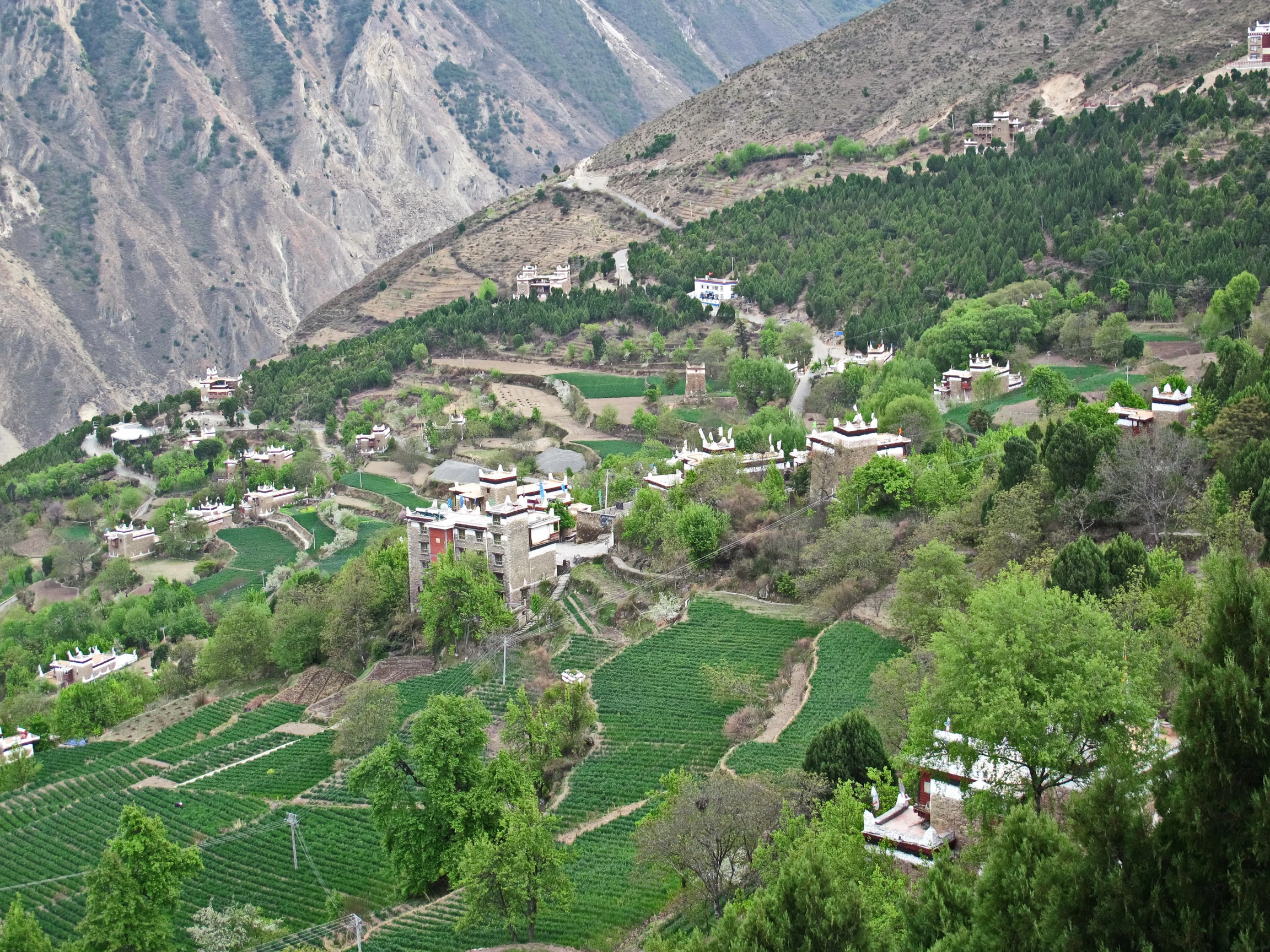
Start Jiaju with a view across the cultivated hillside, then one public lane. The wider view reveals roads and the climbing hidden between apparently neighbouring roofs. This pairing suits a morning from Danba or a short onward-road stop, provided the vehicle meeting point is agreed first.
Jiaju is a Gyarong Tibetan settlement in Danba County, western Sichuan. It rises above the Dajin River valley, roughly eight kilometres from the county seat according to local reporting. That figure describes the village’s proximity to town. The winding approach, the entrance procedure and the final leg to a house or viewpoint are what determine how much of your morning you will spend there.
Read the hillside from a viewpoint
Before taking the wide picture, trace roads between trees, rectangular plots on gentler ground and white roof-corner points. Together they show how homes occupy the slope. Keep the cultivated spaces between houses in the frame as part of village life.
Viewpoint No. 1 (一号观景台) is a useful name to have in Chinese. A July 2024 reporting visit described local residents selling apples and handicrafts near it. Ask the visitor centre which viewpoint is open and practical for your party that day. A single platform with a clear view gives a better sense of the settlement than several stops spent looking for somewhere to leave a car. At the platform, leave the railing free after taking your pictures so that people who need its support can use it.
Compare one nearby building with one across the fields. Near stonework and windows give scale; the farther house shows its place within a patch of hillside. Keep it as a landmark for changing views along the lane instead of searching for a route to its door.
Choose how far to walk
| If you want to… | Build your stop around… | Agree before you leave the entrance |
|---|---|---|
| See the village between two road journeys | One accessible public viewpoint and a short out-and-back to the vehicle. | Where vehicles may wait, how you reach the platform and the latest sensible departure for your next overnight stop. |
| See architectural detail at walking pace | A viewpoint, then one inhabited lane with stone walls and houses visible from the public road. | The turning point, the uphill return and whether anyone in the party needs a place to sit. |
| Stay long enough for a meal or portraits | A morning walk and a meal with a host who accepts your party. Leave the afternoon flexible. | The exact house, last vehicle-access point, meal arrangements and permission for any portraits. |
At the start, look back towards the pickup and judge the return slope. A gentle descent becomes a climb later. Unless a legal far-end pickup is named and agreed, plan to retrace the public route; a straight map line may cut across fields or end at a private gate.
The name means roughly a hundred households, fitting a community spread across the hill rather than a single central square. Use signed public access, let residents pass and ask before portraits. Public-lane access does not extend to a courtyard, rooftop or use of someone’s dress.
The houses at close range
From outside, follow a house from stone base to white roof-corner details. The 2019 research describes traditional lower storage or livestock, living areas above and an upper terrace or religious space. Individual adaptations mean the outline cannot establish how today’s household uses each level.
Notice where additions meet older walls: different heights, a joined guest wing or an extension enclosing a court. Researchers documented guest rooms and bathrooms carrying familiar roof and window details. For an architecture-led stay, ask to see the reserved room and entrance rather than judging from the roof alone.
For visitors with a particular interest in history, Jiaju’s second village has the former political department site of the Fifth Red Army. A Sichuan reporter described a complex combining a four-storey Tibetan residence and a tall stone tower. Ask locally whether the site is open to ordinary visitors before allowing time for it. An outside look at the proportions is worthwhile in its own right. A tower on the horizon gives no indication that its staircase, upper levels or roof are accessible.
A morning from Danba, with lunch and the ride back
Have breakfast at your accommodation and leave large bags there if you are returning to the same room. Save both the hotel’s Chinese name and 甲居藏寨游客中心 for the driver. At the entrance, establish which part of the road your vehicle may use, where to change transport if required and how to return when you finish. Take a photograph of the meeting point with a fixed sign or building in it. Matching two photographs is much easier than explaining which bend you mean over the phone.
Take the first viewpoint together, then choose any extension with the slower walkers. A split group needs an agreed comfortable place to wait. In wet conditions, count shelter and the walk back to the vehicle; cloud may hide the opposite slope while leaving nearby roof corners and stonework worth studying.
For a village lunch, ask your host in advance what can be cooked that day. Residents interviewed at Jiaju described serving corn buns and yak soup hotpot. The buns are a practical choice to ask about if you want a lighter stop. A pot shared around a table suits a party with a longer lunch break. Confirm the broth, meat, portion and any dietary needs when you order. In season you may see local apples for sale. A roadside stall or coffee cart makes a pleasant find when it is operating, but it is a poor plan for the group’s only meal.
If lunch in the village has not been arranged, return to Danba for a seated meal. Make the county-town restaurant or your hotel the final drop-off in the vehicle plan, including any transfer back from a scenic shuttle. If you have luggage at the hotel, allow time to collect it before changing vehicles. Travelers continuing towards Tagong and Xinduqiao should agree on a route-side lunch and the onward hotel address in advance. A Danba return and an onward mountain drive are different days.
A room in Jiaju or a hotel in Danba?
| Overnight choice | What you gain | What to establish when booking |
|---|---|---|
| A hotel in the county seat | An easier start for a through journey, somewhere to leave cases and flexibility over dinner after the village visit. | Whether the vehicle can stop at the entrance, luggage storage after checkout and the pickup place for the Jiaju road. |
| A village guesthouse | Time to see the settlement after day visitors leave and to have breakfast on the hillside. | Which room is reserved, stairs and distance from drop-off, bathroom, heating, dinner and breakfast times, and passport registration. |
| A night farther along the circuit | A start from Xinduqiao the next morning when that is the direction of your trip. | The time you must leave Jiaju, road conditions for the transfer and what happens to the later stops if the road day runs long. |
For a village stay, ask the host to describe the walk from the last point a car can reach. “Parking available” leaves open whether a suitcase must then be carried uphill or up several flights of stairs. A small overnight bag is helpful if larger cases can be left securely by prior agreement. If someone uses a walking aid, request current photographs of the approach and steps, the distance to the dining room and the actual bathroom. Pick the county-town base if these details are uncertain.
With two nights in Danba, you can make the first day an arrival day, devote the next morning to Jiaju and return to the same bed. That makes a sensible three-day, two-night local segment for someone already traveling through western Sichuan. Add a third night for a four-day stay if you want a weather reserve or another village on its own day. On an out-and-back journey from Chengdu, count the long approach and the full return as travel days. Leave a night in Chengdu before a fixed early flight if the mountain-road arrival would otherwise be tight.
Choose a Verotrip itinerary that fits the visit
| Published itinerary | Where Jiaju fits | Who it suits |
|---|---|---|
| Six-day western Sichuan highland private tour | Night in Danba after the Mount Siguniang approach, then a Jiaju visit before Moshi Park, Tagong and the drive to Xinduqiao on Day 3. | Visitors who want to see the hillside as one stop in a moving highland circuit. |
| Five-day Danba villages photography itinerary | Four suggested nights in Danba. Day 2 is an agreed village setting in the Jiaju area, with other local days before returning to Chengdu on Day 5. | Travelers who want time for portraits and can settle permissions and photographer arrangements beforehand. |
On the six-day western Sichuan circuit, the first night is in Chengdu, the second in Danba and the third in Xinduqiao. For Day 3, choose the viewpoint and one short walk so the driver has daylight for the onward journey. If you want to spend longer in the mountains on Day 2, the Mount Siguniang valley guide explains the difference between Shuangqiao and Changping. A full valley walking day needs its own space in the plan.
The five-day Danba photography itinerary gives the hillside a different role. It allows time to choose a permitted setting, work at the pace of the people posing and return to the same base. Confirm the selected village, photographer, working hours and image delivery in the written proposal. A resident’s participation or the use of a private rooftop requires a separate invitation from the people concerned.
Price on request. Give your Verotrip travel consultant the dates, the overnight base before and after Jiaju, your preferred walking distance and whether you want lunch or photography in the village. Ask the quotation to identify the return or onward drop-off, waiting time, scenic transport and tickets, English-speaking assistance, meals and room arrangements. Bring the original passport used for the booking and confirm the ticket channel that accepts it for your date. A regional visitor pass reported in March 2026 had its own redemption procedure. Check the actual arrangement for your visit before buying one.
Questions about visiting Jiaju
Can I visit Jiaju without staying in a village house?
Yes. A viewpoint and a walk along an open public lane work as a visit from Danba town. If you choose that plan, arrange the ride back as part of the outing and decide whether lunch will be on the hill or in town before leaving breakfast.
Which stop should I keep if the weather closes in?
If the approach remains open, a sheltered, short look at the houses can be more rewarding than waiting at a viewpoint in cloud. If the road or paths are affected, have lunch in town and use another morning if you have one. Ask the driver or visitor centre about conditions before starting uphill.
Can I visit a family home or photograph the view from a roof?
Ask the specific household. Some residents welcome guests for meals or accommodation. An invitation to a dining room covers that visit. Check separately before entering private rooms, going upstairs, photographing family members or setting up equipment on a terrace.
How do I choose between a Jiaju stop and an extra night?
Work backwards from where you need to sleep next. For a booked night in Xinduqiao, keep Jiaju to the view and a short lane. If the houses, meals and village photography are the reason for coming to Danba, a second night at the same base leaves time to stay for lunch and walk back when you are ready.
Cover photograph of Jiaju Tibetan Village by Nyx Ning, 29 March 2013. Resized and converted to WebP under CC BY-SA 3.0.