Updated 24 October 2026.
To enter China with a pet by car, arrange the animal’s entry before committing to the road crossing. Mainland China’s accompanied-pet rules cover one dog or one cat per person per entry. The pet needs official documents and a microchip; avoiding quarantine depends on its departure history, supporting evidence and the arrival inspection. Your own immigration permission and the car’s admission are separate.
The most useful first enquiry names the border, travel date, exporting country or region, every country the animal has recently visited, and its chip and rabies records. “We are driving from Europe” is too broad for a route that spends several months elsewhere before China. Build the veterinary timetable around the real arrival date, not the date you leave home.
First decide whether the whole journey works for your pet
This guide concerns a traveller accompanying a dog or cat into mainland China on a temporary overland trip. Commercial imports, other animal species and separate animal-shipping arrangements need their own assessment. Do not treat a second pet as extra luggage under one person’s allowance.
Before paying a vehicle deposit, establish three workable plans: the animal’s entry and eventual exit; the people’s immigration and accommodation; and the vehicle’s admission, driving documents and route. Use the car and campervan entry guide for the vehicle file. Pet papers do not approve the car, and a car organiser’s route confirmation does not settle animal quarantine.
A shorter journey or postponement may be the better choice if your vet considers the trip unsuitable, the documents cannot be completed, or a quarantine stay would make the holiday impractical. Compare that early with care in a familiar place. A border is a poor place to discover that your only fallback is unavailable.
Which route through the pet rules applies?
China Customs Announcement 5 of 2019 sets the national framework: official exporting-country quarantine and rabies certificates, identification, inspection and defined quarantine exemptions. Quarantine, when required, is 30 days at a customs-designated site. The following table helps you frame the enquiry; customs decides the animal’s treatment.
| Your pet’s situation | What determines the next step | Travel decision |
|---|---|---|
| From a designated country or region | Valid chip, required official papers and a satisfactory arrival inspection | Ask the entry customs office to confirm the departure history and receiving channel. |
| From a non-designated country or region | The same foundation, plus an accepted laboratory’s rabies antibody report meeting the threshold | Resolve laboratory acceptance and document validity before fixing the crossing. |
| Needs quarantine | A port equipped for quarantine and a customs-designated facility | Plan around the 30-day stay; a hotel or campervan is not that facility. |
| Guide, hearing or search-and-rescue dog | The separate exemption requires relevant user and professional-training evidence, a chip and satisfactory inspection | Submit the actual status and documents; a pet’s label alone does not establish eligibility. |
For the non-designated category, the rabies antibody threshold is at least 0.5 IU/ml, with a report from a laboratory accepted by China Customs. An ordinary clinic result or a laboratory’s general accreditation is not proof that China accepts that laboratory for this purpose.
Departure country matters more than your passport
The Shanghai Customs guide published in December 2023 lists these designated countries and regions: New Zealand, Australia, Fiji, French Polynesia, Hawaii, Guam, Jamaica, Iceland, the United Kingdom, Ireland, Liechtenstein, Cyprus, Portugal, Sweden, Switzerland, Japan, Singapore, Hong Kong and Macau.
Hawaii and Guam are specific entries; that does not designate the whole United States. French Polynesia is a specific entry, not mainland France. The traveller’s nationality is a different question from the animal’s exporting country or region.
On a multi-country drive, send customs a dated history of where the animal has lived and travelled and identify the authority that will issue the final export certificate. Ask how that history will be treated. Do not assume a short stop in a designated place resets the pet’s category, or that the last border crossed alone provides the complete answer.
The Customs notice on updates to country, laboratory and quarantine-port lists says changes are published by GACC. Ask your certifying authority and intended entry customs office to check the applicable list before paying for a blood test or choosing a port.
A Shanghai Customs answer published on the Shanghai government portal expressly confirms the University of Missouri Veterinary Medical Diagnostic Laboratory (USA) as an accepted laboratory. This resolves that laboratory’s absence from an older officially linked directory; it does not establish the status of every laboratory in the world. For another laboratory, send its full legal name, country, address and proposed sample date to the certifying authority and receiving customs office before testing.
The same answer discusses a dog travelling from Peru through France. Transit itself does not invalidate the official certificate when the required clinical examination was within 14 days before China arrival and the certificate otherwise remains valid. It does not decide every multi-country road journey or reset the animal’s departure category. Send the actual transit dates, residence history and issuing authority with your enquiry; port customs makes the final determination.
Build one consistent document file
Ask the veterinarian to scan the chip before preparing records, then compare the number character by character across the file. Carry the originals required by the issuing authority, paper copies and an offline digital backup. A phone photograph is useful for discussion but may not replace an original certificate.
| Prepare this | Check together | Who should resolve a mismatch |
|---|---|---|
| Pet identity and microchip record | Scan result, number, implantation details and the number on every certificate | Your veterinarian and the receiving customs office. |
| Rabies vaccination evidence | Animal identity, vaccination history and validity on the planned arrival date | The veterinarian and the departure country’s official certifying authority. |
| Antibody report where required | Exact testing laboratory, sample date, result, pet identifier and accepted report format | The laboratory, certifying authority and China entry customs. |
| Official health / quarantine certificate | Correct exporting authority, named carrier, pet particulars, examination and arrival dates | The departure country’s official animal-health authority. |
| Port instructions and onward plan | Road channel, presentation method, contact, appointment and departure arrangements | Both sides of the crossing, plus the responsible vehicle team. |
Shanghai Customs specifies an official clinical inspection within 14 days before arrival. A long drive can consume that window: identify a competent certifying authority along the actual departure leg before booking the examination. If the crossing moves, ask whether a new examination, certificate or endorsement is needed; do not alter dates yourself.
For a concrete country-specific example, USDA APHIS’s China instructions, updated February 2026, require two lifetime rabies vaccinations for its no-quarantine pathway, a current vaccination, and testing on or after the second vaccination. The sample is valid for up to one year. Its named US laboratories include Kansas State, Auburn, Missouri, the Department of Defense laboratory and CDC. These are US-export instructions, not a universal list of laboratories worldwide.
APHIS specifies a 15-digit ISO 11784/11785 chip, or a reader for a non-compatible chip, and a health certificate naming the traveller exactly as in the passport. Australia’s official China pet-entry guidance (August 2026), separately sets out Australian-government endorsement and applicable preparation. Use your actual exporting authority’s requirements, including any additional vaccinations or record formats it specifies.
A land port needs a precise receiving arrangement
National eligibility and an operational border crossing answer different questions. A pet that qualifies for a quarantine exemption still needs to be presented through the correct channel. A crossing open to pedestrians or vehicles does not, by itself, tell you how an accompanied animal is handled.
| Land-route question | Evidence to obtain | Do not substitute |
|---|---|---|
| Can this pet enter here by road? | An answer for the exact port pair, direction, date, species and departure history | A report about a passenger crossing, cargo consignment or railway arrival. |
| Where is the animal presented? | Customs office / channel, handler, carrier and any appointment instructions | An assumption that the animal stays in the car throughout. |
| What if quarantine is required? | The receiving port’s facility arrangement, availability and transfer instructions | An airport list, nearby boarding kennel or hotel reservation. |
| Can the journey be delayed or reversed? | Departure-side re-entry permission, pet paperwork and lawful vehicle arrangements | A promise that returning across the same bridge is automatic. |
The APHIS quarantine-port table includes Alashankou alongside airports, railway stations and passenger terminals. That entry is not confirmation of a particular road-channel appointment or space for your animal. Obtain current instructions from the receiving customs office. Do not infer that Mohan, Hekou, Youyiguan or Dongxing has a quarantine facility because people or cars use the crossing.
Channel differences are real. The Shenzhen port authority’s Huanggang FAQ says ordinary pets cannot accompany pedestrians through its passenger hall; the same page separates drivers’ and passengers’ routes. This is a local operational example, not a rule for every Chinese land border. Ask where the named pet handler should go at your exact crossing.
Start through China Customs’ official enquiry channels, including 12360 within China, and ask for the responsible port’s animal-quarantine contact. Keep the reply, date and officer or office reference with your travel file. Describe the full case rather than asking only, “Can I bring a dog?”
Make border day manageable for the animal and family
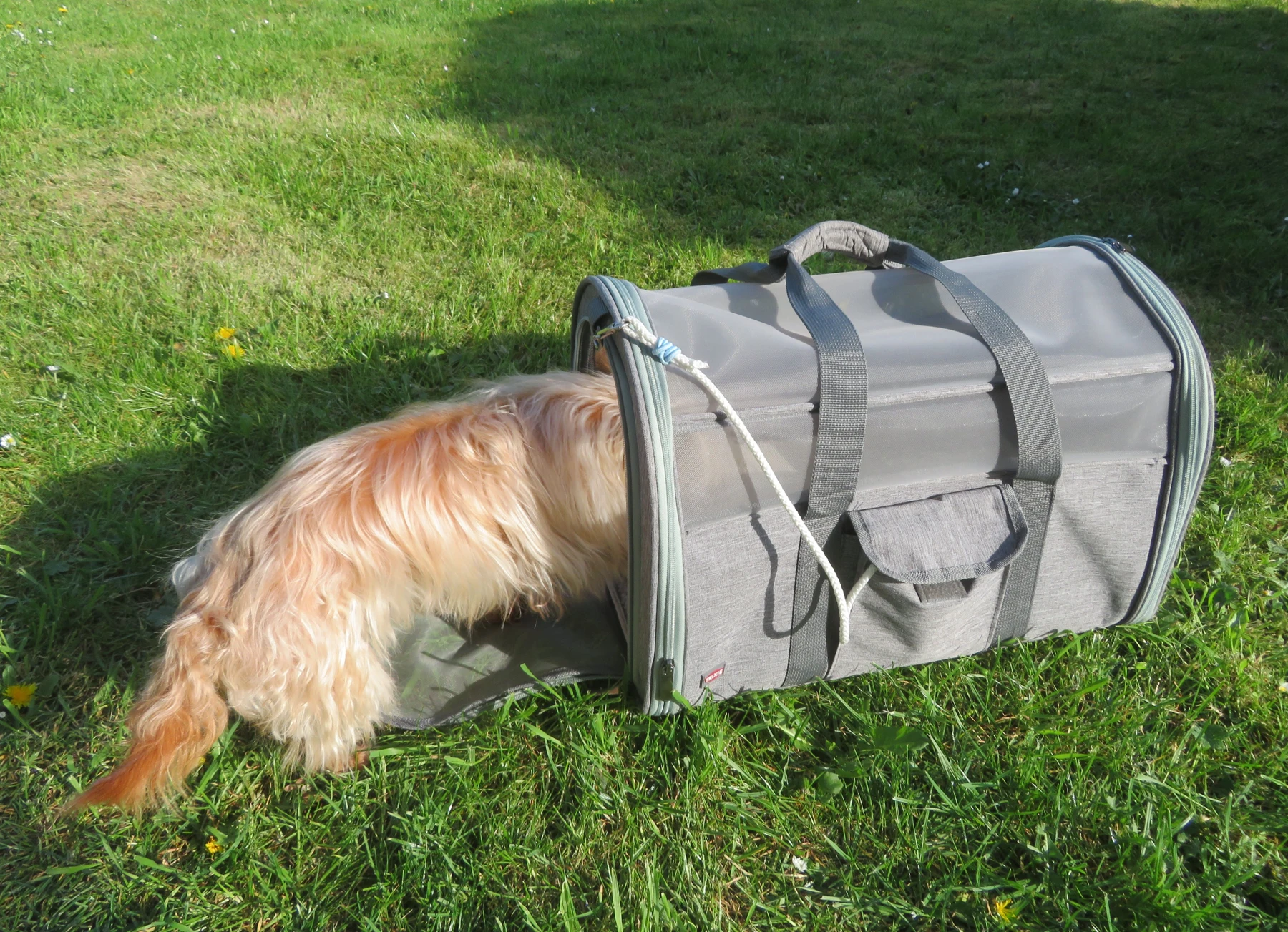
Travel in a suitable, securely positioned carrier or restraint agreed with your vet and transport provider. Plan access to water, routine supplies and prescribed medication. Ask the vet about fitness for long travel and any motion or anxiety concerns; medication decisions belong with the vet.
Keep the carrier accessible without unloading the whole campervan. Decide who handles the pet while another adult deals with children, luggage or the vehicle. If you travel alone, ask in advance how the animal stays supervised while you complete the separate formalities. Do not leave it unattended in a parked vehicle during an unpredictable wait.
| Part of the journey | What to arrange | Fallback to keep practical |
|---|---|---|
| Approach night | Pet acceptance, secure parking, carrier access and a reachable vet | A flexible extra night on the departure side. |
| Border day | One responsible handler; documents, water and essentials within reach | A clear meeting point if people and vehicle follow different channels. |
| China overnight stops | Specific hotel acceptance for species, breed, size and number; applicable local dog rules | A second suitable property, with the pet disclosed before payment. |
| Visits and transfers | Who stays with the animal when a venue or transport operator cannot accept it | Split the sightseeing plan or use an agreed suitable care arrangement. |
| Leaving China again | Destination-country entry conditions and China departure certification | Time for required appointments before reaching a remote exit port. |
Declare the animal to customs and follow the instructed inspection process. Present the pet with its documents; keep it controlled while the chip and records are checked. Ask separately about pet food, treats and medicines carried across the border, including ingredients, quantity and packaging. A sealed bag or an approved animal does not answer that separate question.
For accommodation, “pet friendly” needs detail: permitted species, breed, weight, number, room category, deposit, cleaning charges and whether the pet can be left alone. Obtain confirmation from the property for your booking. Ask about local dog registration and breed restrictions as well as hotel rules; border admission does not establish permission for every city or venue.
If quarantine or refusal changes the trip
Plan financially and practically for delay before reaching the crossing. If quarantine is required, obtain the facility’s instructions for handover, care, medication, contact, release and charges. Do not substitute an ordinary boarding service, hotel room or your campervan for a customs-designated quarantine site.
The national announcement provides for return within a specified period or destruction under the applicable rules in cases including missing required certificates, exceeding the allowance, arriving without the necessary quarantine facility, or failing quarantine. These are serious consequences, not a standard “pay a fee and continue” option.
Before leaving the departure country, establish whether the people, animal and vehicle can return if China entry fails. Ask who will coordinate that return and where you can wait lawfully. If customs detains the pet for return, follow the written deadline and collection procedure. Leaving the animal uncollected is not a solution.
Plan the pet’s exit before planning the sightseeing
China entry papers are not automatically the papers needed for the next country or the journey home. Write out the entire country sequence, then ask each destination’s competent authority about its own animal-entry conditions. Some preparations must be completed well before the final driving day.
Shanghai Customs’ September 2026 departure guidance illustrates the separate process: an advance application through the “Quarantine for Pets Carried Out of China” service, a booked inspection and an animal-health certificate. Its Shanghai office arrangements are not an appointment system for every land port. Ask the customs office serving your planned departure where to apply and attend.
Allow for an appointment in an inland city if required rather than expecting every remote border to issue all paperwork immediately. Keep the pet’s departure schedule aligned with the permitted stays of the travellers and the vehicle. A veterinary delay does not automatically extend either permission.
What to send for a workable travel enquiry
Send Vero Trip the proposed entry and exit port pairs, approximate dates, every traveller’s nationality, and the car’s registration country and basic dimensions. For each animal, add species, breed, age, size, named accompanying person, residence and transit history, chip standard, vaccination dates and any laboratory name, sample date and result. Start with a summary; agree the required document copies and transfer method afterwards.
Our China self-drive tour collection helps compare the land journey and support style. Listed itineraries do not include pet import, quarantine, veterinary work or pet-accepting hotels unless a written proposal explicitly provides them. Use China overland route planning to compare entry and exit combinations, then send your route and pet details so the practical questions can be identified before bookings become fixed.
Plan This Visit as Part of Your Journey
This guide introduces a possible visit rather than a confirmed package departure. Share your dates, starting point and the experience you want through Plan My Trip. Vero Trip can check access, travel time, language support and the services to include before quoting.
Explore related travel themes for other ways to shape the journey.