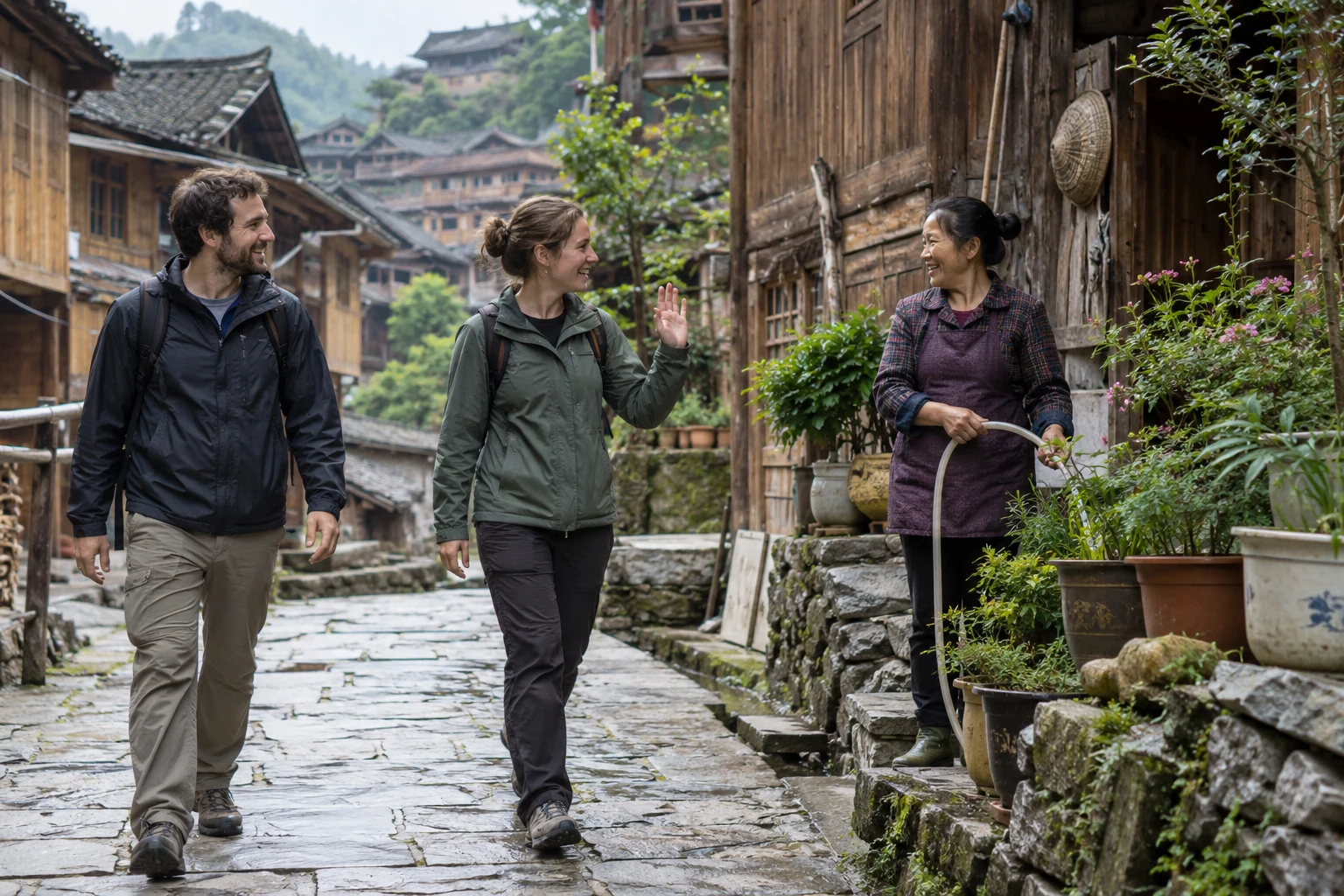
Dali Dong Village is a place to slow down near Rongjiang, with a public-lane walk, attention to wooden buildings and time for a meal. Choose it for a quieter village setting rather than a packed programme of performances. An overnight stay can be rewarding when the room, meals and transfers are arranged carefully; a selective day visit also works from a suitable local base.
Cover: illustrated travel scene with fictional people: travellers in a timber-house village lane. Illustrative context, not an exact-site photograph or a record of Vero Trip guests, guides or services.
This is 大利侗寨 in Rongjiang, Guizhou, not Dali in Yunnan. Use the full Chinese name and 榕江 when reserving transport or accommodation. An English search for “Dali hotel” without the province can send you to a completely different part of China.
A village shaped by water, wood and slopes
The National Railway Administration’s destination entry places Dali beside the Lidong stream in a wooded valley. It describes timber homes, distinctive wooden courtyard houses and covered bridges. Those relationships are a good starting point for a visit: look at how buildings fit the terrain and how paths connect the shared spaces.
Choose a local interpreter or guide if you want a fuller architectural explanation. Agree the language and the places to be discussed. A public village walk should not be described as access to historic interiors unless the relevant owner or custodian has confirmed it.
| Interest | Suggested focus | Boundary to respect |
|---|---|---|
| Architecture | Exterior details, covered bridges and timber courtyard forms | Private homes and protected buildings |
| Slow travel | Public lanes, a meal and time by shared village spaces | Residents’ daily use of paths and gathering areas |
| Photography | Wood, stone, water and the wider valley setting | Consent before photographing people or interiors |
| Cultural interpretation | A prearranged explanation with a suitable guide | No assumption of a performance or ceremony |
A comfortable day from Rongjiang
Arrange a transfer to the precise drop-off point and establish the return before beginning the walk. On arrival, ask about current public access and the condition of the lanes. Start with a short orientation rather than immediately choosing the longest route out of the village.
Leave time to pause at buildings that interest you and to notice ordinary details: roof forms, water channels and the way a lane changes with the slope. A meal provides a natural break. Confirm the menu and preparation rather than assuming every local speciality is available without notice.
For the afternoon, choose another public section or return at an easy pace. An older description of a stone route through the hills does not establish that it is a current visitor trail. Longer countryside walking should be planned separately with permission, conditions and a complete return route checked.
| Option | Best use of time | What needs arranging |
|---|---|---|
| Local day visit | A focused village walk and meal | Return vehicle and luggage storage |
| One village night | A slower afternoon and next morning | Room comfort, meals and passport registration |
| Rail arrival day | A gentle introduction after the transfer | Exact train station and realistic arrival time |
| Wider village journey | Distinct stays with different cultural interests | Avoid repeated packing for very short visits |
A guesthouse needs more than an attractive photograph
Ask for the actual room category, bathroom arrangement, heating or cooling and photographs of the approach. Traditional timber accommodation can have stairs and sound transmission that differ from a city hotel. If easy access or quiet sleep is important, state that before booking.
Check where a vehicle can stop and how luggage reaches the property. A host’s offer to collect you should identify the station, meeting point, price and luggage capacity. Confirm passport registration explicitly for international guests rather than relying on a generic booking confirmation.
Establish dinner and breakfast arrangements in advance. If the village menu is limited, discuss dietary needs early and carry a written explanation where helpful. Do not assume that a vegetarian-looking dish has no meat stock, or that a regional speciality meets halal or allergy requirements.
Music, festivals and everyday life
The official destination description notes Dong singing and traditional festivals. These are aspects of the cultural setting, not a promise that a choir or festival will appear during a normal visit. If a specific cultural presentation is important, ask what is actually scheduled and how participation is arranged.
Keep a distinction between a visitor programme and a community occasion. Ask before joining, photographing or entering a space. Do not block a bridge or doorway while composing a picture, and avoid presenting people’s homes as empty heritage displays.
If buying craftwork or local products, ask about the maker, materials and price. A purchase should not depend on a claim that every item is antique or made in the village. For any older object, consider whether you need documentation or export advice before buying.
Transport, tickets and practical preparation
Rongjiang rail station is a connection point, not the end of the journey. Check the current road approach and allow time for the final village transfer. Keep the driver’s contact details and hotel address offline so the return does not depend entirely on phone signal.
A 2023 official entry described free admission. Treat that as dated information and confirm current access or service charges directly. A meal, guide or transfer can have its own cost even when entry itself has no charge.
Wear shoes with grip for wet stone and bring a rain layer. Keep children close around water and steps. Stay on public paths and do not step into cultivated plots simply because they offer a pleasing angle for a photograph.
Questions visitors often ask
Is this a substitute for Yunnan Dali?
No. It is a different destination in Guizhou with a Dong village setting. Always use the full place name when arranging the journey.
Do I need an overnight stay?
A night suits travellers who value village pace and are comfortable with the confirmed accommodation. A day visit is sufficient for a selective introduction.
How should I combine it with other places?
Use our regional planning guide and tell Vero Trip your rail connections, accommodation preferences and cultural interests. A route should then identify the actual transport and services required.
Planning information reviewed 29 October 2026. Sources: National Railway Administration: Dali Dong Village. Confirm current access and operating arrangements for your travel date.
Related Journeys to Compare
These existing routes offer starting points for the region or travel interests discussed above. Read the full daily itinerary to see what is included. A visit described in this guide, a specialist session or an international border crossing is added only when confirmed in your own programme.