Turn off Renmin Road for Dali Catholic Church’s stone arch and courtyard. The three-part church frontage stands farther inside, its central bell tower rising above the sides with a cross at the top. Look at the gates together to understand the approach.
Give the lanes, architecture and lunch a morning, with the church one part of it. After a late train, settle in first and return in daylight for the timber and paintwork without luggage.
Find the church from Renmin Road
Save 大理天主教堂 and 新民路. From eastern Renmin Road in the old town, turn into Xinmin Road and find 天主堂 over the stone entrance. The specific name distinguishes it from other Christian churches in Dali.
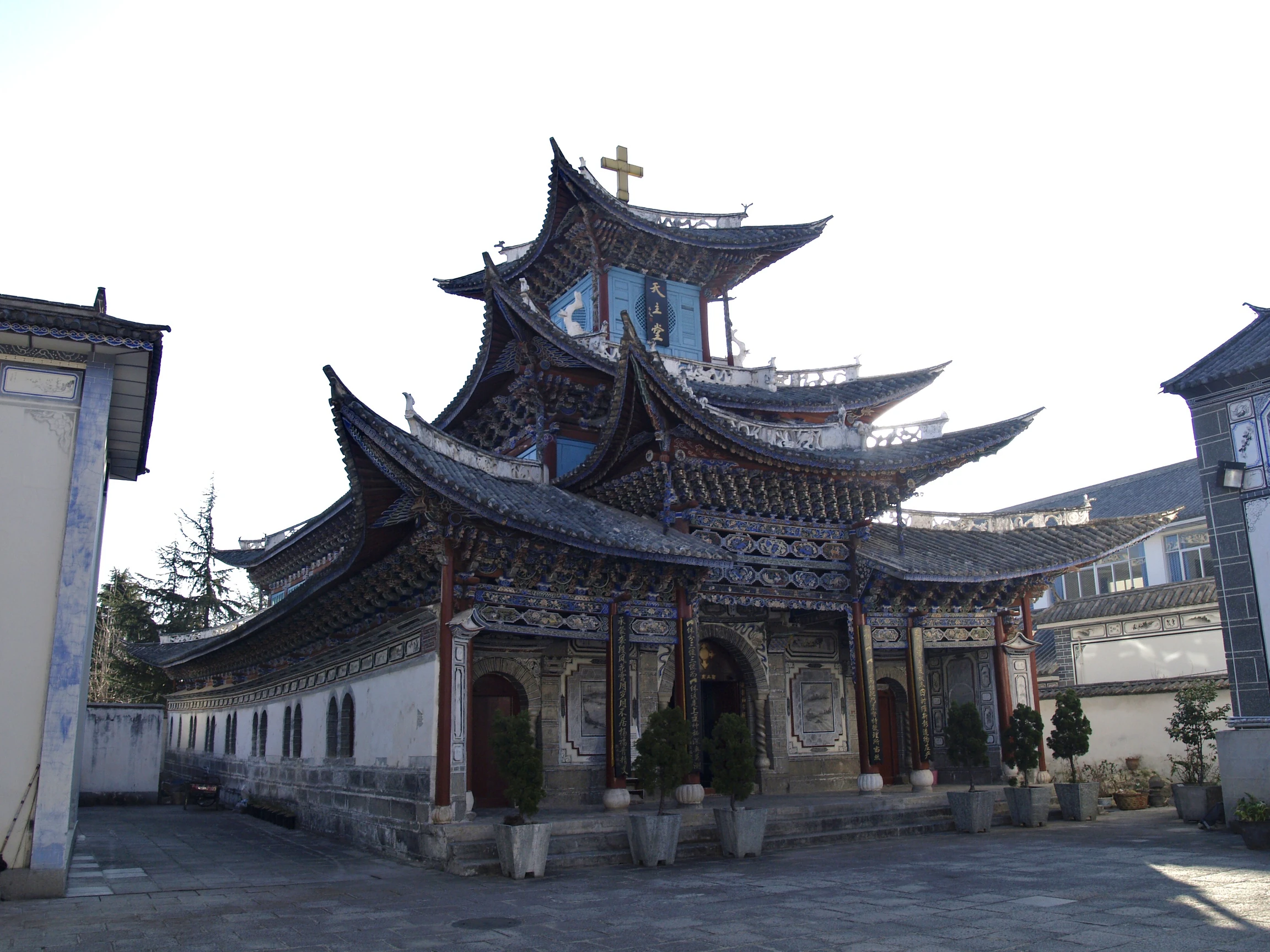
Pause at the street arch before approaching the church frontage. When the courtyard admits visitors, stand far enough back to see doors, rooflines and cross together. A close view shows paintwork but loses the whole silhouette.
A closed gate leaves an exterior lane walk, not a reason to find another entrance. Return to Renmin Road for food or another cultural subject. Confirm interior access first if that is essential.
Read the building from the courtyard
Compare the tall centre and lower sides of the Bai-style frontage. The bell tower and cross rise above the layered eaves. A side angle separates projecting brackets from painted decoration before you return to the three-part view.
Look at the paired inscriptions framing the doors. The church account connects one pair with the Trinity and another with Dali’s mountains and lake. Their form and placement can be appreciated even without reading every character.
| Where to stand | What to look for | What the view tells you |
|---|---|---|
| At the stone arch on Xinmin Road | The short inscription and the passage beyond | The first gate marks the approach. The photographed tower stands farther inside. |
| Towards the back of the visitor courtyard, when open | The central roof above the lower side sections | The cross, bell tower and the broad entrance read as parts of one building. |
| To one side of the front, within the visitor area | Brackets beneath the projecting eaves, painted timber and inscribed pillars | The side view shows the depth of a roof that can seem flat in a frontal photograph. |
| At the public entrance to the worship hall, if permitted | The long axis from the entrance towards the altar | A building with a Bai-style frontage opens into a space arranged for Catholic worship. |
The State Council’s 2019 national heritage list records the church under 1931. This date identifies the protected building. Catholic life in the region has a longer history, and a nineteenth-century reference to a congregation describes a different moment in that history. The distinction helps explain why visitors encounter several dates in accounts of the same lane.
Inside the hall, when visitors are welcome
If invited inside the west-facing frontage, look east towards the marble altar, then up at the starry blue ceiling described by an overseas visitor. Follow the worship axis while keeping prayer space and entrances clear.
Treat courtyard access and hall access separately. Ask before indoor or people photography. The tower and adjoining spaces can be viewed only from the areas where visitors are welcome.
A morning from your hotel, with lunch and a way back
From the old town, walk towards eastern Renmin Road. From Xiaguan or the lakeside, save a legal drop-off and return in Chinese. A church pin is a walking destination, not necessarily a vehicle meeting point; name lunch before separating.
| Part of the outing | From an old-town base | From a lakeside or Xiaguan base |
|---|---|---|
| Getting there | Leave overnight bags at the hotel by arrangement and walk towards Renmin Road. | Allow for a road transfer, then walk the final lanes. Confirm where the car can meet you afterwards. |
| The visit | Walk to the stone arch. Continue to the courtyard and possibly the hall as access allows. | Use the same compact walk. If anyone tires, turn back from the courtyard and allow a longer lunch. |
| Lunch and return | Return to Renmin Road for a seated lunch, then walk back to the hotel or choose a museum stop. | Eat before the agreed collection, return to the meeting point and complete the drive to your hotel. |
Take a seated rice-noodle lunch, checking stock, toppings and chilli. A small shared rushan tasting adds Dali’s milk cheese, which contains dairy. Xizhou baba and village food suit a separate Xizhou outing.
The Dali Municipal Museum in the old town offers a different afternoon for someone interested in inscriptions or clay figures. Check its own admission arrangements before setting out. If the group would rather rest, the return to the hotel after lunch is a complete half-day in its own right. A booked train later that day also needs time for collecting bags, travelling to the station and getting to the departure gate.
Where to sleep for this walk
Compare the actual hotel-door walk and luggage approach. A deep courtyard lane suits lighter packing; a street-accessible room may be easier with cases. Check steps from street to reception and bedroom.
A lake-view stay changes the rhythm. Keep the lakeside hotel if the shore is the main reason for going to Dali, and put the church, old-town lunch and return drive into one outing. Xiaguan can be convenient for a rail connection, particularly on the last night. Check the exact station on your booking before choosing the hotel. The Dali guide to bases and overnight stays compares these choices across a longer visit.
| Length of stay | How to place Xinmin Road | Where the nights fall |
|---|---|---|
| Three days, two nights | Arrive and settle in on day one. Walk to the church on day two, eat in the old town and leave the afternoon flexible. Depart on day three. | Both nights at the same Dali hotel. An old-town base keeps the full day compact. |
| Four days, three nights | Keep day two for the church and old town. Give day three to the Three Pagodas or a section of Erhai, with a separate return. Depart on day four. | Three nights in Dali. Choose the base for the evening and morning walks you want most. |
| Five days, four nights | Use one full day in town, one for Xizhou’s houses and food, and one for Zhoucheng or a relaxed lake outing. Leave day five for departure. | Four nights in one base avoid moving bags between the old town and the villages. |
Choosing an itinerary that fits
The one-day Three Pagodas and Dali Old Town itinerary starts with the pagodas, leaves a break for lunch and finishes with a selected walk in town. If Xinmin Road is your priority, identify the church when agreeing on the afternoon walk. The published route leaves the particular lanes open. A longer climb through the temple grounds in the morning will leave less energy for the afternoon. Our guide to the pagodas and Chongsheng Temple explains the shorter and longer options there.
For someone interested in how Bai builders used courtyards in different settings, the two-day Xizhou and Zhoucheng itinerary gives the villages their own time. Its first day covers Xizhou’s courtyard houses and food. The second looks at indigo craft in Zhoucheng. Visit the church on a separate old-town morning. This way you can compare a place of worship with village houses without taking time from the workshop or expecting access to private homes along the way.
Stone paving, rain and costs
A short Xinmin Road walk still includes standing, stone paving and thresholds. Confirm the exact approach for mobility equipment. In rain or when a seat is needed, begin with a meal and update the driver meeting time.
Price on request for an arranged outing. Tell a Verotrip travel consultant where you are staying, whether the exterior is enough, how far you are comfortable walking and where the outing should end. Ask for the vehicle and waiting, English-language accompaniment, meal, any admission arrangements and the full return to be priced individually in your written plan. For an organised visit, confirm the current visiting arrangements and any original passport or reservation requirements for the people travelling. An old first-person account establishes a past visit, not the arrangements for a future booking.
Questions about Dali Catholic Church
Can I see the distinctive roof without entering the hall?
The broadest view is from the courtyard when it is open to visitors. You can look up at the cross, central bell tower and lower eaves before deciding whether to enter the worship hall. From the street gate alone you have a more limited view.
Is the church a good stop on the way from the railway station?
It works best after you have checked in or left your luggage by arrangement. A taxi or driver may need to leave you outside the final lane, and bringing cases into a small place of worship makes the visit more awkward. If your train arrives late, spend the evening settling in and make the walk the following day.
Can I visit during a service?
Check with the church for the date, purpose of your visit and whether visitors may enter. Someone who wants to attend worship should ask separately about the service and its language. For architectural sightseeing, choose a time the church considers suitable, with the exterior as a worthwhile fallback.
Should I choose the church or the Three Pagodas for a short stay?
Choose the church if you want a short walk, a close look at carved timber and time for lunch in the old town. Choose the Three Pagodas for a larger landscape, the towers and a possible temple walk. With a full day, you can put the pagodas first and reserve an old-town afternoon for Xinmin Road.
Photograph and historical sources
The courtyard photograph was taken on 20 February 2011 by Deadkid dk. The image was resized and converted to WebP under the same Creative Commons Attribution-ShareAlike 3.0 licence.
The Chinese Catholic account of the church identifies the building sequence, paired inscriptions and marble altar. The national heritage register lists the building in Dali as entry 716. An account of a visit to Xinmin Road describes the approach on foot and the interior as seen in 2014.