Updated 2 November 2026
For a first Chongqing trip, choose a hotel with a workable street entrance, allow proper city days, and add Dazu or Wulong only when the full outward and return journey fits. Four or five days can give you a useful city stay with a selected excursion. Three days often mean just one full day between arrival and departure.
Chongqing rewards a plan based on neighbourhoods and real access, rather than a long list of night views. A short distance on the map can still involve steps, a change of level or a different pickup street. For luggage, older relatives and anyone who needs to avoid stairs, those details should shape the route from the beginning.
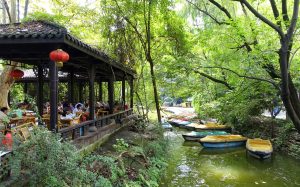
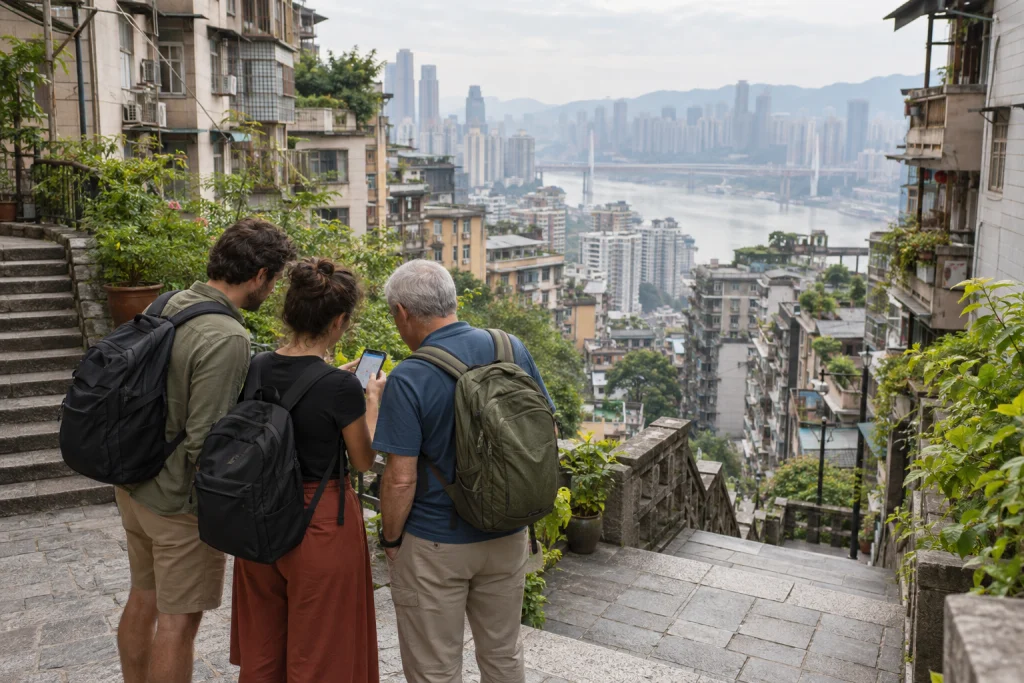
The opening image and walking scene below were created with artificial intelligence as illustrations of fictional hillside-city settings; they are not photographs of a specific Chongqing street, real Vero Trip customers, staff or tours.
How many days should you spend in Chongqing?
Count nights first. Arrival and departure are travel days until the actual connection proves otherwise. A late arrival followed by two hotel nights does not create three full sightseeing days. Start with the visits you most want, then decide whether an excursion deserves a separate day or night.
| Stay | Usable time between arrival and departure | A sensible planning pattern |
|---|---|---|
| 3 days / 2 nights | Usually one full local day. | Choose a city introduction; protect arrival and departure. |
| 4 days / 3 nights | Usually two full local days. | Two city days, or one city day and one carefully arranged excursion. |
| 5 days / 4 nights | Usually three full local days. | Two city days plus Dazu OR one selected Wulong outing. |
| More nights | Depends on the actual connections. | Add a second excursion or an overnight away when it serves your interests; retain time for the city. |
These are planning choices, not claims that every traveller can complete the same circuit. A slower walker may prefer two short city outings to a full day away. A visitor interested primarily in Buddhist art might give Dazu more time and remove an evening attraction instead.
If Chongqing is one stop in a longer China holiday, check its position in the whole route before fixing hotel nights. Keep an essential departure free of an excursion that depends on a distant return. The China family planning guide helps compare complete transfers and rest when several generations travel together.
Choose a base by its entrance and daily journeys
Central Yuzhong and Jiefangbei are useful areas to investigate for a first city stay, while Guanyinqiao in Jiangbei may suit a different hotel or activity preference. Compare the specific property and the routes you will use. A district label or a familiar international hotel brand is not enough to establish convenience.
| Base to investigate | Why consider it | Check before booking |
|---|---|---|
| Jiefangbei / central Yuzhong | A starting point for a city stay focused on the central peninsula. | Exact entrance and vehicle stop, slopes, noise and the walking route to your priorities. |
| Other Yuzhong locations | An alternative within the same district, with different street and transport access. | Do not assume a district name means a short or level walk to Jiefangbei. |
| Guanyinqiao / Jiangbei | Consider for your preferred hotel, dining and activities on that side of the city. | Bridge crossings, actual hotel address and the complete journey to your daily visits. |
| Near an onward airport or railway connection | Useful when the first or last service is the priority. | Correct airport or station, operating hours and reliable transfer; this may be less convenient for sightseeing. |
Ask the hotel for its full Chinese address, reception entrance, vehicle approach and the path from the vehicle to the room. Specify whether you have large suitcases, a folded stroller or mobility equipment. Reception on a different level, a lift inside the building and vehicle access outside are three separate questions.
Read the actual branch page rather than relying on a brand-and-city search. For example, the directions page for one Jiefang West Road property lists no airport or local shuttle. That describes this property; it is a useful reminder to arrange your transfer explicitly rather than assume it comes with a city hotel.
Confirm passport reception, room occupancy, beds and arrival time directly for the people staying. A desirable location does not establish a suitable room, and a room reservation does not automatically include luggage assistance or a private pickup.
Build city days around one compact area
Choose one main neighbourhood or visit for each part of the day, then keep the connecting walk manageable. A central outing might focus on Jiefangbei and a selected riverside view. Another could focus on older streets, a tea stop or a prebooked museum visit. Check the actual approaches before combining them.
Shancheng and Shibati can be interesting choices for people who want older streets and a hillside setting, but the name of a walking area does not establish step-free access. Decide which section you will enter, where you will leave and where the next vehicle can meet you.
Recent visitor material often compresses several districts, hillside streets, meals and night views into a single checklist. One traveller describing a three-day visit said they needed recovery afterwards; other posts were planned lists or repeated restaurant promotions. Use such material to identify the need for a slower pace, rather than treating every listed stop as an independently tested daily route.
Keep room for sitting, food and ordinary travel through the city. A tea visit can be the main pause, rather than another stop to rush through before sunset. If a museum or other indoor visit is essential, check its own dated calendar, reservation and passport instructions first.
Allow for levels, steps and the return walk
For every walk, ask four questions: where do we enter, what steps remain, where do we exit, and where is the pickup? A lift can solve one level change without removing the rest of the climb. A route that is comfortable going downhill can still create a difficult return.
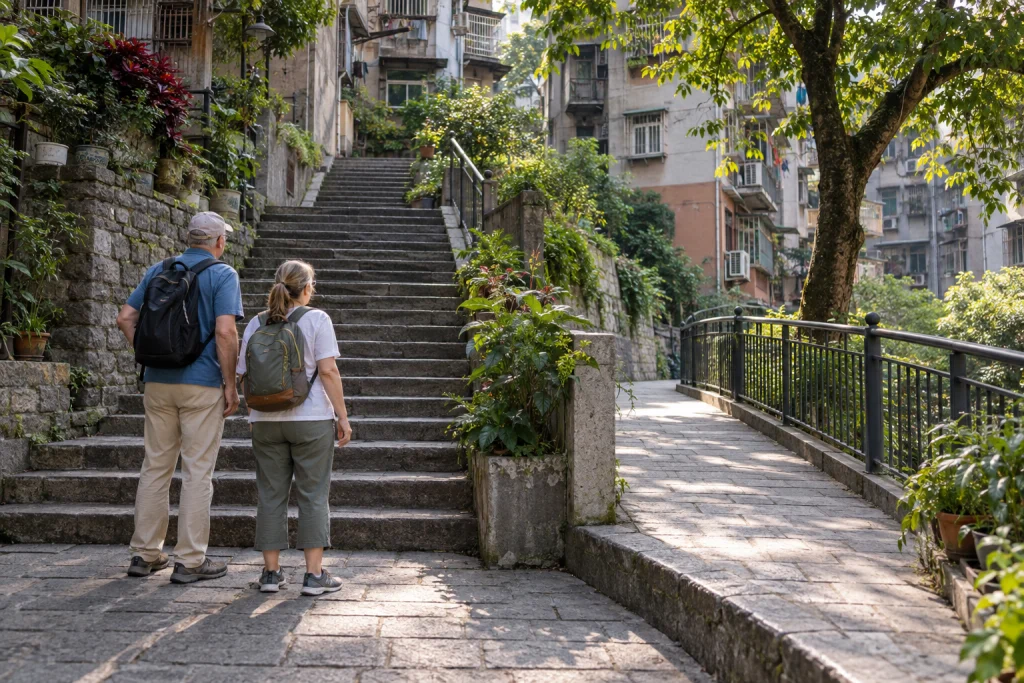
For older relatives, describe walking and standing limits specifically. For a wheelchair user, request a complete access assessment rather than a general promise that the outing is easy. Carrying a stroller over steps is not the same as a step-free route, and an adult who manages stairs alone may not manage them while carrying luggage.
Break a long urban route into separate sections, with an agreed stopping point and a way to finish early. A short car journey may help between neighbourhoods, but the final approach can still be on foot. Confirm the street and meeting level before separating from a driver.
Enjoy night views without making the evening a race
Choose one evening focus and work out how you will return to the hotel. Hongyadong, a riverside walk and a river cruise are different experiences with different access and booking arrangements. A view from outside does not mean you have booked a cruise, entered a venue or reserved a table.
Keep the group together at crowded meeting points and agree a recognisable place to regroup. For children or anyone who tires easily, an earlier meal and a shorter viewing stop may work better than waiting for a particular photograph. A busy crossing or unfamiliar flight of steps is a poor place to reorganise several large bags.
Check any desired cruise or cableway with the actual operator for your date, boarding point, documents and operating conditions. Do not plan the last essential connection around a claimed universal lighting time or a short queue from a social post. If weather or crowd management changes the evening, retain an ordinary dinner-and-return option.
Choose Dazu for carving sites and interpretation
UNESCO’s Dazu Rock Carvings listing describes a group of sites dating from the ninth to thirteenth centuries, with Buddhist, Taoist and Confucian influences. This is a reason to give the art context and time, rather than treating the outing as a single quick photo stop.
Ask which site or sites your day includes. Baodingshan and Beishan are separate settings within the wider heritage property; a proposal saying only “Dazu” leaves an important choice unresolved. Decide whether your interest is a focused visit with interpretation or a broader day with additional travel between sites.
A recent traveller described a booked road trip with hotel pickup but a guide shared with other visitors at the attraction. That distinction matters: a vehicle reserved for your party does not automatically include a dedicated English-speaking guide throughout the visit. Ask who meets you, where interpretation begins and whether that part of the service is private or shared.
Check admissions, any museum component, meals, walking and the full return before payment. Follow the site’s protection rules and barriers; do not adopt social suggestions to climb near carvings, take side entrances or use additional lighting without permission. A visitor’s historical photo advice does not establish a permitted activity today.
Choose Wulong for one realistic landscape outing
The South China Karst World Heritage listing includes Wulong’s karst formations. For trip planning, identify the actual attraction and its route: Three Natural Bridges, Longshuixia gorge and Fairy Mountain are separate choices. Do not assume that one name, ticket or visitor-centre transfer covers all of them.
| Choice | What the day is for | Decision before paying |
|---|---|---|
| Dazu Rock Carvings | Historic carving sites and time to understand their religious and artistic setting. | Which clusters, interpretation language, walking, site transfers, admissions and return. |
| Wulong: Three Natural Bridges | A selected karst-landscape visit, with its own access and exit route. | Actual stairs, walking, lifts or shuttles where operating, visitor-centre transfer and return connection. |
| Wulong: Longshuixia gorge | A separate gorge route, rather than another name for the bridges. | Its complete stair and walking demands; do not add it automatically after a tiring first visit. |
| Fairy Mountain | A different outing from the bridges and gorge. | The particular area and activity, transport and weather alternative; do not assume one ticket covers everything. |
Recent Wulong material described a train, a station transfer, the visitor centre, a bridges visit, a separate gorge and a return journey. Comments disputed whether the quoted early train still ran, while the author explained substantial stairs in the gorge. Two near-identical posts were by the same author; they are one travel account, not two confirmations.
The practical lesson is to check the actual dated trains and the complete route, not to copy a particular early departure. For a first visit with older relatives or limited walking tolerance, choose one suitable attraction after checking its access. Adding a second one is a decision about remaining energy and return time, not simply a matter of buying a larger ticket bundle.
Ask the attraction for current conditions near your travel date, especially after severe weather. A reopening announcement for an earlier month does not establish that every route will be available on your day. If the outing no longer works, keep a city day or a different overnight plan as a real alternative.
Compare the whole excursion journey
A short train ride is only one part of a Wulong outing. Add the journey to the departure station, station entry, the arrival exit, transport to the correct attraction, the visit itself and the return. Check the exact stations on each ticket; do not assume a return from a different station has the same connection.
| Stage | Information you need | Useful fallback |
|---|---|---|
| Hotel to vehicle | Chinese address, exact entrance, street level, luggage walk and legal stopping point. | Agree a reachable meeting point and who helps with bags before checkout. |
| Rail journey to an excursion | Exact origin and destination stations, actual dated services, ticketed seats and station exit. | Choose a different departure or a road arrangement if the complete connection is unsuitable. |
| Station to scenic visit | Confirmed transfer to the correct visitor centre or entrance, with a return plan. | Reduce the number of attractions instead of relying on a last-minute roadside car. |
| Visit exit to return transport | Exit location, shuttle or pickup, walking time and a margin for delays. | An agreed later service or overnight option, subject to availability and costs. |
Allow time after the attraction exit for the actual shuttle or pickup. Avoid a plan that works only if every transfer arrives immediately. Before committing to the last suitable return, agree what happens if a route takes longer or transport is disrupted, including who arranges assistance and who pays for changes.
A private road arrangement can simplify changes between stations and attractions, but it needs its own clear terms. Ask about the vehicle, passenger and luggage space, driver working arrangement, agreed hours and distance, admissions, attraction transport and language support. A published route outline alone does not confirm those services for your date.
Make food, luggage and rest explicit
Plan a suitable meal before a remote outing, and check food availability along the actual route. Carry drinking water and what your party needs between stops. A social restaurant list, repeated across accounts, is not evidence of food suitability, current prices or a confirmed reservation.
Explain dietary needs precisely. Less chilli, vegetarian food, an allergy and halal preparation require different checks. Ask about broths, fats, sauces and shared utensils where relevant. Arrange prayer breaks around a realistic day, rather than assuming a scenic stop will provide the setting or privacy you need.
For departure day, decide where luggage stays after checkout and how you collect it. Taking large cases along a hillside walking route can make a short city visit impractical. If you leave bags with a hotel, confirm the collection time and the final station or airport transfer before you go sightseeing.
Should you combine Chengdu and Chongqing?
Two city bases can work well when you want both Sichuan’s provincial capital and Chongqing’s hillside urban landscape, but the rail transfer is part of the holiday, not a spare gap between sightseeing days. Keep this Chongqing guide for the city and excursion choices below; use our Chengdu trip-planning guide to choose its neighbourhoods and city visits.
| Total stay | A workable split | What fits |
|---|---|---|
| 4 nights | 2 Chengdu + 2 Chongqing | One full local day in each city if arrival, transfer and departure use the other days. Skip distant excursions. |
| 6 nights | 3 + 3 nights | Usually two full local days in each city when arrival, transfer and departure each take a separate day. An excursion would replace one of those local days. |
| 8 nights | 4 + 4 nights | Usually two full city days in each place plus one flexible day for a single excursion or rest. Do not assume this automatically allows both Dazu and a full Wulong day. |
For a four-night version, keep the first city for two nights, move by a date-checked train, then give the second city two nights. Use the arrival evening only for a nearby meal and check-in. With six nights, preserve two full local days per city if both are priorities; taking an excursion day means giving up one of those city days. With eight nights, use the additional flex day for one excursion or rest. In Chongqing, choose Dazu for the rock-carving heritage if that is your priority; compare its site transfers and walking with the Wulong options described above. From Chengdu, choose one nearby visit from the existing Dujiangyan and Qingcheng planning guide rather than trying to fit several distant places around the rail transfer. These are planning patterns, not guaranteed train or attraction schedules.
Search the official 12306 English ticket service for your exact date, departure station and destination station. The official 12306 passenger FAQ says foreign passengers may buy real-name tickets with valid passports, and should carry the valid ID document used for purchase for check-in and boarding. The ticketed station names matter: confirm the actual origin and destination before choosing either hotel, and check the service again for your travel date because train lists can change. A station transfer includes reaching the correct entrance, security, waiting and an urban journey at the other end; do not plan a timed museum entry or a distant evening attraction immediately after arrival.
Travel light on the rail day. Keep medication, documents, chargers and the first night’s essentials in a small bag, and ask each hotel in advance whether it can keep the main luggage after checkout and until what time. Do not assume a station locker, porter, hotel shuttle or private vehicle is included. If anyone needs step-free assistance, the 12306 passenger FAQ says some large stations offer wheelchair or priority services and advises checking with the station; confirm arrangements for the exact station before relying on them.
Choose the direction around confirmed arrival and departure arrangements, not a presumed international flight pattern. Finish in the city from which your booked onward journey actually departs, and leave that final day for the station or airport transfer. If a suitable train is unavailable on your date, or the station approach is difficult for your party, stay longer in one city and use a local day plan instead of forcing a two-city split. Existing six-day Chengdu–Chongqing route can be used as a starting point for an enquiry; it is not proof of a current departure, price or included service. Ask for the actual train or vehicle plan, hotel nights, luggage handling, attraction admissions, guiding, meals and change terms in a dated written proposal. Prices are on request, and the written itinerary determines what is included.
Request a Chongqing plan with clear inclusions
Send Vero Trip your dates, arrival and departure services, nationalities, party size, children’s ages, walking limits, luggage and preferred hotel area. Say whether your priority is the city, Dazu’s art or a particular Wulong landscape, and whether you want interpretation in English or another language.
Compare the published five-day Chongqing city route with the Chongqing destination collection. The city outline and an excursion are different choices; do not assume Dazu or Wulong is included because a route has five days.
Request the actual hotel nights, pickup points, vehicle and guiding arrangements, admissions, meals and change terms. If an important attraction is unavailable, agree the alternative before payment. A good proposal should show how each day works for your party, including the part between the photograph and the next hotel.