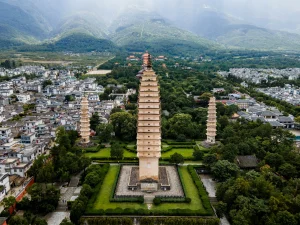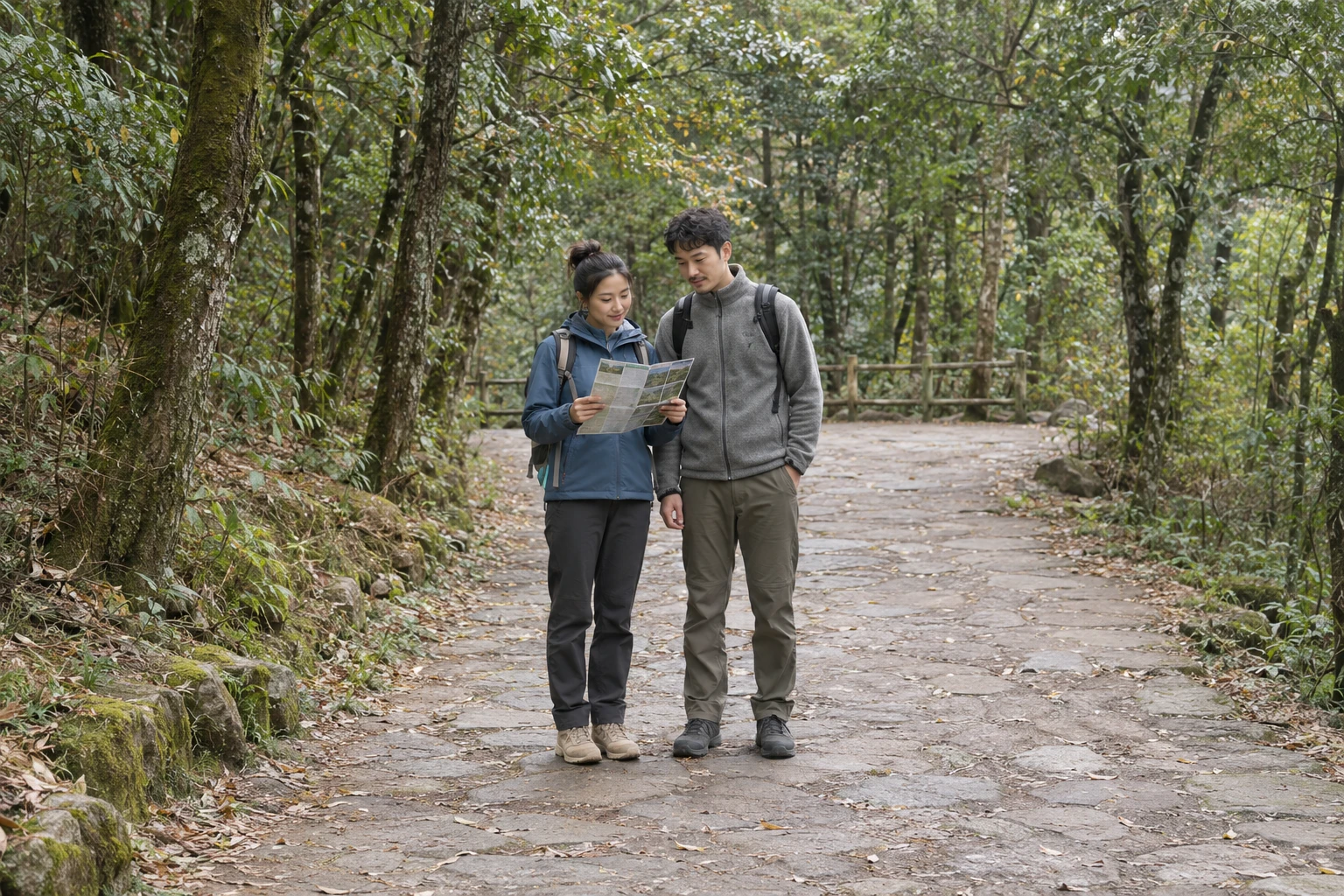
Choose an open Jade Belt section and a complete descent before setting a walking distance. A short Qingbi-side return can leave an easy Dali lunch; Qilongnüchi or the Zhonghe side needs a continuous confirmed path, operating exit and more time. This mountain-side visitor walk has access steps and variable conditions, rather than a summit objective.
The useful names are Yudai Yunyou Road / 玉带云游路, often called Jade Belt Road, and Qingbi Stream / 清碧溪, also written Qingbixi. They describe different parts of the visit. The walking road follows the mountain side; the Qingbi approach climbs to it. A photograph of a comparatively level section says little about the climb from the foothills or the stairs beside a stream.
The choice at a glance
| Walking interest | Suitable planning shape | Return that must be established |
|---|---|---|
| A short forest-and-stream outing | Operating Gantong access, selected Qingbi-side viewpoint and a modest open contour-road section. | Named turnaround and same operating descent. |
| More sustained mountain-side walking | Longer permitted road section, with Qilongnüchi only if its actual approach suits. | Full open connection, elapsed time and descent; no assumed high Ximatan extension. |
| A one-way traverse | Only a fully checked route between named access points. | Different lower-station pickup and the exact descent ticket and operation. |
Let the mountain be the main outing. Wooded slopes, openings across the Dali basin and a stream viewpoint reached by its permitted path give the day interest between named attractions. Clear Erhai views cannot be included in a ticket. A shorter walk may still provide the change of setting wanted.
Separate the walking road from the climb to it
The February 2026 route notice attributed to the Cangshan–Erhai National Nature Reserve administration distinguishes the Gantong ropeway, Qingbi ascent and Jade Belt walking road. It lists the latter from Qingbi Stream towards Taoxi Bridge. This gives the route names a useful official context; it does not mean every listed entrance or connecting section is operating on your date.
Count the approach, contour walk and descent separately. Walking up from Qingbi adds climbing before the main path. A ride removes some ascent but leaves station approaches, stream steps and the way down. Assess the full hotel-to-hotel effort rather than the central road’s length alone.
Do not turn the published endpoints into a compulsory full traverse. Nor should you use a track that continues into a closed forest or crosses a barrier. The notice explicitly directs visitors to open areas. Guided access, a guesthouse recommendation and a downloaded map do not independently authorise a closed section.
A short Qingbi-side walk: the flexible choice
For a manageable woodland outing, consider an operating Gantong ascent and a staff-confirmed short Qingbi-side route. Establish usable stream or gorge viewpoints, steps and turnaround. Keep to the managed path instead of entering the stream or scrambling to a pool.
After the first viewpoint, add a modest open contour-road section and return the same way. Agree its turnaround with the accompanying person. A known descent gives a tired walker a practical finish, while the outward distance still has to be retraced.
For a family, make one shared short section the default. A traveller waiting at a station needs an agreed meeting point and contact arrangement, not an assumption that someone will find a café. Ask about toilets and seating before leaving the staffed area. Station access and boarding also matter for anyone who dislikes heights or has difficulty with steps.
Use the ride or other authorised descent agreed that morning, then a seated Dali lunch. If the mountain takes longer, delay food and lighten the afternoon. Gantong Temple and Jizhao Nunnery are separate cultural visits; the ropeway ticket supplies no automatic admission, meal or activity there.
Longer walking: Qilongnüchi is a choice, not an automatic add-on
Qilongnüchi, the Seven Dragon Maidens’ Pools area, lies along the broader mountain-side visitor landscape. The Dali Tourism Group’s landscape introduction places it in the Heilong stream valley and distinguishes the Ximatan ropeway’s middle and upper areas. A pool-side descent or a set of stairs can make a visit more demanding than simply continuing along the contour road.
Before Qilongnüchi, distinguish a road viewpoint from a stepped pool circuit and establish the exact open return. Gantong, another confirmed exit and an operating ropeway section create different journeys. High Ximatan is a separate substantial outing, not a necessary end to this walk.
A route towards the Zhonghe side also needs an actual exit. Do not buy two unrelated tickets and assume that the whole connection is straightforward. Confirm the continuous open path, steps, expected elapsed walking for your party and the descent service’s final usable boarding arrangement. Your vehicle must meet the correct lower station. If that complete chain cannot be established, keep the shorter return walk.
Internet distances often mix different endpoints and access climbs. Use a map of the named section with rests and return included, not a compulsory kilometre target. A familiar turnaround can add more practical value than a distant attraction name.
What the 2026 Qingbi closure means for planning
There is a dated reason to check the approach specifically. A 10 May 2026 Dali report reproduces the operator’s 9 May notice announcing the Qingbi ascent’s reopening from 12 May after a temporary closure connected with wild-animal activity. It also repeats the direction to stay on established paths and respect barriers.
That historical reopening does not prove today’s full access, and the earlier closure does not mean the route remains closed indefinitely. Check the intended ascent, walking section and descent individually before leaving your hotel. If a closure affects the plan, choose an available managed alternative or a town day; do not improvise a forest bypass.
Wildlife is not an activity promised by this walk. Do not feed, pursue or gather around animals, and follow staff instructions if they are seen. Keep to the open route and observe the forest’s fire restrictions. The report is useful for understanding why access can change, rather than for predicting what visitors will encounter.
A complete Dali day, from breakfast to the hotel return
Before departure: eat breakfast, check the route’s operating position and save the exact lower-station name in Chinese. Leave suitcases at an agreed hotel storage point. Carry essential documents, water, a snack, weather layers and a charged phone in a small daypack. A light pack makes station stairs easier than taking everything intended for the next city.
At the entrance: settle admission and the exact ride sections before joining the queue. Ask where your selected path begins, what has changed and when you must return. If you have booked accompaniment, confirm that the guide will walk the section with you. A driver taking you to the base is a different arrangement.
Let the first section establish the actual pace. Turn at the nearer agreed landmark if progress or conditions call for it. Keep time for the retraced walk, station approach and descent queue; a comfortable outward leg is no reason to spend the return margin on another viewpoint.
After descent, meet at the named pickup and continue through lunch to the full Dali address. A short optional old-town stroll may fit afterwards. A lake circuit, Xizhou or onward train should not depend on an optimistic mountain finish.
Choose Dali nights that leave a usable walking day
| Length | Practical sequence | Useful limit |
|---|---|---|
| Three days, two nights | Arrival; one selected mountain day; departure. | One main full day, with no separate full-day weather swap. |
| Four days, three nights | Arrival; mountain or town day; village/lake day or weather swap; departure. | Two full days with one hotel base. |
| Five days, four nights | Arrival; three separate local days; departure. | Keep mountain, village and lake interests on different days; no need for daily hotel changes. |
Dali Old Town or an appropriate western-side property can be convenient for a stay including the mountain. Check the actual hotel address, road access and walk from the vehicle. An east-shore room may be a lovely place to spend time by Erhai, but it adds cross-basin travel to this western mountain day. Choose the room for your whole stay, using the Dali base and hotel-night guide.
If you are moving to Lijiang or Shaxi, give the onward transfer its own time. A day hike with a return to the same hotel is not automatically a luggage transfer to another town. Agree where bags remain during the walk, who collects them and the final room arrival. Keep an important train outside the uncertain mountain block.
Weather, surfaces and the limits of a lower mountain walk
The government-published Gantong technical and pricing proposal places its upper station in the Qingbi area at about 2,550 metres and describes weather-related interruption. The document is a proposal, so its historical or proposed fares and disruption remedies are not quoted here as today’s terms. Its practical lesson is that the ascent and descent can both be affected by mountain conditions.
Expect changes in temperature and visibility between town and the mountain. Wet stone, fallen leaves and steps can alter the pace even when the central path has little climbing. Use shoes with grip and carry a suitable outer layer. Ask for the actual surface and step information if using walking aids; neither a ropeway nor the word “contour” proves a step-free circuit.
If you are unsure how exertion or elevation fits your health, obtain individual advice before committing to the day. Do not use a lower station than Ximatan as a blanket assurance of suitability. Tell the planner what continuous walking and stairs you comfortably manage, and choose a route that can be shortened without losing the agreed return.
Keep a Dali town day as a weather alternative. You might move the mountain to another full day and use the first day for selected old-town lanes and a meal, conditions permitting. An indoor workshop requires a separate available booking. Ticket refunds, vehicle changes and extra guiding are governed by the actual written terms.
Passports, meals and the service boundary
| Part | What the written proposal should name |
|---|---|
| Admission and passport | Date, accepted document channel, required original and named ride sections. |
| Route and accompaniment | Open walking section, turnaround or exit, steps and guiding language. |
| Meal and water | Town lunch or a specific longer-walk arrangement; payment and dietary basis. |
| Vehicle and luggage | Hotel pickup, waiting, final drop-off, storage and bag responsibility. |
For foreign visitors, establish a legitimate ticket channel that accepts the actual passport type and matches the traveller’s name. Carry the original document required by that booking. An international travel website’s description of Cangshan is general visitor context; it does not prove every domestic app accepts an overseas passport or foreign phone number. This guide does not claim to have tested your purchase or today’s gate.
Plan food before walking. The sensible short outing can finish with lunch in town. A longer proposal needs a specific packed meal or a confirmed suitable stop, enough drinking water and time to eat. Do not rely on an old description of food stalls, temple meals or continuous shops. State allergies and dietary requirements separately; a vegetarian label alone does not settle all ingredients.
Price on request. Ask for the exact admission components, ascent and descent rides, hotel transfers, vehicle waiting, walking accompaniment and meal basis in the dated proposal. Hotel rooms, train tickets, insurance and an onward transfer need separate itemisation. None of those services is included merely because it appears in this planning article.
Questions before a Jade Belt walking day
Do we have to walk the whole Jade Belt Road?
No. Choose a permitted section with a named turnaround and a complete descent. A short return walk and a longer one-way traverse serve different interests and require different transport arrangements.
Can we walk up from Qingbi instead of taking the ropeway?
Only when that specific ascent is open and suits the party. It adds climbing before the mountain-side walk. Check the current route notice; a historical reopening or an old track is not today’s permission.
Does visiting Qilongnüchi include the high Ximatan area?
No. The pool-side walking, ropeway middle area and higher Ximatan visitor area are separate choices. Ask which exact path and ride sections your proposal covers rather than treating them as one stop.
Is there a suitable existing walking itinerary?
The existing Cangshan Jade Belt day itinerary offers a longer walking framework. Its published planning ranges are not this guide’s short-loop promise. Request the currently open section, actual distance, descent, language and full hotel return in writing. For the access comparison, use the three Cangshan cableway choices.
Plan a walking day that fits the rest of Dali
Send Verotrip your dates, hotel area, party size, comfortable walking time, stair and height concerns, luggage and onward journey. State whether you prefer the short Qingbi-side return or want a longer permitted mountain-side walk. Use Plan My Trip to request a dated proposal with the chosen access, meal and finish made clear.