Walk below Wulong’s Three Natural Bridges, where each limestone span appears overhead between open hollows. Allow a full day from central Chongqing, or a morning and lunch from a nearby base. Count the final walk to the return shuttle alongside the descent when deciding whether the route suits everyone.
Make 天生三桥, the Three Natural Bridges, the day’s main walk if time is limited. Tianlong’s courtyard, Qinglong’s opening and Heilong’s shade offer different stops on one route. Fairy Mountain, Furong Cave and Longshuixia need separate time and transfers despite sharing the broader Wulong setting.
What to look for under each bridge
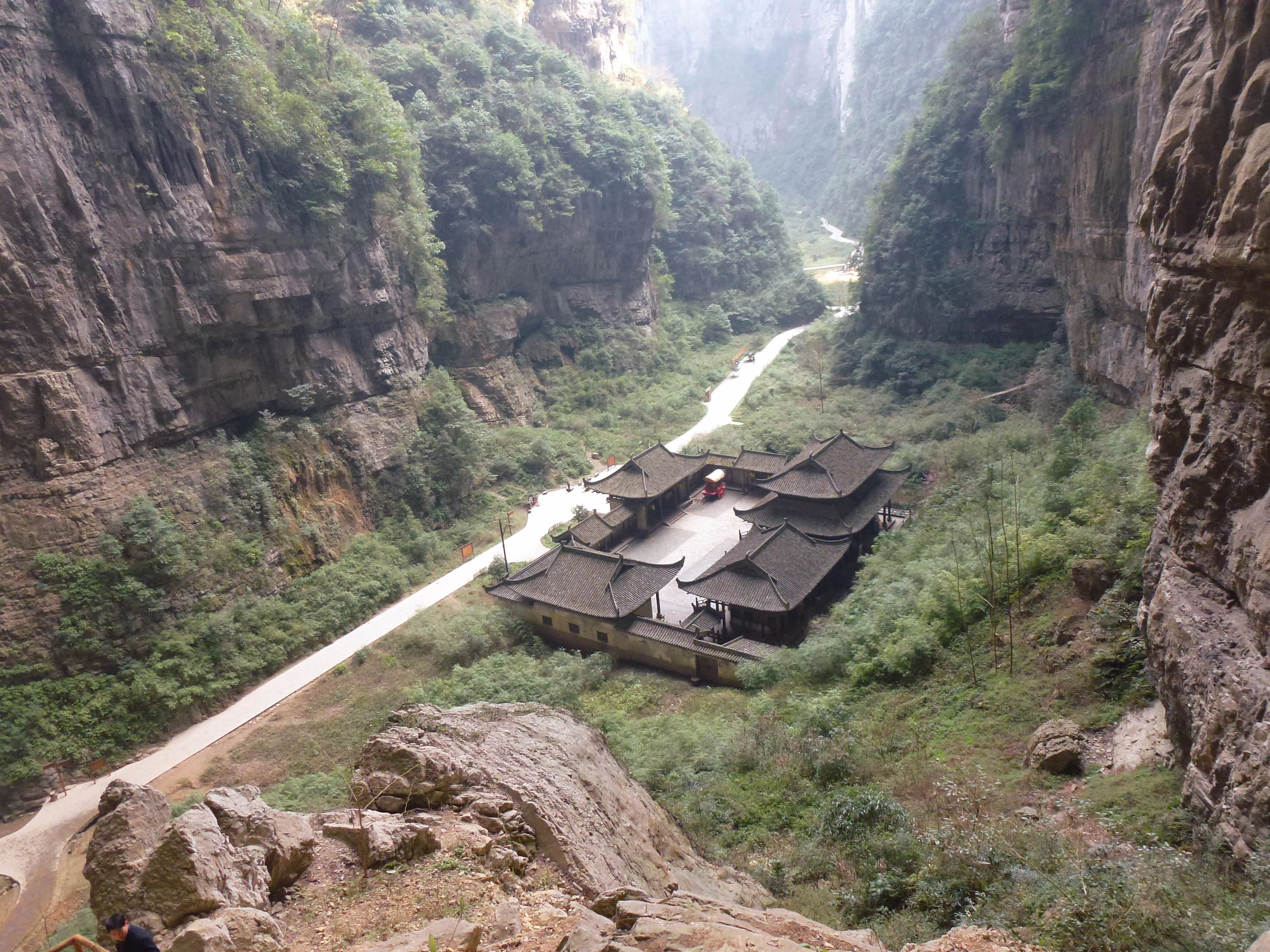
At Tianlong Bridge (天龙桥), watch the overhead rock gain depth as the path changes angle. Tianfu Post House’s small pitched roofs give scale to the cliff. For the broad courtyard view, use a permitted approach stopping point while you still have height, leaving the stairs clear.
On the gorge floor, the post house becomes tiled roofs and enclosed courts rather than a tiny landmark. Its rebuilt buildings evoke the official route and served in Curse of the Golden Flower. Keep the older route’s history distinct from the buildings’ age; the public path explains the setting even if interiors are restricted.
At Qinglong Bridge (青龙桥), follow the bright wall into the dark underside of the tall opening. Then find people below to restore its scale. The shape rewards looking without relying on a rainbow or reflection, both of which depend on the day’s water and light.
Under downstream Heilong Bridge (黑龙桥), let your eyes adjust to shade before tracing grooves and pockets in the rock. The hanging springs named in local descriptions vary with conditions. Keep enough time after this final arch for the signed exit and transfer point.
| Stop on the gorge walk | Where to direct your attention | A practical choice |
|---|---|---|
| Tianlong Bridge and Tianfu Post House | Compare the tiled roofs below with the mass of the cliff above. | Use a designated stopping area for the elevated view. Keep the stairs clear for people descending. |
| Qinglong Bridge | Look through the tall opening, then down to the scale of the path. | Choose a safe spot off the flow of walkers. Wet rock beside the path adds little to the view. |
| Heilong Bridge and the exit | Look for the shadowed passage and traces of water in the stone. | Check the remaining walk to the shuttle before deciding how long to linger. |
Wulong belongs to the South China Karst World Heritage property. A useful word on a map is tiankeng (天坑), a giant collapse depression. From the public route the distinction is visible. In a hollow the sky opens up and vegetation finds light. At a bridge the surviving span joins the rock on either side above you. Watching that change as you walk explains the landscape better than memorising three height figures. UNESCO describes the geological setting in its South China Karst entry.
From Chongqing to the gorge and back
For a road day, leave your main luggage at your Chongqing hotel and arrange the outbound and return legs together. Give the driver the name and address of your hotel, the name of the visitor centre serving the Three Natural Bridges and the place you will meet after the scenic shuttle brings you back. Save that meeting point on your phone before going down into the gorge. A pin at the post house marks a sight on foot and is of little use for a driver collecting you.
For rail, look at trains to Wulong South (武隆南站). The station is a transfer point. In July 2025, Chongqing Daily reported a tourist bus linking it with the Xiannüshan visitor centre. Look up the service for your travel date, including the last useful return. Allow time to reach the departing station in Chongqing, collect or validate your rail ticket if needed, and make the onward road transfer after arrival. Work backwards from the return train before you buy the outbound one. A fast railway journey can still make a long door-to-door day.
At the centre, show 天生三桥 when asking for the queue: Xiannüshan can name the centre, hotel area or separate attraction. Confirm the entrance, return drop and lift operation. A working descent lift covers only part of a journey that still includes stairs, walking and the exit connection.
A useful lunch plan depends on when you reach the centre. For an early start, have breakfast before departure, bring drinking water and something small to eat, then sit down for a proper lunch once back in the visitor-centre area. For a later arrival, eat before taking the inbound shuttle if the remaining admission and return times allow it. A bowl of noodles or a shared rice meal is easier to fit around a train than a long hot-pot lunch. A group with allergies or dietary requirements should arrange the meal and its ingredients in advance. The post house marks a sightseeing stop, so plan your meal elsewhere.
The last walk and the return vehicle
A sightseeing cart at the far end of the walking route and a transfer bus back towards the visitor centre serve different purposes. On 8 October 2026 the operator announced roadworks beginning the following day on the exit cart road. The notice directed visitors to walk roughly 800 metres to the transfer point during the works. It left the date for resuming cart service open. Ask at the centre which arrangement applies before you descend. The operator’s dated exit notice gives the Chinese wording to show staff.
Before descending, establish the final gradient, steps and surface to the pickup in use. A bus seat cannot help someone who cannot reach it. For different walking speeds, name one reunion point; for anyone needing an early exit, confirm a workable shorter option before the inbound shuttle.
| Day plan | How lunch and the return fit | Who it suits |
|---|---|---|
| Central Chongqing hotel and back by road | Eat around the gorge visit, take the return shuttle and meet the driver for the complete ride to the same hotel. | Travellers who want one main walk and a single city base. |
| Rail to Wulong South and back | Allow for the station-to-centre journey in both directions, lunch and the final transfer back to your Chongqing hotel. | People comfortable managing several connections with a small day bag. |
| Sleep near the visitor centre | Leave bags with the hotel by arrangement, walk the gorge, have lunch after the shuttle, then collect your bags. | Travellers who prefer to spend the morning walking and the afternoon travelling. |
For an afternoon of heavy rain, ask about trail and lift operations before setting out from Chongqing. Rock surfaces and steps can be slippery even after the rain eases. A light waterproof layer leaves your hands free on a handrail. If the walk is closed or the return connection too tight, move it to another day. For a city-based alternative, the Chongqing trip guide can help you choose a shorter city visit. Longshuixia is another gorge walk exposed to the weather.
Where to stay for the Three Natural Bridges
A central Chongqing hotel is convenient if Wulong is one excursion in a city holiday. The room, luggage and evening meal are waiting in the same place after a long return journey. On the night before the walk, check the time needed from your actual hotel to your departure station or road pickup. Choose a later city dinner and leave the following morning flexible if anyone in the party tires easily.
A hotel near the Xiannüshan visitor centre suits an early start at the gorge. Ask for the actual walking or driving distance from the hotel entrance to the correct boarding point. A property advertised as being on Fairy Mountain may involve a further transfer. Wulong town or a hotel chosen for a rail connection makes sense for a late arrival or early departure. It brings the station journey into one part of the day but leaves a road transfer to the scenic area in the other.
| Time for Chongqing and Wulong | Suggested nights | Where the bridges fit |
|---|---|---|
| 3 days / 2 nights | Both nights in central Chongqing. | Arrive on day one, use the full second day for the bridges and return to your hotel. Depart on day three. |
| 4 days / 3 nights | Two nights in Chongqing, then one near the visitor centre. | Give the city a complete day, move to Wulong on day three and walk on day four. Choose this only with adequate time for the onward journey. |
| 5 days / 4 nights | Two nights in Chongqing, one near the visitor centre and a final night back in Chongqing. | Travel to Wulong on day three, walk on day four and return after lunch. The final city night protects the departure on day five. |
Verotrip’s four-day Chongqing group itinerary uses another sensible arrangement. Its third day goes from Chongqing to the Three Natural Bridges and back for the final night, after a city sightseeing day. The five-day Chongqing and Wulong itinerary combines the bridges with Fairy Mountain on day two and continues to Chiyou Jiuli City and the Wujiang on day three. Read the daily sequence when choosing between them. Someone who wants extra time at Qinglong and an unhurried return may prefer the day devoted to the bridges.
Tickets, language and walking needs
International visitors have visited the Three Natural Bridges. Chongqing Daily interviewed an Irish traveller there in October 2026. For your own visit, check which current booking channel accepts your original passport, how your name must be entered, what to bring and whether you need to collect or validate a ticket before boarding. Check separate charges for entry, transfers and any optional viewing platform against your intended route. Dated notices and photographs cannot establish which facilities are operating on your day.
Price on request. Give your Verotrip travel consultant the travel date, hotel or rail station, group size and any limit on walking downhill or climbing steps at the end. Ask for the pickup, waiting time and final drop-off in writing, along with any English-speaking accompaniment, admission, transport inside the scenic area, lunch or overnight stay that you want included. A driver who meets you after the shuttle and a guide who walks through the gorge provide different services. Decide which matters to you before comparing prices.
Questions about Wulong Three Natural Bridges
Will I walk on top of the bridges?
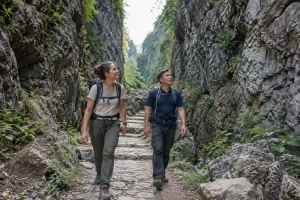
Plan for the marked visitor route down into the gorge and past the openings. The best way to understand the spans is to look up from below and compare them with the gaps of open sky between them. Ask staff which entrances and viewing points are available on the day.
Can I see the bridges and Fairy Mountain in one day?
They are two separate visits with a transfer between them. A combined itinerary exists, and it makes for a fuller day. If you are starting and ending in central Chongqing and the bridges are the reason for coming, keep them as the main visit. Allow for lunch, the full gorge exit and the return to the hotel before adding a second stop.
Is this the same place as Wulingshan Great Rift Valley?
Wulong (武隆) is the district for the Three Natural Bridges. Wulingshan Great Rift Valley (武陵山大裂谷) is a different attraction in Fuling. The similar English place names can make searches confusing. See the Fuling gorge guide if that is the destination shown on your reservation.
Is the gorge a good stop on the way to an evening flight?
A flight introduces a deadline after the walk, exit connection, road or rail journey, baggage collection and airport transfer. A final night in Chongqing keeps those connections off your flight day. If you must fly the same evening, check each leg and its fallback before committing to the gorge.
The cover shows Tianfu Post House on the floor of the Wulong gorge on 13 February 2015. Photograph by RoyalCathayan, resized for this page. The original and this version share the CC BY-SA 4.0 licence.