For a Luodai day from Chengdu, make the Hakka town itself the main visit. Walk a selected part of the old main street, compare guild-hall architecture, turn into a side lane and sit down for lunch or tea. An optional look at the modern Boke Building can round out the outing without turning the day into a circuit of distant attractions.
Luodai Ancient Town — 洛带古镇 — is in Chengdu’s Longquanyi District. Use the full Chinese name for the road destination and agree the actual visitor parking or drop-off point. The historic street, an individual hall and an attraction elsewhere in the district are different places to navigate to.
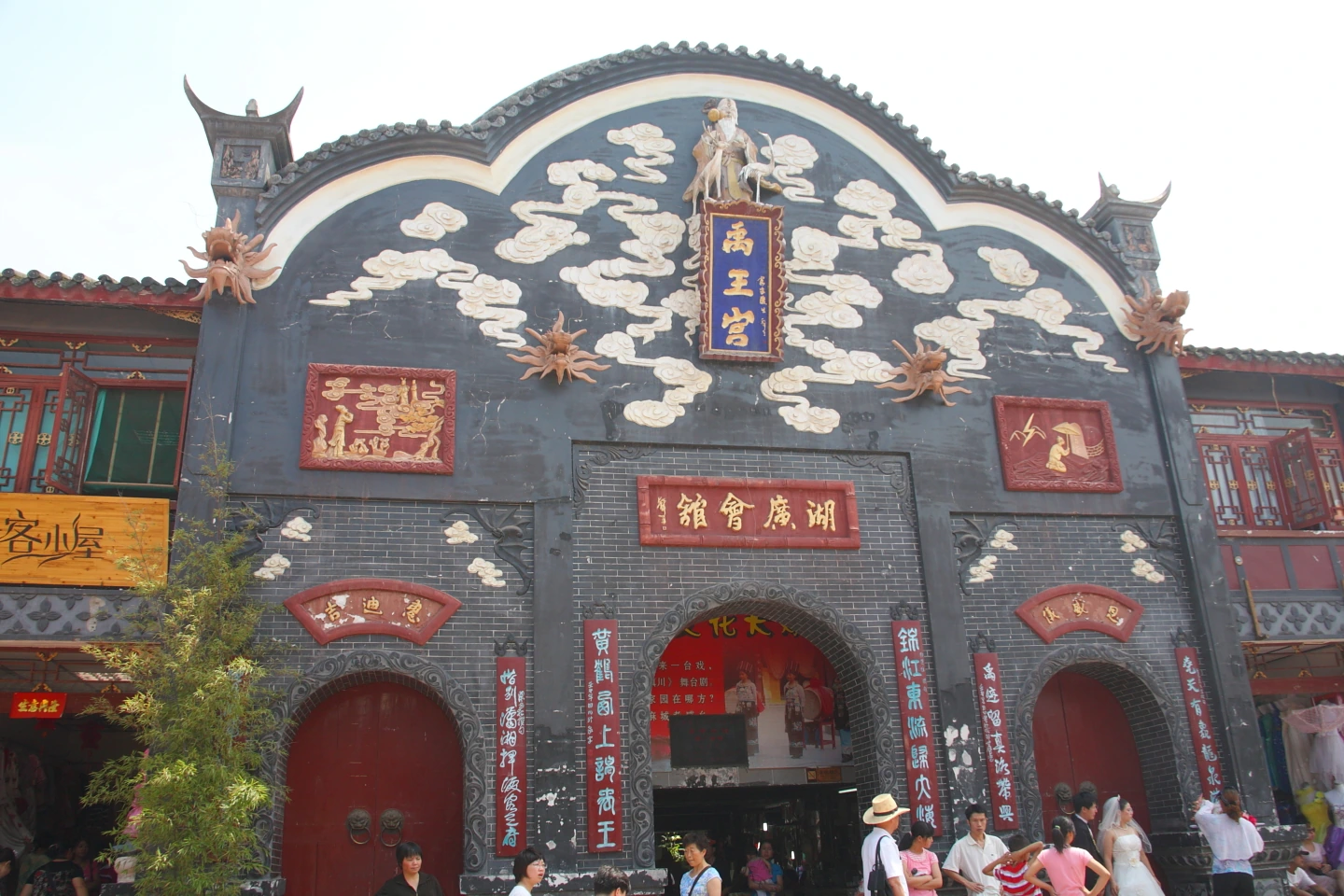
Checked 1 November 2026. Header: Huguang Guild Hall in Luodai, photographed by Einar Fredriksen on 30 June 2009, CC BY-SA 2.0. This archival photograph is not evidence of current opening arrangements or a Vero Trip customer visit.
Why choose Luodai?
Luodai offers a way to understand Hakka migration and community life in Sichuan through streets and buildings. The four regional guild halls—Guangdong, Jiangxi, Huguang and Chuanbei—give the visit a focus beyond souvenir browsing.
An original report by National Business Daily’s City Evolution team explains how Hakka communities arriving in Sichuan maintained links with their origins while adapting to local life. That is a useful theme for the day: look at the halls, then notice the shops, meals and everyday movement around them.
Expect an active visitor town. The streets also support food businesses, costume experiences and photography shops. A good visit can include those modern activities, provided you choose them deliberately rather than expecting every lane to look like an undisturbed historical scene.
A walk with a few clear choices
The Longquanyi Civil Affairs account of the town’s lanes describes the main street dividing into upper and lower sections around Jiangxi Lane. Use that junction as an orientation idea once you have checked the current visitor map, rather than trying to cover every lane from one end to the other.
Main street and Jiangxi Lane — 正街、江西巷
Begin by understanding the street pattern and the position of Jiangxi Guild Hall. Look at building fronts, the way lanes branch off and the change between wider gathering spaces and narrower passages. Save a recognisable junction as a reunion point before anyone starts browsing independently.
Jiangxi Lane’s name comes from its relationship to the hall. The civil-affairs account also connects the lane with the town’s older transport and trading life. That background makes a short lane walk more meaningful than simply finding a backdrop for a photograph.
Choose two guild halls, rather than rushing through four
Consider Guangdong Guild Hall — 广东会馆 — and either Jiangxi Guild Hall — 江西会馆 — or Huguang Guild Hall — 湖广会馆. Chuanbei Guild Hall — 川北会馆 — is another named option if it fits your route and interests. Compare gateways, rooflines, inscriptions and the spaces visible from admitted visitor areas.
Check each entrance notice before entering. An open street does not establish a hall’s interior opening time, admission charge or exhibition access. If an interior is unavailable, an architectural walk can still work; a traveller specifically interested in a particular exhibition should verify it before making the journey.
Beixiangzi or Chaishi Lane — 北巷子、柴市巷
Beixiangzi gives another view of the town’s changing businesses. The district account describes its food connections and newer small shops and craft businesses. It is a useful branch for browsing, a meal decision or a pause after looking at the halls.
Chaishi Lane’s name recalls an older timber-trading area. Read it as a historical connection, not a promise that a timber market is still operating there. Choose one of these lane branches if time or walking comfort is limited. There is little benefit in collecting all seven lane names while hurrying past the details.
Boke Building — 博客楼 — as an optional extension
The circular Boke Building draws on Hakka enclosed-building imagery. The City Evolution report describes it as a modern recreation inspired by that form. Appreciate the change in scale and shape, while keeping it distinct from the older street and guild-hall fabric.
Check the current walking approach and whether the part you want to see is admitting visitors. An exterior view and an indoor exhibition are different visits. This building should not be presented as an ancient surviving Fujian tulou or a visit to Fujian’s heritage sites.
| Visit style | What to prioritise | What to leave optional |
|---|---|---|
| Architecture and migration history | Main-street orientation, two selected guild halls and Jiangxi Lane | An additional hall or exhibition only if open and the group wants more. |
| Food and a slower town walk | A shorter street section, Beixiangzi browsing, seated lunch and tea | Costume photography or another lane after the meal. |
| Mixed interests or limited walking | One hall frontage, a manageable street section and a clear reunion point | Boke Building only after checking the added walk and current access. |
Self-drive, a driver or a public-transport connection?
Self-drive makes sense when your lawful driving and rental arrangements are already in place. The official traffic-police explanation of temporary driving permits says the permit is used with the foreign licence and its Chinese translation; a rental contract should also be carried when driving a rented vehicle.
That source explains the framework through Shanghai’s services. It does not establish where or how quickly a visitor can obtain documents in Chengdu. Confirm the applicable local procedure and the rental company’s acceptance before booking a car. A foreign licence alone should not be treated as permission to begin driving.
For a single town outing, compare that effort with a vehicle-and-driver arrangement. Set the hotel pickup, waiting allowance, town collection point and return destination in writing. A driver is not automatically an English-speaking guide, and a private vehicle does not establish access to a restricted lane.
Public transport can be another choice if you are comfortable checking the actual connection for your date. Resolve the last section from the relevant station or stop to Luodai and the return connection before leaving. Do not assume a metro station named for the wider district is at the old-town street.
The road approach: plan for the edge of the old streets
A district media notice carrying traffic-police guidance describes several outer approaches to Luodai, including routes using San’e Street — 三峨街 — and notes limited parking and narrow roads near the visitor area. Use that as orientation; follow current navigation, controls and signed parking on the actual day.
Choose the visitor entrance or parking pin before setting off from the hotel. A destination pin for a guild hall may lead toward a street that is unsuitable for vehicle access. Park in an authorised place or use a lawful drop-off, then begin the town walk.
Photograph the parking name and save the route back. If using a driver, agree whether collection is at the same point or a different permitted stop. A change of walking exit should be communicated before the driver starts the return approach.
Busy-day controls can change the arrival plan. An October 2026 on-site report documented capacity management and temporary entrance traffic controls during National Day. It does not establish a permanent November restriction, but it is a reason to keep the schedule flexible and avoid promising easy parking on a holiday.
A comfortable return-day rhythm
Keep one Chengdu hotel and use Luodai as the day’s main outing. A selective town visit with a meal can fill the useful part of the day without another large attraction. The sequence below is an editorial planning outline; it is not an operating timetable or a fixed journey duration.
| Part of the day | Suggested rhythm | Decision to make |
|---|---|---|
| After hotel breakfast | Travel to the agreed Luodai visitor parking or drop-off | Use current traffic information and keep the return plan clear. |
| First town walk | Main-street orientation, selected guild-hall frontages and Jiangxi Lane | Enter only currently admitted spaces; allow time for details. |
| Lunch and a seated pause | Choose a proper meal or selected tastings, then tea if wanted | Decide whether the group wants another lane or has seen enough. |
| Optional later visit | Beixiangzi browsing or Boke Building, according to the chosen walk | Check the added distance, access and the time needed to reach collection. |
| Return to Chengdu | Walk back to the vehicle or take the confirmed return connection | Collect hotel-stored bags separately if an onward transfer follows. |
Food, tea and modern visitor experiences
For a seated lunch, look for a menu that lets the party agree dishes and portions before ordering. Hakka stuffed tofu — 客家酿豆腐 — is one food associated with the town in the City Evolution report. Ask about its filling and preparation; tofu in a dish name does not mean the dish is vegetarian.
Shangxin liangfen — 伤心凉粉 — appears in the October visitor report. If you want to try it, ask about chilli, ingredients and portion size rather than assuming the English description explains the whole dish. For allergies or dietary restrictions, communicate the requirement before ordering and choose another option if the provider cannot give a clear answer.
A tea stop is a useful rest between walking sections. Confirm whether the charge is per person, per cup or per pot, and whether seating time or refills change the total. The amount one visitor paid in a past report is not a current town-wide price.
Flower hair arrangements, costume rental and photography are established parts of the modern visitor economy described in the reporting. If interested, ask for a written or clearly displayed scope: makeup, clothing, rental duration, photography, edited files, extra images and any deposit. Keep enough time to change back and return the clothing before vehicle collection.
These are optional commercial experiences. A photograph of a performance or a holiday programme does not confirm a daily show. If a particular activity is the reason for travelling, verify its date and provider separately rather than counting on finding it by chance.
Walking comfort, weather and luggage
Allow for stone paving, thresholds and changes in level around individual buildings. Wear comfortable shoes with grip and shorten the walk if surfaces are wet. For a wheelchair or stroller, confirm the actual route and each desired entrance; a public street does not make every historical interior step-free.
Give children or a slower walker a short first section and a seated break before extending the outing. Keep the reunion point simple when the party splits between shops or food stops. A fixed collection time is easier to meet when everyone knows the route back.
In light rain, reduce outdoor browsing and use an available indoor meal or tea break. During a severe-weather warning or local instruction affecting the visit, change or cancel the outing. Do not make an unverified hillside or distant attraction the automatic alternative.
Leave large cases at the Chengdu hotel under an agreed storage arrangement where possible. If checking out first, confirm whether bags remain at the hotel or travel in the vehicle, and how retrieval fits the return. Passenger space and luggage capacity both matter.
Budget and service boundaries
| Cost or service | What to compare | What should be clear |
|---|---|---|
| Road travel | The complete hotel-to-town-and-back arrangement | Pickup, vehicle, waiting, tolls, parking, return destination and overtime. |
| Halls and activities | The specific interior, exhibition, guide or optional experience wanted | Current access, any admission or reservation and what has actually been booked. |
| Meals, tea and shopping | Menu prices, portion basis and optional purchases | What is self-paid, any agreed allowance and the price before accepting a service. |
| Changes and onward travel | Weather alternatives, cancellation and any extra station or airport journey | Written terms, bag retrieval and any insurance actually arranged. |
Price on request. Tell Vero Trip your dates, Chengdu hotel, party size, walking pace and whether you want lawful self-drive planning or a vehicle-with-driver enquiry. Specify any hall or activity that matters particularly. The dated written proposal should identify the actual services, price and exclusions.
This guide does not confirm an available vehicle, English guide, admission, meal, costume experience, hotel or insurance package. If the day ends at a station or airport, provide the exact location and departure details. Chengdu East, Shuangliu Airport and Tianfu Airport require different return plans; move Luodai to another day if the onward connection leaves little margin.
Use the Chengdu planning guide to place this outing within a longer city stay. If comparing towns, the Huanglongxi road-day guide describes a separate destination with a different street-and-river focus. Choose the place that matches your interests rather than trying to give both full visits on the same short day.
Questions before choosing Luodai
Can ordinary international tourists visit?
The City Evolution report describes international tourists visiting Luodai. Plan a normal public-town visit and follow current local instructions. Check any individual hall or booked activity separately; the report does not establish an immigration entitlement or a universal passport-booking procedure for every venue.
Does the town need an overnight stay?
The plan here returns to the same Chengdu hotel. An overnight stay is a separate choice for someone who specifically wants more town time. Confirm the named property, room, document check-in and vehicle access before choosing it.
Is Boke Building an ancient Fujian tulou?
No. It is a modern building inspired by the enclosed Hakka building form. Keep that distinction when comparing it with the older town and guild halls. It is not a visit to a Fujian destination.
Should I add a hill or wall-climbing attraction?
This itinerary is a town day. A separate attraction adds its own admission, walking load, road approach and return allowance. Assess it independently rather than assuming it is part of the old-street visit or suitable for everyone in the group.
What should I send when enquiring?
Use Plan My Trip with your date, hotel, group, walking limits and return requirements. Say whether guild-hall architecture, Hakka food or a separately arranged costume or photography experience is your priority.
Header credit: Einar Fredriksen, Huguang Guild Hall, Luodai, photographed 30 June 2009. CC BY-SA 2.0. Converted to WebP at the original 1,440 × 960 pixels, without enlargement or alteration of the scene; responsive displays may crop the view. The WebP version is offered under the same licence. Archival scene, not current opening or a Vero Trip tour record.